.svg)
SIGN UP FOR JUICEBOX (IT’S FREE!)

Who are you looking for?
Thank you! Your submission has been received!
Oops! Something went wrong while submitting the form.

.png)
Workday Recruiting is the talent acquisition module within Workday's broader HCM suite, used predominantly by enterprise organizations.
The platform's network of integrations is a direct outcome of this enterprise focus, featuring sourcing tools designed for international recruitment, specialized services for background checks and assessments that meet large-scale compliance standards, and integrated HCM components that streamline the transition from applicant to employee.
This guide covers the strongest Workday Recruiting integrations across those categories and the contexts in which each fits.
Integrations turn Workday Recruiting from one module of the HCM suite into the connective layer between top-of-funnel sourcing and the broader employee lifecycle. Sourcing tools widen the candidate pool beyond what's already in Workday, assessment platforms add structured signal to the evaluation, signature tools handle post-offer paperwork, and adjacent HCM modules carry new hires from Recruiting into Onboarding, Learning, and beyond. Each integration extends Workday rather than replacing what's already in place.
The operational benefit at enterprise scale is significant because the cost of fragmented data can lead to costly errors and omissions. Recruiters and HR partners stop manually rekeying information across systems, the audit trail captures the full hiring lifecycle, and reporting reflects every stage of the funnel from initial sourcing through hire. Without integrations, enterprise Workday environments tend to develop parallel records and shadow systems that consume operational time and create compliance gaps.
Workday integrations operate under different constraints than mid-market ATS integrations. Implementations are typically led by an internal IT or HRIS team rather than a recruiter selecting tools individually. Three criteria matter for Workday in particular:
Studio-level configurability: Off-the-shelf connectors that assume a fixed Workday data model rarely fit cleanly. The best integrations expose configuration options for fields, workflows, and event triggers, so the connection can match the specific Workday tenant rather than the generic version.
Audit trail and compliance fit: Workday environments support enterprise audit requirements for SOX, GDPR, EEO, and industry-specific regulations. Integrations that participate in that audit framework, by logging actions, surfacing field changes, and supporting data residency, are operationally compatible. Integrations that bypass it create compliance gaps that surface later.
Multi-region and multi-tenant capability: Workday customers often run global hiring across different legal entities, tax jurisdictions, and data residency requirements. Integrations that support multi-region operations natively reduce the configuration overhead of running separate connections for each region.
Workday Recruiting's sourcing capabilities cover candidate database search, internal mobility, and basic CRM functionality through the Talent Pools feature. For enterprise teams running active outbound sourcing or hiring at the volume Workday environments typically handle, dedicated sourcing tools extend that foundation significantly.
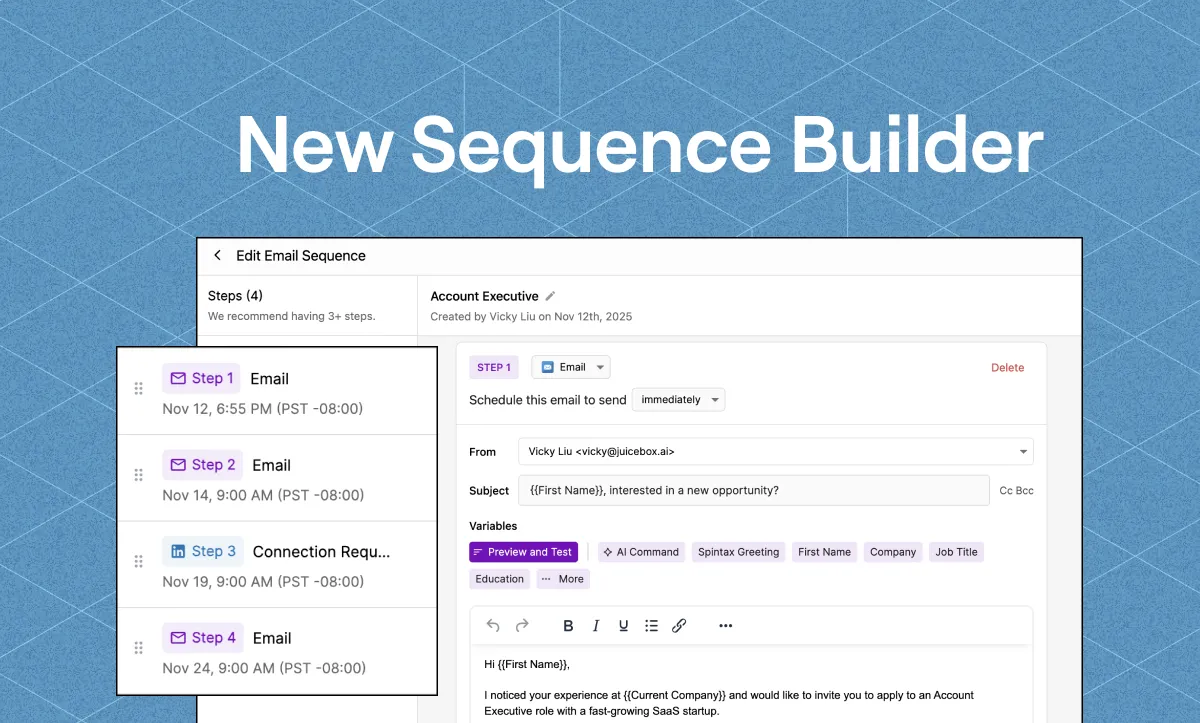
Juicebox is an AI-native sourcing platform that supports the kind of multi-region, high-volume sourcing characteristic of enterprise Workday Recruiting environments. Here's how it works:
The Workday integration handles the workflow between sourcing and the structured candidate management Workday environments require. Candidates engaged through Juicebox flow into Workday Recruiting as prospects or applicants, with profile information, outreach history, and engagement status syncing into Workday's data model. For enterprise teams, this preserves source attribution and engagement history in a way that supports the reporting and audit requirements that come with operating at scale.
How it fits enterprise environments
Juicebox's fit with Workday depends on a few specific capabilities:
Juicebox Agents
In addition to its core sourcing capabilities, Juicebox Agents add an autonomous sourcing layer that runs continuously. Here's what they do:
Eightfold is a talent intelligence platform with a Workday integration focused on internal mobility and candidate matching across large existing databases. Where most sourcing tools focus on external candidate discovery, Eightfold's relevance in Workday environments is its work on the candidate data already inside Workday: identifying internal candidates for open roles, surfacing past applicants who match new requirements, and adding skill-based matching to the existing pipeline.
For enterprise teams with mature talent acquisition organizations and large internal databases, Eightfold complements external sourcing tools rather than replacing them. The integration is most valuable to organizations actively investing in internal mobility programs.
Assessment integrations bring structured candidate signals into Workday Recruiting alongside interview feedback and scorecards. At enterprise scale, the consistency and audit trail produced by integrated assessments often weigh as heavily in the integration decision as the hiring outcomes themselves.
HackerRank's Workday integration sends coding assessments from candidate records and writes scores, completion data, and code submissions back to the candidate record. Assessment results are visible alongside structured interview feedback within Workday, supporting the consistency and audit requirements typical of enterprise engineering hiring.
HireVue is an assessment and video interviewing platform with strong adoption in high-volume enterprise hiring, particularly in early-career, retail operations, and customer-facing roles. The Workday integration triggers structured assessments and video interviews from candidate records and returns standardized scoring back to Workday. For enterprise teams running high-volume hiring at scale, the combination of structured workflows and audit trails typically outweighs more flexible alternatives during the selection process.
Background checks are a post-offer compliance requirement, and enterprise environments add layers of complexity that mid-market organizations rarely face. Choosing a background check provider in this environment means weighing multiple jurisdictions, industry-specific compliance frameworks, and data residency requirements at the same time.
HireRight is one of the most widely used background check providers among Workday customers. Its integration triggers checks from Workday candidate records once an offer is extended, with status updates and completed results syncing back to Workday for compliance documentation. HireRight's coverage depth in regulated industries and presence across global markets tends to be the deciding factor for enterprise customers choosing it over more US-centric alternatives.
Sterling provides similar functionality with comparable global coverage and depth in regulated industries. The choice between Sterling and HireRight typically comes down to existing vendor relationships, specific country coverage requirements, and price negotiations rather than capability differences.
The post-offer paperwork stage involves offer letters, employment agreements, and onboarding documents that must be generated, signed, and filed in the employee record. Integration here connects Workday Recruiting to the document layer cleanly.
DocuSign's Workday integration generates offer letters and agreements from Workday data, routes them for signature, and writes signed documents back to the candidate record (and subsequently to the employee record after hire). For enterprise environments, the audit trail DocuSign provides is often a compliance requirement rather than a convenience.
Adobe Sign provides comparable functionality for organizations already using Adobe's broader document suite. The capability set is comparable to DocuSign's, and the choice between them generally tracks with broader tooling standards already adopted across the organization.
Workday Recruiting is one module within a broader HCM suite. Some of the most valuable integration relationships are with adjacent Workday modules and complementary HCM platforms that extend the talent lifecycle past hiring.
Workday Onboarding is the native handoff partner for Workday Recruiting. New hire data flows automatically from Recruiting into Onboarding once a candidate is moved to the hired stage, triggering paperwork, equipment provisioning, and orientation workflows. For Workday-using enterprises, the native handoff is typically the configuration of choice over third-party onboarding platforms.
LinkedIn Learning's Workday integration is less directly tied to Recruiting and more relevant to the broader talent lifecycle. New hires can be enrolled in role-specific learning paths automatically based on their Workday role assignment, and learning completion data flows back to Workday for skills tracking. For enterprise teams thinking about hiring as part of a longer talent development arc, this integration extends Workday's value past the immediate point of hire.
Workday Recruiting handles enterprise pipeline management and audit-grade record-keeping well, but its native sourcing assumes candidates are already in the system. Juicebox brings multi-region, multi-source candidate discovery into the workflow with sync that preserves the source attribution and engagement history enterprise reporting depends on.
Start with Juicebox for free, or review self-serve paid plans on the pricing page.
Run your first search for free. Find and engage top talent across 800M+ profiles. Trusted by 5,000+ customers.

.png)
.png)