.svg)
SIGN UP FOR JUICEBOX (IT’S FREE!)

Who are you looking for?
Thank you! Your submission has been received!
Oops! Something went wrong while submitting the form.

Recruiting today often feels like shouting into the void and hoping the right person hears you.
This guide shows you how to stop guessing and start making smart, data-backed hiring moves that put you miles ahead of the competition.
You'll learn what talent intelligence software is, see how AI-powered platforms like PeopleGPT use it to find the best people, and walk through the exact plays elite teams run to build their winning rosters.
Let's break it down:
If your game plan is still just waiting for applications to roll in or dusting off old spreadsheets, you're already behind. The market is just too quick for that now. The absolute best candidates? They're usually passive—happily employed and not scrolling through job boards. This old, reactive way of hiring forces teams into a corner, constantly scrambling to fill roles and often having to settle for "good enough" instead of the perfect fit.
This is exactly where talent intelligence software flips the script. It’s the difference between playing defense and offense.
Instead of just managing a chaotic inbox of applicants, these platforms give you a live, bird's-eye view of the entire talent market. Think of it like Google Maps for recruiting. It empowers you to make sharp decisions based on what's happening right now, not on a gut feeling.
By looking past simple keyword matches, you start to see the bigger picture—where the talent is, where it's going, and who's ready for a new challenge. It’s the foundation for building a truly winning talent strategy, letting you build pipelines of amazing people before you even have a job opening.
Think of your Applicant Tracking System (ATS) as a digital filing cabinet. It’s a great way to keep track of the résumés that come across your desk, but it’s fundamentally passive. It only shows you who has already applied.
Talent intelligence software, on the other hand, is your team's live, dynamic GPS for the entire global talent market. It’s proactive, not reactive.
Instead of just waiting for candidates to find you, this software actively maps out the professional world. It scans competitor org charts, university alumni networks, professional social profiles, and industry news to give you a real-time, strategic view of the talent landscape.
This isn’t just about collecting names; it’s about understanding the story behind them. It helps you answer the big-picture questions that traditional recruiting simply can't:
Let's dig a little deeper. At its core, talent intelligence software aggregates enormous amounts of public and proprietary data, then cleans it, enriches it, and turns it into something you can actually use. An ATS holds static information—a snapshot submitted by a candidate at a single point in time. Talent intelligence platforms create living, breathing profiles that evolve as a person’s career does.
This shift from a reactive to a proactive model is completely changing the recruiting game. We're seeing this play out in the market's explosive growth. The global talent intelligence software market was valued at USD 10.05 billion in 2024 and is projected to skyrocket to USD 34.85 billion by 2035.
This isn’t just a fad. It signals a fundamental change: winning teams are no longer just managing applicants. They are actively mapping and engaging with the entire talent ecosystem to build pipelines before a role even opens up.
To make this distinction clearer, let's look at how these two types of tools stack up side-by-side.
| Attribute | Traditional Recruiting Tools (e.g., ATS) | Talent Intelligence Software |
|---|---|---|
| Focus | Managing inbound applicants and workflow. | Mapping the entire external talent market. |
| Data Type | Reactive and Static. Data comes from candidates who apply directly. | Proactive and Dynamic. Aggregates real-time data from millions of public sources. |
| Data Sources | Candidate résumés, application forms, internal notes. | Social profiles, company websites, news articles, professional networks, academic papers. |
| Key Function | Organize, track, and manage active candidates through the hiring process. | Identify, analyze, and engage with passive talent before they apply. |
| Outcome | A filled role from a pool of active job seekers. | A strategic talent pipeline, market insights, and competitive intelligence. |
The table really highlights the core difference: an ATS helps you manage the people who knock on your door, while talent intelligence software gives you a map to find the best people anywhere in the world and invite them in.
Still trying to wrap your head around it? Imagine you need to buy a specific, rare type of car.
That’s the power you unlock when you move from a closed, inbound system to an expansive, outbound one. By leveraging comprehensive talent insights, you can pinpoint the exact candidates you need, understand their career journey, and engage them with the right message at the perfect time.
Talent intelligence software offers a massive strategic edge, but its real magic is in the specific, actionable features that completely change the day-to-day grind of recruiting. These aren't just fancy upgrades to old tools; they're entirely new capabilities that drive efficiency and much smarter decision-making.
When these features work together, they turn a sea of raw market data into a clear hiring advantage.
This infographic breaks down how these platforms convert that vast data into strategies you can actually use.
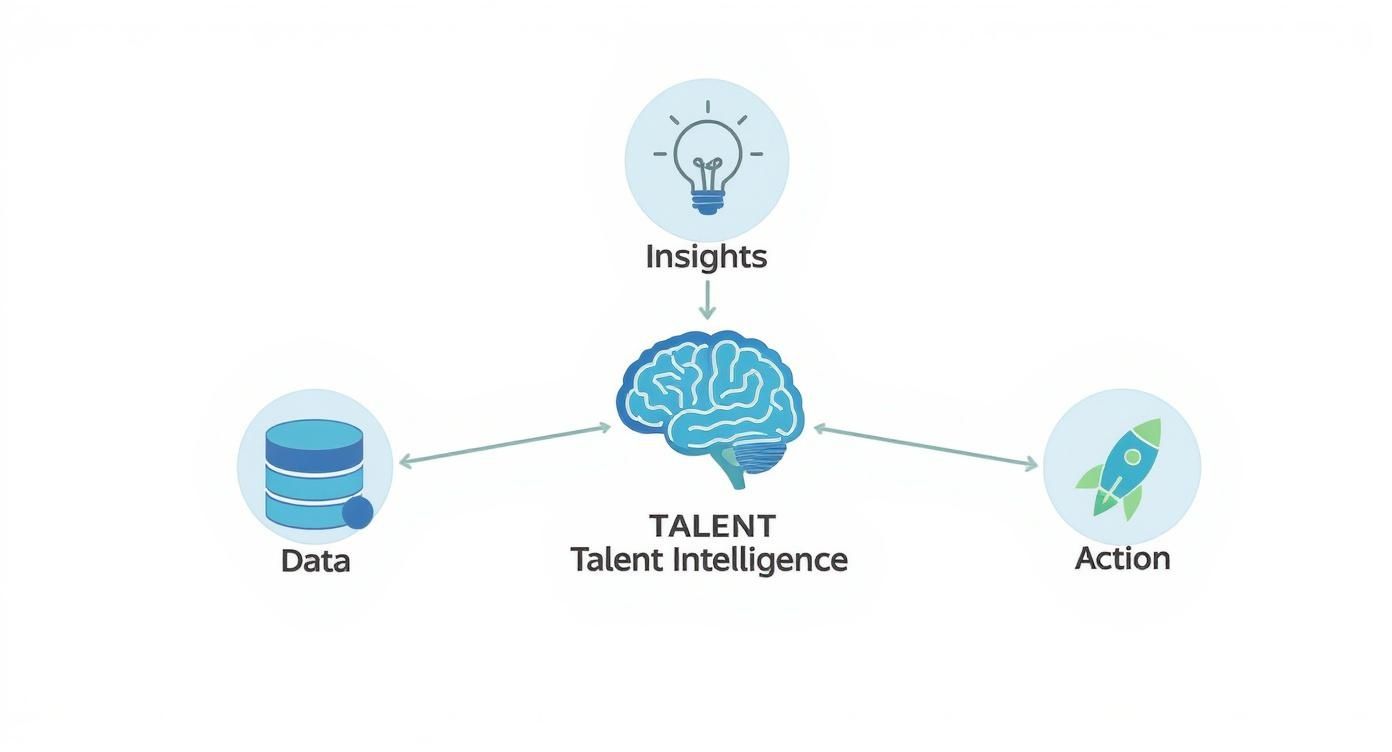
As you can see, there's a clear flow from gathering data to analyzing it for insights, and finally, to taking decisive action. It creates a continuous loop of getting better and smarter.
The absolute cornerstone of any talent intelligence platform is its ability to proactively find people. Your Applicant Tracking System (ATS) can only search the résumés you already have. AI-powered sourcing, on the other hand, scans the entire public web—professional networks, company sites, academic papers, you name it—to build a complete picture of the talent market.
Instead of just matching keywords, these systems use a dynamic skills graph. This lets the AI understand context. It knows a "growth hacker" likely has skills in "SEO," "content marketing," and "data analytics," even if those exact words aren't on their profile. The result? You get higher-quality matches that a human sourcer might easily overlook.
Imagine a recruiter needs to find a senior software engineer in a new city. The old way would take days of manual searching. With an AI sourcing tool, they can pull together a qualified shortlist of the best candidates in minutes, complete with contact info and signals on who might be ready for a move.
Think of this feature as giving you a live, bird's-eye view of your competition. It's like having an X-ray of their org charts. Talent intelligence software lets you map out entire teams at rival companies, pinpoint key players, and discover untapped talent pools.
Market mapping isn't just about poaching talent. It's about understanding workforce trends, identifying skill hotspots, and making informed decisions about where to invest your recruiting resources. It answers strategic questions before you even post a job.
You can analyze talent density by location, track hiring and layoff trends at key competitors, and even benchmark your own company's compensation and diversity against the industry standard. This is the kind of intel that's gold for workforce planning and staying one step ahead.
This is where things get really futuristic. Predictive talent modeling uses machine learning to analyze career paths and behavioral data, forecasting which passive candidates are most likely to be open to a new job.
The AI looks for signals like:
By piecing these signals together, the software scores candidates on their "readiness" to make a move. This lets your team focus its outreach on the warmest leads, which dramatically boosts response rates and shrinks the time-to-hire. These platforms build out richer talent profiles than a static résumé ever could, giving you a complete view of a candidate's journey.
To truly appreciate what these systems can do, it’s worth exploring the specific features they offer. Each piece, from sourcing to analytics, is essential for building a modern, proactive recruiting machine.
While speed is a great perk, the real power of talent intelligence software is its ability to shape long-term, strategic wins for your business. Just filling seats faster doesn't mean you're winning. The goal is to make smarter, more informed decisions that build a stronger company from the ground up.
This is where the platform's data-driven core really comes to life. It flips the script from "How fast can we hire?" to "How do we hire the best person who will actually thrive here and help us succeed?"
Every hiring manager’s worst nightmare is a mis-hire. It's expensive, disruptive, and a total morale killer. Talent intelligence software acts as a powerful buffer against this by zeroing in on quality of hire—a metric that’s directly tied to long-term business performance.
Instead of just going with gut feelings or scanning keyword-stuffed resumes, these platforms use data to build a complete picture of a candidate. They can pinpoint people who not only have the hard skills but also show strong signals of cultural alignment, like previous experience in similar company environments or a genuine interest in your industry.
By matching on a deeper level—beyond what’s on the job description—you can slash turnover rates. When you bring on people who are a true fit for the role and the company, they're far more likely to stick around, stay engaged, and be productive.
The result? A more stable, experienced team and a much healthier return on your recruiting investment.
Unconscious bias is one of the toughest nuts to crack in recruiting. It creeps into decisions, leading to homogenous teams that stifle innovation and new ideas. Talent intelligence software offers a practical solution by anchoring the entire hiring process in objective data.
By focusing on verified skills, experience, and potential, the software dials down the influence of subjective things like a candidate's name, age, or where they went to school. It helps you discover qualified people from a much wider, more diverse talent pool, breaking recruiters out of their usual sourcing habits.
This data-first approach helps you build a pipeline that reflects the real world, not just a tiny corner of it. It lets you:
Ultimately, this builds a fairer hiring process and a stronger, more diverse team.
In this market, your people are your biggest competitive edge. Knowing what your competitors are doing on the talent front is just as vital as knowing their product strategy. Think of talent intelligence software as your secret weapon for competitive analysis.
It lets you map out competitor org charts, spot their top performers, and analyze their hiring patterns. Are they beefing up their engineering team? Moving into a new market? This is gold for proactive workforce planning. For instance, if you have solid compensation intelligence on a rival, you can put together much more compelling offers.
This intel is also key for retention. When you know who your competitors are trying to poach, you can identify your own key players who might be at risk and take steps to keep them happy. The move to cloud-based tools has made this easier than ever. In fact, a recent trend shows that 60% to 75% of new implementations are cloud-based, as big companies need scalable ways to manage talent data. (You can dig into these talent intelligence market findings on Business Research Insights.) This puts a serious competitive advantage within reach.
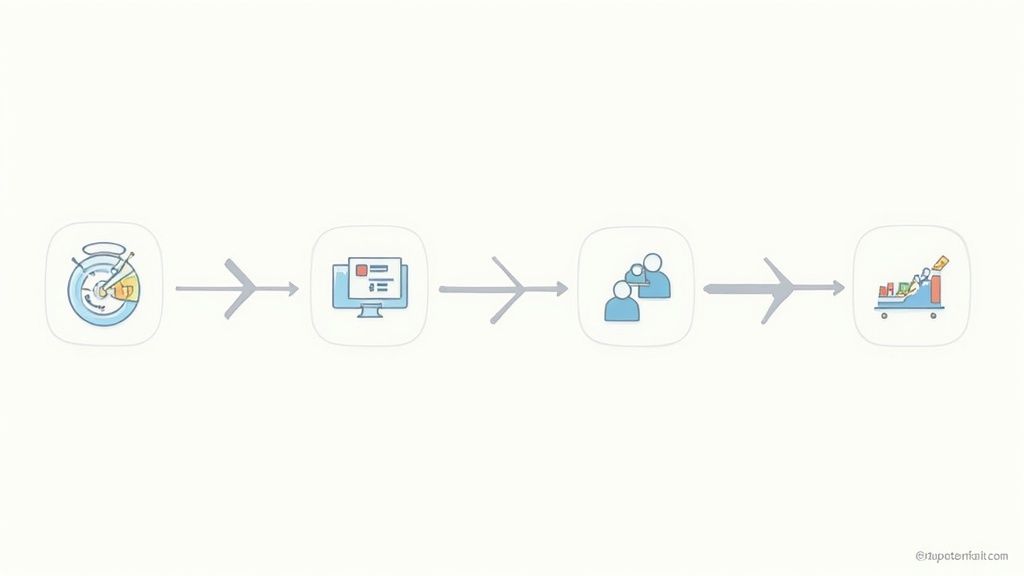
Bringing a new piece of tech into your workflow can feel like a massive project, but a smart, phased approach breaks it down into bite-sized pieces. Integrating a talent intelligence platform isn't about flipping a switch and hoping for the best. It’s about carefully weaving it into your team's day-to-day to supercharge what they're already doing, not get in their way.
A solid rollout plan moves from big-picture strategy to on-the-ground execution, making sure the software becomes a core part of your recruiting engine.
Before you even glance at a demo, you have to define what "winning" looks like. Why are you even considering this tool? Without a clear "why," you'll never be able to prove it was worth the investment.
Your goals need to be specific and, more importantly, measurable. "Hire better" is a nice thought, but it’s not a target. Instead, aim for concrete outcomes.
These Key Performance Indicators (KPIs) are your North Star. They'll guide every decision you make during implementation and give you the cold, hard data needed to show leadership a clear return on investment.
A talent intelligence platform should be your central command center, not just another island of data. The whole point is to create a single source of truth for all things talent. That means making it play nice with the tools you already use is non-negotiable.
The most critical link is with your Applicant Tracking System (ATS). By syncing the two, you breathe new life into the static résumés collecting dust in your ATS, enriching them with dynamic, real-time data. Suddenly, your old candidate database transforms into a goldmine you can proactively search.
Implementation is not just a technical setup; it’s a strategic alignment. Your new platform should complement and amplify the tools you already use, creating a unified ecosystem that eliminates friction and duplicate work for your team.
Look beyond the ATS, too. Integrating with your HRIS or CRM ensures data flows seamlessly across the entire employee journey, from first contact to first-year review.
The shiniest, most powerful software on the planet is completely useless if your team doesn’t know how—or why—to use it. Adoption is the stage where implementations live or die. Your job is to get recruiters genuinely excited about what this new tool lets them do.
Frame it as a way to kill their most boring, repetitive tasks so they can spend more time doing what they actually love: building relationships and closing top candidates. This is a central idea in understanding how to use AI in recruitment; the goal is to augment human skill, not just automate work.
A practical, role-specific training plan is key:
Your work isn't done just because the software is live. Implementation is an ongoing cycle of measuring, learning, and tweaking your approach. Now's the time to circle back to those KPIs you set at the very beginning.
Build dashboards to keep a close eye on your progress. Is time-to-fill actually going down? Is the quality of your hires—measured by things like first-year performance reviews—getting better? Are your offer acceptance rates climbing?
Use this data to double down on what’s working and fix what isn’t. You might discover that certain search filters consistently deliver better candidates, or that one outreach template gets a ridiculously high response rate. Constant iteration is what turns a good implementation into a great one, ensuring your talent intelligence software delivers more and more value over time.
Not all talent intelligence platforms are created equal. With the market blowing up, it seems like every vendor is slapping an "AI" label on a tool with a basic search bar. To cut through the noise, you need a solid game plan for figuring out what actually works.
Making the right choice isn't just about ticking off a feature list. It's about finding a partner that fits your team's workflow, your company's growth plans, and the tech you already use. If you rush this, you could end up with a pricey piece of software that nobody uses, creating more headaches than it solves.
A talent intelligence platform is only as good as its data. Full stop. If the information is stale, wrong, or just plain thin, even the most sophisticated AI on the planet will be useless. This is the single most important thing to get right.
Think of it this way: a world-class chef can't make a Michelin-star meal with wilted lettuce and expired ingredients. Your software is no different. The platform's talent pool is its pantry, and you need to be sure it’s stocked with fresh, high-quality information.
When you're getting a demo, don't be afraid to push the vendor on the details:
"AI-powered" has become the biggest buzzword in HR tech. Your job is to pop the hood and understand how the AI actually works. A "black box" algorithm that you can't understand or control is a massive liability.
You need AI that is both powerful and transparent. This means the platform should be able to show you its work—explaining why it recommended a certain candidate. Look for features that highlight the evidence behind a match, linking a person's skills and experience directly to your job requirements.
The best talent intelligence software doesn't just give you answers; it shows you how it got there. This transparency builds trust and lets your recruiters make confident, data-backed decisions instead of just blindly following what an algorithm says.
This is especially critical for keeping your hiring process fair and unbiased. If the AI can’t explain its reasoning, how can you be sure it isn’t accidentally reinforcing old biases?
A powerful platform that your team hates using is a failure. User adoption is everything, which makes the interface (UI) and overall experience (UX) non-negotiable. The software should feel intuitive from day one and make a recruiter's life easier, not add another complicated tool they have to learn.
Just as important is how the platform plays with the tools you already have. It absolutely must integrate seamlessly with your Applicant Tracking System (ATS). A clunky connection that forces your team to manually copy and paste data will kill productivity. A great platform enriches the data you already have in your ATS, it doesn't create another island of information.
The broader market gets this. The talent management software market, a close cousin to talent intelligence, was valued at USD 10.09 billion in 2024 and is projected to climb to USD 25.01 billion by 2032. This growth is all about the demand for smarter, AI-driven tools that actually work together. (You can learn more about these talent management findings from Fortune Business Insights.)
Finally, remember you’re not just buying a piece of software—you’re starting a partnership. The vendor's customer support and commitment to your success are just as crucial as the product itself.
Ask the tough questions about their support:
A vendor who acts like a true partner will provide ongoing training, share best practices, and work with you to make sure you’re getting every bit of value out of your investment. Don't settle for a company that vanishes the moment the ink on the contract is dry.
Jumping into the world of talent intelligence can bring up a lot of questions. We get it. Below, I’ve tackled some of the most common ones that pop up when recruiters and HR leaders are figuring out where this tech fits in their world.
Let's clear things up so you can see the real value.
This is easily the most common question, and the difference is night and day. Think of your Applicant Tracking System (ATS) as a digital filing cabinet. It’s a reactive tool built to manage people who have already applied for your jobs. It’s essential, but it only shows you who knocked on your door.
Talent intelligence software, on the other hand, is proactive. It’s your map to the entire talent market. It doesn’t just sit and wait for applications to roll in. Instead, it actively scours the professional world—from competitor teams to niche online communities—to help you find the best people, especially the passive ones who aren't even looking for a job.
To put it simply:
Absolutely not. The goal isn't to replace recruiters but to supercharge them. A talent intelligence platform is the ultimate co-pilot, taking over the monotonous, data-heavy tasks that bog recruiters down.
AI is fantastic at the grunt work—sifting through thousands of profiles, identifying market trends, and finding contact info. This frees up recruiters to do what they do best: build real relationships, understand what truly motivates a candidate, and use their strategic skills to close the deal.
It’s about shifting from administrative overload to becoming a strategic talent advisor.
The return on investment (ROI) isn't just one single number; it's a ripple effect across your entire hiring process. It’s about making smarter, faster, and more cost-effective decisions.
Companies that adopt talent intelligence usually see major wins in a few key areas:
Most companies start seeing a clear, positive return within the first year.
Forget the horror stories of year-long IT projects. Modern, cloud-based platforms are built for speed.
A typical implementation can be up and running in a matter of weeks, not months. The biggest steps are integrating the software with your current systems (like your ATS) and getting your team trained up. A good vendor will feel like a partner, guiding you through a clear plan to make sure your team is not just using the new tool, but is genuinely excited about it.
{{large_cta}}
Run your first search for free. Find and engage top talent across 800M+ profiles. Trusted by 5,000+ customers.