.svg)
SIGN UP FOR JUICEBOX (IT’S FREE!)

Who are you looking for?
Thank you! Your submission has been received!
Oops! Something went wrong while submitting the form.

Workforce planning is the process of aligning your company's talent strategy with its business goals. It’s about forecasting who you’ll need to hire, understanding the skills your current team has, and then building a plan to close any gaps. The goal? Having the right people, in the right roles, at the right time. At Juicebox, we see it as the blueprint for building an unbeatable team, moving talent from a cost center to a competitive advantage.
Most believe workforce planning is just an HR function. The opposite is true. It's a core business strategy that directly impacts revenue and market share. Why? Because without the right people, your product roadmap is just a wish list.
Ever seen someone build a skyscraper without a blueprint? It’s a recipe for disaster—a weak foundation, floors that don’t align, and a structure doomed to fail. Running a business without strategic workforce planning is the same. You end up making a series of reactive, expensive hiring decisions that slowly undermine your company’s future.
Most companies are stuck in a cycle of reactive hiring. A key engineer quits, and a mad scramble begins. A new product launch needs skills no one has, triggering massive delays.
Sound familiar?
This isn't just inefficient; it's a direct threat to growth. A McKinsey report found that a staggering 12% of U.S. companies have workforce plans that look out more than a single year.
Modern workforce planning is about moving beyond messy spreadsheets and gut feelings. By bringing data and AI into the mix, you turn the process from reactive guesswork into a predictive advantage.
Instead of just reacting when someone leaves, you can anticipate turnover. Instead of discovering a critical skills gap during a crisis, you can proactively build the capabilities you'll need six or twelve months from now. This is a fundamental shift that connects your people decisions directly to financial outcomes. It’s also closely tied to broader concepts, which you can explore in our guide to strategic workforce management.
To build a resilient and forward-thinking team, you need a solid foundation. The entire process rests on four key pillars that bring structure and clarity to your talent strategy.
Here’s the bottom line:
A solid workforce plan is built on four core components. Think of them as the foundational pillars that support your entire talent strategy, ensuring it's both proactive and aligned with your business objectives. Each pillar answers a critical question that moves you from simply reacting to hiring needs to strategically shaping your future team.
Here’s a quick breakdown:
| Pillar | Objective | Key Question to Answer |
|---|---|---|
| Demand Forecasting | Predict future talent needs based on business goals, growth projections, and market trends | Who will we need to hire in the next 6, 12, or 18 months to hit our goals? |
| Supply Analysis | Evaluate current team skills and potential, plus external talent availability | What skills and talent do we already have, and who is available externally? |
| Gap Analysis | Identify shortfalls between existing capabilities and future talent requirements | Where are the biggest gaps between our current team and our future needs? |
| Action Planning | Create targeted strategies—hiring, upskilling, restructuring—to close talent gaps | What specific steps will we take to hire, train, or retain the people we need? |
To stay ahead, it's also crucial to explore proven methods for developing your team. Checking out the Top 10 Workforce Development Strategies for 2025 can provide actionable ideas to integrate into your workforce planning framework. This proactive approach ensures your organization is always prepared for what's next, turning your talent into a true competitive advantage.
A brilliant strategy is just a document until you put it into action. This is where the big-picture goals of workforce planning get real, turning into a concrete, step-by-step process. For growing companies, this isn't about adding red tape; it’s about building a clear, repeatable engine that aligns your talent directly with your business roadmap.
The whole thing can be broken down into four distinct, manageable stages. Each one answers a critical question, moving you from simply reacting to market shifts to proactively shaping your company's future.
This visual breaks the process down into three core phases: aligning your strategy, analyzing your talent landscape, and taking decisive action.
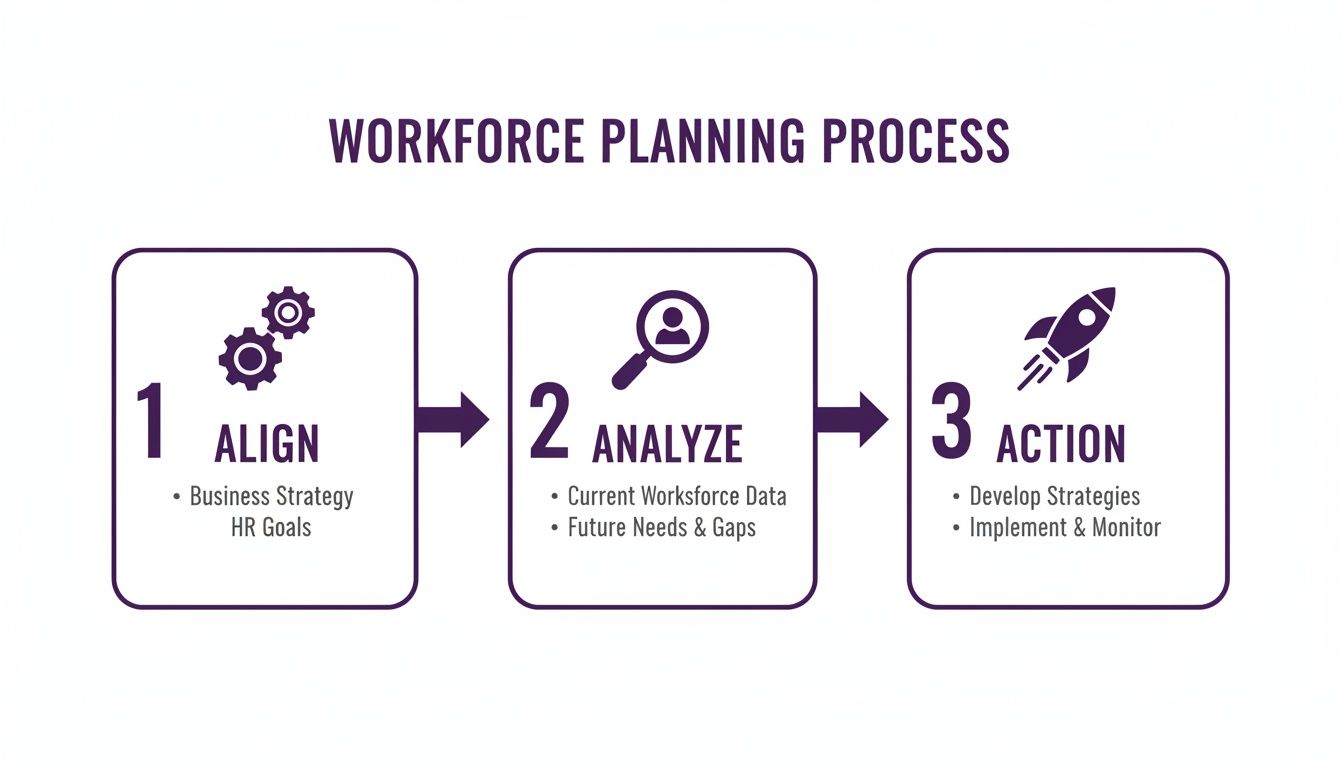
The key takeaway? Effective planning is a cycle, not a one-off event. It’s about continuously translating strategic goals into real-world talent outcomes.
First things first: you have to look ahead. Demand forecasting is all about connecting your hiring needs to your company's biggest goals, like a new product launch or expanding into a new market. It answers the question: What skills and roles will we need to win in the next 6, 12, or 18 months?
You might think this requires a crystal ball. But it's more science than magic. Start with your product roadmap, sales projections, and tech stack evolution. If you’re planning to launch a new AI feature in Q3, you're definitely going to need Machine Learning Engineers.
Why does this fail so often?
According to Gartner, only about 15% of companies actively engage in this level of forward-looking workforce planning, giving those who do a massive competitive edge.
Once you know what you need, it’s time to take stock of what you have. Supply analysis looks at talent from two angles: your internal workforce and the external market. It answers the question: What skills do we currently have, and who’s actually out there for us to hire?
The internal part involves evaluating your current employees' skills and potential for growth. The external part means getting a real-time pulse on the broader talent landscape. This is where most manual processes completely fall apart. Traditional market analysis is slow, often relying on outdated salary surveys. To make smart moves, you need comprehensive market intelligence, fast. This is where a deeper understanding of the talent landscape becomes critical, a concept we dig into in our guide on what is talent mapping.
This is where your demand forecast and supply analysis collide. A gap analysis pinpoints the specific shortfalls between the talent you need and the talent you have. It answers the question: Where are our most critical skill shortages?
This isn't just about a headcount number. It’s about identifying specific capability gaps that could completely derail your strategic goals.
For example, your analysis might reveal things like:
Pinpointing these gaps with precision is the most important output of the workforce planning process, as it directly fuels your action plan. For tactical tips, check out our guide on how to streamline your recruitment process.
Finally, you build a targeted plan to close the gaps you've identified. The action plan is what translates all your analysis into concrete initiatives. It answers the final question: How will we build, buy, or borrow the talent we need?
This plan outlines specific, measurable actions. For that backend engineer gap, your plan might involve launching a targeted sourcing campaign for external hires (buy). For the product manager gap, you could create an upskilling program for promising internal candidates (build). And for a short-term project, you might engage specialized contractors (borrow).
The challenge with traditional workforce planning is that by the time you've manually compiled all this data, your business needs have already changed. This is where AI-powered tools come in, collapsing weeks of work into minutes.
Most companies treat a skills gap analysis like a dusty annual check-up—a one-and-done audit that gets filed away and forgotten. This is a huge mistake. A continuous, forward-looking analysis is the engine of any effective workforce planning strategy.
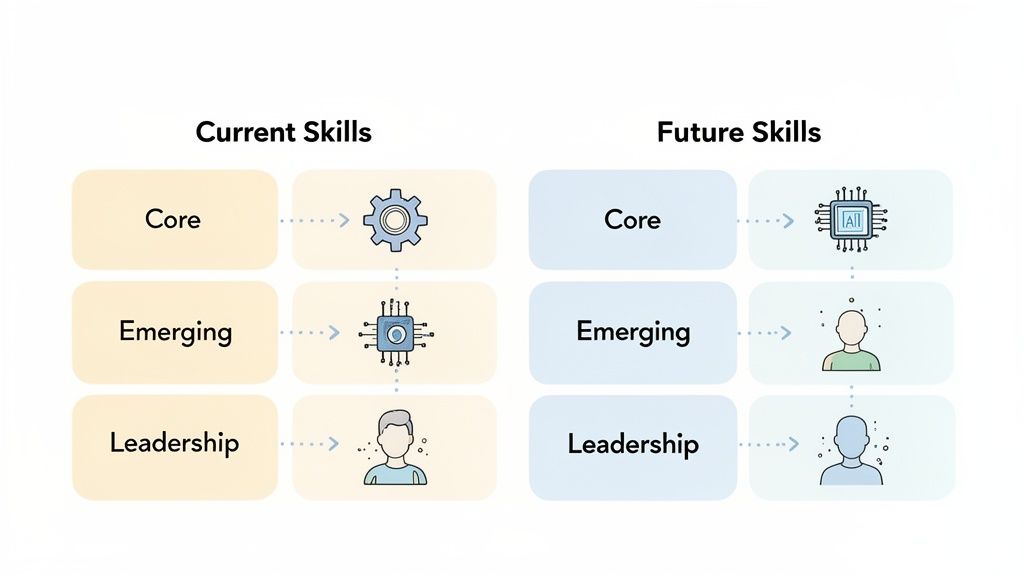
This process isn't just about cataloging what your team can do today. It's about building a clear, honest picture of the skills you have versus the skills your future business will demand. The goal is to future-proof your team, using data to predict which capabilities will be non-negotiable in the next 1-3 years.
The first step is bringing structure to the chaos. You need to categorize the skills your organization relies on. A simple but powerful framework breaks it down like this:
You might think this sounds too complex for a fast-moving team. That’s a fair objection. The old way—manual surveys and spreadsheets—is slow and often outdated by the time you're done. The skills landscape just moves too fast for that.
But there’s a problem most tools ignore: they only show you your internal skills. They're missing the context of the external market, leaving you blind to emerging trends and what your competitors are doing.
This is where a modern approach completely changes the game. Look at Ramp, the fast-growing fintech. They used Juicebox to constantly scan the market for emerging financial technology skills. This let them benchmark their own teams against top competitors and proactively hire for the capabilities they'll need in six months, not the ones that were valuable six months ago.
An effective skills gap analysis is all about looking forward. The skills that got you here won't necessarily get you there.
This isn't just a theory; the data is screaming it at us. One recent report forecasts that 70% of the skills required for most jobs today will be different by 2030. To get ahead, you have to focus on future demand, and resources identifying the Top Skills For The Future can offer a great starting point.
This forward-looking process boils down to three key steps:
By turning this analysis into a continuous cycle, you shift from a reactive audit to a proactive, predictive advantage.
An analysis is useless without action. After forecasting your needs and identifying the critical skill gaps holding you back, it's time to build a clear roadmap. This is where your workforce planning strategy hits the ground, structured around the proven 'Build, Buy, or Borrow' framework.
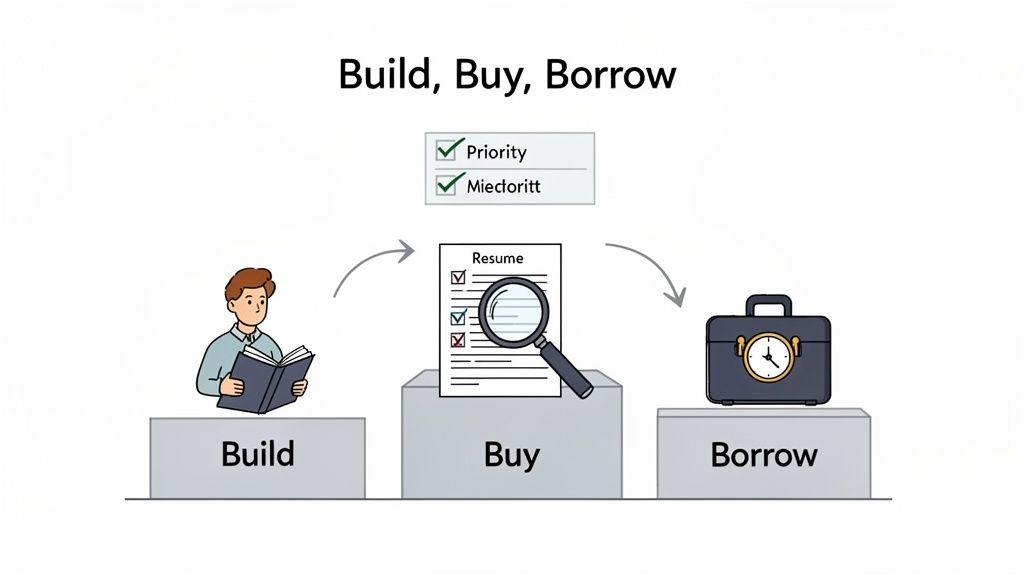
This isn’t just some abstract exercise. It’s a practical decision-making tool that helps you put your resources where they matter most, ensuring every talent move directly supports your biggest business objectives.
Your most valuable talent might already be on your payroll. The 'Build' strategy is all about developing your current employees through targeted upskilling and reskilling initiatives. It's a powerful move that boosts both capability and retention.
Here's the kicker.
A strong focus on internal mobility is a top priority, with 82% of organizations increasing their investment in it this year. Promoting from within sends a clear signal that you value their growth, creating a culture where people want to stay.
Here’s how to put it into practice:
But here’s a problem most tools ignore: they can't help you find internal candidates with adjacent skills who are prime for upskilling. That requires a deeper level of talent intelligence that connects internal potential with future needs—a core part of building a sustainable talent pipeline.
When you need skills that don’t exist internally—or you need them now—the 'Buy' strategy comes into play. This involves targeted external hiring to bring in the exact talent required to fill your most critical roles.
But effective 'buying' isn’t just posting a job and hoping for the best. It requires a proactive sourcing strategy.
This is where modern tools give you a massive advantage. For example, Ramp used Juicebox to source niche engineering talent 5x faster, filling critical roles they had pinpointed in their quarterly workforce planning session. By tapping into a talent pool of over 800 million profiles, they bypassed the limitations of single-source platforms and connected with candidates their competitors couldn't find. It’s a perfect example of using comprehensive data to execute a targeted 'Buy' strategy with speed and precision, a challenge for even the best freelance recruiter.
Sometimes, a full-time hire isn’t the right answer. The 'Borrow' strategy involves bringing on contractors, freelancers, or consultants for specialized, short-term needs. This approach gives you flexibility and access to expert skills without the long-term commitment of a permanent employee.
This is ideal for:
By mastering the 'Build, Buy, and Borrow' framework, you transform your workforce planning from a static report into a dynamic, multi-faceted action plan. It gives you the agility to respond to any business need.
So, how do you prove your workforce planning is working? A beautifully crafted plan is one thing, but showing its real-world business impact is what separates a strategic talent function from a cost center. It’s time to zero in on the KPIs that leaders really care about.
Effective measurement draws a straight line from your talent strategy to the company's bottom line. It’s all about proving that your proactive planning leads to faster hiring, higher-quality talent, and better retention—all things that directly fuel growth. Without data to back it up, your plan is just a theory.
To demonstrate real value, you have to track the right things. The key is to focus on a handful of metrics that tell a clear, compelling story about efficiency, quality, and financial impact.
Here are the essential KPIs for any modern workforce planning dashboard:
Retention is a massive focus right now. A DHR Global 2026 survey points to declining engagement (64%) and rising burnout as major risks. Interestingly, professional development (71%) is now a bigger motivator than hybrid work (63%). You can discover more insights from this talent trends report.
You can’t track what you can’t see. Relying on old-school tools and siloed spreadsheets makes it impossible to get a single, clear view of your talent landscape.
The goal is to create a single source of truth—a centralized hub where you can see demand forecasts, supply analysis, and performance metrics all in one place.
This is where all-in-one platforms like Juicebox give you a massive leg up over disjointed tools like those found on lists of Indeed alternatives. Instead of manually exporting data, you get a real-time, consolidated view. This doesn't just save hundreds of hours; it also slashes costs by getting rid of redundant software subscriptions.
Here’s a look at how a modern talent analytics dashboard provides instant market insights.
The dashboard immediately visualizes key data points like talent supply by location and top skills, turning complex market analysis into intelligence you can act on right away.
By consolidating your tech stack, you shift from reactive reporting to proactive, data-driven decision-making. You can spot trends before they become problems and clearly communicate the ROI of your workforce planning efforts to leadership.
Let’s be honest: the reactive, fire-drill hiring that plagues most companies is a recipe for falling behind. It’s stressful, expensive, and rarely gets you the A-players you actually need to win.
Strategic workforce planning is the antidote. It’s not just about filling the roles on your careers page today. It's about meticulously building a resilient, agile organization that can consistently dominate its market.
This proactive approach is what unlocks true strategic agility. It gives your company the power to jump on new opportunities and outmaneuver competitors because you’re never held back by talent constraints. In today's market, a forward-looking talent strategy is your ultimate competitive moat, turning your people into your most powerful asset. This shift is critical; as one 2026 workforce analysis points out, the signals of market shifts are getting louder, making slow, reactive hiring more costly than ever.
What's the real benefit of workforce planning?It syncs your talent strategy directly with business goals, making sure you have the right people with the right skills in the right seats to win.
How does workforce planning make a company more agile?By anticipating talent needs, you can pivot or scale quickly without getting stuck in hiring bottlenecks. You're ready before the need becomes a crisis.
What is the 'Build, Buy, Borrow' model in workforce planning?It's a framework for closing talent gaps: 'Build' by upskilling current staff, 'Buy' by hiring externally, and 'Borrow' by using contractors.
How often should a talent action plan be reviewed?Review your plan quarterly. This aligns with business cycles and lets you adapt to market changes without falling behind your strategic goals.
{{large_cta}}
Run your first search for free. Find and engage top talent across 800M+ profiles. Trusted by 5,000+ customers.
.png)
.png)