.svg)
SIGN UP FOR JUICEBOX (IT’S FREE!)

Who are you looking for?
Thank you! Your submission has been received!
Oops! Something went wrong while submitting the form.

When most companies think about growth, their first instinct is to push their teams harder. They treat their organization like a performance engine and just slam the accelerator, hoping for more speed.
But that just leads to burnout, high turnover, and eventually, the engine stalls.
True workforce optimization isn't about redlining your engine. It's about fundamentally re-engineering it for more power and efficiency, so you can go further, faster, without blowing a gasket. This is where you can streamline your recruitment process to build a better engine from the start.
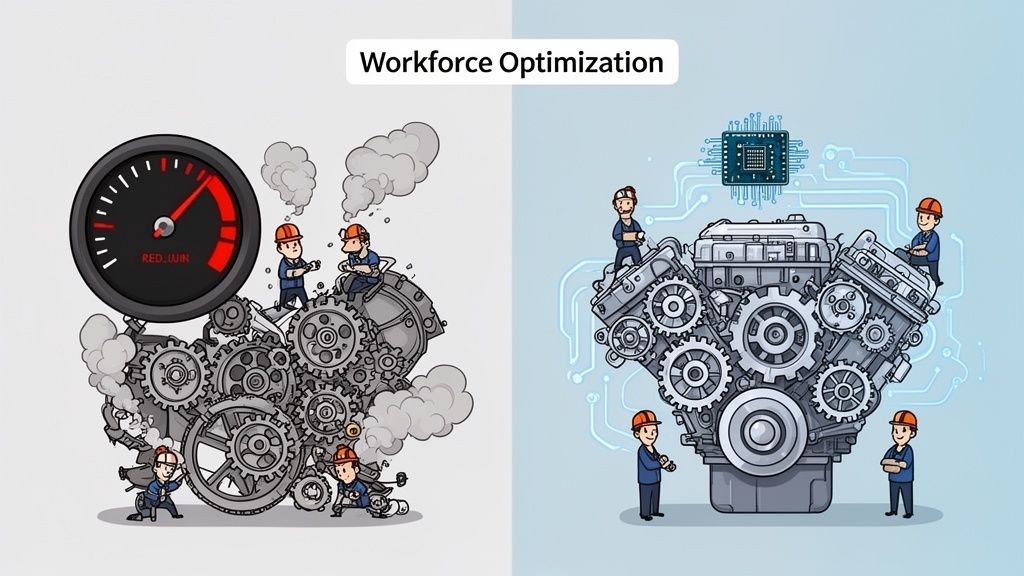
Workforce optimization transforms a manual, reactive process into an intelligent, proactive strategy.
At Juicebox, we see companies grapple with what we call the 'capacity gap'—the growing chasm between what your business needs to do and what your people can actually deliver. Our experience shows that traditional hiring methods can't close this gap.
This isn't just a feeling; it's a measurable crisis. Microsoft’s 2025 Work Trend Index dropped a bombshell: while 53% of leaders say productivity has to ramp up, a shocking 80% of employees report not having the time or energy to get their current work done.
What's the bottom line? The old playbook of just hiring more people or demanding longer hours is officially broken. This is where a modern approach to workforce optimization becomes your most critical strategy, not just another HR buzzword. It’s about achieving more with the team you already have, but in a sustainable way.
TL;DR: What is Workforce Optimization?
Workforce optimization is a data-driven strategy to align talent with business goals. It closes the 'capacity gap'—where demand outpaces your team's ability to deliver—by using smarter data, better processes, and AI to boost productivity without causing burnout. The goal is to achieve more with your existing team by working smarter, not just harder.
A solid workforce optimization strategy is built on four interconnected pillars. In the past, managing these was a slow, manual, and reactive chore. But there's a problem with that old approach. It keeps you one step behind. Today, AI-powered tools have made these pillars dynamic and proactive. Making this shift requires a real understanding of what is people analytics and how data can supercharge each step.
Here’s a look at how the old way stacks up against the new.
| Pillar | Traditional Approach (Manual & Reactive) | Modern Approach (AI-Powered & Proactive) |
|---|---|---|
| Demand Forecasting | Annual headcount planning based on gut feel and rear-view analysis. | Real-time skills forecasting driven by live market trends and future business goals. |
| Skills Mapping | Static, self-reported skills sitting unused in legacy HR systems. | Dynamically inferred skills from project data, creating a live, searchable internal talent map. |
| Talent Acquisition | Posts a job description and waits for applicants, reacting to immediate needs. | Proactively builds talent pools for future skill gaps using AI-powered sourcing. |
| Scheduling & Deployment | Manual assignment based on availability and headcount. | Optimized deployment based on skills, project priority, and performance data. |
By moving from a reactive to a proactive model, your talent function stops being a cost center and becomes a strategic engine for growth. This isn't about replacing human judgment—it's about giving it superpowers with data, so you can make faster, smarter decisions about your most valuable asset: your people.
You might think implementing such a system is complex and expensive. The truth is, modern tools are designed for rapid deployment, allowing teams to see value in days, not months. This isn't a massive overhaul; it's a series of smart, targeted upgrades.
Solid workforce optimization isn't about gazing into a crystal ball to guess next year's headcount. That’s just counting bodies. The real strategic advantage comes from getting a clear, accurate read on the skills your business will need to compete and win 6, 12, or even 24 months from now. A freelance recruiter can help fill immediate gaps, but forecasting prevents them from happening in the first place.
Think of it like a general manager building a championship team. They aren't just filling roster spots; they're analyzing what skills they'll need to beat future opponents and scouting talent that fits that specific game plan.
Here's the deal. Most companies build next year’s hiring plan by looking at last year's numbers, a habit that keeps them constantly playing catch-up. A forward-looking skills map, on the other hand, ties your talent strategy directly to where the business is headed and what the market is doing.
This kind of proactive thinking is fast becoming non-negotiable. The World Economic Forum's 2025 Future of Jobs Report predicts a massive shake-up, with technology set to create 78 million new roles by 2030. To keep up, companies have to shift from just planning headcount to dynamically forecasting skills.
It's the difference between just filling seats and actually building the muscle your company needs to grab future opportunities.
Instead of guessing, you get immediate, actionable data. Take a fast-growing fintech company like Ramp. They could use a tool like Juicebox to instantly analyze the market for, say, "senior compliance officers with experience in cryptocurrency regulations."
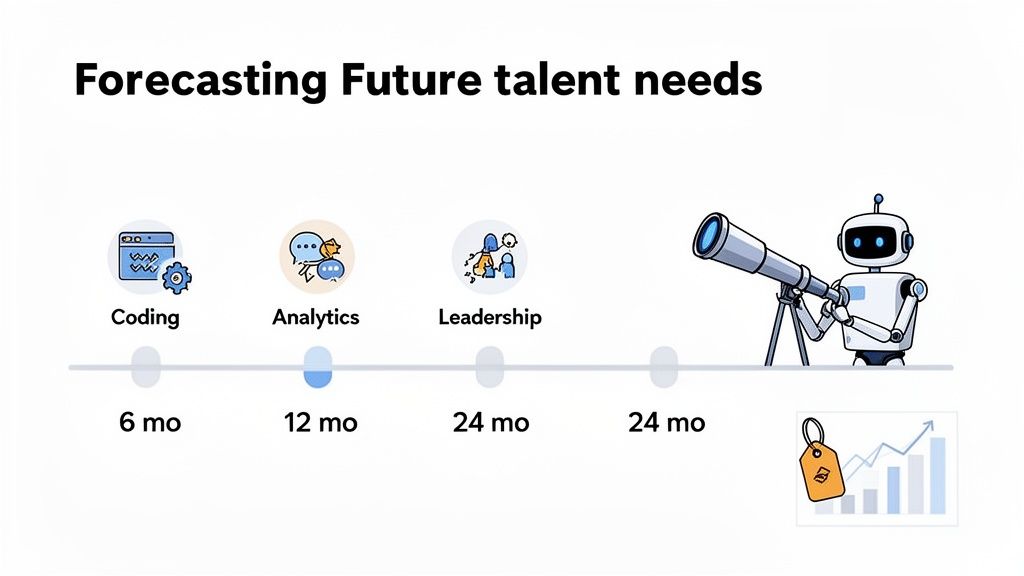
The platform would give them a clear picture of the available talent pool, what they expect to be paid, and which companies currently employ them. This is where understanding predictive analytics for HR becomes an absolute game-changer. This allows Ramp to start building a pipeline for these mission-critical roles months before the need becomes a five-alarm fire, slashing their time-to-hire.
Building a comprehensive workforce planning strategy is no longer a "nice-to-have." When you plug in real-time market data, you create a talent acquisition function that doesn't just react to hiring requests—it actively drives the business forward.
Before you even think about posting a job externally, the smartest leaders always look inward first. This is a core discipline of workforce optimization, and for good reason. The fastest, most impactful hire is often the one you don't have to make.
It's all about uncovering the goldmine of skills, potential, and ambition that's already sitting inside your organization. All you need is a map.
Think of it like this. Your company is a huge library. A traditional skills inventory is like a card catalog that was printed five years ago and left on a dusty shelf. It’s static, instantly outdated, and completely misses all the new knowledge your team picks up every single day. You know incredible people are in there, but finding the right person for a new project feels like guesswork.
This is exactly where most internal mobility programs fall apart. They’re built on self-reported skills that almost nobody remembers to update.
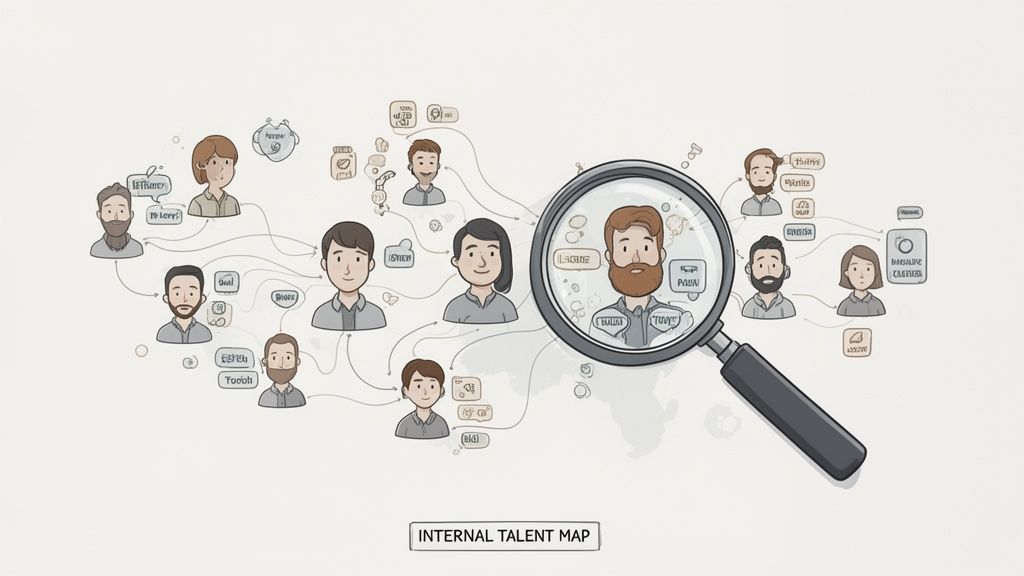
Here’s the problem with that dusty card catalog: a static skills database is obsolete the moment you create it. But what if you could turn it into a living, breathing search engine that understands your team’s real-world expertise, right now? Exploring Indeed alternatives can show you how modern platforms approach this problem.
That’s the whole idea behind dynamic skills inference. Instead of making employees fill out endless forms, AI platforms can analyze the data your company already has to build an always-on map of your team's true capabilities. This tech can infer skills from places like:
This approach gives you a living, searchable map of who knows what, today. Effective internal talent rediscovery is about seeing the skills your people have, not just the titles they hold.
This kind of real-time visibility has immediate, powerful benefits. You can redeploy talent to high-priority projects with surgical precision, saving a massive amount of time and money that would otherwise go to external recruiting.
Proof: GitLab, known for its remote-first model, needed to staff a critical security project quickly. Instead of an external search, they used their internal data to identify an engineer in a different department who had contributed to open-source security projects in her spare time.
Result: By redeploying her, they filled the role in three days, saving an estimated $40,000 in external recruiting costs and months of lost time.
This is workforce optimization in action—unlocking the hidden potential of your current team to solve your biggest challenges faster and more efficiently.
Most leaders believe internal mobility is a slow, bureaucratic process. The opposite is true when you have the right data. With a dynamic skills map, you can fill critical roles in days, not months, boosting morale and saving a fortune in the process.
Once you’ve spotted a skills gap your internal team can’t cover, the old playbook has one move: post a job and wait. This is reactive recruiting. It’s like fishing with a single line and hoping the right candidate just happens to swim by. It’s painfully slow, unpredictable, and leaves you completely at the mercy of who’s looking for a job right now. Understanding different pricing models, like SeekOut pricing, can reveal the cost of relying on these traditional tools.
But true workforce optimization flips that script. Instead of just fishing, you're building a fully stocked pond. This means creating sustainable talent pipelines for your most critical roles before you even have an open req. You’re no longer just scrambling to fill a single job; you’re building a long-term, reliable supply chain for talent.
The leap from reactive to proactive isn't just about timing—it's a fundamental shift in mindset. But there's a catch. Manually building talent pools is a soul-crushing amount of work. Wrestling with clunky Boolean strings and sifting through thousands of irrelevant profiles is a fast track to recruiter burnout.
AI sourcing tools completely change the game. To really dig into this strategic advantage, check out our complete guide on how to build a talent pipeline.
Instead of fighting with complex search operators, imagine just telling your sourcing tool what you need in plain English. A recruiter could type a prompt like, "Find backend engineers in Austin with experience scaling payment systems at a fintech startup."
In seconds, the system scans millions of profiles from dozens of sources—not just LinkedIn—and delivers a ranked, qualified list of candidates. This isn't science fiction; it's what platforms like PeopleGPT do today. And of course, a critical part of this is knowing how to upskill employees, making sure your internal talent supply is just as strong.
Proof: Cognition, an AI startup, needed highly specialized AI researchers. Using traditional sourcing, building a qualified shortlist took weeks. By using PeopleGPT with natural language prompts, their team built deep talent pools almost instantly.
The Result: They cut their time-to-shortlist by 80% in just one week, giving them a massive speed advantage in a hyper-competitive market.
This shift creates a ripple effect across your entire hiring process. When your talent acquisition team spends less time on manual, low-value sourcing, they can invest that time in high-value work, like engaging candidates and building real relationships.
Take a look at how this changes the day-to-day reality of recruiting:
| Recruiting Stage | Reactive Approach (The Old Way) | Proactive Approach (The Optimized Way) |
|---|---|---|
| Need Arises | Panic. A manager needs a backfill ASAP. | Strategic. You pull from a warm, pre-vetted talent pool. |
| Sourcing | Start from scratch. Post jobs and wait for applicants. | Activate pipeline. Re-engage qualified, interested candidates. |
| Time-to-Shortlist | 2–4 weeks manually sifting through profiles. | Under 24 hours. AI delivers a qualified list instantly. |
| Candidate Quality | Hit or miss. Limited to active job seekers. | Top-tier. Access to passive talent—the best, not just available. |
| Business Impact | High cost-per-hire, long vacancy times, team burnout. | Lower cost-per-hire, faster fills, strategic TA function. |
The difference is night and day. One is a frantic, expensive scramble; the other is a smooth, strategic activation.
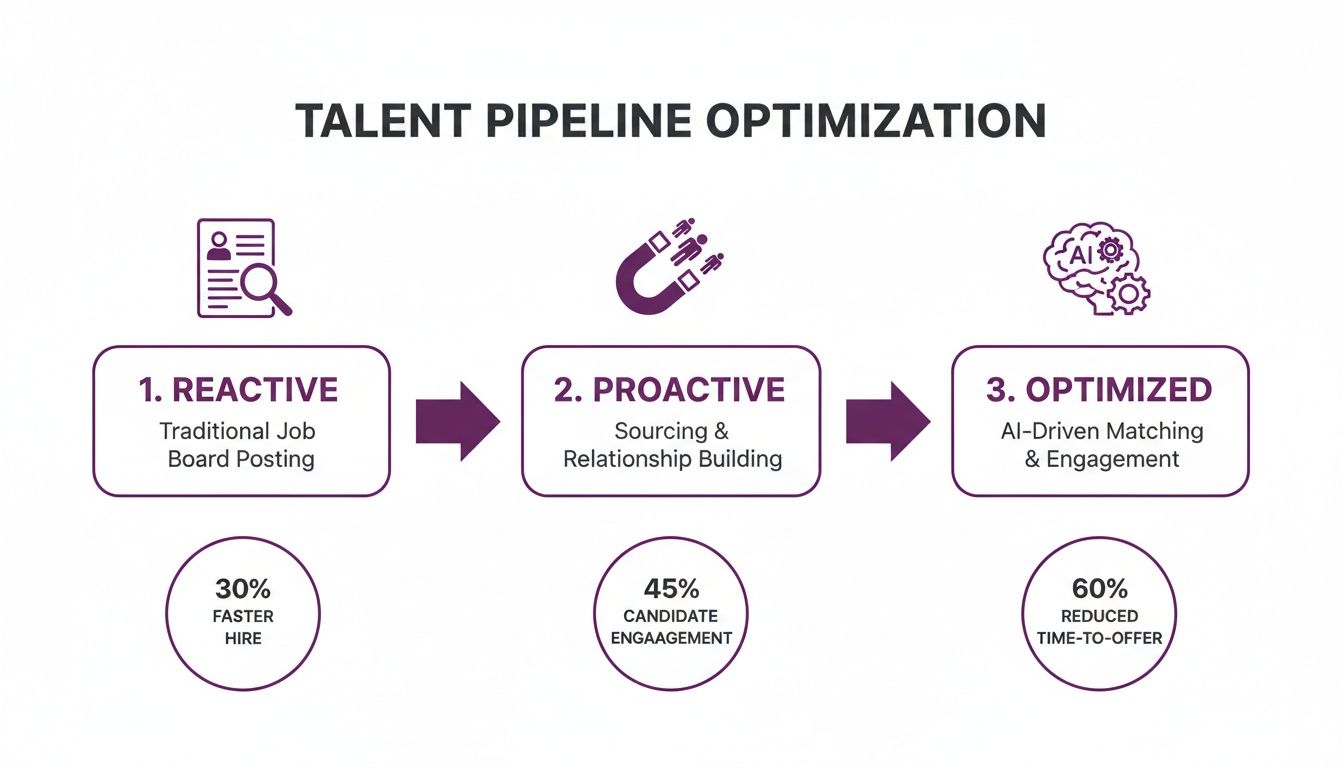
This is the heart of modern workforce optimization for talent acquisition. It’s about using technology to automate the repetitive tasks so that your human experts can focus on what they do best. By building proactive pipelines, you ensure that when a new role opens up, you’re not starting from scratch. You’re simply activating a warm pool of top-tier talent who are already waiting to hear from you.
Moving from theory to practice is where the real magic happens with workforce optimization. This isn’t about some massive, year-long overhaul. You might be thinking that a true workforce optimization strategy needs a huge budget and a dedicated project team. You're picturing months of vendor meetings and a painful rollout.
That’s the old, clunky enterprise model. That way fails because it's too slow. Modern tools are built for speed. They let even small teams start optimizing in minutes, not months, so you can prove the value fast and then scale what actually works.
The data is jarring: McKinsey’s HR Monitor 2025 found that only 12% of US HR leaders are doing strategic workforce planning with a three-year horizon. This reactive approach is bleeding money, especially when you learn that 50% of businesses are juggling 17 different worktech tools. You can discover more insights from McKinsey’s HR Monitor 2025.
The path forward is about consolidation and intelligence. You can get started with this simple, four-phase framework.
First things first: take inventory. Map out every tool your talent acquisition team is using. Look for expensive overlaps and frustrating data silos. Are you paying for multiple sourcing tools that all pull from the same shallow talent pool? Knowing things like LinkedIn Recruiter pricing can highlight these costs.
Once you see the gaps, don't try to boil the ocean. Pick one small, high-impact team to run a focused pilot—maybe it’s the group struggling the most with those impossible-to-fill roles. The goal is simple: use a modern AI sourcing tool to build a qualified pipeline faster. Nailing your recruiting metrics from day one is the key to proving ROI.
Data is your best friend here. After the pilot, compare the new results against your old baseline metrics. Focus on a handful of KPIs that really matter: Time-to-Shortlist, Time-to-Hire, Quality-of-Hire, and Cost-per-Hire.
With proven results, you can now scale the new process with confidence. Roll out the AI sourcing tool to your entire talent acquisition team, making sure to provide clear training and documentation. The final move is to integrate the tool with your Applicant Tracking System (ATS).
Effective workforce optimization is a fundamental shift in how you build your company's capabilities. It's not just about filling seats faster; it’s about building a smarter, more agile, and far more resilient organization.
This strategic alignment of talent and business goals unlocks the ability to outmaneuver competitors, jump on new market opportunities, and innovate at a pace others can't match. It’s how you achieve more with the team you already have, sustainably.
What is the first step in workforce optimization?
Start by forecasting the skills your business will need in the next 6–12 months. Focus on capabilities, not just headcount.
How is this different from workforce planning?
Planning is the "what" (forecasting needs). Optimization is the "how" (the continuous process of aligning talent to meet those needs efficiently).
Can small businesses benefit from this?
Absolutely. For a small company, every hire is critical. Optimization helps them land top talent faster and more affordably, leveling the playing field.
What are the most important metrics?
Track time-to-hire, cost-per-hire, quality-of-hire, and your internal mobility rate to see if you're promoting from within.
{{large_cta}}
Run your first search for free. Find and engage top talent across 800M+ profiles. Trusted by 5,000+ customers.