.svg)
SIGN UP FOR JUICEBOX (IT’S FREE!)

Who are you looking for?
Thank you! Your submission has been received!
Oops! Something went wrong while submitting the form.

Workforce management is the strategic system companies use to optimize their people. It's the integrated process of balancing employee productivity, controlling labor costs, and achieving business goals. This involves everything from forecasting labor needs, scheduling the right talent, managing time and attendance, to analyzing performance. In short, it’s the operating system for your most valuable asset: your team. And most companies are getting it wrong.
This guide moves beyond generic definitions. We'll show you how modern workforce management, when connected to AI-powered recruiting, becomes a strategic advantage that most HR tools can't deliver.
TL;DR: What is Workforce Management?
Workforce management (WFM) is the integrated set of processes an organization uses to optimize the productivity of its employees. It covers everything from forecasting labor needs and scheduling staff to tracking time and attendance, managing absences, and analyzing performance data to improve business outcomes.
Ever tried to conduct an orchestra where the musicians have the wrong sheet music and show up whenever they feel like it? The result would be total chaos, not a symphony. That’s exactly what happens in a business trying to operate without a solid workforce management strategy. It's the central nervous system that ensures every part of the organization works together in harmony.
What used to be a dry, back-office HR task—mostly about time clocks and payroll—has exploded into a critical lever for growth. The numbers don't lie. Grand View Research valued the global workforce management market at $8.07 billion in 2022 and projects it will rocket to $19.35 billion by 2030. That's a clear signal that this is no longer just an operational chore; it's a strategic imperative.
But there’s a problem most tools ignore.
At its core, workforce management has always been about having the right people with the right skills in the right place at the right time. But modern WFM goes so much deeper than just filling shifts.
Today, it's about proactively tying your entire talent strategy directly to your business objectives. This means using data not just to manage the team you have now, but to predict who you’ll need to hire next, spot critical skill gaps before they become a problem, and build an organization that’s resilient and quick on its feet. This is where the fundamentals of people analytics become absolutely essential.
For recruiters, this isn't just theory—it's your roadmap to success. When WFM is humming along correctly, it helps you:
Modern tools now allow talent teams to turn these insights into action, instantly.
The screenshot above shows how a simple, conversational prompt can translate complex workforce needs into a targeted list of perfect candidates. Instead of wasting hours on a LinkedIn Recruiter pricing plan, recruiters can instantly find talent that aligns with the long-term strategic goals identified through solid workforce management.
Good workforce management isn’t about juggling a bunch of separate HR tasks. It’s about building a high-performance engine where every component works in perfect sync. If one part misfires, the whole machine starts to sputter.
Thinking of it this way breaks a complex system down into five core pillars. These pillars show how WFM has grown from a simple back-office job into a real strategic driver for the business.
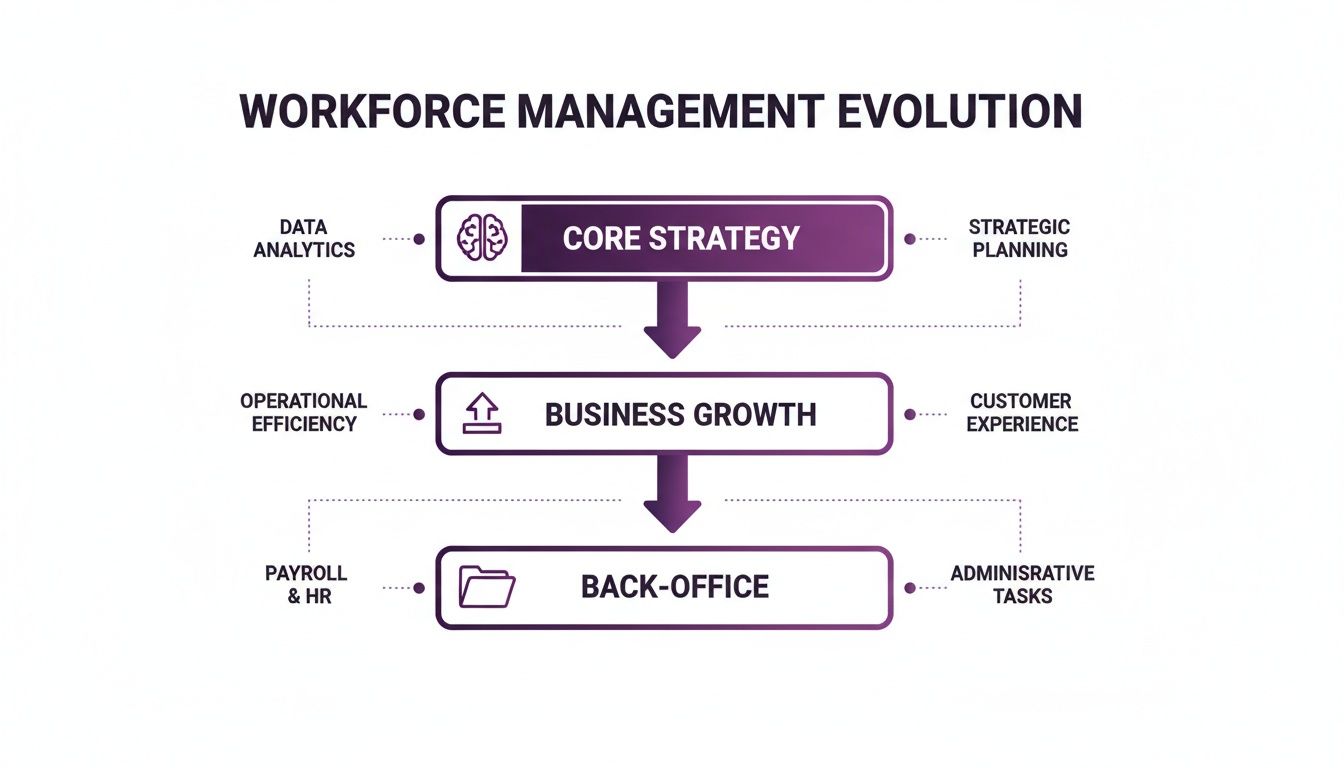
This flowchart nails it: the operational stuff at the bottom feeds the data needed for growth, which in turn sharpens the core strategy at the top. It's a powerful feedback loop.
Here's the bottom line.
To give you a quick overview, here's how each of the five pillars fits into the bigger picture of a solid workforce management system.
| Pillar | Primary Function | Key Business Impact |
|---|---|---|
| Forecasting & Budgeting | Predicts future labor needs and costs based on historical data and business goals. | Prevents overspending on labor and avoids costly understaffing. |
| Scheduling & Staffing | Creates and manages schedules, aligning the right people with the right skills to the right shifts. | Optimizes labor coverage for peak demand, improving service and revenue. |
| Time & Attendance | Tracks employee work hours, breaks, and time off accurately. | Ensures accurate payroll, reduces compliance risk, and provides reliable data. |
| Performance Analytics | Measures productivity, engagement, and overall employee performance. | Identifies top talent, pinpoints skill gaps, and informs smarter hiring decisions. |
| Compliance & Payroll | Manages adherence to labor laws and ensures employees are paid correctly and on time. | Avoids legal penalties, protects brand reputation, and builds employee trust. |
Each pillar builds on the last, creating a system that’s much stronger than the sum of its parts. Let's dig a little deeper into what makes each one tick.
This is where you figure out how much fuel your engine is going to need. Forecasting uses past data and future business goals to predict your labor needs. It’s all about answering questions like: How many people will we need for the holiday rush? What specific skills are we missing for our big Q4 product launch?
Getting your forecast right stops you from both overstaffing (which burns cash) and understaffing (which burns out your team and tanks customer service). According to ADP's 2023 report, employees are already putting in an average of 8 hours and 6 minutes of unpaid overtime every single week. Good forecasting helps protect your people from that grind.
Without a clear forecast, you’re just guessing. Simple as that.
Once you know what you need, this is how you deploy it. Scheduling is about getting the right people with the right skills into the right roles at exactly the right time. It's a tricky balancing act between business demands, employee preferences, and all those pesky labor laws.
You might think scheduling is just about filling empty slots on a calendar, but that’s a recipe for high turnover. Smart scheduling takes employee availability, skills, and even their career goals into account. This is how you get peak performance without running your team into the ground.
For example, a retail store uses its forecast to see a 30% jump in foot traffic coming on Saturdays. The scheduling system then makes sure the best sales reps are on the floor during those key hours, which directly boosts revenue.
This pillar is your engine’s clock, making sure everything runs on time and every minute is accounted for. It's the bedrock for tracking when people clock in, clock out, take breaks, and use their time off. It might sound basic, but mistakes here create a massive ripple effect.
Bad time tracking leads directly to payroll errors, compliance nightmares, and garbage data that makes your future forecasts useless. This is why having a clear process, like a 9/80 work schedule, is so critical for accurate tracking. Modern systems automate this, cutting down on human error and giving you a clean, real-time look at your labor hours.
Think of this as your engine’s diagnostic system. It’s constantly monitoring output and efficiency. This goes way beyond just tracking hours—it measures productivity, work quality, and how engaged your employees actually are. It helps you spot your rising stars and identify flight risks before they hand in their notice.
By analyzing this data, talent teams can get laser-focused on what an ideal candidate looks like and source more proactively. It’s where investing in strategic talent development gives you a serious competitive advantage, because you can start building the skills you need instead of just buying them.
For recruiters, performance data is a goldmine. It tells you exactly what "good" looks like in your company, letting you source candidates who mirror the traits of your top performers. This cuts down on bad hires and boosts retention from day one.
Finally, this is the maintenance that keeps your engine running legally and smoothly. This pillar ensures you’re following the tangled web of labor laws, from minimum wage and overtime rules to fair scheduling mandates. It also makes sure everyone gets paid accurately and on time—the absolute foundation of employee trust.
One compliance mistake can lead to huge fines and wreck your company’s reputation. This pillar ties everything else together. Time and attendance data feeds payroll, and your schedules have to follow the law. It’s the glue that holds the entire system together.
Most people believe workforce management is about pure optimization—squeezing maximum output from minimum labor cost. The opposite is true. The real goal is to create an environment where human potential can thrive. When you focus only on the mechanics, you completely ignore the engine: your people.
And what happens when that engine stalls? Disengagement. According to 2023 Gallup data, a staggering 62% of employees are just going through the motions, while another 15% are actively disengaged. This isn’t just a morale problem; it's an economic catastrophe. This apathy costs the global economy an estimated $8.9 trillion every single year.
On the flip side, teams in the top quartile for engagement see 23% higher profitability. The numbers don't lie.
Disengagement isn't a minor leak; it's the dominant state for most of the global workforce. That makes it the single biggest threat to any productivity initiative you can dream up.
This is where your talent acquisition strategy comes into sharp focus. You can't just schedule your way out of a disengagement crisis. Your first line of defense is hiring the right people from the very start—individuals who aren't just skilled, but are naturally aligned with your company's mission and culture.
Take Finity, a fast-growing tech firm. Their engineering output was slowing down, even with a top-tier WFM tool in place. So they shifted their focus. Instead of just filling seats, they started actively sourcing candidates with a history of contributing to open-source projects using various sourcing tools for recruiters.
The results? Within six months, project velocity shot up by 20%, and voluntary turnover in that department dropped by 15%. They proved that engagement isn't a switch you flip after onboarding; it's a quality you hire for.
This requires a much deeper look into a candidate’s intrinsic motivations, something traditional recruiting often misses. A huge piece of this puzzle is understanding why women leave STEM roles and building targeted interventions to keep them.
You might think your current hiring process already filters for good candidates. But most processes are reactive, designed to evaluate skills for an immediate, specific need. This approach is flawed because it completely ignores the long-term engagement factor.
The result is a revolving door of skilled but uninvested employees who quietly drag down the productivity of your entire team.
The real challenge is to weave the principles of employee engagement into the very fabric of your talent acquisition process. This demands a proactive approach where recruiters act as strategic partners, using data to find people who will not only perform but elevate everyone around them.
But there’s a deeper problem that even the best WFM tools ignore…
That old wall between HR operations and talent acquisition? It’s completely falling apart. Recruiters are no longer just filling orders as they come in. In any company that wants to stay competitive, they’re the architects of the future workforce—the critical link between a high-level strategy and the people who actually get the work done.
When you align your hiring efforts with your bigger workforce management strategy, you turn recruiting from a reactive cost center into a proactive, strategic powerhouse. It’s all about using the rich data from your WFM system to inform every single sourcing decision.
You might think hiring is just naturally reactive. A need pops up, you fill it. Simple. But that’s the exact mindset that leaves so many companies scrambling to plug talent gaps and wondering why turnover is so high. It traps recruiters in a constant state of emergency, forcing them to trade long-term quality for short-term speed.
Operating that way means you're always one step behind.
Your workforce management system is an absolute goldmine of predictive insights. By tapping into it, recruiters can stop chasing roles and start building the teams of tomorrow. The trick is knowing which data points to pull and how to spin them into actionable sourcing strategies.
Here’s a practical look at how it works:
Getting this alignment right is non-negotiable. Globally, employees report working an average of 8 hours and 6 minutes of unpaid time each week. At the same time, Gallup reports that a staggering 51% of employees are actively looking to leave their jobs. This data, pulled from recent global workforce trend reports, screams for companies to connect hiring to retention and strategic planning.
Having these insights is one thing, but acting on them quickly is what gives you a real competitive edge. This is where modern AI sourcing tools become essential for any serious workforce management effort. They close the gap between knowing what you need and actually finding those people.
The right AI lets a recruiter translate a complex, data-driven candidate profile into a simple, natural-language search. You can instantly find talent that matches not just keywords, but the strategic needs you've identified from your WFM framework. This is the core difference between a reactive and proactive recruiter and talent acquisition strategy.
The image above shows a recruiter using a simple prompt to source candidates with a precise mix of skills and experience—a task that would take hours with old-school Boolean searches. This kind of speed allows talent teams to put WFM insights into action in real-time, building qualified pipelines before a critical role even opens up.
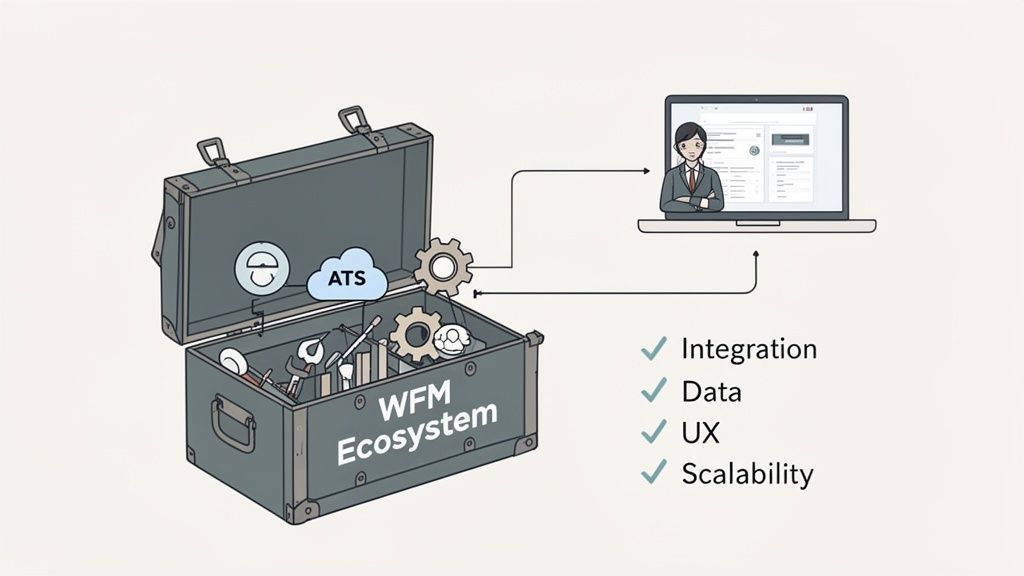
Picking the right software for your workforce management ecosystem isn't about finding one magical, all-powerful platform. It’s about building a connected toolkit that your team will actually use.
The market is crowded with massive systems that promise the world but often deliver complexity. For a modern talent team, the real goal is to stay nimble.
You need tools that empower recruiters, not bury them in administrative quicksand. That means prioritizing solutions that are fast, intuitive, and plug seamlessly into the systems you already rely on. Your tech stack should feel like a force multiplier, automating the grunt work and freeing up your team to focus on building relationships with incredible talent.
But there’s a massive gap most tools completely ignore: the disconnect between high-level workforce data and the actual, on-the-ground work of sourcing candidates. A WFM system might tell you to hire more machine learning engineers in Q4, but it won’t lift a finger to help your recruiters find them.
That’s the exact point where most strategies fall apart.
Let's make this tangible. Imagine your workforce management forecast flags a critical, future need for a "Senior Backend Engineer with FinTech and Rust experience" to support a new product launch in six months.
The old way? Wait for a job req, post it to a dozen job boards like some Indeed alternatives, and then spend weeks sifting through irrelevant applications.
Here’s how a modern, AI-powered workflow shrinks that cycle from weeks down to minutes.
A recruiter takes that strategic insight from the WFM plan and plugs it into an AI sourcing tool like PeopleGPT using simple, natural language. The AI instantly generates a list of qualified, verified candidates who perfectly match the strategic need—no complex Boolean strings or manual database searches needed.
The recruiter can immediately start building a pipeline of warm candidates, turning a future goal into a present-day recruiting action. That's the kind of agility that defines effective workforce management.
This entire process—from identifying the need to building a qualified shortlist with verified emails—can happen in less than five minutes. You might think this speed comes at the cost of quality, but it's actually the opposite. Manual methods are notoriously prone to human bias and clunky keyword-matching errors. AI, on the other hand, can analyze millions of data points to find candidates who not only have the right skills but also show career trajectories that align with where your company is headed.
Take Ramp, for example. They used this exact AI-driven approach to rapidly scale their engineering teams. By translating their workforce plan directly into targeted PeopleGPT searches, they were able to source and engage top-tier candidates 5x faster than with their old tools, filling critical roles in a fraction of the time.
This proves that the right tools don't just support your workforce management strategy—they supercharge it.
To avoid buying expensive shelfware, talent leaders should evaluate every potential tool against a simple, WFM-aligned framework. Forget the endless feature lists and flashy demos for a moment. Instead, focus on what truly connects strategic planning to tactical execution.
This checklist will help you cut through the noise and zero in on tools that genuinely empower your team./
| Evaluation Criterion | Key Question to Ask | Why It Matters for WFM |
|---|---|---|
| Integration Capability | Does this tool plug directly into our core systems, like our ATS? | Manual data entry is a productivity killer. A tool that doesn’t integrate smoothly creates more work than it saves, plain and simple. |
| Data Accessibility | Can we get real-time talent market insights without jumping through hoops? | Access to data on salary bands, competitor hiring, and skill supply is essential for making smart, proactive decisions based on your WFM plan. |
| User Experience (UX) | Can our recruiters start using this effectively without weeks of training? | A confusing interface or reliance on complex processes creates a barrier to adoption. If your team won't use it, it's worthless. |
| Scalability and Focus | Will this tool grow with us without forcing us into a bloated, expensive contract? | Look for solutions built for specific functions, like sourcing. When it comes to effective human resources software, targeted tools almost always outperform monolithic platforms. |
Ultimately, the best tools are the ones that feel invisible—the ones that get out of the way and let your recruiters do their best work. Use these questions as your guide, and you'll build a tech stack that not only supports your workforce plan but actively helps you bring it to life. A freelance recruiter can also benefit from using these targeted tools to stay competitive.
What's the first step to implement a WFM strategy?
Start with a simple audit. Look at your current scheduling, time tracking, and performance numbers to find the most obvious gaps and biggest opportunities.
How is WFM different from basic HR software?
WFM focuses on operational efficiency—scheduling and productivity. A traditional HRIS is a system of record for employee data—payroll, benefits, and info.
Can small businesses benefit from workforce management?
Absolutely. Simple forecasting and scheduling tools can dramatically cut labor costs, improve efficiency, and prevent burnout even in a very small team.
How does AI improve workforce management?
AI automates forecasting, builds smarter schedules, and helps recruiters proactively find candidates who align with the company's long-term strategic goals.
True workforce management isn't just about operational efficiency; it’s about building a strategic, resilient organization from the ground up. By aligning your workforce plan with proactive, AI-powered recruiting, you unlock the ability to hire the exact people you need to win, long before your competitors even know the game has started.
{{large_cta}}
Run your first search for free. Find and engage top talent across 800M+ profiles. Trusted by 5,000+ customers.

.png)
.png)