.svg)
SIGN UP FOR JUICEBOX (IT’S FREE!)

Who are you looking for?
Thank you! Your submission has been received!
Oops! Something went wrong while submitting the form.


A sourcing strategy is your company's game plan for finding, engaging, and winning over potential job candidates. Think of it less as a rigid document and more as a living blueprint that turns recruiting from a reactive scramble into a predictable, proactive machine.
In other words, it’s how you build a reliable supply chain for talent before you desperately need it. Most companies treat sourcing as a reaction to a hiring need, but the opposite is true: effective sourcing finds people before the role even exists. This is our core differentiation at Juicebox—we build tools that enable proactive, AI-driven talent acquisition, moving teams beyond the limitations of manual, reactive methods.

In a market where skilled tech talent is gold, the old "post and pray" method just doesn't cut it anymore. Simply listing a job and hoping for the best is a recipe for empty pipelines and missed hiring goals. You might think your current process is good enough, but why does that fail? Because it’s passive.
A solid sourcing strategy flips the script. It shifts your team's focus from passively waiting for applicants to actively building talent pipelines for the roles you need to fill today and tomorrow. This isn't a luxury; it’s a critical business function.
Need proof? A staggering 74% of employers report struggling to find skilled talent, marking one of the tightest labor markets in decades.
Look, the core idea is simple but powerful. Your strategy gives you a repeatable framework for identifying the right people, on the right platforms, with the right message. It forces you to get systematic about how you compete for—and win—top talent. For a deeper dive into these concepts, check out our guide on the fundamentals of candidate sourcing.
Every effective sourcing strategy is built on four interconnected pillars. Get these right, and you have a sturdy foundation. Think of them as the legs of a table—if one is wobbly, the whole thing becomes unstable.
Let's break them down.
This table gives you a quick snapshot of the essential components. Understanding how they work together is the first step to building or auditing your own approach.
| Pillar | Description | Key Focus Area |
|---|---|---|
| Channels | The platforms, communities, and networks where you actively search for talent | Diversify beyond LinkedIn into niche forums, open-source projects, and professional groups |
| Technology | The tools used to identify, engage, and manage candidates efficiently at scale | Shift from manual Boolean searches to AI-powered platforms like PeopleGPT to accelerate discovery and outreach |
| Brand | How your company is perceived by potential candidates in the market | Use authentic team stories and a compelling mission to attract passive talent not actively job hunting |
| Metrics | The data used to measure the effectiveness and ROI of sourcing efforts | Focus on source quality, pipeline health, and conversion rates—not just time-to-fill |
Getting a handle on these four areas will give you a clear mental model for where your sourcing efforts are strong and where they need attention. Nail these, and you're well on your way to building a world-class talent engine.
A powerful sourcing strategy isn't just a document; it's a well-oiled engine. To build one, you need to understand its four essential parts: the channels you use, the technology that powers your work, your employer brand, and the metrics that prove it's all working.
Getting these four pieces humming in sync is what separates elite teams from the rest.

Each component is critical. A weakness in one can stall out the entire system, leaving you with a sputtering hiring process.
You might think LinkedIn is all you need for sourcing. But leaning too heavily on a single platform is a rookie mistake. But there’s a problem most tools ignore: the best talent isn't always on the biggest platforms.
A multi-channel approach isn't just nice to have; it's non-negotiable. Here's the bottom line:
The goal is to fish where others aren't. That’s how you get access to candidates your competitors, who may be exploring Indeed alternatives, will never even see.
The right tech stack is a massive force multiplier for your sourcing. It’s the difference between manually digging for gold with a shovel and using advanced sensors to pinpoint exactly where the motherlode is.
Slow, manual Boolean searches just don't cut it anymore. Modern, AI-native platforms like PeopleGPT accelerate every single step, letting you move from identifying a need to engaging a qualified shortlist in minutes, not days.
The best sourcing tools for recruiters are the ones that automate the grunt work, freeing you up for what matters most: high-value human interaction.
Your employer brand is what convinces passive candidates—the ones who aren't even looking for a new job—to take your call. It's the collection of stories, values, and experiences that answer the question, "What's it really like to work there?"
Ditch the generic career page copy. Instead, share authentic stories from your team. Post a blog about a tough technical challenge your engineers just solved, or highlight a project a product manager shipped that they're proud of. This kind of realness attracts candidates who are truly aligned with your mission and culture.
Finally, a strong sourcing strategy runs on data. But so many teams track the wrong things. Vanity metrics like "time-to-fill" don't actually tell you if your pipeline is healthy or not.
You need to focus on metrics that signal true pipeline quality:
The shift to remote work has also put compensation front and center. One recent Payscale report noted that as companies tapped into global talent, salary hikes in tech averaged 10-15% just to stay competitive. Keeping an eye on these recruiting metrics is crucial.
There’s one crucial difference that separates elite recruiting teams from the rest of the pack. It has nothing to do with their tools or budget. It all comes down to their mindset—specifically, whether they operate proactively or reactively.
A winning sourcing strategy is almost always proactive.
Reactive sourcing is the traditional, default model. You post a job description and just wait for applicants to trickle in. Think of it like fishing with a single line, hoping the right fish just happens to swim by and take the bait. It’s a game of chance, and in a tight market, the odds are rarely in your favor.
Proactive sourcing, on the other hand, is a completely different game.
It’s less like fishing and more like building a fully stocked fish farm. You actively cultivate talent pipelines for future needs, long before a job requisition is ever approved. You're constantly building relationships and spotting top talent, so when a role finally opens up, you have a warm, engaged pool of candidates ready to go.
Most people think sourcing is just about finding candidates to fill currently open roles.
The opposite is true. Great sourcing finds people before the role even exists.
This mental shift from reactive to proactive is the single most important factor in slashing hiring costs, boosting candidate quality, and closing roles faster. When you aren't scrambling to fill an urgent need, you make better, more strategic decisions. You can learn more about this approach by exploring how to build a talent pipeline that consistently delivers.
Let’s put this into perspective. A 2025 study by Alteryx showed how geopolitical events force companies to rethink their supply chains, moving to proactive strategies like reshoring and diversifying suppliers. The same logic applies to talent—waiting for a hiring crisis is a recipe for failure.
To make the distinction crystal clear, let's compare the two approaches side-by-side.
Here’s a direct comparison that shows just how different these two mindsets are in practice. The old way leaves you playing defense, while the new way lets you control the game.
| Attribute | Reactive Sourcing (The Old Way) | Proactive Sourcing (The New Way) |
|---|---|---|
| Timing | Starts only when a job becomes open | Ongoing, continuous process |
| Focus | Filling an immediate, urgent need | Building long-term talent pipelines |
| Talent Pool | Limited to active job seekers who see the job ad | Includes passive candidates, referrals, and silver medalists |
| Speed | Slow; time-to-hire often 30–60+ days | Fast; roles filled in days, not weeks |
| Candidate Quality | Highly variable; depends on who applies | Consistently high; candidates are pre-vetted |
| Business Impact | High agency fees and lost productivity | Lower cost-per-hire and sustained competitive advantage |
The difference is stark, isn't it? Reactive sourcing leaves you vulnerable to market shifts and completely dependent on luck. A proactive sourcing strategy gives you control, predictability, and a repeatable engine for attracting top talent.
Ultimately, it turns recruiting from a cost center into a strategic driver of business growth.
Moving from theory to action is where the real value is. Building a solid sourcing strategy doesn’t demand a massive budget or a huge team; it just requires a systematic, repeatable framework. This five-step process gives you exactly that, whether you're creating a plan from scratch or auditing the one you already have.
Think of it as graduating from reactive "fishing" to proactive "fish farming." You're moving from just-in-time hires to building a sustainable talent ecosystem.
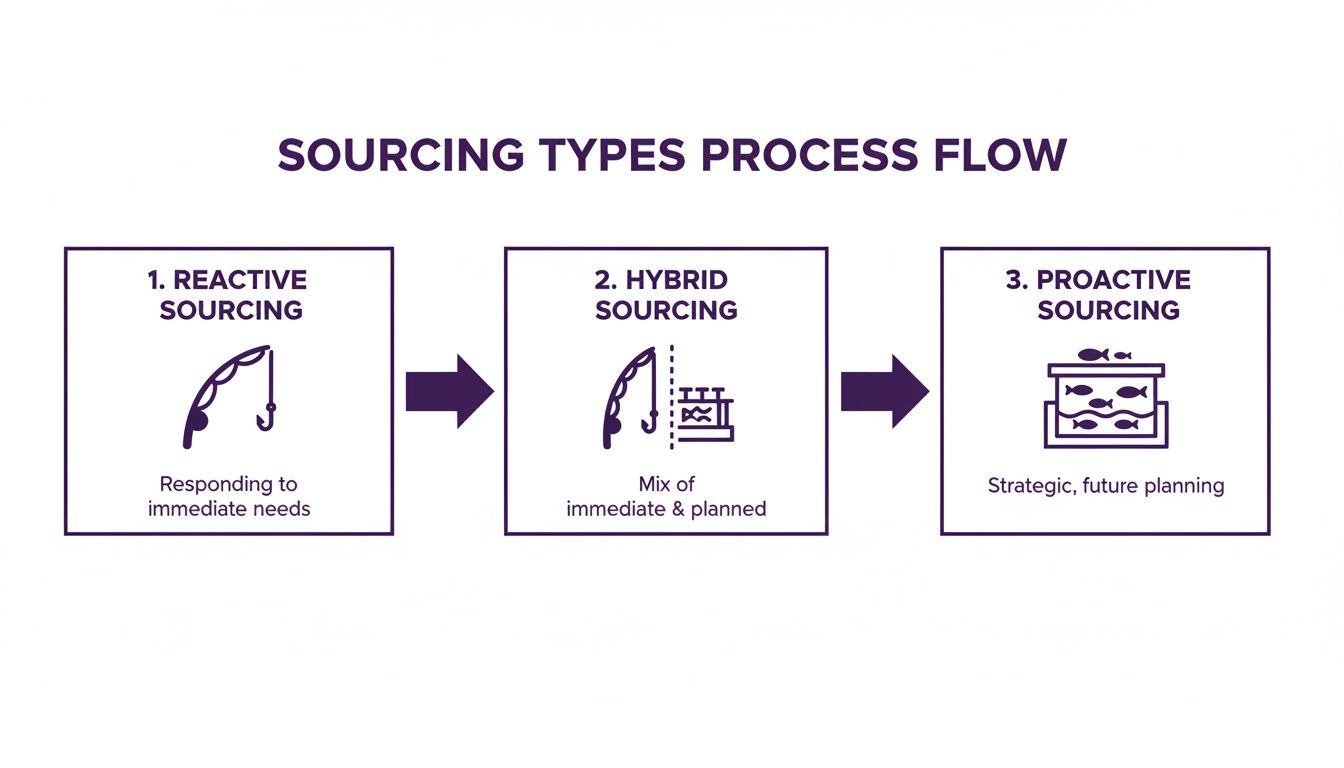
This evolution is the sign of a modern, mature talent acquisition function. Let's break down how to get there.
Before you can find the right people, you have to know exactly who you're looking for. An Ideal Candidate Profile (ICP) is so much more than a list of skills copied from a job description. It's a detailed persona that truly captures the DNA of your most successful hires.
Go beyond the basics and map out:
Once you have this crystal-clear picture, you can start mapping talent pools—pinpointing the companies, industries, and regions where these folks tend to work.
Relying on a single channel, like LinkedIn, is one of the fastest ways to kill your pipeline. A modern sourcing strategy spreads its bets across multiple platforms to find the talent your competitors are completely missing.
What's the key? Start exploring these high-potential areas:
This multi-channel approach guarantees a steady flow of candidates, even when one source inevitably runs dry. For a deeper dive, you can learn more about building effective talent sourcing strategies.
The right technology is a force multiplier for your sourcing team. It automates the tedious, low-value tasks and frees you up to focus on what matters most: building genuine relationships with people. Your goal should be to create a tech stack built for speed and scale.
For some inspiration, it's worth checking out these proven 7 SaaS lead generation strategies, as the principles of building a tech-driven pipeline apply here, too.
This is where AI-native platforms completely change the game.
Proof: Ramp, a leader in finance automation, used PeopleGPT's natural language search to source senior engineers. They successfully cut their reliance on expensive third-party agencies and closed critical roles in under 30 days by using Juicebox's AI to find candidates other tools missed.
By replacing slow, manual Boolean searches with a simple prompt, they accelerated their entire source-to-shortlist workflow. Modern tools collapse the search, verification, and outreach steps into a single, fluid motion.
Your employer brand is your most powerful magnet for passive talent. It shouldn't be an afterthought; it needs to be woven into every single touchpoint, from your initial outreach email to your company's career page.
Don't just tell candidates you have a great culture—show them.
Share authentic stories from your team, highlight interesting technical challenges you're solving, and be transparent about your company's mission and values. This kind of authenticity is what convinces top-tier talent to actually reply to your message. Check out these recruitment emails for inspiration.
You can't improve what you don't measure. A data-driven sourcing strategy moves beyond vanity metrics like time-to-fill and hones in on KPIs that signal true pipeline health and efficiency.
You should be tracking these numbers religiously:
These numbers will give you a clear, honest story about where your strategy is winning and where it needs a tune-up.
Even the most well-oiled sourcing engine can sputter and die. When it does, it's rarely a mystery—it's usually one of a few classic, self-inflicted wounds.
Understanding these common failure points is the first step to building a sourcing strategy that doesn't just work but lasts. Let's walk through the three mistakes that quietly sabotage most recruiting teams.
You’ve mastered LinkedIn. You live and breathe it. It feels efficient, but in reality, you’ve built a pipeline so fragile it could snap overnight.
When a single channel accounts for 80% or more of your hires, you're not just limiting your talent pool—you're completely at the mercy of its algorithm, pricing, and audience fatigue. One price hike for LinkedIn Recruiter licenses, and your entire cost-per-hire model is toast. This isn't a strategy; it's a massive blind spot.
Sourcing isn't just about finding profiles. It's about convincing a real person to actually talk to you. A bad candidate experience—generic outreach, slow follow-ups, radio silence—is like poison for your employer brand.
Word gets around. A bad reputation means the best people won't even open your messages.
Proof: IBM, in a 2022 study, found that candidates who have a positive experience are 38% more likely to accept a job offer. A poor one doesn't just lose you a candidate; it creates a detractor.
But here’s the metric most teams miss. Everyone is obsessed with time-to-hire, but they completely ignore the candidate drop-off rate by stage. If you don't know when and why you're losing great people, you're just bleeding talent in the dark. It’s the ultimate unforced error.
The most dangerous mistake of all? Guesswork. When you don't track the quality of your sources, your team is just throwing spaghetti at the wall and hoping something sticks. You're operating on gut feelings, not facts.
This is how you end up wasting hundreds of hours and thousands of dollars on channels that produce nothing but noise, while your true goldmines go completely untapped. But there’s a better way.
The next big leap in talent acquisition isn't just on the horizon—it's already here. The future of any truly effective sourcing strategy is deeply entwined with AI and intelligent automation.
This isn't just an upgrade; it's a fundamental shift. We're moving away from the manual, often tedious tasks that used to eat up a recruiter's day. Think about all those hours spent crafting complex Boolean strings or endlessly sifting through profiles. That's rapidly becoming the old way of doing things.
Now, the focus is shifting to autonomous AI agents that can source, analyze, and even start conversations with qualified candidates 24/7. This kind of technology frees up an incredible amount of strategic bandwidth. It lets recruiters get back to what they do best: building genuine relationships, digging into what truly motivates a candidate, and ultimately, closing top talent.
The takeaway is simple. AI doesn't replace great recruiters; it gives them superpowers. It empowers them to operate at a scale and speed that was previously impossible. As sourcing continues to evolve, using smart tools like advanced AI chatbot platforms becomes non-negotiable for staying competitive.
This transition elevates your sourcing function from a tactical, day-to-day necessity into a powerful competitive advantage. By embracing these tools, you build a faster, more resilient talent pipeline. To see just how much this is reshaping the industry, check out our deep dive into the top 10 AI recruiting tools for 2026. The best teams are already making this move, future-proofing their hiring engine.
Sourcing is proactive talent identification and engagement; recruiting is the broader process of screening, interviewing, and hiring engaged candidates.
Review your sourcing strategy quarterly to adapt to market changes, new hiring goals, and performance data from your different sourcing channels.
Yes, it's critical. A strategy helps small teams focus limited resources on high-impact channels, improving efficiency and competing with larger companies.
Ultimately, a modern sourcing strategy is about building a proactive talent engine, not just filling jobs reactively. This shift from a cost center to a strategic advantage unlocks predictable, scalable hiring that gives your company a true competitive edge.
{{large_cta}}
Run your first search for free. Find and engage top talent across 800M+ profiles. Trusted by 5,000+ customers.
.png)


.png)