
.svg)
SIGN UP FOR JUICEBOX (IT’S FREE!)

Who are you looking for?
Thank you! Your submission has been received!
Oops! Something went wrong while submitting the form.

So, what is headhunting?
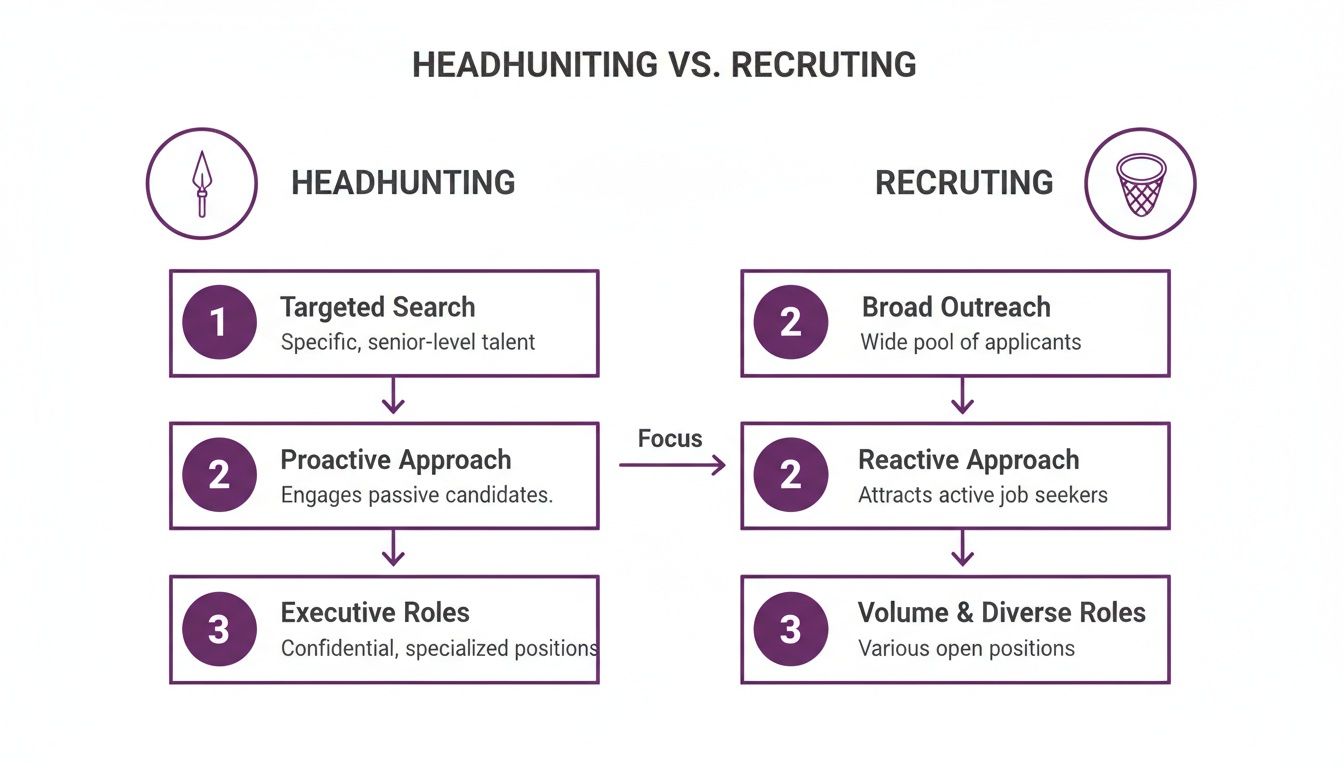
Think of it less like traditional recruiting and more like talent acquisition surgery. While most recruiting involves casting a wide net for people actively looking for a job, headhunting is a precise, proactive hunt for top-tier professionals who aren't looking (ie sourcing passive candidates).
That’s the whole game.
In this guide, you'll learn what headhunting is, how it works, and how to use headhunting to build elite teams. Unlike generic recruiting that just fills seats, Juicebox champions a proactive headhunting approach that secures game-changing talent your competitors can't find.
TL;DR: What is Headhunting?
Most people use "headhunting" and "recruiting" interchangeably, but in the trenches, they're worlds apart. Getting this right is critical, especially when you need to fill a make-or-break role.
Here’s the deal.
Recruiting is mostly a reactive process. A position opens up, you write a job description, post it online, and then wade through a sea of inbound applications. It’s about managing the flow and picking the best person from the group that raised their hand.
Headhunting, on the other hand, is 100% proactive. It starts with a simple, powerful assumption: the absolute best person for this job is probably happy, successful, and crushing it in their current role. The headhunter’s mission is to map the market, pinpoint these high-performers, and then craft a story so compelling it convinces them to make a move.
But what if your ideal candidate isn't even on LinkedIn?
This Forbes article nails the strategic nature of headhunting, emphasizing the discreet, targeted approach needed to lure away top talent.
The goal isn't just to fill a seat; it's to create an opportunity that a star player can't ignore. This requires deep industry knowledge and a surgical approach, which is why headhunting is the go-to method for executive search services and other critical leadership hires. Need to build a better talent pipeline? Check out these top sourcing tools for recruiters.
To really break it down, it helps to add a third function to the mix: sourcing. Sourcing is the research phase—finding and listing potential candidates. Recruiting manages the entire hiring process for active applicants, while headhunting is the specialized practice of pursuing passive talent for specific, high-stakes roles.
Here’s a simple table to make the distinctions crystal clear.
| Dimension | Headhunting | Recruiting | Sourcing |
|---|---|---|---|
| Primary Goal | Persuade a specific, passive top-performer to consider a new role. | Fill an open position by managing active applicants from job postings. | Build a pipeline of potential candidates for current or future roles. |
| Candidate Type | Passive candidates: not actively looking; often happy in their current job. | Active candidates: applying to jobs and browsing job boards. | A mix of active and passive candidates, primarily for pipeline building. |
| Approach | Proactive & surgical: direct, confidential outreach based on market mapping. | Reactive & volume-based: post jobs, screen inbound applications, manage process. | Proactive & research-based: identify potential fits using tools and databases. |
| Typical Roles | Executive, leadership, highly specialized, or confidential roles. | Junior to mid-level roles with larger available talent pools. | Supports both recruiting and headhunting across all role levels. |
| Core Skillset | Persuasion, negotiation, deep market knowledge, relationship building. | Process management, screening, interviewing, closing candidates. | Research, data mining, Boolean search, identifying potential leads. |
Ultimately, recruiting is like fishing with a net—you hope to catch good fish from the school that swims by. Sourcing is like using a sonar to find where the fish are. Headhunting? That’s spear fishing. You identify the one you want and go after it with skill and precision.
Great headhunting isn’t some dark art—it’s a disciplined, repeatable process. While every search has its own quirks, the best headhunters stick to a proven playbook that takes them from a vague business need to a signed offer letter with a game-changing hire.
This isn't about posting a job ad and praying. It's about running a proactive, targeted campaign.
This methodical approach is exactly why the headhunting industry is booming. Valued at USD 1.24 billion in 2024, the global market is on track to hit USD 2.03 billion by 2031. That growth is a direct result of how painfully difficult it is to find specialized leaders and top-tier STEM talent. You can read the full research on headhunting trends here.
Every search kicks off with a deep dive that goes miles beyond a standard job description. A headhunter sits down with the key players—the hiring manager, the C-suite—to build a multi-dimensional picture of their perfect candidate.
This isn’t just a checklist. It includes:
Nailing this alignment from the get-go prevents a ton of wasted time and ensures the search is laser-focused on people who can actually do the job and succeed.
"A headhunter's most valuable asset is clarity. Without a crystal-clear understanding of the target, you're just making noise in a crowded market."
With the ideal profile locked in, it’s time for market mapping. This is where the headhunter identifies every single company where this perfect candidate might be working right now. From there, they build out a "longlist" of specific individuals to target.
This is way more than a quick LinkedIn search. It’s deep-dive research, digging into competitor org charts, industry news, and conference speaker lists to find the high-performers who aren’t broadcasting their availability. The goal is to create a complete map of the talent universe, whether they're looking for a job or not. If you're looking for alternatives, consider these top Indeed competitors.
Here’s where the real art of what is headhunting comes into play. Reaching out to passive candidates is a completely different game than sending standard recruitment emails. You might assume top talent just ignores unsolicited messages, but that’s only because most outreach is generic, lazy, and all about the sender's needs.
The secret is a personalized, high-value approach. A great message is discreet, references the candidate's specific accomplishments, and frames the opportunity around their career growth, not just your company's open role. Knowing how to engage passive candidates is a critical skill that separates the pros from the spammers.
Once someone shows interest, the real vetting begins. This goes way beyond scanning a resume. Headhunters use structured interviews packed with behavioral questions to understand past performance and situational questions to see how they'd handle future challenges.
Backchannel reference checks are another key tool in the playbook. These aren't the formal references a candidate gives you. They're quiet, informal chats with trusted contacts who have worked with the person before, giving you an unfiltered look at their real strengths, weaknesses, and leadership style.
Finally, the headhunter shifts into the role of a strategic partner to get the deal done. This means managing salary expectations, skillfully navigating counter-offers from the candidate’s current job, and making sure the entire transition is seamless.
By this point, a great headhunter has built so much trust with both the client and the candidate that they can mediate the final negotiation and lock in a win-win outcome. This last step is what turns a promising conversation into your next brilliant hire.
Figuring out when to bring in a headhunter versus sticking with your usual recruiting process can be a game-changing decision. Headhunting isn't for every open role—its real power is unlocked in specific, high-stakes situations where the cost of an empty seat, or worse, the wrong hire, is massive.
Think of it like calling in a specialist. You wouldn't ask your family doctor to perform open-heart surgery. In the same way, for roles that are foundational to your company's future, you need a targeted, surgical approach.
Ready for a gut check?
The global recruitment market hit a staggering $757 billion in 2024, yet finding the right person is still the biggest challenge for most companies. With nearly a quarter of US businesses losing skilled candidates because their hiring process is too slow, a headhunter's speed and precision become a massive advantage.
So, when does it actually make sense to pick up the phone?
One of the most common reasons to hire a headhunter is when discretion is everything. This usually happens when you need to replace an executive who doesn't know they're being replaced yet, or when you're planning a major expansion that's still under wraps.
A headhunter acts as your confidential intermediary. They can approach potential candidates and gauge interest without ever revealing your company’s name until much later in the game. This protects you from market rumors, keeps competitors in the dark, and prevents chaos internally.
For instance, a public company needed a new CFO but couldn't afford for the news to leak and tank its stock price. A headhunter quietly built a shortlist of qualified candidates from rival firms, handling the entire process under a strict NDA until the final offer stage.
What do you do when you need to hire someone for a role so specialized that maybe only a handful of people on the planet are truly qualified? Imagine trying to find a founding AI research scientist with deep experience in a specific neural network architecture, or a regulatory lawyer who's an expert in an obscure international law.
These people aren't scrolling through job boards. Not a chance.
This is where a headhunter shines. They meticulously map the entire talent market for that niche skill set, identifying the true experts, understanding their work, and crafting a compelling story to lure them away from their current high-impact jobs. You can even explore hiring a freelance recruiter for these specific needs.
Proof: A biotech startup desperately needed a Chief Medical Officer with Phase III trial experience in a rare genetic disease. Their internal team spun their wheels for months. A headhunter identified and landed a top candidate from a major pharmaceutical giant in just 10 weeks by using advanced market mapping.
When a critical leadership role sits empty, the whole department—or even the company—can grind to a halt. The core value of a headhunter is their ability to tap into an existing network and use a proven process to fill that gap quickly with a top-tier candidate. This is the bedrock of every successful retained executive search engagement.
They aren't starting from zero. Great headhunters are always building relationships with top performers in their field. This curated network allows them to present vetted, qualified leaders in a matter of weeks, not months.
Let's bust the biggest myth in talent acquisition right now. Most people believe headhunting is some expensive luxury, a service only Fortune 500s can afford.
The truth is the exact opposite. Why? Because the single most expensive mistake you can make is hiring the wrong person for a critical role.
A single bad hire at the leadership level can cost a company up to 213% of that role's annual salary, according to research from the U.S. Department of Labor. This isn't just about the salary you paid out; it's a domino effect of hidden costs. We're talking about lost productivity, tanking team morale, wasted training budget, and then having to pay to restart the entire hiring process from scratch. When you look at the real cost per hire, the numbers get scary, fast.
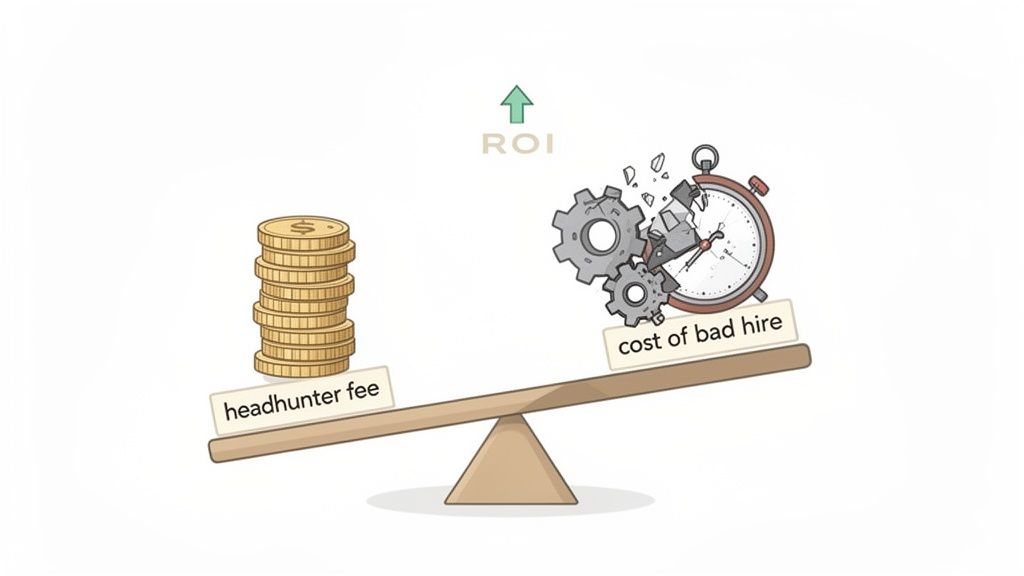
A typical headhunter's fee runs about 20-30% of the candidate's first-year salary. Yes, that sticker price can feel high at first glance, but you have to frame it as a strategic investment, not a simple expense.
Think about it this way: if a bad Director of Engineering hire costs your company $800,000 in project delays and team churn, a $60,000 headhunting fee to find the right one delivers an ROI of over 1,200%.
The investment in headhunting acts as an insurance policy against the catastrophic costs of a bad hire, securing your company's future growth and stability.
The return on your investment really comes from three places:
When you actually run the numbers, headhunting stops looking like a cost center and starts looking like a powerful financial tool.
Proof: Ramp, a Juicebox customer, closes roles 5x faster by using advanced AI sourcing to pinpoint ideal candidates. This dramatically slashes the cost associated with having those positions sit empty, saving them hundreds of thousands in lost productivity.
So, the question isn't whether you can afford to use a headhunter. The real question is, can you afford not to? The speed, quality, and access they bring to the table directly protect your company from the massive financial and cultural fallout of a bad senior hire. That makes it a no-brainer.
Modern headhunting isn't just about human intuition anymore; it's a powerful blend of that intuition and smart technology. For decades, the real bottleneck in finding top-tier talent wasn't the outreach or the negotiation—it was the painfully slow, manual slog of just finding the right people in the first place.
But there’s a problem most tools ignore.
This grunt work ate up countless hours that should have been spent building relationships. But that entire workflow is being turned on its head. The slow grind of crafting perfect Boolean strings and endlessly filtering databases is giving way to something faster, smarter, and way more intuitive. This is where AI steps in, completely shaking up the traditional headhunting playbook.
The old way of sourcing candidates was rigid and unforgiving. Headhunters had to become masters of complex Boolean logic, piecing together commands like (title:"software engineer" OR title:"SDE") AND ("fintech" OR "financial services") AND ("San Francisco" OR "SF") AND (NOT "intern"). One misplaced parenthesis and your whole search would crumble.
AI-powered tools are making that complexity obsolete. A tool like Juicebox's PeopleGPT acts as a modern headhunter's secret weapon, searching over 800 million profiles using simple, natural language. Instead of writing code, you just describe who you're looking for.
For instance, a headhunter can now just type a prompt into Juicebox like:
"Find software engineers in San Francisco who have worked at Series B fintech startups and have experience with payment APIs."
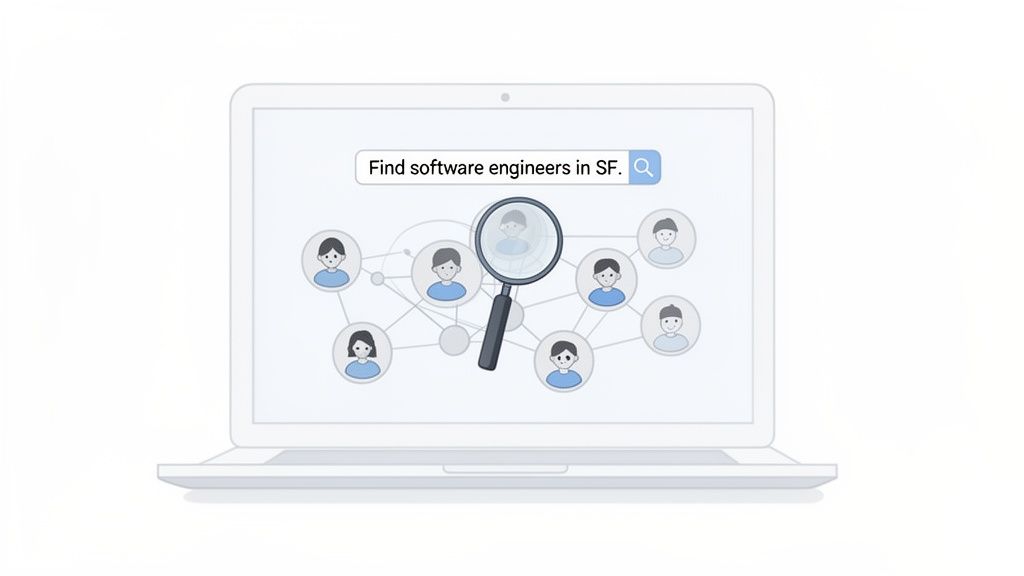
This simple, conversational prompt instantly pulls up a list of highly relevant candidates. This shift transforms days of tedious research into mere minutes of strategic sourcing. It frees up recruiters to focus on what humans do best: building connections, selling the vision, and closing candidates.
This is a massive strategic advantage, especially when inefficiency is so costly.
Teams are now interviewing 40% more candidates per hire compared to a few years ago, making speed more critical than ever.
You might think that leaning on AI means losing the human touch. But what if the opposite is true? By automating the most time-consuming parts of the job, AI gives headhunters the breathing room to be more human, not less.
Here’s what this really unlocks:
Understanding how to use AI for recruitment isn't just a "nice to have" skill anymore; it's a core competency for anyone serious about recruiting.
When you look at the ways recruitment firms use LinkedIn Recruiter to hire top talents, the core principle is the same. Technology amplifies a headhunter's ability to find and engage the right people faster and more accurately than ever before. It's about working smarter, not just harder.
So, the role is filled. Is that the finish line? Not even close.
The true impact of great headhunting isn't just plugging a gap in the org chart; it's about the strategic, long-term value that hire brings to the business. While old-school metrics like time-to-fill are easy to track, they tell you almost nothing about what really matters.
To understand the real ROI, you need to measure the quality of the hire. This means looking at metrics that tie directly back to business outcomes. Start by tracking the new hire’s actual performance. A strong recruitment process should deliver talent that absolutely crushes their first-year review.
By focusing on these strategic recruiting metrics, you stop talking about what is headhunting as a cost. Instead, you build a powerful business case that proves it’s a direct investment in long-term growth.
How do headhunters find candidates others can't?They go off-market, using deep industry networks, market mapping, and AI sourcing tools like PeopleGPT to pinpoint high-performing passive talent who aren't on job boards.
Is headhunting just for C-suite roles?No. It’s effective for any tough-to-fill role, like specialized engineers or data scientists, where top talent is rare and in high demand.
What does a headhunter typically cost?For a retained search, fees are usually 20-35% of the hire's first-year salary, reflecting the intensive work to find a perfect fit.
Can I headhunt without an agency?Absolutely. Modern AI sourcing platforms give in-house teams the same firepower, allowing you to engage elite passive candidates directly.
Ultimately, real headhunting is not about just plugging a hole in your org chart. It is a strategic talent acquisition method designed to secure the exact person who will drive your business forward.
This unlocks the ability to build elite teams with surgical precision. By moving beyond passively waiting for candidates and instead proactively targeting the absolute best in your industry, you gain a massive competitive advantage.
{{large_cta}}
Run your first search for free. Find and engage top talent across 800M+ profiles. Trusted by 5,000+ customers.

.png)
.png)


.png)