
.svg)
SIGN UP FOR JUICEBOX (IT’S FREE!)

Who are you looking for?
Thank you! Your submission has been received!
Oops! Something went wrong while submitting the form.

An employee referral program is a company’s secret weapon for hiring. It’s a structured recruiting strategy that encourages your current employees to recommend great people from their own networks. Think of it as turning your entire team into a squad of trusted talent scouts who already know what it takes to succeed at your company.
This isn't just a hiring channel; it's a proven method for finding higher-quality hires who stick around longer. In this guide, you'll learn now only what employee referral programs are but how to create a en employee referral program that actually works.
TL;DR: What is an Employee Referral Program?
An employee referral program is a structured internal recruiting method where a company encourages its current employees to refer qualified candidates from their networks for open positions. When a referred candidate is hired, the employee who referred them typically receives a reward or bonus. This strategy leverages trusted networks to improve hiring quality, speed, and employee retention, with data showing referred hires stay 70% longer.
Ever wonder how some companies seem to find incredible people so effortlessly, while others are stuck sifting through endless, mediocre job board applications? The answer is often a killer employee referral program. It’s a system built to tap into your most valuable asset—your current employees—to find your next great hires.
Here’s the bottom line.
Instead of casting a wide, generic net, you’re diving into curated networks of professionals who already have a trusted connection to your team. When an employee puts their name on the line for someone, they’re vouching for that person’s skills and character. That’s a powerful, first-level screening that most tools ignore.
At its heart, the main goal is to make hiring better, faster, and cheaper. By empowering your whole workforce to recruit, you can unlock some serious advantages:
Pattern Interrupt: Think about the last time a friend recommended a restaurant. You probably trusted their judgment more than a random online review, right? The same principle applies here.
The data on this is overwhelmingly clear. Employee referrals aren't just a "nice-to-have"; they're a cornerstone of modern recruiting. A whopping 84% of companies worldwide now have a referral program in place.
Their effectiveness is undeniable. Referrals boast a staggering 30% hiring rate for applicants, blowing the 7% average from other methods out of the water. In the U.S. alone, these programs are responsible for 30-50% of all new hires, making them absolutely essential for any company looking to scale efficiently. You can discover more insights about these employee referral statistics and see the numbers for yourself.
This isn’t a new idea, but its power has only grown. A great program creates a virtuous cycle: talented employees refer other talented people, who then strengthen the company culture and performance, making it an even more magnetic place to work. It’s a self-sustaining engine for attracting top-tier talent.
Let's be honest, not all hiring channels are created equal. Job boards might cast a wide net, but they often pull in a mountain of unqualified résumés. An employee referral program, on the other hand, is your precision tool. It consistently delivers higher-quality talent that gets up to speed faster and, most importantly, sticks around longer.
This isn't just a hunch; it's a strategic advantage built on three core pillars: hiring quality, speed, and retention.
The real magic of referrals is the built-in pre-vetting. When one of your team members recommends someone, they're putting their own reputation on the line. They're implicitly vouching for that person's skills, work ethic, and, crucially, their fit with your company culture. This initial filter is incredibly powerful.
Your best people know exactly what it takes to thrive at your company. They get the unspoken rules, the team dynamics, and the specific skills needed to get the job done right. This inside knowledge turns them into your best talent scouts, able to spot candidates who don't just look good on paper but are a genuine fit.
The numbers don't lie.

This data shows that a high hire rate and broad adoption make referrals a dominant force in modern recruiting. A staggering 82% of employers point to referrals as their top source for ROI. On top of that, 88% say referrals deliver the best-quality candidates. A well-oiled referral program is one of the best ways to recruit top talent because it creates a direct pipeline to people who are already warmed up to your company’s mission and values.
In recruiting, time is money. Every day a key role sits empty, it costs you in productivity and team morale. Referrals slash the hiring cycle. Some studies show referred candidates are hired up to 55% faster than those sourced from career sites.
Why so much faster? The applicant pool is stronger from the start, so you spend less time sifting through irrelevant résumés. You can find more strategies to reduce time-to-hire in our detailed guide.
But hiring quickly is only half the battle.
This is where referrals are unbeatable. Referred employees have a 70% higher retention rate after one year compared to hires from other sources. They show up on day one with a built-in support system—the person who referred them—which smooths their transition and helps them feel like part of the team right away.
Just look at SaaS company InVision. They launched a tiered referral program and cut their time-to-hire by 40% in just six months. That’s the kind of immediate impact a great referral strategy can have.
Knowing referral programs are powerful is one thing; building one that consistently delivers top talent is a whole different ball game. The difference between a program that spits out a trickle of candidates and one that becomes a core hiring engine often comes down to its design.
You might think building a great program requires a mountain of admin work. But that’s a common myth. The opposite is true. The best programs are built on simplicity, not complexity. They prioritize a frictionless process and compelling incentives, often automated by modern recruiting platforms that handle everything from tracking to payouts. This kills manual headaches and makes scaling a breeze.
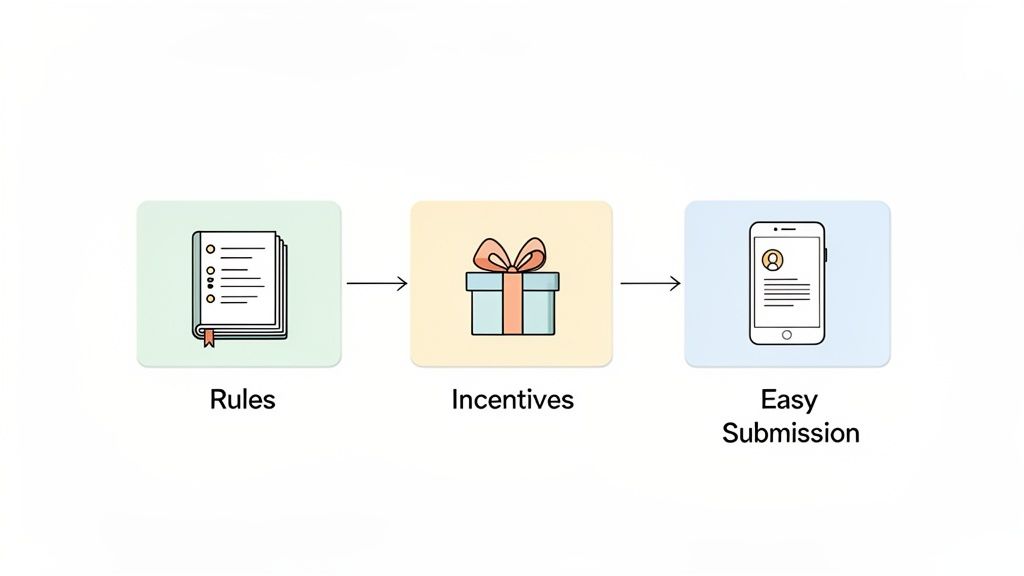
Complexity is the enemy of participation. Seriously. If your employees need a user manual to figure out the rules, they just won't bother. The whole process should be so straightforward that anyone can grasp it in under a minute.
Your rules need to clearly answer three basic questions:
Clarity here builds trust and gets rid of any gray areas that might make people hesitate to refer their network.
While most people genuinely want to help the company grow, let's be real—incentives are what drive consistent action. The key is to offer rewards that your team actually wants.
But wait, there's more.
While cash is king, non-monetary rewards can be just as powerful, especially if they tap into your company culture. Think about offering extra paid time off, a budget for professional development, or unique experiences. The right mix of rewards can appeal to a broader range of motivations and is a key part of your overall strategy for employee benefits.
To make sure your program actually delivers, it pays to study what works. This guide on how to create a referral program that actually works is a great place to start.
A brilliant employee referral program with great incentives is completely useless if nobody knows about it or trusts the process. Building the program is only half the battle; the real work is driving consistent, enthusiastic participation.
To get it right, you need a proactive, multi-channel internal marketing plan.
Think of your program's debut as a product launch. Your communication plan should hit multiple touchpoints:
But even the best promotional campaigns can fall flat because of one massive, often-ignored problem. So, what's the single biggest mistake companies make? It’s a complete lack of transparency and agonizingly slow feedback loops.
When an employee takes the time to refer a talented person, sending that referral into a black hole is the fastest way to kill their motivation. If they never hear what happened, they'll assume the program is a sham and will never participate again. Trust destroyed.
To maintain momentum, you must create a transparent process. Acknowledge every submission immediately. Provide regular, automated updates as the candidate moves through the interview stages.
This simple act of communication shows you value your employees' efforts. It reinforces that their contributions are seen and appreciated, which is fundamental to boosting employee engagement across the board. This is how you build a referral culture that lasts.
Pattern Interrupt: Ever sent an important email and got zero reply? That's exactly how your employees feel when their referrals disappear into the void.
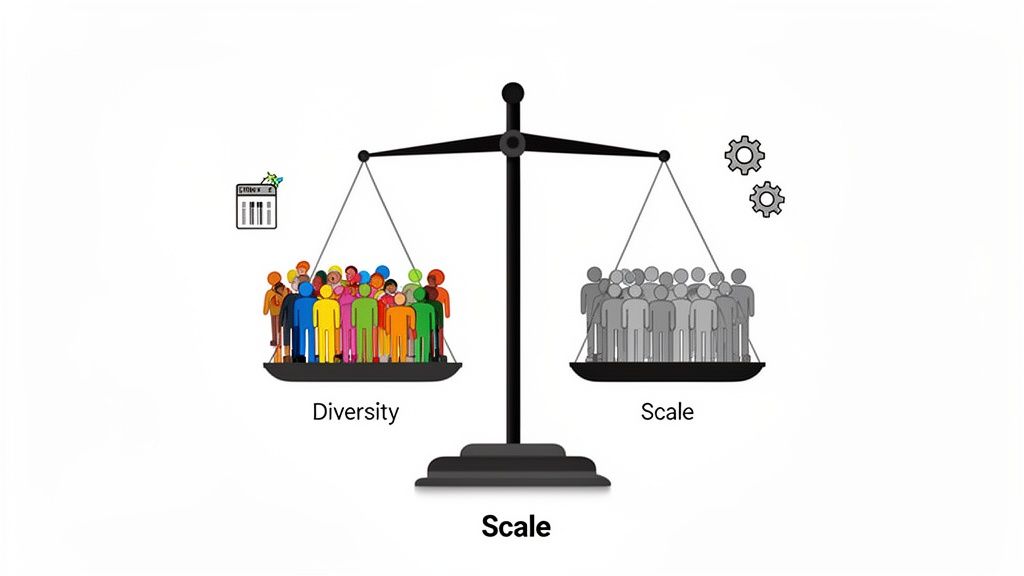
An employee referral program is fantastic, but if you lean on them too heavily, you can create some serious blind spots. The two biggest traps are accidentally building a homogenous workforce and failing to create a system that can scale.
Think about it. When employees mostly refer people from their own networks, you risk unintentionally cloning your existing team. This "like-for-like" hiring is a quiet killer of innovation and leads straight to a monoculture. This is a classic route to adverse impact in hiring.
You can’t just cross your fingers and hope for diverse referrals. You have to actively build a balanced pipeline. While your referral program is bringing in a steady stream of trusted candidates, you need to simultaneously use modern tools like AI recruiting tools to find great talent from underrepresented backgrounds.
This is where you can bring in a powerful sourcing tool like PeopleGPT to find talent outside your team's immediate network, ensuring you're building a truly representative talent pool.
The second major pitfall is scale. Let’s be honest, trying to track referrals with spreadsheets is a recipe for disaster once your company starts to grow. An integrated system, ideally built right into your Applicant Tracking System (ATS), is the only way to scale effectively.
On average, it takes about 15 referrals to land one hire. That ratio alone tells you that a robust, multi-channel sourcing strategy is essential. Referrals are a vital piece of the puzzle, but they can't be the only piece.
Bonuses range from $1,000–$5,000, but can be much higher for hard-to-fill senior roles. Tier bonuses based on role difficulty.
Over-reliance can lead to a homogenous workforce. Pair your program with proactive sourcing from diverse talent pools to ensure balance.
Spreadsheets don't scale. Use an Applicant Tracking System (ATS) to automate tracking, ensure transparency, and gather performance data.
An employee referral program isn't just another hiring channel. It's the engine that builds a high-performance, high-retention culture. By empowering your team to become your best talent scouts, you aren't just filling roles faster—you’re creating a powerful competitive advantage in the war for talent.
What this unlocks is a self-sustaining cycle where great people bring in more great people, cementing your company’s reputation as an employer of choice. This is a core pillar for any company aiming to streamline their recruitment process.
{{large_cta}}
Run your first search for free. Find and engage top talent across 800M+ profiles. Trusted by 5,000+ customers.

.png)