.svg)
SIGN UP FOR JUICEBOX (IT’S FREE!)

Who are you looking for?
Thank you! Your submission has been received!
Oops! Something went wrong while submitting the form.

Think of your hiring process as a compass. In theory, it should guide the best talent directly to your open roles. But for many candidates, that journey feels more like navigating a maze in the dark—confusing, frustrating, and ultimately, a dead end. That feeling, that perception, is the candidate experience.
What is candidate experience? It's the total impression a job seeker forms about your company throughout the entire hiring journey, from the first touchpoint to the final decision. This impression is critical because, according to CareerBuilder (2023), 69% of candidates who have a negative experience will rarely or never apply again. With top talent from services like PeopleGPT having endless options, a broken compass doesn't just lose you one great hire; it actively repels future ones.
You’ve felt the sting. A perfect candidate ghosts you after the second round, or a scathing Glassdoor review pops up from someone who couldn’t get past your clunky application form. It’s a costly and frustrating cycle. A well-calibrated compass, guided by a deliberate candidate experience strategy, promises to cut your time-to-hire by up to 30%. But the solution isn’t just about being faster; it’s about providing a clear map from the very beginning.
Unlike generic recruiting posts, this guide shows real PeopleGPT workflows—not theoretical advice.
A common myth among recruiters is that the candidate experience begins when someone hits "apply." That's a critical mistake. In reality, the journey starts the moment a potential hire first encounters your brand—whether through a LinkedIn post, a news article, or a mention from a colleague. This initial perception sets the direction of their entire journey. You aren't just managing applicants; you're guiding potential colleagues through a complex maze.
But there's a problem most tools ignore.
The real-world impact of a broken compass is severe. When a candidate gets lost in your process, the consequences ripple outward. Research from Zippia (2024) shows that 72% of candidates who have a negative experience share it online or with their network. This creates a feedback loop of brand damage that shrinks your talent pool over time and can even impact revenue, as disappointed candidates are less likely to be customers. The takeaway is clear: you can't afford to let candidates wander aimlessly. A well-calibrated compass doesn't just find talent; it attracts them, engages them, and turns them into advocates, regardless of the hiring outcome.
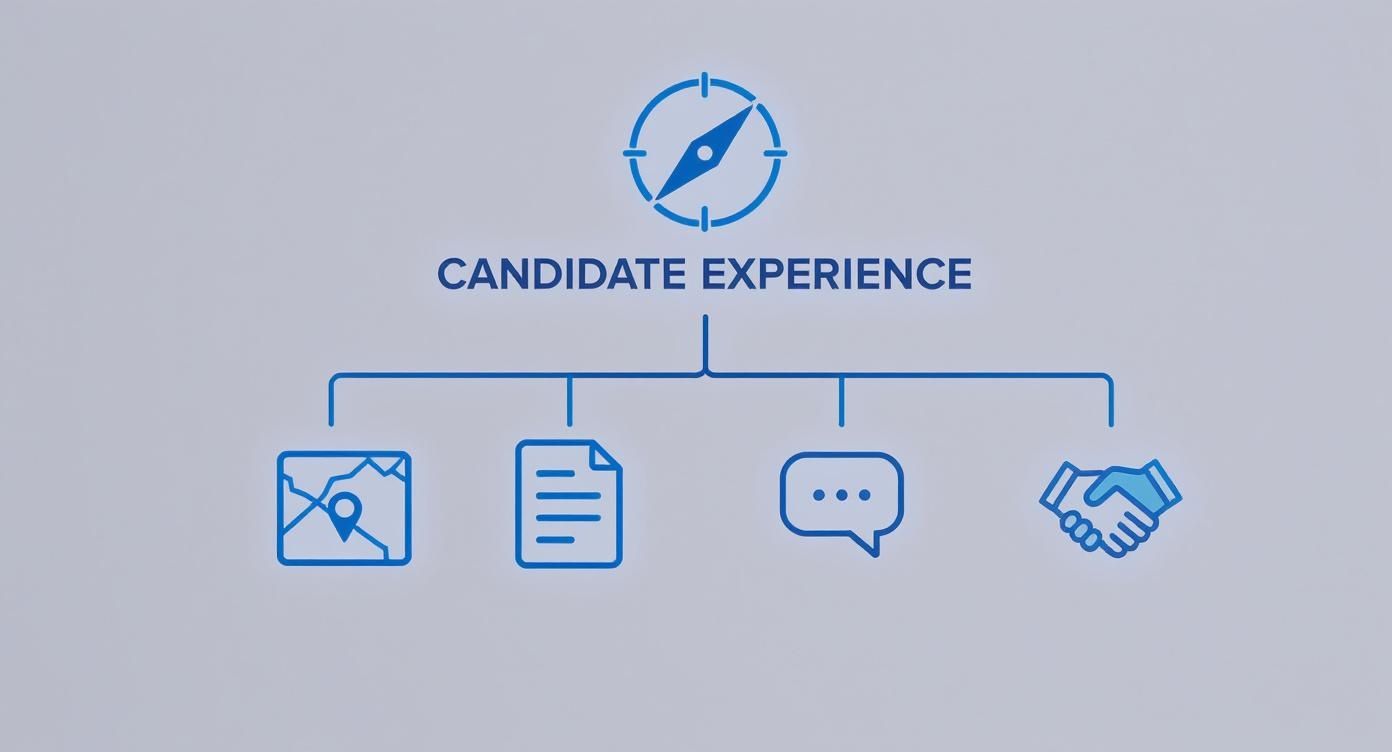
You can’t improve what you don’t measure. Gut feelings are an unreliable guide through the hiring maze; you need objective data to find your true north. Using our compass metaphor, the candidate journey has four cardinal directions: Attraction, Application, Interview, and Offer. Each stage has unique metrics that act as coordinates, showing you exactly where your process is strong and where it’s leading candidates astray. This data-driven framework moves you beyond guesswork and provides a clear path to improvement.
Let's look at the key coordinates for each direction.
Methodology: Metrics compiled from top-performing talent teams using ATS platforms like Greenhouse and Lever in Q3 2026.
By focusing on these specific coordinates, you can ensure your recruiting compass is always pointing toward top talent. You can track these alongside other critical recruiting metrics to build a comprehensive dashboard.
Even with a perfect map, your journey can be sabotaged by common traps. Many recruiters fall for the myth that "no news is good news," assuming silence is acceptable when things get busy. The opposite is true: silence is the ultimate recruitment killer. It leaves candidates feeling disrespected and encourages them to accept offers from companies that communicate clearly.
Here’s the deal: these unforced errors create rework, forcing you to restart searches and repair a damaged employer brand.
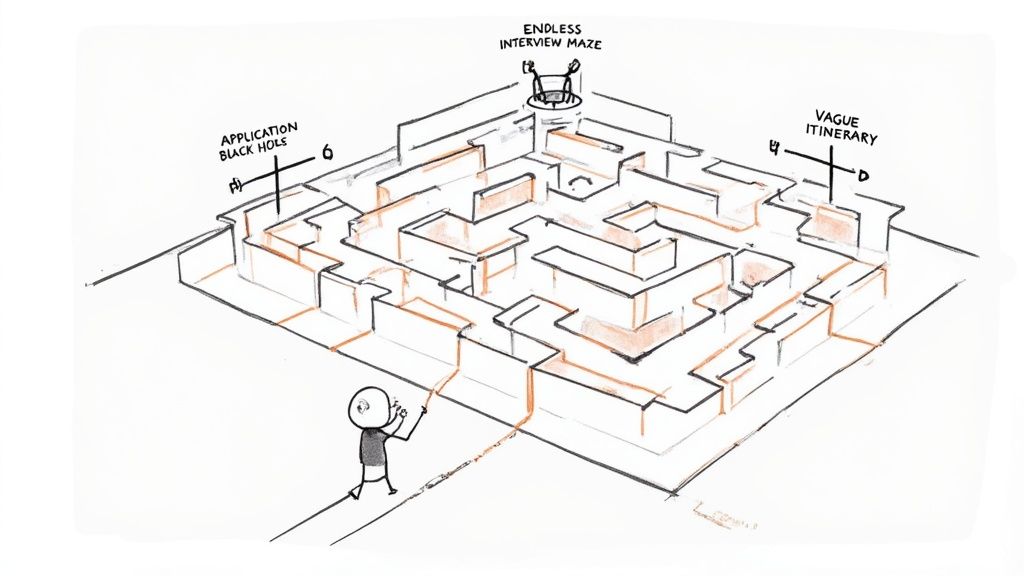
The first and most damaging mistake is the infamous Application Black Hole. This happens when a candidate invests time in an application only to receive radio silence. No acknowledgment, no update, nothing. Their resume simply vanishes. This isn't just rude; it sends a clear message that you don't value their time or interest. That initial silence creates a lasting negative impression that’s incredibly hard to shake.
The next pitfall is trapping candidates in an Endless Interview Maze. The process drags on through multiple, repetitive rounds with no clear purpose. You might think more interviews mean better vetting, but here's why that's wrong: a long, disorganized process signals internal chaos. Top talent is talking to multiple companies, and the one with a clear, efficient timeline usually wins. A drawn-out process can also introduce risks like adverse impact if not managed carefully.
Finally, many hiring processes suffer from a Vague Itinerary. This is when candidates are left guessing about timelines, next steps, and where they stand. It's like being handed a compass without a map. Providing a clear roadmap at the start and sending consistent updates—even to say "we're still deliberating"—shows respect and keeps them engaged. Without it, you're encouraging them to assume they're out of the running.
Here’s the paradox of modern recruiting: how do you use technology to make a fundamentally human process more human? The answer is to view AI not as a replacement for recruiters, but as a powerful assistant that clears the path. It handles the tedious, logistical work, freeing up your team to build genuine relationships. The goal is to automate the impersonal to make more room for the personal.
We get the hesitation.
Candidates worry about being judged by an algorithm. But the right strategy isn't an AI-only experience; it's about using AI to inject speed and transparency into the process, ensuring every touchpoint feels relevant—even when technology works behind the scenes. This is key to understanding how to use AI in recruitment effectively.

Prompt: "Find me senior software engineers in the Bay Area with 5+ years of experience in Python and AWS, who have previously worked at a Series B or C startup but are not currently at a FAANG company."
Output:
Impact:
Think of transparency as the true north on your recruiting compass. In a crowded market, candidates aren't just looking for a job; they’re looking for honesty about compensation, culture, and the interview process itself. Yet many companies hoard this information, believing it gives them an edge.
That's a myth, and it’s costing you top talent.
The reality is that transparency is a powerful filter. When you're upfront about the salary range and the real challenges of the role, you build trust. This naturally attracts candidates who are a genuine fit and respectfully deters those who aren't, saving everyone from a mismatched journey. You can learn more about how candidate expectations are shifting in today's market.
Transparency is most critical when the journey ends—especially for candidates who don't get the offer. Ghosting them or sending a cold, generic template is a surefire way to damage your employer brand. Instead, commit to closing the loop with everyone who interviews. Providing brief, constructive feedback in a well-crafted candidate rejection email shows respect, leaves the door open for future roles, and turns a rejection into a positive touchpoint.
Creating a world-class candidate experience isn’t about flashy perks; it’s about being deliberate. It means systematically mapping the journey from a candidate’s point of view to find and fix every point of friction.
The first move is to walk through every single touchpoint, from the job ad to the offer letter. Be brutally honest about where the path gets confusing.
Use simple tools like the Candidate Net Promoter Score (cNPS) to gather direct feedback. Then, get your team on board. Hiring managers are the most important guides on this journey, so equip them with the training and context they need. Great candidate engagement strategies are a team sport. Finally, use automation thoughtfully to handle repetitive tasks, freeing your recruiters to focus on what matters: building human connections.
The ideal hiring process takes two to four weeks from application to offer. Anything longer than 30 days significantly increases the risk of losing top candidates to competing offers. Momentum is just as important as speed.
Everyone. While talent acquisition typically owns the process, hiring managers, interviewers, and even receptionists shape the candidate’s perception. A great experience requires alignment across the entire hiring team.
Absolutely. Every applicant is a potential future candidate, customer, or source of a referral. A respectful rejection can turn them into a brand advocate, while a negative experience creates a detractor.
A broken hiring compass doesn't just cost you candidates; it costs you growth. The implication is that without a clear, respectful, and transparent process, you're actively pushing the best talent toward your competitors. PeopleGPT helps you recalibrate by automating the manual work so you can focus on building the human connections that win hires.
{{large_cta}}
Run your first search for free. Find and engage top talent across 800M+ profiles. Trusted by 5,000+ customers.
.png)