.svg)
SIGN UP FOR JUICEBOX (IT’S FREE!)

Who are you looking for?
Thank you! Your submission has been received!
Oops! Something went wrong while submitting the form.

A new hire's first 24 hours are a critical inflection point. A generic "welcome aboard" email is more than just a missed opportunity; it’s a silent signal that their journey might be less thoughtful than the one that brought them here.
Most onboarding messages dutifully cover logistics: start times, who to meet, where to find the coffee machine.
But the best welcome to the team messages do something far more strategic. They resell the new hire on their decision, reinforcing the core value proposition of the role and the company, making the employee feel like they've just unlocked a career advantage.
TL;DR: The Best "Welcome to the Team" Message Frameworks
This guide moves beyond platitudes. We will break down eight distinct frameworks for crafting impactful welcome messages, from quick Slack DMs to formal onboarding emails. Each example is built not just to welcome, but to activate a new team member from their very first interaction. You might think a simple "hello" is sufficient, but a well-crafted message can significantly improve ramp-up time and long-term retention. According to a 2022 Gallup analysis, a structured onboarding experience makes employees 2.6 times more likely to be extremely satisfied with their workplace.
The secret isn't a longer email or a fancier graphic. It’s about precision. The key is to connect the greeting to a core company value, turning a simple administrative task into a powerful reinforcement of why they chose to join your team. Here, we'll dissect the templates, tactics, and psychological triggers used by high-growth companies to ensure their welcome to the team message lands with maximum impact. One of our core differentiators is how we use AI not just for sourcing, but for creating a more intuitive and efficient recruiting workflow, a principle that starts with this very first message.
The best "welcome to the team" messages don't just celebrate a new beginning; they deliver immediate value. The Quick-Win Onboarding Welcome is a high-impact strategy that shifts the focus from passive orientation to active achievement. Instead of a generic greeting, this message immediately demonstrates how the new tool, process, or role will save time or solve a critical pain point, validating the new hire’s decision to join from the very first interaction.
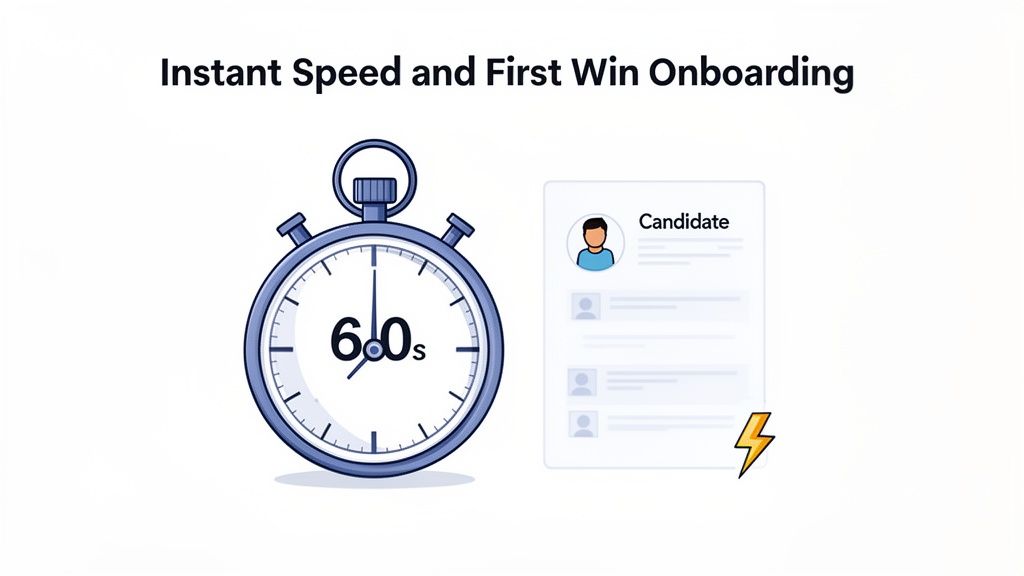
Popularized by product-led growth (PLG) companies like Notion and Zapier, this method proves the product’s core promise within minutes. For a recruiter using a tool like Juicebox, it’s the difference between saying "Welcome!" and "Welcome! Let's find your first qualified candidate in the next 60 seconds." This transforms the initial onboarding from a checklist of tasks into an exciting first win.
This approach centers on a specific, quantifiable, and immediate benefit. By leading with your most compelling value proposition, you create an "aha!" moment that builds momentum and confidence. It's a key part of an effective strategy for automated employee onboarding because it replaces administrative fluff with tangible results.
Example 1: Slack/Teams Welcome
Welcome to Juicebox, [New Teammate]! Your first candidate search takes 60 seconds. Click here to try PeopleGPT and find 10 qualified software engineers right now → [Link]Example 2: Onboarding Email
Hi [Name], thrilled to have you on the team! Let's skip the long setup. Most recruiters cut their sourcing time by 80% with our AI. Ready to see how? Click below to run a pre-built search for a [Specific Role, e.g., Senior Product Manager] in your target industry. It takes less than a minute. [CTA Button: Find Candidates Now]A powerful welcome to the team message for a new recruiter isn't just a greeting; it's an immediate upgrade to their toolkit. The Multi-Source Data Authority Welcome establishes instant credibility by showcasing the breadth of data they now command. Instead of being limited to a single, saturated talent pool like LinkedIn, this message frames their new role as a competitive advantage, giving them access to a hidden market of candidates.
This approach, popularized by data aggregation leaders like HireEZ and Findem, shifts the conversation from "here's another tool" to "here's your new unfair advantage." It directly addresses the core pain point for recruiters: hitting the limits of single-source platforms and struggling to find unique, high-quality talent. By emphasizing access to over 800 million profiles, the welcome message confirms the recruiter made the right choice by joining a team with superior resources. This is particularly valuable when sourcing for roles covered in our freelance recruiter guide.
This strategy leads with a powerful, quantifiable claim about data access to build trust and differentiate your toolset from day one. It's about immediately positioning the new hire as a strategic partner armed with comprehensive market intelligence. This tactic is a cornerstone of effective data-driven recruitment because it transforms the perception of sourcing from a reactive task into a proactive, intelligence-led function.
Example 1: Onboarding Email
Hi [Name], we're thrilled to welcome you to the team. You're now equipped with Juicebox, which connects you to over 800M profiles across GitHub, AngelList, Crunchbase, Indeed, and 25+ other sources. You're no longer limited to the same pool everyone else is fishing in. Let's find your first hidden gem. [CTA Button: Start Your First Multi-Source Search]Example 2: In-App Tooltip (First Login)
Expand your candidate pool instantly. 80% of winning hires at top tech companies are found outside of LinkedIn. With Juicebox, you have access to all of them. Welcome aboard!The most effective welcome to the team messages immediately solve a nagging, persistent problem. The No-Boolean Simplification Welcome targets one of the most tedious aspects of recruiting: wrestling with complex search strings. This approach frames your tool or process as a liberating alternative to the rigid, symbol-heavy syntax of traditional Boolean search, promising a faster and more intuitive workflow.

Popularized by the conversational interfaces of tools like ChatGPT and Perplexity AI, this "just talk to it" positioning resonates deeply with recruiters tired of debugging queries like ("java" OR "python") AND "aws" AND NOT ("intern" OR "junior"). Instead of a generic greeting, this welcome message demonstrates that the new hire can now source talent simply by describing their ideal candidate in plain English.
This strategy works by directly contrasting the old, painful way with the new, simplified solution. You aren't just introducing a feature; you are eliminating a well-known source of friction. By showing how natural language replaces confusing operators, you deliver an immediate sense of relief and empowerment. This method is a cornerstone of modern AI-powered tools that prioritize user experience and is a powerful component of any system for automated resume screening, as it streamlines the very first step of the funnel.
Example 1: Onboarding Email
Hi [Name], welcome to the team! Say goodbye to complex Boolean strings. With PeopleGPT, you just describe the candidate you're looking for. Try it now: find "Backend engineers in SF with Kubernetes experience who founded startups." No weird symbols, just results. [CTA Button: Run Your First Search]Example 2: In-App Onboarding Message
Welcome, [Name]! Tired of parentheses and quotation marks? Just tell PeopleGPT what you need. Click here to see how "Senior product managers in New York with fintech experience at a Series B company" instantly finds qualified candidates. [Link to Pre-Built Search]For leaders in talent acquisition, every tool must justify its existence through ROI. The Cost Efficiency Champion Welcome moves beyond a simple "hello" and immediately frames the conversation around tangible savings. It's designed for budget-conscious TA Directors and CFOs who need to see a clear financial upside, transforming the initial welcome from a pleasantry into a powerful business case.
This welcome to the team message directly contrasts your platform’s value against expensive incumbents. Instead of just highlighting features, it emphasizes the dramatic cost reduction, often citing an 80% or greater saving compared to tools like LinkedIn Recruiter. By anchoring the conversation in dollars and cents from the first touchpoint, you validate the purchasing decision and arm your new user with the data they need to champion the tool internally.
This strategy works by quantifying value in the most universally understood language: money. It preemptively answers the "Is this worth it?" question by presenting a stark, undeniable comparison. It's particularly effective for users in an evaluation or trial phase, as it provides clear justification for full adoption and helps them understand the direct impact on their cost-per-hire metrics.
Example 1: Onboarding Email for a TA Director
Hi [Name], great to have you with us. Let’s get straight to the point. The average LinkedIn Recruiter seat costs $10,800 per year. Your new Juicebox seat is just $1,188. That’s an immediate saving of ~$9,600 annually with 2x the sourcing capabilities. Ready to put those savings to work? [CTA Button: Start Sourcing Now]Example 2: In-App Banner for New Users
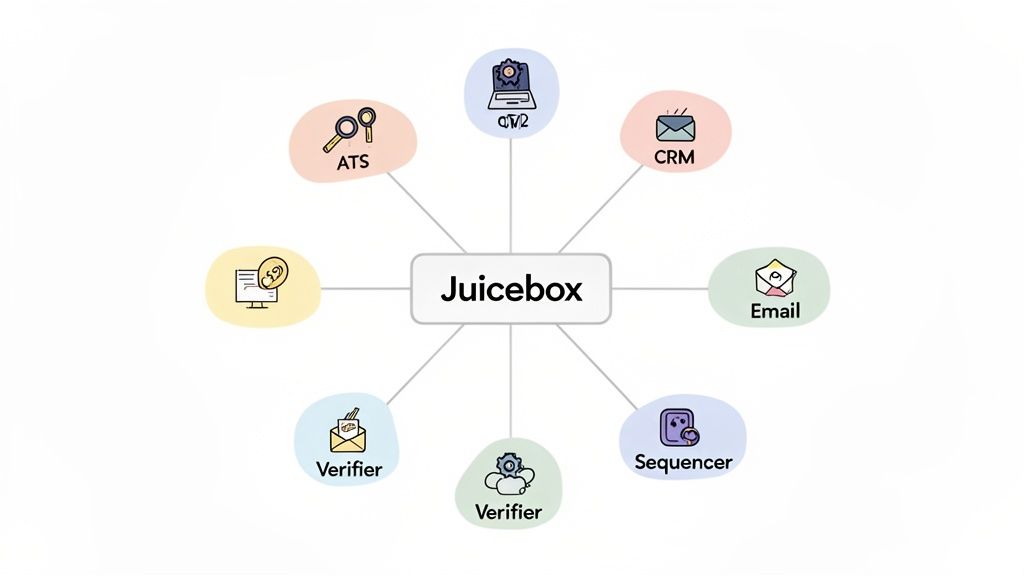
Welcome to the team! At LinkedIn Recruiter rates, running your first search would cost ~$45. With Juicebox, it's included in your $99/mo plan. You're already ahead.The most effective "welcome to the team" messages solve problems immediately, and for modern TA teams, tool fatigue is a massive one. The Integration & Consolidation Welcome positions your platform not as another tool to manage, but as the central hub that simplifies a fragmented workflow. This message immediately addresses the pain of juggling multiple systems by highlighting how your product connects everything, saving time and eliminating manual data entry from day one.
This strategy, pioneered by integration-first platforms like Zapier and HubSpot, shifts the onboarding focus from learning a new interface to enhancing an existing one. Instead of saying, "Welcome, here’s our tool," it says, "Welcome, let's make your existing Greenhouse and Slack workflow 10x more powerful." It turns the welcome message into a powerful demonstration of efficiency and a direct solution to context-switching. Learning how to streamline your recruitment process is key to this consolidation.
This approach works by immediately framing your tool as the missing link in the user's current tech stack. It's less about your features in isolation and more about how they amplify the value of tools the recruiter already uses daily. By focusing on deep integration with a user's ATS or CRM, you make your product indispensable and prove its ROI within minutes of their first login.
Example 1: Onboarding Email
Welcome to the team, [Name]! Ready to stop switching between tabs? Let's connect Juicebox to your ATS. In 60 seconds, you can sync candidates directly from search → outreach → Greenhouse without leaving our platform. [CTA Button: Connect Greenhouse Now]Example 2: Slack/Teams Welcome
Hey [New Teammate], welcome to Juicebox! Quick question: does your team use Lever, Ashby, or Greenhouse? We have native integrations that make syncing candidates seamless. Click here for a quick-start guide on setting it up → [Link]The most forward-thinking "welcome to the team" message isn't just a greeting; it's an activation. The Autonomous Agent Welcome introduces a new paradigm where recruiting moves from manual, active sourcing to automated, passive candidate discovery. This message immediately positions a tool like Juicebox not as a search bar, but as a tireless, AI-powered teammate that works around the clock.
This strategy appeals to growth-focused teams who understand that the future of talent acquisition is moving beyond human-initiated searches. Inspired by the agentic automation seen in tools from OpenAI and Clay, this welcome reframes the onboarding experience from "let's start searching" to "let's put your new recruiting agent to work." It shifts the value proposition from saving time on searches to eliminating the need for them entirely. This is a core component of the top 10 AI recruiting tools for 2026.
This approach works by introducing the concept of a persistent, learning AI agent that sources candidates 24/7. Your welcome message becomes the trigger to deploy this "digital recruiter." Instead of teaching a new hire how to use a tool, you're showing them how to delegate a core function to AI, freeing them up for higher-value tasks like candidate engagement and closing.
Example 1: Onboarding Email
Welcome to Juicebox, [Name]! To get started, we've activated your autonomous Juicebox Agent. It will source candidates for your open roles 24/7 and learn from your feedback. Check your inbox tomorrow morning for the first batch of qualified candidates. No manual searching required. [CTA Button: Configure Your Agent's Priorities]Example 2: Week-2 Follow-up Slack Message
Hi [Name], just checking in. Your Juicebox Agent has been working for you this past week. It sourced 47 potential candidates for the Senior Backend Engineer role while you were offline. Want to review its performance and give feedback to make it smarter? Here's the activity log → [Link to Dashboard]The most strategic welcome to the team messages go beyond simple greetings; they provide immediate business intelligence. The Talent Market Intelligence Welcome positions your tool not just as a search utility but as a strategic planning partner. Instead of focusing solely on finding candidates, this message empowers senior talent leaders with the data they need to inform hiring strategy, validate headcount planning, and de-risk their talent pipeline from day one.
Popularized by platforms like Eightfold AI and LinkedIn Recruiter Insights, this method shifts the conversation from sourcing tactics to talent strategy. For a VP of Talent Acquisition using Juicebox, it’s the difference between "Welcome!" and "Welcome! Here’s the real-time supply, salary, and diversity data for Backend Engineers in San Francisco to validate your Q4 hiring plan." This immediately demonstrates deep value for leaders who are accountable for more than just filling individual roles.
This approach centers on providing actionable, market-level data that answers strategic business questions. By leading with macro-level insights, you prove your platform’s value for high-level planning and decision-making, cementing its role as an indispensable part of their toolkit. This welcome is crucial for any effective talent intelligence strategy because it frames the tool as a source of truth for the entire talent function.
Example 1: TA Director Welcome Email
Hi [Name], great to have you with us. Before you run your first search, let's look at the market. Our Talent Insights show the current supply/demand, salary ranges, and diversity benchmarks for your key roles. See the live data for [Target Role, e.g., Senior AI Engineers] in your market → [Link to Pre-built Insights Dashboard]Example 2: In-App Onboarding Prompt
Welcome, [Name]! Let's get a pulse on your market. Here’s a snapshot for Backend Engineers in SF: 12,000 active candidates, an average salary of $180-220K, and 28% are women. Click here to adjust the filters and explore insights for your other open roles. [CTA Button: Explore Talent Insights]Hiring your first technical employee is a high-stakes, often intimidating milestone for a solo founder or early-stage CEO. The Founder & Solo Hire Welcome is a specialized message that acknowledges this unique pressure, shifting the tone from a generic product introduction to that of a trusted co-pilot. It replaces corporate jargon with empathy and positions your tool as a simple, powerful ally that demystifies a complex process.
This approach, popularized by founder-centric companies like Stripe and Notion, recognizes that the user's primary goal isn't just to use a tool, but to overcome a significant business hurdle. It's the difference between saying "Here's our software" and "Welcome to the team! We know hiring your first engineer is tough. We're here to make it simple." This builds immediate trust and positions the product as an indispensable guide, not just another subscription.
This welcome message centers on empathy, education, and accessibility. It immediately addresses the founder's specific pain points (fear, uncertainty, lack of expertise) and offers a clear, jargon-free path to a tangible win. This is a critical first step for any new venture. After all, a founder's initial decisions, such as choosing the right business structure, set the foundation for future success, and their first hires are just as fundamental.
Example 1: Onboarding Email
Hey [Name]—we know that hiring your first engineer is hard. Juicebox removes the guesswork. Here's a 2-step plan to find 5 great candidates in the next 30 minutes: 1. Use our pre-built 'Senior Backend Engineer' template. 2. Instantly see 100+ profiles. Let’s go! [CTA Button: Find Your First Engineer]Example 2: In-App Welcome Prompt
First time hiring engineers? We've got you covered. This 5-minute playbook will walk you through writing the job description, sourcing candidates, and what to ask in the interview. [Link to Founder Hiring Guide]What's the best time to send a welcome to the team message?
Send it the business day before their start date. This builds excitement and gives them key info without overwhelming their first morning.
How long should a welcome email be?
Aim for 100–150 words. The goal is to be concise, impactful, and easy to scan. Link out to more detailed onboarding documents.
Who should send the welcome to the team email?
The hiring manager should send the primary welcome. A team-wide welcome via Slack or email on their first day is also a great practice.
Should I include logistics like start time in the welcome message?
Yes, briefly confirm the essentials: start time, location (or video link), and who they'll meet first. Keep it simple and clear.
Throughout this guide, we've dissected the anatomy of a powerful welcome to the team message. We've moved beyond generic templates to reveal the strategic mechanisms that turn a simple greeting into a cornerstone of your onboarding and retention strategy. The core takeaway is this: your first official communication with a new hire isn't just a formality; it's the first tangible proof of your company's culture, efficiency, and commitment to their success.
You might think a welcome email is just a minor administrative task. But this perspective misses a critical opportunity. A Gallup study found that only 12% of employees strongly agree their organization does a great job of onboarding new employees. This massive gap is where you can gain a significant competitive advantage. A strategic welcome to the team message directly addresses this gap by setting clear expectations, building immediate rapport, and validating the new hire's decision to join you.
What does this unlock? It unlocks a faster, more effective integration of talent into your organization. Instead of a new hire spending their first week lost in a sea of paperwork and ambiguity, they arrive feeling prepared, valued, and connected to their team's mission from the very first minute. This is the difference between an employee who is simply present and one who is truly engaged.
We've explored a range of approaches, from the quick-win message that builds immediate momentum to the data-driven welcome that showcases your strategic advantage. Let's distill the most critical, replicable insights:
Ultimately, your welcome message is a high-leverage, low-cost investment in long-term employee retention. It's an opportunity to prove that your company operates with the same intentionality and excellence that you expect from your new hire.
Of course, a single message, no matter how well-crafted, is just one piece of the puzzle. To truly turn your welcome message into a retention tool, it must be supported by a seamless administrative and operational backbone. Ensuring the logistics are handled flawlessly allows the human element of the welcome to shine. To effectively turn your welcome message into a retention tool, ensuring seamless administrative processes is key. Discover the benefits of using the best HR software for startups to automate and streamline these crucial early-stage tasks. When new hires aren't bogged down by clunky paperwork, they can focus on what matters: integrating with their team and starting to contribute.
The best welcome messages are a reflection of a well-oiled machine, one that values an employee's time and energy from the very beginning.
The templates and frameworks in this guide are your starting point. The next step is to codify this process. Create your own internal playbook, A/B test different subject lines and message structures, and gather feedback from new hires on their onboarding experience. The goal is to build a systematic, repeatable process that consistently delivers a world-class welcome.
By mastering the art of the welcome to the team message, you are not just improving your onboarding process. You are building a stronger, more engaged, and more resilient organization, one new hire at a time. This deliberate approach sends a clear signal: we are thrilled you are here, we are prepared for you, and we are invested in your success.
The core benefit of a strategic welcome is activating new hires faster. This unlocks a more engaged and productive team from day one, turning a simple administrative task into a powerful lever for retention and performance.
{{large_cta}}
Run your first search for free. Find and engage top talent across 800M+ profiles. Trusted by 5,000+ customers.

.png)

.png)