.svg)
SIGN UP FOR JUICEBOX (IT’S FREE!)

Who are you looking for?
Thank you! Your submission has been received!
Oops! Something went wrong while submitting the form.

Unlimited PTO can feel like a maze—a powerful perk for attracting top talent that can just as easily lead to burnout if not managed carefully. The bottom line up front: a successful unlimited PTO policy isn't about removing limits, but about building a culture where rest is a strategic tool for high performance.
Unlike generic guides, this post integrates real recruiter workflows and AI sourcing examples powered by PeopleGPT. We'll show you how to construct a policy that serves as a bridge to a healthier, more productive culture.

Unlimited Paid Time Off (PTO) is one of the most powerful—and misunderstood—perks in modern hiring. It can be a massive draw for top-tier talent, but it can also accidentally create a culture of burnout. This guide is your blueprint for navigating the maze, moving past generic advice to give you a real framework for a policy built on trust and clarity.
In the United States, where there's no federal law mandating paid vacation, policies vary wildly. The appeal of unlimited PTO is obvious: it signals trust and gives employees a sense of autonomy. But here's the paradox: without clear rules and a culture that actively supports taking time off, "unlimited" can feel like "never." Employees get nervous about asking for leave and end up taking less vacation than their counterparts on traditional plans.
A successful policy isn't just about removing limits; it's about building a bridge to a culture where taking restorative time off is encouraged and modeled from the top down. A great policy should boost well-being, not create anxiety. To get into the weeds of making this work, a comprehensive guide to unlimited time off is a fantastic resource, but our goal here is to give you the insights to build a program that genuinely works for your company and your people.
An unlimited PTO policy isn't just a document; it's an entire support structure. Think of it as a bridge connecting your company to a culture of trust and high performance. For that bridge to be sturdy, it needs three non-negotiable pillars: authentic leadership buy-in, crystal-clear communication, and deep psychological safety. Without these supports, even the most generous policy can buckle under the weight of ambiguity.
This is the single most important factor. If your leaders visibly model healthy time-off habits, the policy will work. If they're firing off emails at 10 PM on a Saturday or bragging about never taking a vacation, employees get the real message: the policy is just for show. True buy-in is a leader's out-of-office message for a week-long trip, celebrated openly. This gives the whole organization permission to unplug and reinforces that rest is part of the performance cycle.
Ambiguity is the enemy of autonomy. An effective unlimited PTO policy needs clear, well-communicated guidelines that answer key questions before they're asked. Without them, employees are left guessing, which usually means they take less time off for fear of breaking an unwritten rule. Your guidelines should explicitly cover request protocols, coverage plans, and performance expectations. Many successful policies even include a mandatory minimum—say, 15 days—to fight burnout.
As you build out your framework, a downloadable work from home policy template can be useful for structuring your approach, especially for remote arrangements.
Employees won't use a benefit if they fear it will hurt their career. Psychological safety is the bedrock belief that taking time off won't get you passed over for a promotion or seen as less committed. Fostering this environment means training managers to have supportive conversations about workload and well-being. It also helps to integrate these conversations with broader performance and pay strategies. To see how these pieces connect, check out our guide on modern compensation intelligence.
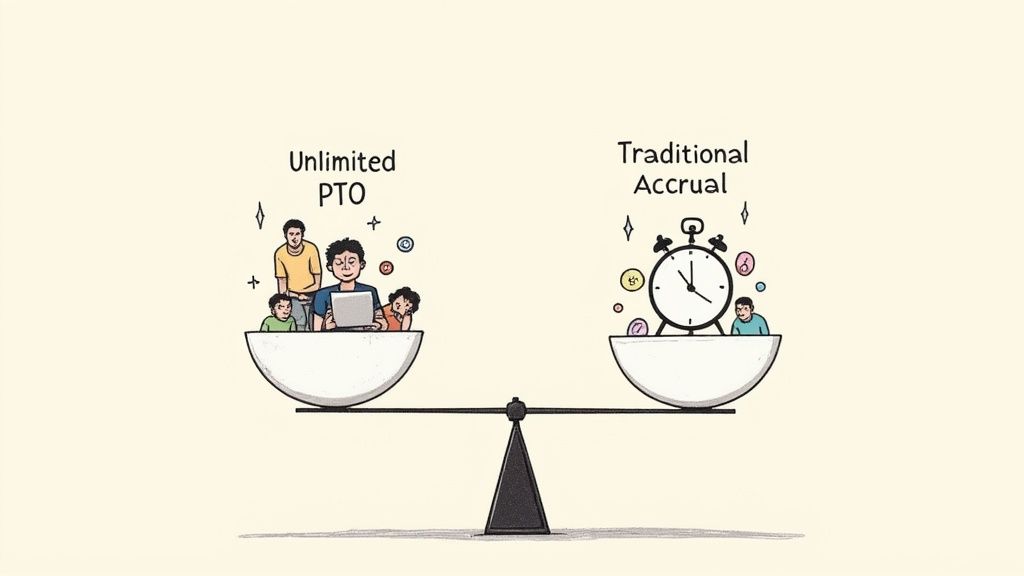
The choice between unlimited and traditional PTO is a massive signal about your company culture. One policy is a bridge built on trust and autonomy, while the other is a structured pathway offering predictability. The real split boils down to how your company measures contribution. Traditional accrual is built on tenure and time, while an unlimited PTO policy is built on trust and performance. It shifts the focus from hours logged to results delivered—a powerful magnet for high-achievers.
But that freedom can be a double-edged sword. A 2022 Namely survey found that employees with unlimited PTO took an average of just 13 days off per year, compared to 15 days for those with traditional plans. This stat is a huge red flag, showing how cultural pressure can undermine a flexible benefit. The team at WFA has great insights into these psychological hurdles.
FeatureUnlimited PTOTraditional AccrualCultural SignalTrust & AutonomyStructure & PredictabilityTalent AttractionStrong magnet for high-performersStandard benefit; less of a differentiatorAdministrative LoadLowers tracking, increases manager coachingHigh; requires meticulous tracking of hoursFinancial LiabilityNo payouts for accrued time on exitAccrued days are a predictable liabilityRisk of BurnoutHigher if culture doesn't encourage time offLower due to "use-it-or-lose-it" policiesFairness & EquityPotential for inconsistencyHigh; rules are standardized by tierLegal ComplexityHigher; state laws on payouts varyLower; legally straightforward
The core trade-off is clear. Unlimited PTO offers a huge boost in flexibility and recruiting appeal but requires a strong, high-trust culture to function correctly. Traditional accrual offers predictability but can feel rigid to modern candidates. Drafting your policy requires careful legal consultation, much like a solid AI recruiting software guide is essential for navigating today's tech landscape.
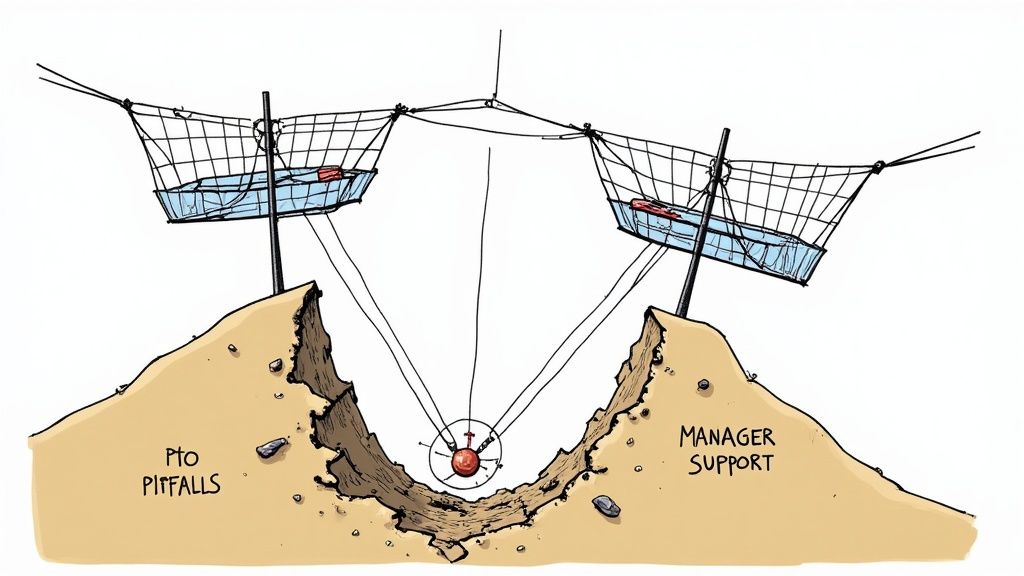
Even the most well-intentioned unlimited PTO policy can fall apart. Think of your policy as a newly paved bridge; without the right guardrails, it’s going to crack. The biggest risk isn't that people will take too much time off—it's that they won't take enough. Subtle pressures, like vacation shaming or an "always-on" culture, can twist a policy meant for freedom into a source of anxiety.
The most dangerous pitfall is a culture of "presenteeism," where taking a break is quietly frowned upon. According to a 2023 report from the Society for Human Resource Management (SHRM), 52% of U.S. workers feel guilty about taking vacation time. This is where your policy can do more harm than good. These insights on fair PTO practices detail how just announcing a policy doesn't change behavior.
Fixing these cracks takes specific, structural changes that reinforce a culture of trust. Here are three practical steps:
Finding candidates who thrive in a high-autonomy environment is critical for an unlimited PTO culture to succeed. This is where AI doesn't replace you—it makes you smarter. Instead of manually sifting through profiles, you can use PeopleGPT to pinpoint talent from companies known for progressive, high-trust cultures.
This workflow turns a broad search into a targeted talent pipeline in minutes.
A great unlimited PTO policy is a living part of your culture, and like any bridge, it needs regular inspection to ensure it remains sound. Measuring its success isn't about micromanaging days off; it's about confirming the policy is fostering trust and preventing burnout. A data-informed check-up lets you make tweaks before small cracks become major problems.
The numbers tell a story. Start by digging into these core data points:
Understanding these figures is a crucial part of your overall recruiting metrics, because a rested team is a high-performing team. But numbers only tell you what is happening. To understand why, you need qualitative feedback from engagement surveys and one-on-ones. The true measure of an unlimited PTO policy is whether employees feel genuinely safe and encouraged to take the time they need.
Navigating the practicalities of unlimited PTO can be tricky. Here are answers to the most common questions.
No. This is a massive misconception. A better term is "flexible" PTO, not "unmanaged." All time-off requests still require manager approval and coordination with the team to ensure business continuity. The policy operates on trust, but within a framework of professional accountability.
This is legally complex. In theory, since no days are "accrued," there is nothing to pay out. However, some states, like California, may require a payout for a "reasonable" amount of unused time, especially if an informal cap exists. It is critical to consult with legal counsel to ensure your policy is compliant with state laws.
Yes and no. It eliminates the tactical work of tracking accruals and rollovers. However, it shifts the administrative focus to more strategic, people-focused work: coaching managers on encouraging time off, monitoring for signs of burnout, and ensuring the policy is applied fairly across all teams.
{{large_cta}}
Run your first search for free. Find and engage top talent across 800M+ profiles. Trusted by 5,000+ customers.
.png)