
.svg)
SIGN UP FOR JUICEBOX (IT’S FREE!)

Who are you looking for?
Thank you! Your submission has been received!
Oops! Something went wrong while submitting the form.

Effective training for a recruiter isn’t about memorizing a few clever sourcing tricks—it's about building a repeatable system that delivers speed, accuracy, and scale. The old-school playbook of wrestling with complex Boolean strings is a fast track to burnout, not brilliant hires. Juicebox AI is different because we focus on transforming sourcers into strategic 'Talent Operators' who navigate the market with the precision of a pilot, using AI not as a crutch, but as a cockpit.
TL;DR: The Ultimate Recruiter Training Guide
This guide outlines a modern training framework for recruiters. Key pillars include mastering AI-powered, intent-based sourcing over outdated Boolean, crafting personalized, multi-step outreach that gets replies, and using data-driven dashboards to track meaningful KPIs like time-to-fill. We provide a 90-day plan to evolve recruiters into strategic "Talent Operators" who use real-time market insights to advise hiring managers and drive business outcomes.
It's time to transform your team into strategic advisors who deliver top talent consistently.
Let's be honest: the traditional methods of recruiting are collecting dust. Success today isn't defined by how many hours you spend manually sifting through profiles. It’s about building a proactive, data-driven sourcing engine that consistently surfaces top-tier candidates before your competitors even know they exist.
This shift is more critical than ever, thanks to the persistent skills gap. A staggering 77% of employers globally reported difficulty finding the talent they need in 2023, according to a ManpowerGroup survey. This is a massive hurdle, and when the right talent is that scarce, the recruiter's ability to identify and engage them becomes the ultimate competitive advantage.
But there's a problem most tools ignore...
...they teach dependency on a single platform. A truly effective training for a recruiter builds system-level thinking, not just button-pushing skills.
The core of this new approach is a fundamental mindset shift. We’re moving away from the reactive 'post and pray' model and stepping into the role of proactive talent advisors.
Think of it this way: the modern recruiter is like a pilot using advanced instruments to navigate the talent market, not someone just manually rowing a boat and hoping for the best. This new reality demands a different kind of training—one grounded in strategy, data, and technology.
This training model emphasizes three key pillars:
Below is a perfect example of how modern tools give recruiters the data they need to operate strategically.

Dashboards like this empower recruiters to track KPIs, spot bottlenecks, and make informed decisions—the very essence of the Talent Operator mindset. It’s this level of insight that elevates the role from purely administrative to truly strategic. If you're new to the field, learning how to become a recruiter is the first step.
For years, mastering complex Boolean search felt like a rite of passage for recruiters. Most people believe the more complex the string, the better the candidate.
The truth? The opposite is often true. Overly rigid searches create massive blind spots, instantly filtering out incredible profiles that don't use the exact keywords you happened to guess.
That era is over. Modern training for a recruiter has to shift from memorizing operators like 'AND' or 'NOT' to mastering intent.
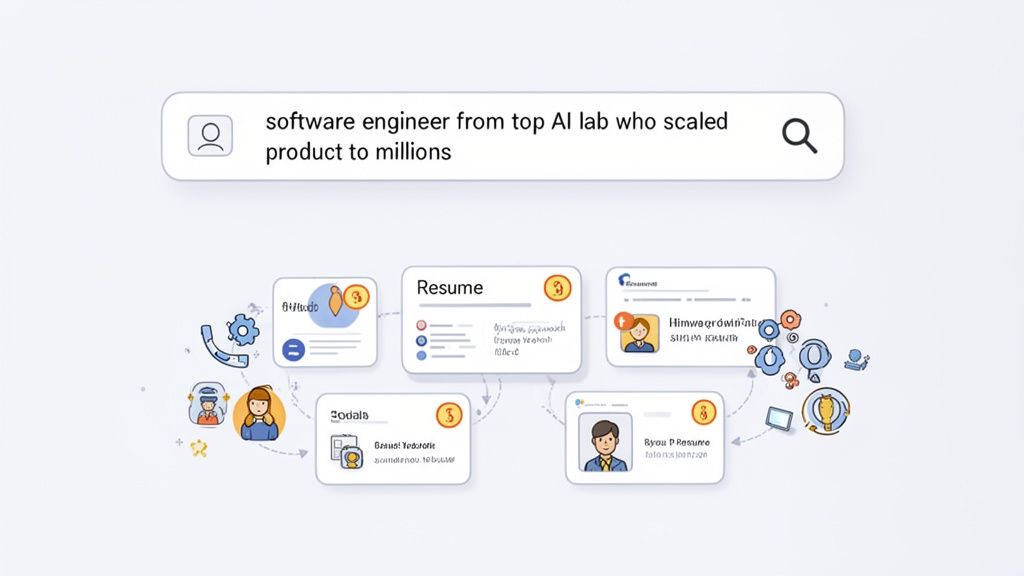
This is exactly where AI-native tools completely change the game.
Let’s get real. Imagine your hiring manager asks for ‘a software engineer from a top AI lab who has scaled a product to millions of users.’
In a traditional database, you’d waste 20 minutes building a convoluted Boolean string. You’d try to account for every possible variation of "top AI lab" and "scaled a product," and you’d still miss dozens of exceptional people.
With a tool like PeopleGPT, you just type that exact sentence into the search bar. The AI doesn’t just hunt for keywords; it actually understands the intent behind your request. It then scans millions of profiles from over 30 sources—way beyond a single network—to find candidates who match the concept, not just the text. Learning about xray search can provide more context here.
For instance, a candidate from Ramp, a company known for hyper-growth, might have scaled a product to millions. In fact, one team at Ramp reduced their average time-to-hire by 40% in a single quarter by adopting this kind of AI sourcing tech.
This approach surfaces talent described in unconventional ways—profiles that old-school, Boolean-based tools would completely miss. Our guide on natural language searches for recruiting dives way deeper into this powerful method.
You might think that relying on AI for sourcing is like a "black box" that strips away your control. But that’s a misconception fueled by older, less transparent tools.
Why does that thinking fail? Because the right platforms give you more control, not less.
Here's the proof:
This level of detail empowers recruiters to make faster, more confident decisions. Instead of wondering if your search string is broken, you get immediate, data-backed results. This is the new standard for effective sourcing.
| Week | Focus Area | Key Skill Development | Practical Exercise |
|---|---|---|---|
| Week 1 | The Mindset Shift | Understand the limitations of Boolean and the power of intent-based search. Move from keyword matching to concept matching. | Run 3 searches for a current role using both a complex Boolean string and a plain-language query. Compare the top 10 results from each. |
| Week 2 | Mastering Natural Language Queries | Craft effective plain-language prompts. Describe the ideal candidate’s impact and experience (not just title). | Find 5 “purple squirrel” candidates for a hard-to-fill role using only descriptive, conversational search queries in PeopleGPT. |
| Week 3 | Verifying and Deepening Insights | Use transparent AI to validate profiles. Dive into source data to understand the candidate’s story and trajectory. | For 3 top candidates from Week 2, follow the source links to their original profiles. Document 3 key accomplishments not listed on their resume. |
| Week 4 | Building Proactive Talent Pools | Identify and tag high-potential candidates for future roles before a req is open. Build pipelines based on skills and trajectory. | Create a “Future Leaders in Product” talent pool. Add 15 candidates showing high growth potential, even if they’re not a fit for current roles. |
This hands-on approach ensures recruiters don't just learn a new tool—they adopt a fundamentally better way of finding talent, making them more strategic partners in the hiring process. Understanding options like freelance recruiters can also broaden your strategic toolkit.
Finding a perfect-fit profile is a great start, but it's just the beginning.
What's the bottom line? Top candidates are absolutely flooded with generic, copy-paste messages every single day—and most of them hit the trash folder instantly.
This is where your training for a recruiter has to get serious about personalization. I'm not talking about just dropping in a [First Name] tag. It's about crafting compelling, smart messages that show you’ve done your homework and understand why they are a good fit for this role. Anything less, and you’re just adding to the noise. For inspiration, check out our best recruitment emails.
There's no magic template here, but there is a reliable framework. A high-conversion email almost always has these three parts:
Of course, your outreach shouldn't be limited to just email. To build a truly robust talent pipeline, recruiters need to get savvy with digital engagement across multiple platforms. Digging into strategies for social media marketing for recruitment agencies is a great way to expand your toolkit.
But here’s the thing most recruiters miss: one email is almost never enough. The real wins come from structured, multi-step sequences. This single tactic has been proven to boost reply rates by as much as 3x, according to data from Gmass.
Here’s the deal. Automated follow-ups aren't about annoying people—they're about persistent, professional engagement. A well-designed sequence adds value at each step. For example, your first follow-up could share an article about a new technology the team is using, tying it directly to the candidate's known interests.
This part of your training must be hands-on. Get your new recruiters into a tool with a built-in email sequencer. Have them build out a three-step campaign for a real, hard-to-fill position. They need to set the rules (like stopping the sequence automatically when someone replies), A/B test a couple of subject lines, and watch the open and reply rates.
This is how you turn outreach from a guessing game into a repeatable, data-driven process. For a deeper dive, you can explore a whole range of candidate engagement strategies in our detailed guide.
If you can't measure it, you can't improve it. It's a simple truth that separates good recruiting teams from great ones. Yet, so many teams still get bogged down by vanity metrics like ‘number of applications’—a number that tells a story of activity, not impact.
Any effective training for a recruiter has to include a blueprint for building and using a dashboard that actually drives decisions. The whole point is to shift the conversation to the KPIs that truly matter for efficiency and the quality of your hires. Think of these not as numbers on a screen, but as diagnostic tools that reveal the health of your entire hiring engine.
You might be wondering, "What should I track?" A powerful recruiting dashboard is built on just a handful of core metrics that directly influence business outcomes. Forget the clutter and concentrate on these three pillars:
Focusing on these metrics transforms a recruiter from an order-taker into a strategic talent advisor. For example, the team at Ramp used integrated analytics to identify pipeline bottlenecks and ended up reducing their average time-to-hire by 40% in a single quarter. That’s the power of having data-backed conversations with hiring managers.
For a deeper look, check out our guide on building a recruiting reporting and analytics dashboard.
In today's high-stakes talent market, this data-driven approach isn't a luxury; it's essential. The 2023 Employ Recruiter Nation Report found that 31% of talent teams see 'not enough people to fill open positions' as a top challenge. With companies more worried than ever about retention, investing in this kind of data literacy for recruiters is how you build a sustainable talent function. Discover more insights about 2023 talent acquisition trends.
A structured plan is the fastest way to turn a new hire into a high-impact talent partner. This 90-day roadmap is designed to build mastery in modern recruiting, taking trainees from core skills all the way to strategic execution. Think of it less like a checklist and more like a hands-on curriculum for training for recruiter excellence, with measurable progress baked into every stage. This is a critical part of streamlining the recruitment process.
This framework is all about building momentum, with each new skill stacking on top of the last. It’s heavy on practical application, not just theory, turning abstract concepts into repeatable habits that actually drive results.
Ready to get started? The first month is all about laying a solid foundation. The goal here is simple: get fluent with your core tools and master the art of finding great candidates without getting stuck in outdated methods. This phase is critical for building the confidence needed to take on more complex roles later.
According to Zippia, an estimated 26.7% of U.S. employees were already fully remote in 2021, a shift that calls for a whole new set of engagement skills. A 2022 survey from CareerBuilder revealed that while 34% of employees want more training on AI tools, only 29% are getting it. You can learn more about these employee training statistics and see why this plan is so crucial.
This timeline shows the key recruiting KPIs you’ll want to track from day one—pipeline health, time-to-fill, and source effectiveness.
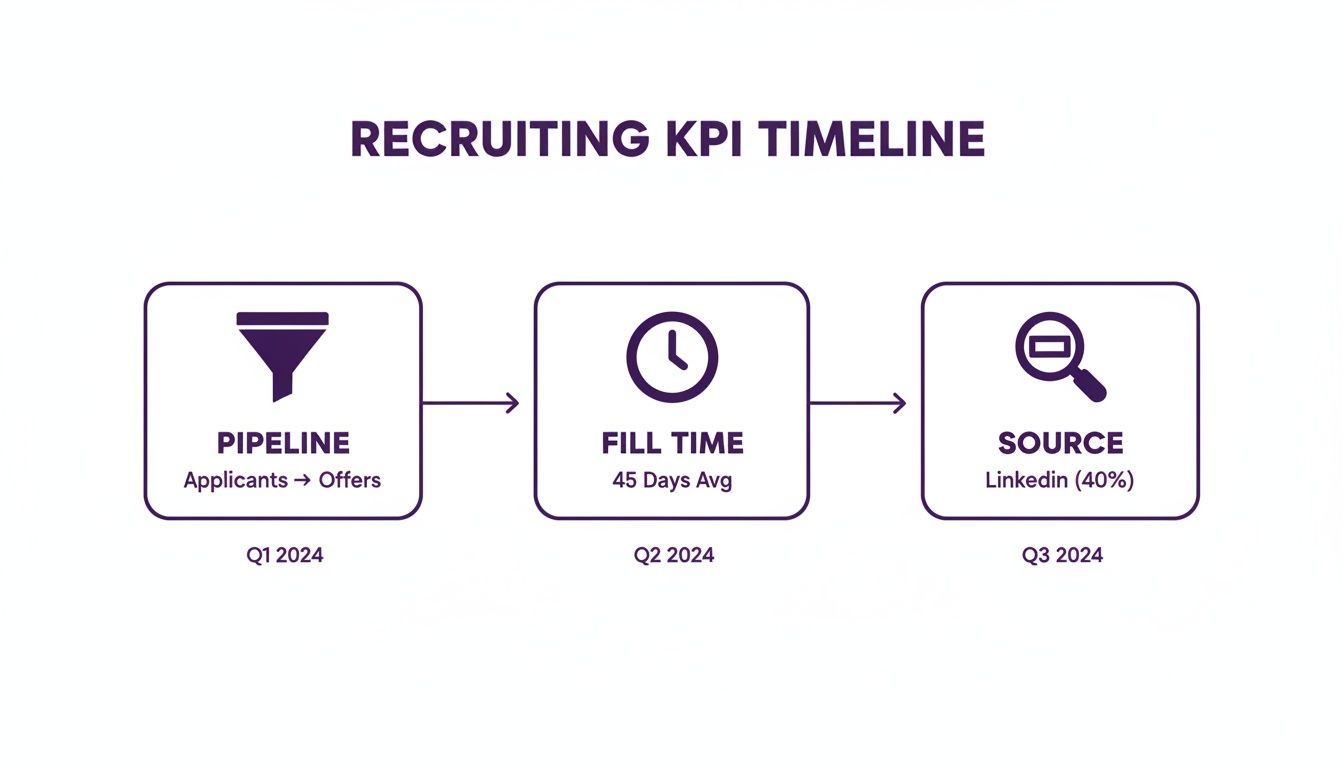
Getting these metrics down is non-negotiable. They provide immediate, unfiltered feedback on a recruiter's efficiency and their real impact on the business. Understanding SeekOut pricing and other tool costs is part of this strategic view.
With the basics locked down, the second month is all about optimization and scale. This is where a recruiter learns to amplify their efforts, using automation and data to engage more candidates, more effectively, and fill roles faster. The goal is to shift from manual grinding to building a smart, scalable system.
The final 30 days are about elevating the recruiter’s role from just filling seats to shaping strategy. This means using data to influence hiring decisions and confidently owning the entire recruitment lifecycle for the toughest roles. This is where a good recruiter becomes an indispensable talent advisor.
The real power of modern training for a recruiter isn’t just about learning new tricks. It’s about making a fundamental shift in your role.
But what does this actually mean for you?
You’re moving from a reactive administrator to a proactive, strategic talent advisor who actively shapes the future of your company.
By mastering AI-native tools and data-driven workflows, you unlock the ability to not just fill roles, but to find the right people faster and more accurately than anyone else. This is a massive advantage in any hiring market. Speed is non-negotiable for quality—fast-moving employers get the best candidates, while the slow ones are left with the leftovers. Check out some powerful Indeed alternatives to expand your search.
This training is your launchpad. It’s designed to make you an indispensable part of your company's growth engine, ready to tackle any hiring challenge with precision. For instance, platforms like supportgpt can provide invaluable AI assistance, completely changing how you manage tasks and engage with candidates.
You are no longer just filling reqs; you are building the teams that build the future. Dive deeper into this topic by exploring our guide on the impact of AI on recruitment.
What is the core benefit of this training approach?
You shift from being reactive to proactive, building talent pipelines and influencing hiring decisions long before they become urgent, fire-drill situations.
How does AI training make a recruiter a "talent advisor?"
It arms you with data and real-time market insights, allowing you to advise hiring managers on strategy, not just source a list of names.
Can this training really make recruiters indispensable?
Yes. When you deliver top talent faster and offer strategic insights that others can't, you become a critical driver of company growth and success.
This training reframes the core benefit of a recruiter from fulfilling requests to providing strategic market intelligence. By mastering modern tools and data, you unlock the ability to proactively shape hiring strategy, advise leadership, and build the teams that drive your company's future—making you an indispensable asset.
{{large_cta}}
Run your first search for free. Find and engage top talent across 800M+ profiles. Trusted by 5,000+ customers.


.png)
