.svg)
SIGN UP FOR JUICEBOX (IT’S FREE!)

Who are you looking for?
Thank you! Your submission has been received!
Oops! Something went wrong while submitting the form.


Think of your hiring process as a supply chain, but for people. The master clock for this whole operation? That's your time to fill metrics. It starts ticking the second a job requisition gets approved and doesn’t stop until a candidate says "yes" to your offer. This is the first critical metric any modern talent team should master, especially when building a data-driven recruitment strategy.
TL;DR: How to Improve Time to Fill
Your time to fill is likely inflated by slow, manual sourcing. The global average is 44 days (StaffingHub, 2024), but top candidates are off the market in just 10 days (SHRM). To fix this, you must replace outdated sourcing with an integrated AI workflow that combines sourcing, verification, and outreach. This turns days of work into minutes, giving you a decisive speed advantage to engage A-players before competitors can.
In this market, you can't afford to be slow. The global average time to fill has ballooned to a painful 44 days, making this metric much more than a simple HR statistic. It's a core business KPI that hits your bottom line, hard.
Every single day a key role sits empty, you're bleeding value. Projects get delayed, your team's morale takes a hit, and you're leaving money on the table for competitors to grab. A prolonged hiring cycle is a hidden tax on growth, and Juicebox's approach is designed to eliminate it by focusing on the single biggest lever: sourcing speed.

There's a common myth that focusing on speed means sacrificing quality.
The truth? It's the exact opposite.
A long, drawn-out hiring process is an expensive bottleneck that guarantees you lose the best people to faster companies. Think about it: the top 10% of talent is typically off the market in just 10 days. If your process takes a month or more, you're not even competing for the A-players. They’ve already signed an offer and updated their LinkedIn profile.
This guide isn't about looking in the rearview mirror. We're reframing the time to fill metrics from a historical report into your biggest competitive weapon. By truly understanding it—and then optimizing it—you can turn your hiring function from a reactive cost center into a strategic engine for growth.
Mastering this metric brings three massive benefits:
But there’s a problem most tools ignore. The biggest delays aren't happening in the interview stages or during offer negotiations. The real damage happens right at the very beginning of the process: sourcing.
Sourcing is the black hole where weeks vanish into manual searches, stale data, and outreach that goes nowhere.
We'll show you how to find your unique bottlenecks and claw back that critical time, especially from this first crucial stage. When you fix the top of your funnel, you create a ripple effect that speeds up everything that follows. That’s the secret to not just tracking your time to fill metrics, but actively shrinking it.
For instance, forward-thinking teams like Cognition have managed to cut their time to fill by 50% in under three months. Their secret? Implementing an AI-driven source-to-outreach flywheel that gets them to the right people, faster than anyone else. This is similar to how a 9-80 work schedule can compress work into fewer days—AI compresses sourcing into fewer minutes.
Getting the calculation right is the first step toward mastering your hiring process. The formula for the time to fill metrics seems straightforward, but the devil is in the details—specifically, which start and end dates you choose.
The only formula that gives you the full picture is this one:
Time to Fill = Date of Offer Acceptance – Date of Job Requisition Approval
Let's walk through a real-world example. Say you need a new Senior Product Manager.
Using the correct formula, your time to fill is 45 days (April 15 minus March 1). This calculation captures the entire hiring lifecycle, from the moment the business greenlights the role to the final handshake.
Here’s where it gets interesting.
So many teams get this wrong. They use "time to fill" and "time to hire" interchangeably, and in doing so, they mask major inefficiencies in their process.
It’s a critical error.
If you only track time to hire, you’re blind to the "hidden" delays. You miss the weeks a requisition sits in an approval queue before your recruiting team can even start sourcing. That’s where the biggest bottlenecks often hide.
Tracking your time to fill metrics accurately gives you a complete, honest look at your hiring engine's health. To see how it fits into the bigger picture, explore the top recruiting metrics that winning teams monitor.

Now, you might be thinking that pushing for a lower time to fill will force you to compromise on candidate quality. This is one of the most persistent myths in talent acquisition.
Here’s why that fails:
A slow, inefficient process is what actually compromises quality. The best candidates are in high demand and juggling multiple offers. A lengthy, disorganized process doesn't just frustrate them; it actively removes them from your pipeline because they’ll accept a faster offer from a competitor. According to SHRM, the most sought-after candidates are often off the market in just 10 days.
Speed, when driven by a well-oiled process, becomes your greatest advantage. It shows candidates you're decisive and respect their time—qualities that attract A-players. When you fix your internal workflows to slash your time to fill, you naturally improve your ability to engage and close the best talent before anyone else can. Understanding how to streamline the recruitment process is key.
For this metric to be useful, you have to apply the formula the exact same way across every role and every department. No exceptions.
Don’t start the clock at "job posting" for one role and "requisition approval" for another. That kind of inconsistency will corrupt your data, making it impossible to spot real trends or diagnose bottlenecks.
Establish a single, company-wide definition for your start and end dates. Your Applicant Tracking System (ATS) should automate this, but even if you're using a simple spreadsheet, disciplined data entry is non-negotiable.
This consistency is the foundation for turning your time to fill metrics from a simple number into a powerful strategic tool. It’s how you’ll finally see which departments are hiring efficiently and which ones need support, ultimately building a more predictable growth engine for the entire business.
Trying to define a single "good" number for your time to fill is a trap. Too many teams get hung up on chasing a global average—like the often-cited 44 days—but that’s a flawed strategy. It completely ignores the most important factor: context.
Your industry, the role's complexity, and how scarce the right skills are will cause massive swings in any realistic hiring timeline. A tech company hunting for a niche machine learning engineer will never move as fast as a restaurant hiring front-of-house staff.
And that’s okay.
The real goal isn't to beat some random global average; it's to consistently outperform your direct competitors who are all fishing in the same talent pool. Even the best sourcing tools for recruiters can't change market realities, but they can give you a speed advantage.
The only way to know if your hiring process is truly efficient is to measure it against the right yardstick. Understanding the benchmarks for your specific sector helps you answer the only question that matters: "Are we slower than other companies trying to hire this exact same type of person?"
Before you can compare, you need to get your own numbers straight. This simple formula is the foundation for any meaningful benchmark comparison.
Calculating this gives you the raw data you need to see how you stack up against relevant industry standards. It’s the first step to pinpointing where your process actually needs work.
You might assume that tech companies, with all their advanced tools, would be the fastest at hiring. But that assumption misses a critical piece of the puzzle: complexity. Intricate technical interviews and intense demand for niche skills actually make tech one of the slowest sectors to hire in.
Research from Josh Bersin backs this up. While the overall global average hovers around 44 days, some industries consistently blow past that. For instance, the average time to fill a tech role is 52 days. Manufacturing is even tougher, with a typical hiring cycle of 55 days—a whopping 45% longer than the median. In sharp contrast, hospitality roles can often be filled in just 27 days, as highlighted in a 2025 global recruitment report. For another perspective, see how we broke down Seekout pricing.
Once you have the right benchmarks, you can start setting goals that actually mean something. Instead of a vague mandate like "reduce time to fill by 10%," you can get specific and effective. Context is everything here, and a deep understanding of different recruiting metrics is what separates good teams from great ones.
Here’s a quick look at the main factors that stretch out your timelines:
So, what does this look like in the real world? The disparities between industries are stark.
The data below shows just how useless a single, global benchmark really is. Each industry operates with its own unique set of challenges and constraints that directly impact hiring speed.
| Industry | Average Time to Fill (Days) | Key Influencing Factor |
|---|---|---|
| Manufacturing | 55 | High demand for specialized technical skills and ongoing skilled labor shortages |
| Technology | 52 | Intense competition for talent and complex, multi-stage interview processes |
| Healthcare | 49 | Strict credentialing requirements and a shortage of specialized practitioners |
| Hospitality | 27 | High-volume roles with less complex skill requirements and faster interview cycles |
As you can see, comparing your engineering team's 50-day average to a hospitality company's 27-day benchmark is completely pointless. Your context is your reality.
Use these industry-specific numbers to set realistic targets that drive meaningful improvement. Stop chasing an irrelevant global figure and start building a hiring engine that’s truly efficient for your world.
If your time to fill is creeping up, it’s a clear signal that your hiring engine has a broken part. But the problem is rarely where you think it is.
Most teams jump to blaming interview scheduling or slow offer approvals, but those are just symptoms. The real disease is almost always a slow, inefficient start to the process.
The single biggest bottleneck inflating your hiring timeline is manual, outdated sourcing. Every hour spent crafting complex Boolean strings, sifting through irrelevant LinkedIn profiles, and cross-referencing data across siloed platforms is an hour you’re not engaging with top talent. This initial delay creates a domino effect, pushing back every subsequent step and putting you weeks behind competitors before the first interview is even scheduled. Exploring Indeed alternatives is a good start, but the tools are only part of the solution.
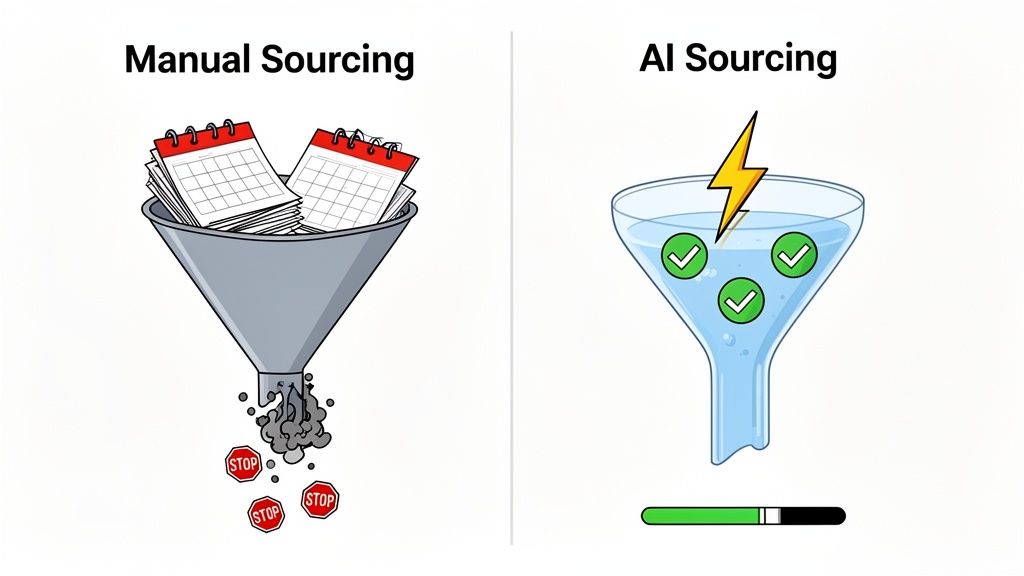
You might think your sourcing process is “good enough.” But what if your team is spending days on what should take minutes?
That’s precisely the issue. High-growth companies like Ramp proved this by overhauling their sourcing workflow. They moved from a manual, multi-day process to using an AI aggregator that surfaced qualified candidates in minutes. The result? A direct and immediate compression of their time to fill.
But here’s the catch.
Simply finding candidates faster isn't the whole solution. What happens if your outreach is slow or ineffective? A fast sourcing engine connected to a slow engagement process just creates a new bottleneck. This is why a holistic approach is essential; you need a workflow that seamlessly connects finding talent to actively engaging them.
To fix your process, you first need to pinpoint where it’s actually breaking down. High time to fill metrics are usually the result of one of these three common culprits. Let’s break down each one and provide a clear, actionable solution.
This is the most common and costly bottleneck. Relying on Boolean searches across one or two platforms is like trying to find a needle in a haystack while wearing a blindfold. It’s slow, imprecise, and guarantees you miss out on the 80% of qualified talent not actively updating their LinkedIn profiles.
Your recruiters find great candidates, but the profiles sit in a hiring manager's inbox for a week. By the time they give feedback, the best candidates have already moved on. This slow loop is a common source of friction that kills momentum and frustrates everyone involved.
Finding a great profile is only half the battle. If it takes days to verify their contact info and send the first email, you’re losing your speed advantage. The concept of speed to lead response time shows that the first person to make contact often wins, and the same principle applies directly to recruiting.
Let's be honest, the old way of chipping away at your time to fill metrics with small process tweaks is dead. Top recruiting teams aren't just getting a little faster; they're fundamentally changing how they find and engage talent. They've stopped treating the top of the funnel like a manual chore and turned it into a high-speed expressway with AI.
This new workflow takes what used to be a week of grinding and compresses it into a single afternoon. It all starts with a simple, human conversation with the machine. Forget wrestling with clunky Boolean strings. Now you just ask for what you need: "senior backend engineers in SF who worked at Series B fintech startups."
From there, the system does the heavy lifting.
In just a few seconds, you get a ranked and scored list of thousands of qualified profiles pulled from the entire internet—not just a single, walled-off platform like LinkedIn. But finding the names is just the start. The real breakthrough happens when sourcing, verification, and outreach are all connected.
It works like a flywheel:
This completely eliminates the dead space between finding a great candidate and actually starting a conversation. It's a complete source-to-outreach engine that attacks the single biggest cause of hiring delays: the front end of the process. Our guide to AI recruiting tools breaks down exactly how this tech works.
The industry data paints a pretty grim picture otherwise. A 2024 StaffingHub report found a global average of 44 days from requisition to offer. To make matters worse, another study showed 60% of companies saw this number go up last year.
When you're fighting against a 44-day clock, tools that shrink your sourcing time from days down to minutes aren't just a nice-to-have. They can realistically claw back one to two weeks of that timeline.

This screenshot of Juicebox's PeopleGPT interface shows it in action. You type a prompt, get a list, and have outreach tools ready to go. The key is fusing search, verification, and sequencing into one unified motion, so recruiters can act the second they spot a high-potential candidate.
This isn't just theory. Teams putting this model to work are seeing their time to fill metrics drop almost immediately. The AI startup Cognition, for instance, cut its time to fill by a massive 50% within three months of adopting this source-to-outreach flywheel.
By automating the most grueling part of their process, their recruiters could finally focus on what they do best: building real relationships with top-tier candidates. This proves that giving your team the right AI tools doesn't just make them faster. It changes the speed at which your entire company can hire and grow, turning recruiting from a reactive cost center into a true strategic advantage.
Improving your time to fill isn't about finding a single magic bullet. It’s about methodically building a smarter, data-driven system. This is your implementation roadmap—a clear action plan that pairs better tools with an intelligent process to turn insights into real, measurable results.
Think of this as your shift from reactive firefighting to proactive strategy. The goal is to construct a hiring engine that’s not just fast, but also predictable and consistent. That’s how you give your company a serious competitive edge in the war for talent.
This isn't just a list; it's a structured framework to systematically diagnose and accelerate your hiring velocity. Follow these steps, and you'll build a process that consistently delivers high-quality candidates in record time.
A robust, data-driven hiring process is also much easier to execute with an effective recruitment project management playbook to keep everything on track and efficient.
This roadmap provides a tangible action plan you can take back to your team today. A commitment to this framework is a commitment to building a truly data-driven recruitment culture.
By implementing this systematic approach, you stop guessing and start engineering a high-performance hiring machine. This is how you unlock faster, more predictable company growth—one great hire at a time.
Time to fill measures the entire process from job approval to offer acceptance, reflecting operational efficiency. Time to hire only tracks the candidate journey.
No, the opposite is true. A slow process loses top talent to faster competitors. Speed, powered by an efficient system, wins the best candidates.
Manual, time-consuming candidate sourcing. It's the bottleneck that creates a domino effect, delaying every subsequent step in the hiring process.
Mastering your time to fill metrics isn't about chasing a number. It's about building a high-speed talent engine that gives your company a serious competitive edge.
This unlocks the ability to consistently find and engage the best candidates before anyone else even knows they’re on the market. That’s how you transform recruiting from a reactive bottleneck into a proactive driver of business growth.
{{large_cta}}
Run your first search for free. Find and engage top talent across 800M+ profiles. Trusted by 5,000+ customers.