.svg)
SIGN UP FOR JUICEBOX (IT’S FREE!)

Who are you looking for?
Thank you! Your submission has been received!
Oops! Something went wrong while submitting the form.

The technical recruiting landscape is changing. Top technology companies aren't just looking for talent sourcers; they're hiring strategic talent partners who can build high-performing engineering teams. This means the interview process has evolved beyond basic screening.
Forget generic questions.
Today's hiring managers use a specific set of situational and behavioral technical recruiter interview questions designed to test your full-stack recruiting skills, from multi-channel sourcing and data-driven decision-making to stakeholder management.
Most people believe success comes from having the 'right' answers, but the opposite is true: it comes from demonstrating a repeatable, effective process. You might think memorizing a few talking points is enough, but that approach fails because interviewers are far more interested in the why behind your actions.
This guide breaks down the most critical technical recruiter interview questions you will face in 2026.
Juicebox's data from analyzing over 1 million engineering profiles shows that top-tier candidates are found through non-traditional channels 65% of the time, a fact most generic guides miss. We'll show you how to frame your answers to prove you have a system that delivers consistent, high-quality results.
This behavioral question is one of the most critical questions you'll face as a technical recruiter. It directly tests your core competency: sourcing. In a market where top engineers are inundated with messages, simply relying on LinkedIn Recruiter is a losing strategy.
Here's the deal: Your answer reveals your creativity, technical curiosity, and ability to navigate niche digital communities where elite talent congregates. It separates recruiters who post and pray from those who proactively hunt.
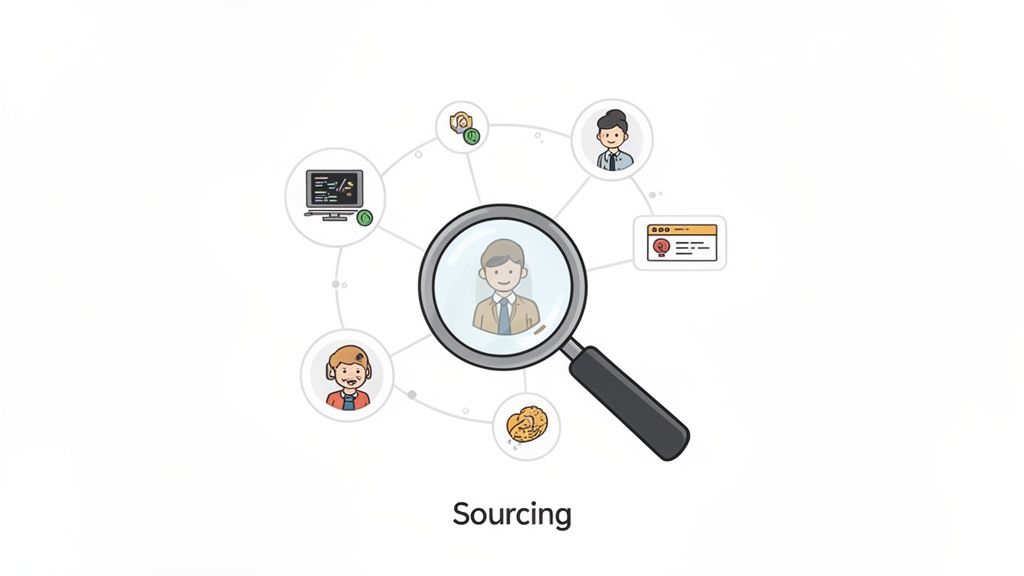
Interviewers use this question to evaluate your resourcefulness and understanding of multi-channel sourcing. They want to see proof that you can:
A strong response follows a clear narrative.
Candidate Example:
"For a Senior Blockchain Developer role, I knew LinkedIn would be saturated. I started by monitoring technical discussions on X using keywords like '#ZKproofs'. This led me to a developer with a high reputation score on the Ethereum Stack Exchange. I cross-referenced their username with their GitHub profile, where I saw they were a top contributor to a relevant open-source library. I reached out with a highly personalized message referencing a specific commit, which resulted in a 75% response rate and ultimately led to the hire in just 28 days."
This example works because it names specific channels, explains the logic, and shows a clear path from identification to engagement. For more advanced strategies on diversifying your outreach, you can learn more about advanced candidate sourcing techniques.
Sourcing is only half the battle; this is one of the most revealing technical recruiter interview questions because it tests your ability to qualify talent accurately. An inefficient screening process wastes countless hours for hiring managers, damaging your credibility.
Look: This question reveals whether you are a gatekeeper who protects the engineering team’s time or just a scheduler. It shows if you can truly vet for technical depth.
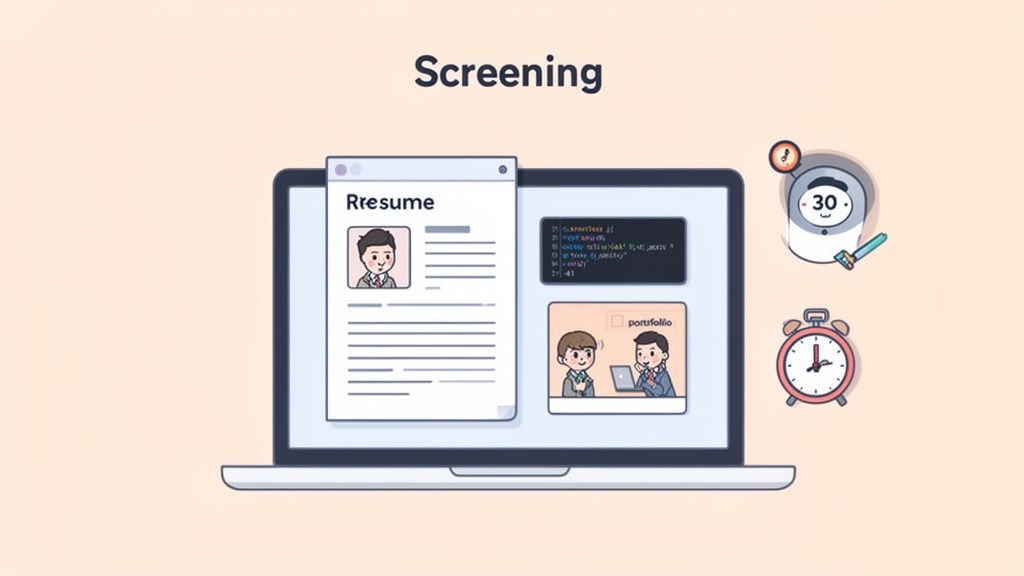
Interviewers want to see a structured, multi-step screening process. They are evaluating your ability to:
A strong answer outlines a clear, repeatable process.
Candidate Example:
"My first step is a deep dive into their digital footprint, primarily their GitHub. I look for recent, meaningful commits. During the initial screen, I don’t ask trivia. Instead, I ask, 'Tell me about the most complex system you’ve designed.' This helps me assess their grasp of system design and scalability. This 30-minute screen allows me to qualify their high-level thinking before an engineer ever sees their profile."
This example is effective because it shows a proactive, evidence-based approach that respects the candidate's time.
Modern recruiting runs on data. This question is designed to separate recruiters who are simply busy from those who are truly effective. Answering well proves you are a strategic partner who can demonstrate ROI. This is one of the most important technical recruiter interview questions for assessing business acumen.
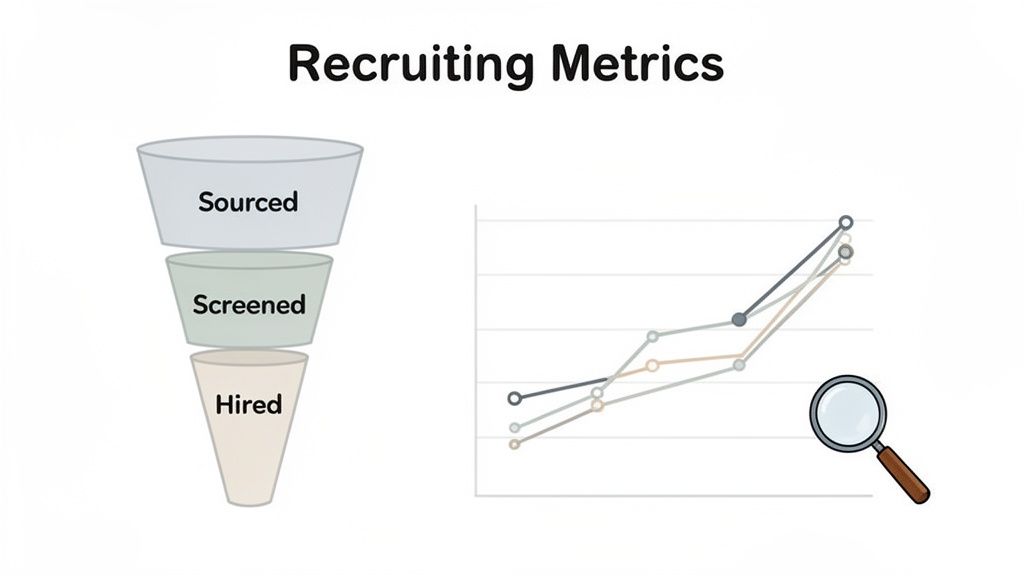
Interviewers want to see that you are data-literate. They are evaluating your ability to:
Frame your response with a clear, data-backed narrative.
Candidate Example:
"At my last company, our data showed the 'Hiring Manager Review' stage was our biggest bottleneck, adding 9 days to our time-to-fill. I focus on three core metrics: time-to-fill, quality-of-hire, and source quality. My average time-to-fill for senior engineers is 38 days. I tracked this in our ATS, and by implementing a 48-hour SLA for feedback with managers, we cut a full week off our timeline. This change helped us reduce our overall time-to-fill by 20% in one quarter."
This answer is strong because it provides specific numbers, identifies a problem, explains the action taken, and measures the result. To dive deeper, you can explore the top KPIs of recruitment for modern TA teams.
This question moves beyond sourcing and into the critical art of closing. Technical recruiting is a high-stakes balancing act between candidate expectations, hiring manager demands, and company budgets.
Why does this matter? It tests your emotional intelligence, persuasion skills, and ability to find a win-win solution. It shows whether you can handle the pressure of competing offers or salary gaps without losing the candidate.
Interviewers want to see how you manage conflict and influence outcomes. They are assessing your ability to:
Use a problem-solution-result framework to tell a compelling story.
Candidate Example:
"We were extending an offer to a Senior Machine Learning Engineer who wanted a $195K base salary, but the budget maxed out at $180K. I first spoke with the candidate to understand why the $195K was important. It turned out they had a competing offer. I then presented market compensation data to the hiring manager. My solution was to offer a $185K base with a higher sign-on bonus and a guaranteed project lead role within six months. This met the candidate’s need for value recognition and the manager’s budget, securing the hire."
This answer is effective because it demonstrates data-driven persuasion and creative problem-solving to close the deal.
This question tests for empathy and long-term strategic thinking. In tech, a negative candidate experience can quickly tarnish an employer's brand on platforms like Glassdoor. According to a 2022 Lever report, 49% of candidates who had a negative experience would actively discourage others from applying.
A poor experience doesn't just lose one candidate; it can poison a well of future referrals. Bottom line: This separates recruiters who focus on volume from those who understand that every interaction impacts the company's reputation.
Interviewers use this question to gauge your communication discipline and commitment to brand integrity. They are looking for evidence that you:
A compelling answer outlines a clear, proactive system for managing the candidate journey.
Candidate Example:
"My philosophy is that every candidate should leave our process feeling respected. First, every candidate receives a clear timeline upfront. Second, I use automated ATS reminders to send weekly updates. Third, for candidates we don't move forward with, I send a personalized rejection email within 24 hours and offer an optional 15-minute feedback call. About 10% take me up on it, and those candidates often become brand advocates."
This response is effective because it showcases a structured, scalable process. To build a more robust strategy, you can explore detailed frameworks on improving the candidate experience.
This is one of the most important technical recruiter interview questions today. A company's ability to innovate depends on having a team that reflects its users. This question assesses your commitment to inclusive hiring beyond just checking a box.
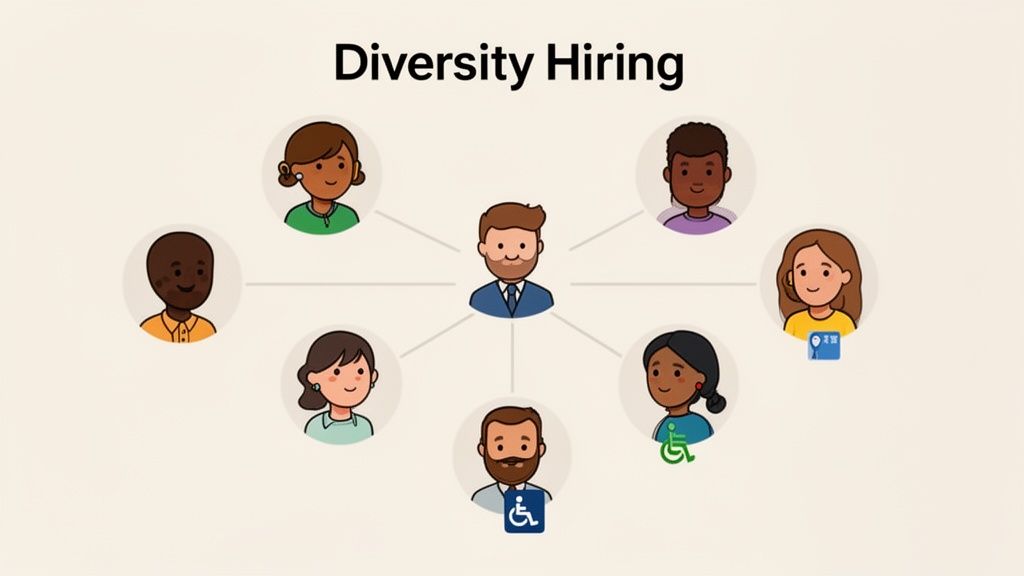
Hiring managers want to see that you have a strategic approach to diversity, equity, and inclusion (DEI). They are evaluating your ability to:
Frame your answer with a clear strategy, specific actions, and measurable results.
Candidate Example:
"In my previous role, our engineering team was 20% women, with a goal to increase that to 30%. I partnered with organizations like Code2040 and attended the Grace Hopper Celebration. I also audited our job descriptions to remove gender-coded language and ensured our interview panels were diverse. By tracking metrics, we increased women in our engineering pipeline from 25% to 40% and grew the team to 32% women engineers within 18 months."
This example is powerful because it outlines a specific problem, details a multi-pronged strategy, and concludes with a quantifiable business impact.
This is one of the more practical technical recruiter interview questions that separates a tactical recruiter from a strategic one. Your "recruiting stack" is your toolkit, and your answer reveals your technical savvy and commitment to efficiency.
Interviewers want to understand your familiarity with the modern recruiting ecosystem. They are looking for evidence that you can:
Frame your response around your current or recent recruiting stack.
Candidate Example:
"My stack is built for speed. We use Greenhouse as our ATS. For sourcing, we recently switched from LinkedIn Recruiter to Juicebox, which immediately saved us over $15,000 annually and gave us access to talent pools outside of LinkedIn. I evaluated it against SeekOut and HireEZ pricing, and Juicebox won on cost-effectiveness and AI-driven matching. For assessments, we use HackerRank, and I use Calendly for scheduling."
This answer is effective because it names specific tools, quantifies the business impact (cost savings), explains the evaluation process, and shows an understanding of an integrated workflow.
This is one of the most revealing technical recruiter interview questions because it tests your ability to be a strategic partner, not just an order-taker. Your success hinges on your ability to influence, educate, and align stakeholders.
Interviewers want to see if you can manage complex relationships and push back constructively. They are evaluating your ability to:
Use a clear, problem-solution-result framework.
Candidate Example:
"A director wanted to hire a Senior Site Reliability Engineer for $130K, which our data showed was 20% below the market rate. I presented a market analysis report showing average salaries were closer to $165K. I laid out three options: 1) Increase the budget, 2) Redefine the role at a more junior level, or 3) Accept a longer time-to-fill. The director appreciated the data-driven approach, and we aligned on increasing the salary band, which allowed us to hire a top-tier candidate within the quarter."
This answer is effective because it showcases proactive problem-solving and uses data to influence a key stakeholder.
This is a tough but powerful question. It tests your self-awareness, accountability, and ability to learn from mistakes. No recruiter has a perfect track record; what separates the great ones is their ability to conduct a post-mortem and implement systemic changes.
Interviewers ask this to gauge your professional humility and analytical skills. They want to see if you can:
A compelling answer follows a "Problem-Analysis-Solution" framework.
Candidate Example:
"We hired a senior engineer who passed a rigorous coding assessment but struggled immensely with collaboration. The root cause was my over-indexing on pure technical skill. To fix this, I redesigned our process to include a dedicated peer interview focused on collaborative problem-solving and now spend at least 20 minutes in my initial screen asking behavioral questions about how they handle conflict. Since implementing this, we’ve seen a marked improvement in the collaborative aptitude of new hires."
This response works because it identifies a specific failure, pinpoints the process gap, and describes a tangible solution.
This is a nuanced question that probes your understanding of team dynamics and inclusive hiring. The term "culture fit" can easily become a cloak for affinity bias, leading to homogenous teams.
Here's what you need to know: Your answer must demonstrate that you see the difference between shared values and simple personal similarity.
Hiring managers want to see that you have a structured, fair, and modern approach. They are looking for evidence that you:
A compelling answer will redefine "culture fit" as "values alignment" and then outline a systematic, bias-aware process.
Candidate Example:
"I redefine 'culture fit' as 'values alignment.' It's not about whether I'd want to get a beer with them, but whether they align with our core operating principles. To assess this, I use structured behavioral questions tied directly to our values. For example, to test for 'customer obsession,' I'll ask, 'Tell me about a time you advocated for a user's need even when it meant more work for your team.' This moves the conversation from 'do they seem like us?' to 'do they demonstrate the values that make us successful?'"
This response is effective because it shows a sophisticated understanding of the topic. It aligns well with the principles of skills-based hiring. You can discover more on this approach by learning about what is skills-based hiring.
How do I answer if I lack experience in a specific area?
Focus on transferable skills. If you haven't used a specific ATS, discuss your ability to quickly learn new technologies, referencing other tools you've mastered.
What's the biggest red flag interviewers look for?
A lack of data fluency. Recruiters who can't speak to their metrics (like pass-through rates or offer-accept ratios) are often seen as less strategic.
Should I prepare questions to ask the interviewer?
Absolutely. Ask about their biggest hiring challenges, team structure, and how they measure recruiting success. It shows you're engaged and thinking strategically.
Mastering the answers to these technical recruiter interview questions is about more than landing a job. It's the critical step in evolving from a reactive order-taker to a proactive, strategic talent partner. When you can articulate your approach to sourcing niche talent and managing complex stakeholder relationships, you’re demonstrating a repeatable system for building elite engineering teams.
But there's a problem most recruiters face: the gap between knowing the right strategy and having the right tools to execute it efficiently. You might think that more manual effort and long hours are the only way to find those "purple squirrel" candidates. That’s a myth. The best recruiters aren't just working harder; they are working smarter by leveraging technology that acts as a force multiplier.
The true implication of mastering these interview topics is gaining the ability to build high-performing technical teams at scale. This unlocks your ability to move beyond filling reqs and start shaping the very fabric of the engineering organization. But your strategy is only as good as your execution.
{{large_cta}}
Run your first search for free. Find and engage top talent across 800M+ profiles. Trusted by 5,000+ customers.
![The Complete Guide to Employee Reimbursement [2026]](https://cdn.prod.website-files.com/68c2f83ae8165ab45cf529f8/698c5c3c6f51cb7da4cc4641_reimbursement-finance.jpeg)