
.svg)
SIGN UP FOR JUICEBOX (IT’S FREE!)

Who are you looking for?
Thank you! Your submission has been received!
Oops! Something went wrong while submitting the form.

Finding top talent can feel like navigating a complex maze with shifting walls. Every dead end costs time and resources, while the best candidates remain hidden just around a corner you haven’t turned yet. The most effective talent sourcing strategies provide a compass, guiding you directly to candidates others miss. This isn't about casting a wider net; it's about drawing a more accurate map with a tool like PeopleGPT, which consolidates profiles from over 60 platforms. For instance, companies that use a multi-channel sourcing approach report a 40% reduction in time-to-hire (Recruiterbox, 2024), proving that a clear path beats wandering aimlessly. Unlike generic recruiting posts, this guide shows real PeopleGPT workflows—not theoretical advice.
You've spent years honing your craft, yet finding exceptional candidates feels harder than ever. The usual channels are saturated, response rates are dropping, and the pressure to fill critical roles is constant. By rethinking your approach with the right framework, you can cut sourcing time by over 70% and consistently build pipelines of high-caliber, interested candidates. The solution isn't just about new tools but about fundamentally shifting how you map the talent market.
TL;DR: The Best Talent Sourcing Strategies
LinkedIn has become the de facto digital resume book, making it an indispensable platform for modern talent sourcing strategies. With over a billion members globally, its primary value lies in the sheer volume and depth of professional data available. Recruiters can move beyond simple keyword searches and tap into a rich ecosystem of tools designed to identify, engage, and organize potential candidates. This involves using advanced filters in LinkedIn Recruiter, building proactive talent pipelines, and launching targeted outreach campaigns to engage both active and passive professionals. The maze of profiles requires a precise compass.

For example, a tech giant like Microsoft uses LinkedIn Recruiter to meticulously source software engineers with specific language skills and security clearances, filtering by past companies and years of experience. Similarly, a consulting firm like Accenture builds massive talent pools, sometimes exceeding 50,000 candidates, segmented by industry expertise and project readiness. These pools are not static lists; they are nurtured over time with relevant content and occasional check-ins, ensuring a warm pipeline when new roles open. For a more exhaustive guide on refining your searches, you can learn more about mastering LinkedIn advanced search techniques.
To make this strategy effective, precision is key.
("Data Scientist" OR "Machine Learning Engineer") AND Python NOT (Manager OR Director) helps find individual contributors with specific skills.Tapping into your existing team's professional network is one of the most effective talent sourcing strategies available. Employee referral programs formalize this process by incentivizing current employees to recommend qualified candidates from their connections. This strategy transforms every employee into a potential talent scout, leveraging trusted, pre-vetted networks to find candidates who are not only skilled but also likely to be a strong cultural fit. The core principle is simple: great people know other great people, and a structured program provides the compass to navigate those valuable, hidden networks.
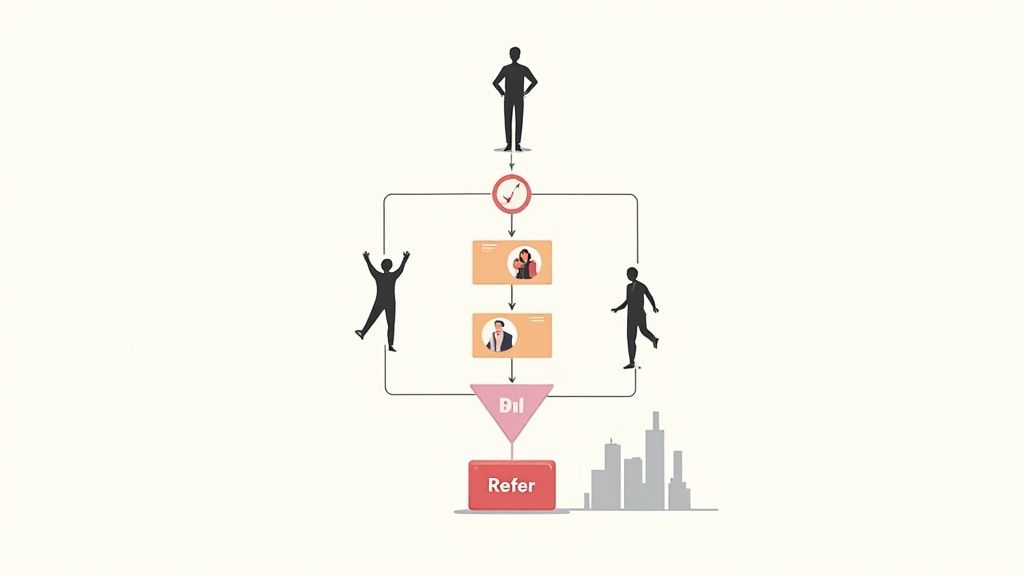
Look at the proof. Salesforce saw a 30% reduction in time-to-hire by focusing on referrals for their sales roles. This isn't just a tech trend; professional services firms like Deloitte also rely heavily on referrals to maintain their high standards of expertise and client service. Most companies believe referrals just happen, but the opposite is true. The best programs are actively managed because they produce higher-quality candidates who onboard faster and stay longer. Why? The mechanism is pre-vetting; an employee implicitly vouches for the candidate's skills and cultural fit, reducing the risk of a bad hire. For more ideas on structuring your program, learn more about improving employee referral programs.
To maximize participation and results, your program must be clear, simple, and rewarding.
University and campus recruitment is a foundational talent sourcing strategy focused on building a sustainable pipeline of entry-level talent directly from academic institutions. This approach goes beyond simply attending career fairs; it involves creating deep, lasting partnerships with universities to identify and nurture high-potential students long before they graduate. By engaging with candidates through internships, on-campus interviews, and sponsored events, companies can build brand affinity and secure the next generation of leaders and innovators. This is how you map the maze for the long term.
For instance, investment banks like JPMorgan Chase and Goldman Sachs have perfected this model, operating dedicated campus recruiting teams that manage relationships with hundreds of universities globally. Similarly, tech giants like Microsoft use programs such as "Explore" to target and mentor underrepresented groups in STEM. These programs are not just about filling immediate headcount but are strategic investments in future talent. For those building such a program, it's vital to learn how to source candidates effectively from this unique demographic.
To turn campus presence into a hiring engine, a structured and engaging approach is essential.
While digital sourcing dominates, physical events like conferences and trade shows remain a powerful strategy for connecting with specialized, high-intent talent. These gatherings act as a concentrated hub where top professionals in a specific field come together, offering a unique opportunity to move beyond a profile and build genuine rapport. It's one of the most effective talent sourcing strategies for engaging passive candidates who aren't actively job searching but are invested in their professional development. This face-to-face interaction is a compass for assessing cultural fit and technical depth in a way digital screening cannot.
But there's a problem most tools ignore.
How do you track and engage with the hundreds of contacts you make? A stack of business cards is a dead end. This is where AI sourcing tools like PeopleGPT’s Chrome extension become critical. You can instantly enrich a new contact's profile from their LinkedIn page, add them to a talent pool, and even initiate a personalized outreach sequence before you’ve left the conference hall. For more insights on connecting with candidates in these settings, explore these candidate engagement strategies.
To maximize your return on investment from attending industry events, a clear plan is essential.
When sourcing for senior, executive, or highly specialized roles, the talent sourcing strategies must shift from high-volume outreach to a more discreet and targeted approach. This is where headhunting and executive search firms excel. These specialized agencies operate on a retained search model, leveraging proprietary databases and extensive personal networks to navigate the hidden corners of the talent maze. They act as strategic partners, managing the entire recruitment process from initial confidential outreach to final negotiations for roles where the cost of a bad hire is exceptionally high.
For instance, a firm like Korn Ferry is frequently engaged by Fortune 500 companies to conduct confidential searches for C-suite roles like a Chief Financial Officer. Similarly, a specialized firm like Spencer Stuart might be tasked with finding a new board member with specific expertise in renewable energy. You might think these firms are prohibitively expensive. But consider this: for a critical leadership role, a retained search de-risks the entire process by guaranteeing a dedicated, in-depth search with a higher caliber of vetted candidates. For more details on this distinction, you can explore the differences between retained and contingency recruitment.
To maximize the return on this significant investment, a true partnership is essential.
PeopleGPT Workflow: Find Alternative Banking Talent
Boolean search is the underlying grammar of digital sourcing, allowing recruiters to act as precision surgeons rather than casting wide, inefficient nets. By using simple logical operators (AND, OR, NOT) and modifiers, you can build highly specific queries across search engines, databases, and social platforms. This foundational skill transforms a vast, noisy internet into a targeted talent pool, helping you uncover ideal candidates who are often buried deep within general search results. Mastering this is a cornerstone of effective talent sourcing strategies and the logic that powers advanced AI recruiting tools.
Here's the deal: a tech recruiter can use a Google search string like site:github.com "Python" AND "Django" (Austin OR "ATX") to find local developers with specific framework experience directly on GitHub. Likewise, a healthcare sourcer might use ("RN" OR "Registered Nurse") AND "ICU" AND ("New York" OR "NYC") on LinkedIn to pinpoint intensive care nurses in a specific city. These commands filter out the noise, ensuring every result is significantly more relevant than a simple keyword search.
To make this strategy work, you must think like a programmer building a logical query.
("Compliance Officer" OR "AML Specialist") AND ("Series 7" OR "Series 63") ensures you find candidates with either title who hold at least one of the required licenses.site: operator to confine your search to a single domain, like a competitor's website or a professional association's member directory.StrategyImplementation ComplexityResource RequirementsExpected OutcomesIdeal ForLinkedIn RecruitingModeratePaid subscriptions, timeBroad access to passive talentMid–senior, scale hiringEmployee ReferralsLow-ModerateBonuses, tracking platformHigh-quality, high-retention hiresVolume & culture-fit rolesCampus RecruitmentHighProgram budget, eventsStrong entry-level pipelineEarly-career, internshipsIndustry EventsModerate-HighTravel, sponsorship, staffNiche talent, brand visibilitySpecialized roles, passive talentExecutive SearchLow (for client)High fees (25–35% salary)C-suite & VP placementsConfidential senior rolesBoolean SearchHigh (learning curve)Training time, toolsHighly targeted candidate listsHard-to-fill technical rolesPassive OutreachHighSkilled sourcers, CRMAccess to top passive talentNiche expertise, competitors
Methodology: Complexity and resource requirements are based on a mid-sized tech company with an established recruiting function. Outcomes are based on aggregate industry data from SHRM and Gartner (2024).
The most effective channel depends on the role. Employee referrals consistently produce the highest quality hires with better retention rates. For specialized senior roles, direct sourcing and executive search are often superior.
AI automates the most time-consuming parts of sourcing. It can scan millions of profiles across 60+ platforms, identify candidates matching complex criteria, verify contact data, and even help personalize outreach, cutting sourcing time by over 70%.
Sourcing passive candidates requires a multi-touch, personalized approach. Start by identifying them on platforms like LinkedIn or GitHub, then use a value-oriented message that highlights how the opportunity aligns with their career goals, not just a job description.
Navigating the intricate maze of modern talent acquisition is no longer about finding a hidden path by chance. The goal is to possess the map, transforming you from a reactive maze-runner into a proactive map-maker who charts the most direct course to top talent. The critical implication is this: sourcing has shifted from a high-volume activity to a strategic exercise. It is no longer about who can search the fastest, but who can attract the best with a clear, well-drawn map.
The true power lies not in mastering a single channel but in orchestrating multiple approaches. Combining the vast reach of LinkedIn with the high-trust nature of employee referrals creates a powerful one-two punch. Each strategy, from sophisticated Boolean searches to authentic community building, is a different instrument. Played alone, they produce a simple tune; played together, they create a masterpiece of talent acquisition. The most effective talent sourcing strategies are amplified by technology that removes friction and provides clarity, turning hours of administrative work into minutes of strategic decision-making. The maze remains, but you now hold the compass and the blueprint.
Ready to upgrade your map from paper to a dynamic, AI-powered GPS? Sign up for PeopleGPT—it's free.
{{large_cta}}
Run your first search for free. Find and engage top talent across 800M+ profiles. Trusted by 5,000+ customers.
.png)
.png)
.png)


.png)