.svg)
SIGN UP FOR JUICEBOX (IT’S FREE!)

Who are you looking for?
Thank you! Your submission has been received!
Oops! Something went wrong while submitting the form.

![The Complete Guide to Talent Pipeline Management [2026]](https://cdn.prod.website-files.com/68c2f83ae8165ab45cf529f8/6953a268c9a0db82016c122a_talent-pipeline-management-workforce.webp)
Imagine having a reservoir of top-tier candidates, pre-vetted and engaged, ready to tap the moment a role opens. That’s the core of modern talent pipeline management. It’s a strategic pivot away from reactive hiring—you know, posting a job and just hoping for the best—to a more deliberate, continuous approach to finding great people. This guide breaks down the exact framework for building a future-proof talent pipeline.
While most sourcing guides focus on tactical tips, they miss the strategic foundation. This is where Juicebox is different. We believe that building a dynamic pipeline with AI isn’t just about speed; it's about creating a sustainable competitive advantage.
TL;DR: What is Talent Pipeline Management?
At its heart, talent pipeline management is the practice of systematically identifying, engaging, and nurturing qualified candidates for roles that don't even exist yet. Think of it less like a frantic sprint to fill a vacancy and more like a long-term investment in your company's most valuable asset: its people. You're building relationships before you have an immediate need.
This proactive mindset completely changes the recruiting game.
Instead of starting from scratch every single time a new job requisition hits your desk, you have a warm pool of talent who already know your brand and are genuinely interested in what you’re building. It's the secret to filling critical roles faster and more efficiently.
Not too long ago, recruiters relied on static databases or applicant tracking systems (ATS) that often became resume black holes. Modern talent pipeline management, however, is a living, breathing ecosystem. It's not just about collecting names on a spreadsheet; it's about building and maintaining authentic connections with potential future hires.
What does that actually look like?
The market is catching on fast. The global talent management market is projected to skyrocket from $12.85 billion in 2025 to $26.40 billion by 2030, according to Research and Markets. This explosive growth is largely driven by AI, with 38% of HR leaders now using AI tools to build stronger talent pipelines and close roles up to five times faster.
Let's look at how this new approach stacks up against the old way of doing things.
| Aspect | Reactive Hiring (The Old Way) | Proactive Pipeline Management (The New Way) |
|---|---|---|
| Timing | Starts only when a position opens. | A continuous, ongoing process. |
| Candidate Pool | Limited to active, often desperate, job seekers. | A diverse mix of active and passive talent. |
| Time-to-Hire | Long and unpredictable (weeks or months). | Significantly shorter, often by days or weeks. |
| Candidate Quality | Hit-or-miss; settling for “good enough.” | Consistently high; selecting the best fit. |
| Recruiter Focus | Transactional: filling an immediate need. | Relational: building long-term connections. |
| Tools | Spreadsheets, basic ATS, job boards. | AI-powered sourcing, CRMs, engagement platforms. |
The difference is night and day. One approach leaves you scrambling, while the other puts you in the driver's seat.
You might be thinking that building a talent pipeline sounds like a massive, time-consuming effort reserved for huge corporations. For years, you’d have been right. The manual work required to source, track, and nurture hundreds of candidates was immense and simply not sustainable for smaller teams. That's precisely why that old way of thinking fails. Manual pipeline building is slow, clunky, and just can't keep up.
But here's the good news.
AI-native platforms have completely changed the equation. Modern tools like PeopleGPT automate the tedious, soul-crushing work of finding, verifying, and engaging candidates. This makes robust talent pipeline management accessible to everyone, from a solo founder to a mid-market recruiting team. Now, even the smallest teams can build a powerful competitive advantage without needing an enterprise-level budget.
Building a solid talent pipeline isn't a one-and-done task; it's a continuous, four-stage process. This isn't just some abstract theory, either. It’s a practical framework any recruiter can use to shift from frantic, reactive hiring to proactive, strategic team-building.
Most people believe talent pipeline management is a luxury reserved for giant corporations with bottomless budgets. The reality is the complete opposite. For a two-person startup, a disciplined pipeline is even more critical because every single hire has an outsized impact. One bad hire can sink the ship, while a great one can pour rocket fuel on your growth.
Let's break down the four essential stages of a modern talent pipeline.
This is where it all begins—finding and drawing in high-potential people. The goal here is to cast a wide, intelligent net that goes way beyond the usual suspects on LinkedIn. Proactive sourcing means you're finding incredible talent before they even start polishing their resumes.
This is exactly where old-school methods fall flat. If you're just relying on keyword searches on a single platform, you're only seeing people who have perfectly optimized their profiles for recruiters. Modern sourcing demands a multi-channel game plan:
Once you’ve identified potential candidates, the real work starts. This is the step most teams skip, yet it’s the one that delivers the most value. Nurturing is all about building genuine relationships over time, turning cold contacts into a warm, engaged community that wants to hear from you.
A staggering 73% of candidates are passive, according to LinkedIn data. They aren't actively job hunting, but they're open to the right opportunity if it comes along.
Ready for the secret to engaging them?
Reaching them requires a delicate, value-first approach. Instead of blasting them with job descriptions, try this:
This steady, low-pressure communication keeps your company top-of-mind. So when they are finally ready for a move, you’re the first call they make. Managing this efficiently is key; learning how to streamline your recruitment process will save you a ton of time.
This diagram perfectly illustrates the critical mindset shift from reactive to proactive hiring that a structured pipeline makes possible.
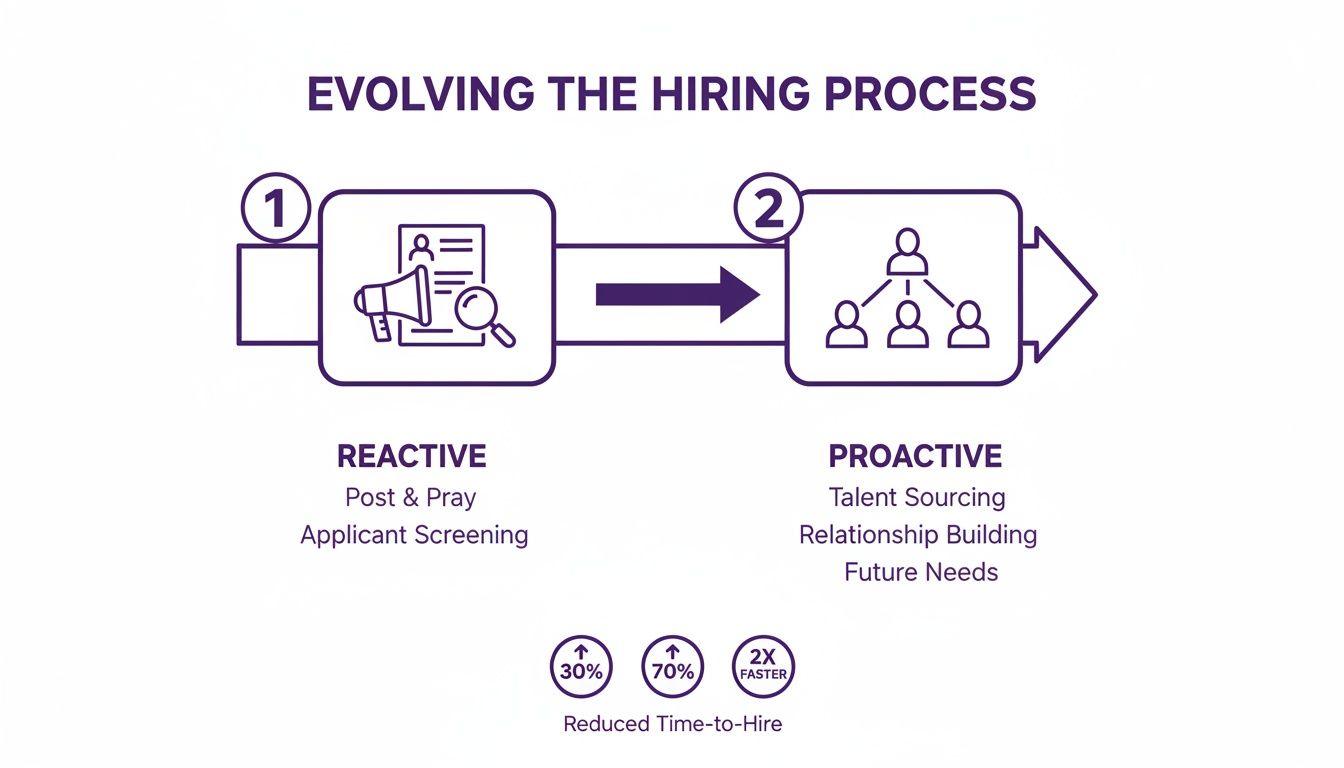
This visual drives home the point: a proactive pipeline strategy turns recruiting from an emergency response into a predictable, strategic part of the business.
While you're nurturing these relationships, you're also constantly qualifying candidates. This isn't a formal interview. It's an ongoing, informal process of assessing their skills, career goals, and cultural alignment through your conversations. A strong pipeline isn't just a long list of names—it's a curated group of pre-vetted people.
The goal is to understand a candidate's potential fit for multiple future roles, not just the one opening you have right now. This requires a shift from a "job-centric" to a "candidate-centric" mindset.
You can gather incredible information by asking thoughtful questions during your check-ins, seeing how they contribute in public forums, or even inviting them to consult on a small, paid project. This deepens the relationship and gives you a firsthand look at their capabilities. It’s a core strategy for building a future-proof team, an idea explored in-depth by experts at Harvard Business Review.
The final stage is turning a warm, nurtured candidate into an active applicant and, ultimately, a new hire. If you've done the first three stages right, this part becomes dramatically easier. Instead of a cold, out-of-the-blue message, your conversation starts from a place of trust and familiarity.
When a relevant role opens up, you're not just another recruiter with a job description. You're reaching out to someone who already knows your company, respects your culture, and has a real relationship with your team. This naturally leads to higher response rates, a quicker interview process, and a much better offer acceptance rate.
This isn't just about filling one job. A successful conversion actually strengthens your entire pipeline. You turn a great candidate into an employee who will, in turn, refer other great candidates. This creates a powerful, self-sustaining talent engine—the ultimate flywheel for effective talent pipeline management.
You might think your Applicant Tracking System (ATS) is doing the work of a talent pipeline. It’s an easy mistake to make, but one that’s probably costing you great candidates and dragging out your hiring process.
Let's get one thing straight: your ATS is a system of record, not a system of engagement.
Think of it as a digital filing cabinet. It’s built for compliance, designed to store resumes from past applicants for specific roles. It’s fundamentally static and reactive, which is why recruiters often call it a "resume black hole." A candidate applies once, and their profile just sits there, gathering digital dust. If you want a full deep-dive, you can learn more about what an ATS is in our article right here.
A real talent pipeline, on the other hand, is a living, breathing ecosystem. It's a dynamic community of engaged, passive candidates you’re actively building relationships with before you even have a job opening. The entire focus shifts from tracking yesterday's applicants to nurturing tomorrow's hires.
This distinction has never been more critical. We're living in a skills-first world now, where traditional credentials like college degrees and tidy career paths are losing their predictive power. The ground is shifting right under our feet.
The World Economic Forum predicts that by 2025, technology will eliminate 85 million jobs but create 97 million new ones. This isn't just a reshuffling; it's a fundamental change in the skills companies need to survive. The talent gaps are already massive—the U.S. alone will be short 1.2 million tech workers by 2026. It’s no surprise that 63% of organizations are leaning on data-driven HR to navigate the chaos, according to a 2023 report by Gartner.
This skills-first approach isn't just a trend; it's a strategic necessity. Companies that continue to rely on outdated proxies for talent will be outmaneuvered by those who can identify and cultivate skills directly.
Your ATS is built to scan for keywords on a resume. But what about the brilliant software engineer who contributes to major open-source projects but never lists "Java" on their resume? Or the product leader whose biggest wins are detailed in public launch announcements, not tidy bullet points? Your ATS will miss them every single time.
So, if the old methods are broken, how do you find and manage people based on what they can actually do?
Siemens is a perfect example. In 2020, the industrial giant invested $100 million in an internal retraining program. Instead of laying off employees with outdated skills and trying to hire new ones, they launched a huge internal retraining program focused on aptitude and potential, upskilling their existing people for the jobs of the future. By betting on potential over pedigree, Siemens built a more resilient, adaptable workforce from the inside out.
That’s the core of modern talent pipeline management. It demands a shift away from the static data in your ATS toward a system that understands skills, potential, and genuine engagement.
But there’s a big problem most tools ignore: How do you actually track and verify these skills across thousands of candidates without hiring an army of researchers? This is where technology that can see beyond keywords and interpret real-world accomplishments becomes a recruiter's unfair advantage.
Okay, theory is great, but a modern talent pipeline management strategy only really comes to life when you put it into practice. Making the leap from a static ATS to a dynamic, living pipeline means adopting a new workflow—one that runs on the speed and smarts of AI and automation. It's about finding people based on what they've actually done, not just the keywords they've stuffed into their resume.
You might be thinking that setting up an AI-driven workflow sounds like a massive, months-long project. The reality? You can get a powerful, automated pipeline humming in minutes. It all starts with a mental shift: stop searching for resumes and start searching for proof of skill. This is where natural language tools give you an almost unfair advantage.
Instead of getting into a wrestling match with complex Boolean strings, you can just ask for exactly who you need in plain English.
Example Prompt: "Find me software engineers in San Francisco who have shipped a mobile app with over 1 million downloads, previously worked at a YC-backed startup, and have experience with Swift and Kotlin."
This is the fundamental difference. A simple, outcome-focused prompt like that can scan dozens of platforms—think GitHub, LinkedIn, personal portfolios, and more—to find candidates whose work speaks for itself. It’s a total break from the old way of doing things.
Building your pipeline with a tool like Juicebox isn't just about moving faster; it's about being smarter. Fast-growing companies like Ramp and Perplexity are using this exact approach to slash their sourcing time by a staggering 80%. They're finding top-tier talent from over 30 different sources, which means they're no longer over-reliant on a single, pricey platform.
Here’s what that workflow looks like in action:
This automated process ensures your pipeline is always stocked with fresh, relevant talent, and you don't have to lift a finger. This isn't some far-off concept; it's the new standard for effective talent pipeline management.

Finding great candidates is only half the battle. A true pipeline needs nurturing, and this is another area where AI can do the heavy lifting. Once the right people are identified, you can use integrated tools to automatically verify their contact info and enroll them in personalized, multi-step email sequences.
But here’s the problem most tools conveniently ignore: personalization at scale is brutally difficult. Generic, templated outreach gets deleted on sight. AI helps solve this by spotting unique details from a candidate’s profile—maybe a specific open-source project they contributed to or a recent award they won—that you can reference in your outreach. The result is a 3x lift in reply rates compared to your standard cold email blast. To keep your whole process sharp, it’s worth looking into key business process improvement techniques.
When you combine AI-powered sourcing with automated, personalized engagement, you build a seriously powerful engine for your talent pipeline management strategy. You’re no longer just finding people; you're building relationships at scale, making sure you have a warm pool of pre-vetted candidates ready to go the moment a role opens up. It’s clear that understanding the broader impact of AI in recruitment is a game-changer.
A talent pipeline is a strategic investment, not just another HR task on the to-do list. To show its true value, you have to look past vanity stats like the number of candidates in your database. Instead, you need to focus on the business-impact metrics that leaders actually care about.
Measuring the return on investment (ROI) of your talent pipeline management strategy isn't just about justifying your budget. It’s about proving how it directly fuels efficiency, improves hiring quality, and drives company growth.
This is the classic recruiting metric, counting the days from when a job is posted to when an offer is accepted. A long Time-to-Fill can cripple a team's productivity and put critical projects on hold.
Here’s the deal: a proactive talent pipeline is the single best way to crush this number. When a role opens up, you’re not starting from scratch. You’re dipping into a pool of warm, pre-vetted candidates who already know who you are. This lets you skip weeks of sourcing and screening, jumping straight into real conversations.
Let's face it, hiring is expensive. This metric bundles all the associated costs—advertising fees, agency commissions, recruiter salaries, and tech subscriptions—and divides them by the number of hires.
A healthy pipeline slashes this cost from every angle:
This is arguably the most important metric, but it’s often the toughest to pin down. It measures the value a new hire brings to the business. While definitions can vary, it typically combines a new hire's performance review scores, their manager's satisfaction, and their 90-day retention rate.
Great talent pipeline management directly boosts this KPI. By nurturing relationships over time, you get a much deeper read on a candidate's skills, motivations, and cultural fit long before a formal interview. This leads to better-aligned hires who ramp up faster and are way more likely to stick around. Diving into the core KPIs of recruitment can give you a more structured way to track this.
A low offer acceptance rate is a painful sign that something is broken. It means you’re putting in all the work to get to the final stage, only to lose your top choice.
A pipeline acts as a powerful buffer against this. Candidates you’ve been talking to for months have a stronger connection to your brand and a higher level of trust. When you finally extend an offer, it feels like the natural next step in an ongoing conversation, not a transactional surprise. This relationship-first approach dramatically increases the odds they'll say yes.
To really see the difference, let’s look at the numbers side-by-side. The data shows a clear and compelling story about the impact of proactive talent pipelining.
| Metric | Without a Talent Pipeline (Industry Average) | With a Talent Pipeline (Reported Improvement) |
|---|---|---|
| Time-to-Fill | 42–49 days | 29 days or less |
| Cost-per-Hire | $4,700 | Reduced by up to 50% |
| Quality of Hire | 75% retention after one year | 90%+ retention after one year |
| Offer Acceptance Rate | 89% | 95% or higher |
These aren't just minor improvements; they represent a fundamental shift in hiring effectiveness. The ability to fill roles faster, cheaper, and with better people is the ultimate competitive advantage.
Beyond these direct hiring metrics, a strong pipeline is essential for strategic initiatives like succession planning. In fact, succession planning is a key outcome, especially as 28% of global employees are considering a job change, according to a 2023 PwC survey. With leadership continuity being a top concern for CHROs, building a pipeline of both internal and external leaders ensures the organization is always ready for what’s next.
A talent pool is a static database of contacts. A talent pipeline is the dynamic, strategic process of actively nurturing those contacts for future roles.
It used to take 3-6 months. With AI tools, you can build momentum in your first week and see significant results inside a month by automating sourcing.
Yes, it's even more critical. It lets them hire strategically without relying on costly agencies, ensuring every hire moves the company forward.
The core benefit of proactive talent pipeline management isn't just about filling roles faster; it's about building organizational resilience. This unlocks the ability to scale predictably, knowing that a steady stream of top-tier talent is always ready to join your mission, giving you a permanent edge in the war for talent.
{{large_cta}}
Run your first search for free. Find and engage top talent across 800M+ profiles. Trusted by 5,000+ customers.
.png)
.png)
.png)