.svg)
SIGN UP FOR JUICEBOX (IT’S FREE!)

Who are you looking for?
Thank you! Your submission has been received!
Oops! Something went wrong while submitting the form.

A talent management system isn’t just another piece of HR software; it’s the central nervous system for your company's entire people strategy. Think of it as the operating system connecting every stage of the employee journey—from attracting top candidates with tools like PeopleGPT to developing them for future leadership roles. It transforms disjointed HR tasks into a unified strategy that attracts, develops, and retains top talent, directly linking people operations to business growth.
But there’s a problem most tools ignore: they're brilliant at managing the talent you already have, but they can't actually find new talent. It’s like having a world-class factory with no raw materials coming in.
TL;DR: What is a Talent Management System?
A talent management system is an integrated software suite that helps organizations manage the entire employee lifecycle—from hiring to retirement. Its primary benefit is transforming disjointed HR tasks into a unified strategy that attracts, develops, and retains top talent, directly linking people operations to business growth.
At its core, a talent management system (TMS) is an integrated software suite that manages the full employee lifecycle. If your individual HR tools—like an applicant tracking system (ATS) or a learning platform—are planets, the TMS is the sun they all orbit. It provides the gravitational pull, aligning recruiting, performance, and development into a cohesive strategy instead of disconnected activities.
This integrated approach is key. While older, all-in-one HR suites tried to do everything, they often did most of it poorly. The new philosophy is to build a "best-in-class" tech stack, where a central TMS integrates seamlessly with specialized, powerful tools.
Let's pause. The global talent management software market was valued at USD 9.96 billion in 2023 and is projected to skyrocket to USD 22.67 billion by 2030. This explosive growth signals a clear trend: businesses are investing heavily to connect hiring and development. But simply buying a system isn’t enough.
You might think an expensive talent management system will solve your hiring problems out of the box. That’s a common misconception. Most systems are brilliant at managing existing employees or candidates who find your careers page.
Here’s the problem: they're passive. A TMS can organize, track, and develop candidates, but it can’t find them. This is why even the most expensive TMS fails to deliver ROI without a powerful, proactive engine filling the top of the funnel. Without a constant flow of high-quality, passive candidates from tools like the best sourcing tools for recruiters, the entire system grinds to a halt.
The world of HR tech is packed with acronyms, making it easy to confuse a talent management system (TMS) with an Applicant Tracking System (ATS). Understanding their distinct roles is the first step toward building a tech stack that actually works.
Let's break it down.
But here’s what both systems miss: they don’t proactively find anyone new. They only manage people you already know about, leaving a huge gap at the top of the funnel.
A winning team requires tools that cover every stage, from discovery to development. A proactive hiring strategy demands a clear line between passive management and active sourcing.
Here’s how they play together:
This diagram shows how a talent management system connects the core parts of the employee lifecycle after a candidate becomes an employee.
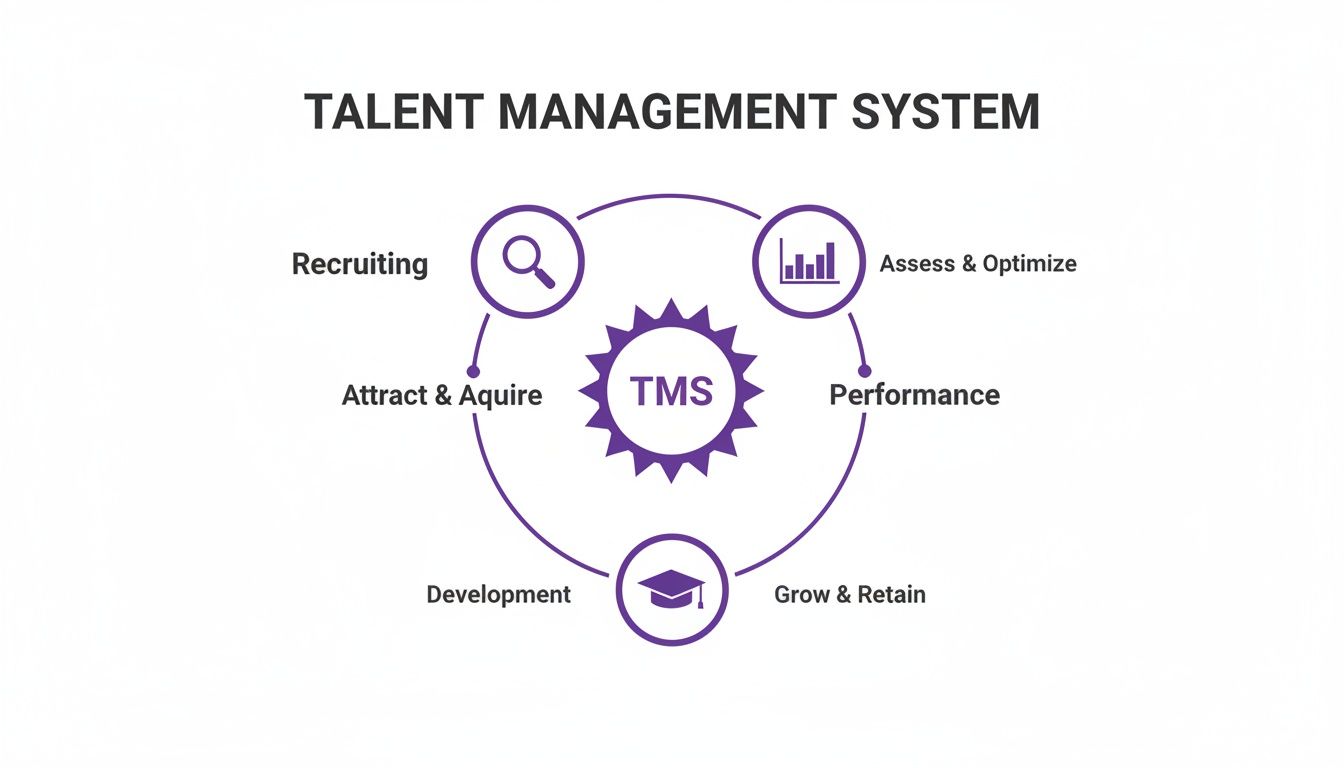
As you can see, recruiting is just the front door. The TMS is responsible for the entire ecosystem of performance and development that follows. Understanding the differences between tools is critical, which is why a recruiting software comparison is so valuable.
A typical talent management system has a long list of features, but the real value isn't what it does, but why it matters to your bottom line. We need to connect these functions to real business outcomes.
Think of it this way. A car's spec sheet lists horsepower, but you care about the feeling of acceleration. It's the outcome, not the spec, that counts. The same goes for a talent management system—its features are the engine, but strategic growth is the destination.
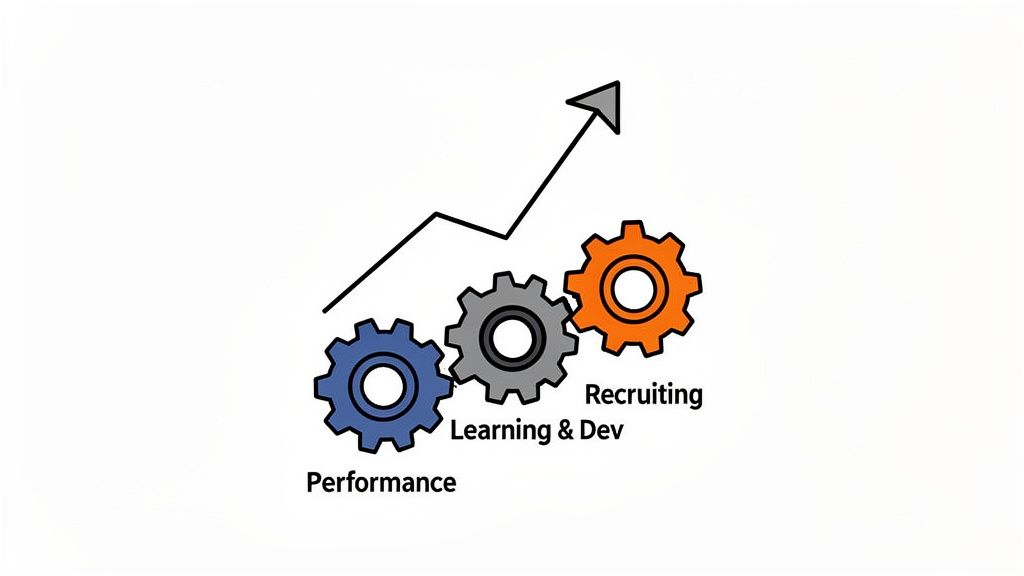
Managing the entire employee lifecycle now grabs over 30% of the market share as companies scramble to retain people. Performance management is practically universal, with 95% of companies using it. These aren't just features; they're strategic levers. For context on other tools, see our analysis of SeekOut pricing.
Most systems have a "Performance Management" module. This is the tool that links an employee's daily work directly to the company's biggest goals.
Now, let's bust a common myth: the belief that you need a single, all-in-one talent management system to be effective. The opposite is true.
Most people believe a single suite simplifies things, but this "one-size-fits-all" approach often fails. Why? Monolithic systems are jacks of all trades but masters of none. Their recruiting module is rarely as good as a dedicated sourcing tool.
For agile companies, a best-in-class, integrated stack delivers far better results. This is where a powerful AI sourcing tool becomes a game-changer. It doesn't replace your TMS; it supercharges talent acquisition. By plugging in a specialized engine like PeopleGPT, you fill your funnel with elite, passive candidates, feeding your talent management system the high-quality pipeline it needs to thrive.
Picking a talent management system is a massive decision. It's not just buying software; it's installing a core part of your company's operating system. The best platform isn’t the one with the most features—it’s the one that delivers the right outcomes. Check out our guide on how to streamline your recruitment process.
But hold on. There's a huge problem most companies overlook. They forget about the sourcing bottleneck. The most advanced talent management system on the planet is just an expensive, empty database if you don't have high-quality candidates to put in it.
So, the first question to ask isn't about performance reviews. It's: "How will we fill this with a steady stream of top-tier talent?"
Before you get lost in feature comparisons, let's be clear. The "all-in-one" dream often ends in disappointment because monolithic systems are rarely best at any one thing, especially finding talent. The modern approach is an integrated tech stack. Research from Gartner shows integration capabilities are a top priority for HR leaders. This lets you connect a powerful AI sourcing platform to fill the pipeline.
Anchor your evaluation on these three pillars to see the true ROI.
The real value comes from its impact on big-picture business metrics. Track these KPIs before and after implementation:
Choosing the right talent management system starts by understanding its purpose: to manage and develop the talent you have. Prioritize integrations so you can plug in a powerful sourcing engine to feed it. Exploring options like Indeed alternatives can also inform your strategy.
A modern talent management system is incredible at nurturing the people you have. But it has one big blind spot: it's completely dependent on the quality of candidates you put into it.
Think of it as a high-performance race car. Great engine, but with low-grade fuel, you'll never see what it can do.
That’s where AI sourcing flips the script. It’s the high-octane fuel for your talent engine. Instead of waiting for applicants, AI sourcing finds top-tier, passive candidates across the web. Ramp, a fast-growing fintech company, proves this model. By using PeopleGPT to source candidates before funneling them into their Greenhouse TMS, Ramp cut their time-to-hire by 50% in just three months. This isn't about replacing your TMS; it's about making it a force multiplier. For more on AI tools, check our list of the top 10 AI recruiting tools for 2026.
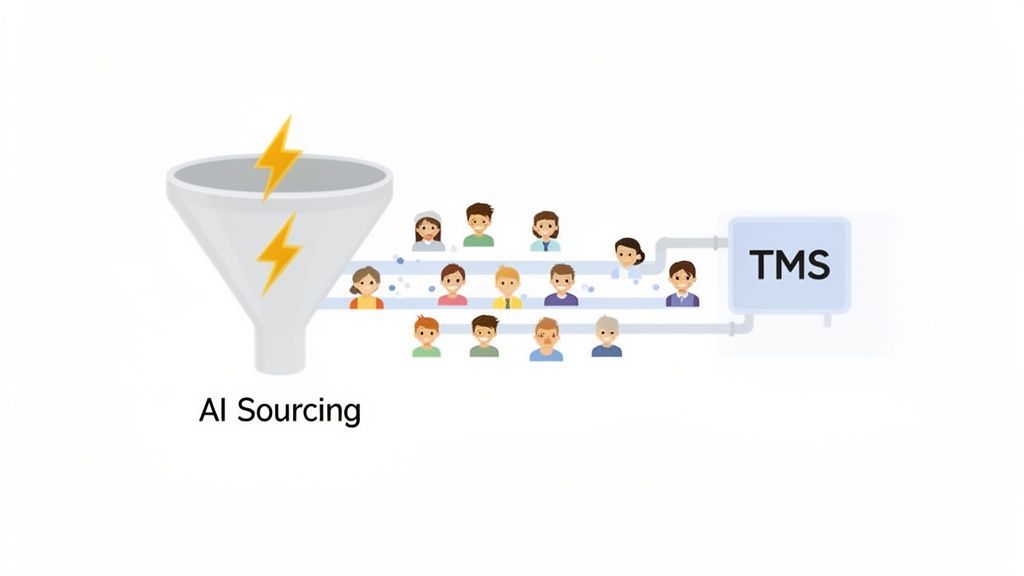
The workflow is refreshingly simple.
This simple shift turns a multi-hour sourcing marathon into a task that takes minutes. The strategic impact is huge, especially in competitive fields like IT, which accounted for 21% of the global talent management software market in 2022. As remote work becomes the norm, integrating specialized recruiting tools like freelance recruiter platforms is a necessity. To get a deeper look, check out our complete guide on AI sourcing.
What's the main purpose of a talent management system?
Its core job is to unify your entire people strategy, connecting everything from recruitment to succession planning into one cohesive, business-aligned engine.
How is a talent management system different from an ATS?
An ATS manages job applications. A TMS covers the entire employee lifecycle post-hire, including performance, learning, and career growth.
Can small businesses benefit from a talent management system?
Absolutely. Modern, scalable systems level the playing field, helping smaller businesses compete for top talent by improving how they hire, engage, and retain.
What is the most important feature in a modern TMS?
Strong integration capability is non-negotiable. A modern TMS must connect seamlessly with your other essential tools, especially AI sourcing platforms.
The core benefit of a modern talent management system is not just about organizing HR—it's about building a repeatable engine to attract, develop, and retain top talent.
When you pair your TMS with a powerful AI sourcing engine, you unlock true talent agility. This is what allows you to outmaneuver competitors, build a world-class workforce, and turn your people strategy into your greatest competitive advantage.
Start sourcing with PeopleGPT.
{{large_cta}}
Run your first search for free. Find and engage top talent across 800M+ profiles. Trusted by 5,000+ customers.
.png)