.svg)
SIGN UP FOR JUICEBOX (IT’S FREE!)

Who are you looking for?
Thank you! Your submission has been received!
Oops! Something went wrong while submitting the form.

Let's cut through the noise. Talent management models are strategic playbooks for how you attract, develop, and keep your best people. Think of them as the operating system for your company's talent—turning reactive, fire-fighting hiring into a proactive strategy that fuels growth. This isn't just about HR; a solid framework is what separates teams that are constantly fighting fires from those building something sustainable. A well-executed model is the engine that drives business forward.
The core benefit is building a proactive talent engine. This means you finally stop hiring out of desperation and start building a bench of talent ready for whatever comes next. Most guides on talent management models give you a laundry list of options, but they miss the most critical part: matching the model to your company's specific growth stage. A framework that works for a 500-person company will suffocate a 50-person startup. We’ll show you how to pick the right one.
TL;DR: A Quick Guide to Talent Management Models
You might think that formal talent management models are just for massive companies with huge HR departments. Most people believe this. The opposite is true. Early-stage companies often need them most. Why? Without a framework, you're just inviting chaos.
Here’s the deal.
A good model connects every piece of the employee lifecycle. Recruiting informs development, performance data fuels your succession plans, and onboarding actually sets new hires up for long-term success.
Adopting the right framework has a direct impact on your bottom line. Companies that nail talent management see real, tangible results. For instance, a 2023 study found that organizations with integrated talent strategies saw 25% lower involuntary turnover rates. That's a huge win.
A well-executed model doesn't just fill seats; it builds organizational capability. It ensures you have the right people with the right skills in the right roles at the right time.
This isn't about adding more bureaucracy. It's about adding clarity and intention to how you manage your people. It shifts your talent acquisition team from being seen as a cost center to a strategic driver of innovation. By mastering different talent management models, you build a system that not only solves today's hiring needs but also anticipates and prepares for tomorrow's. Here's the bottom line: a coherent model is how you win the war for talent.
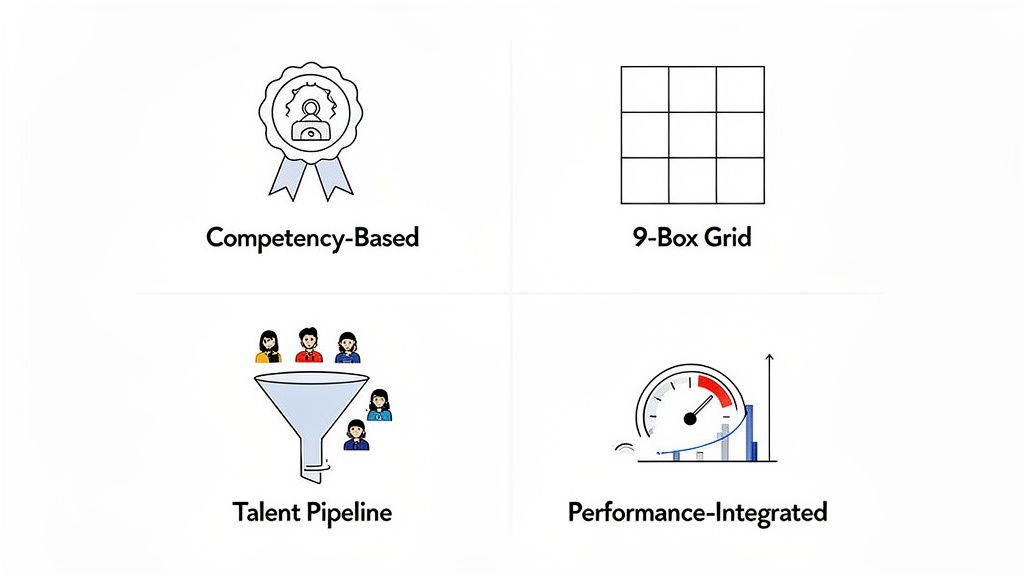
If you want to build a talent engine that actually works, you need to know what’s under the hood. Most high-performing talent strategies are built on four core talent management models. Each one plays a different role, but they really shine when you connect them. When they work together, they create a system that’s much more powerful than the sum of its parts.
Let's pull them apart, one by one.
At its heart, a competency-based model answers a deceptively simple question: "What does great actually look like here?" It’s all about defining the specific skills, behaviors, and knowledge someone needs to succeed in any given role, from a junior developer to the VP of Sales.
Think of it as the architectural blueprint for your entire organization.
This model is the foundation. Without a clear definition of "good," everything else you do—from recruiting to promotions—is basically guesswork.
The 9-Box Grid is a classic for a reason. It's a simple tool for mapping out your talent by plotting employees on a matrix with two axes: current performance and future potential. This one visual instantly segments your workforce, helping you see who fits where.
But there’s a problem most tools ignore. While the 9-Box is a recruiter favorite, it often relies on subjective manager ratings, which can be riddled with bias. That's why it's critical to pair it with objective data from other systems. The goal isn't just to label people; it's to apply different strategies to each group. Your high-potential, high-performance "stars" get put on the fast track, while low-potential, low-performers might need a performance improvement plan.
Most leaders think succession planning is just for the C-suite. That’s old-school thinking. Today's competitive advantage comes from building deep talent pipelines at every level of the business, not just the top.
A talent pipeline model is all about proactively sourcing and nurturing people for critical roles before you even have an opening. Instead of scrambling when a key player resigns, you have a pre-vetted bench of internal and external talent ready to go. A freelance recruiter can be invaluable here.
This approach shifts recruiting from a reactive, firefighting function to a strategic, relationship-building one. It’s the difference between being an architect and an arson investigator.
This is especially vital for high-growth companies where new roles are popping up constantly. By anticipating what you'll need down the road, you can slash your time-to-fill for key positions and keep business momentum from stalling out over a talent gap.
The final piece of the puzzle isn't a standalone model, but more of a philosophy: every single talent decision should be backed by objective performance data.
This is the glue that connects all the other models into one cohesive, intelligent system.
Companies that get this right move faster. Businesses using agile talent management report adapting to market changes up to 30% faster. A 2023 analysis showed that over 70% of Fortune 500 companies wove agile elements into their talent frameworks, which led to a 25% drop in involuntary turnover. This integration creates a constant feedback loop, where real-world performance data continually refines your talent strategy, ensuring it's always in sync with the business.
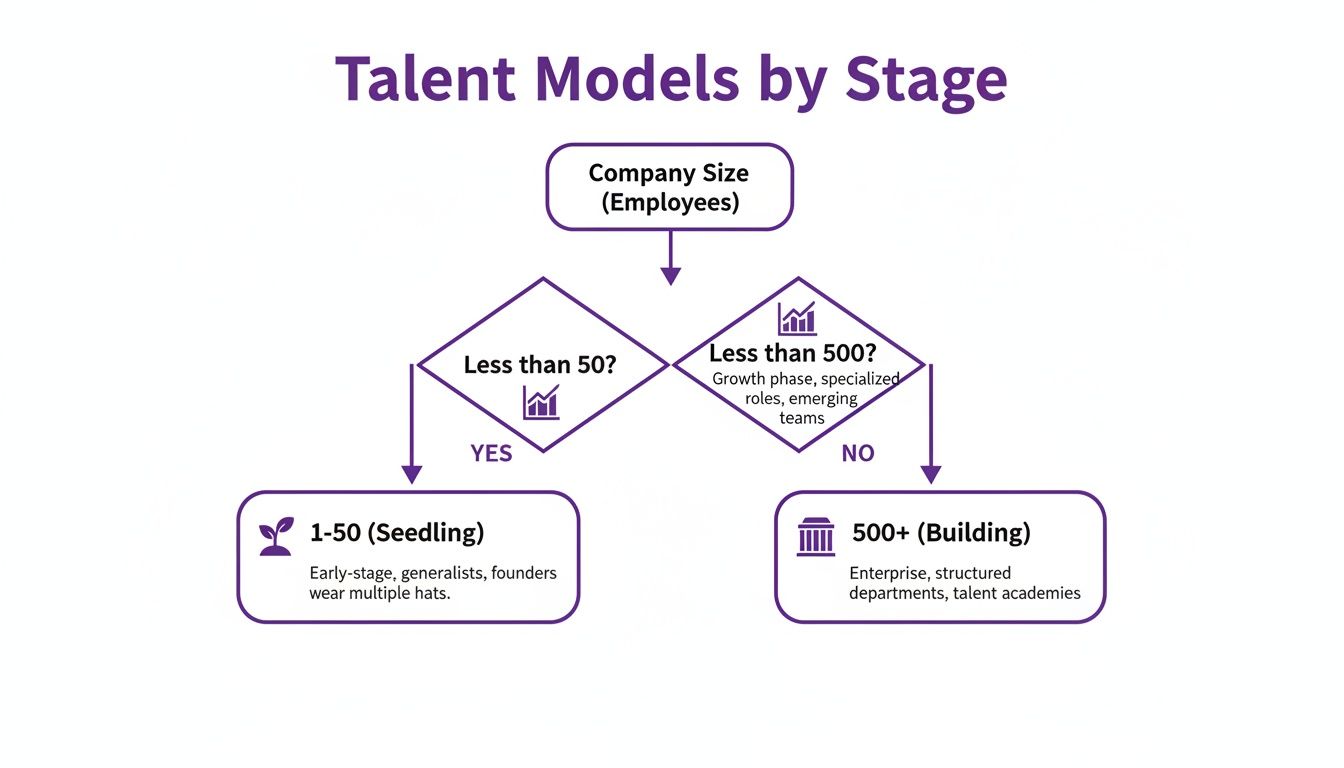
Picking a talent management model that doesn’t fit your company's scale is like trying to navigate a city with a world map—you’ve got the right idea, but the details are all wrong. The right framework depends entirely on where you are in your growth journey.
The trick is to match your model to the biggest business challenge you're facing right now.
For startups, it’s all about speed and survival. Your main talent goal isn't mapping out complex career ladders; it's hiring the right foundational team and doing it consistently. A much leaner approach is the way to go, focusing on core skills like those needed for a 9-80 work schedule.
The whole point here is to create a simple, repeatable rubric to evaluate every candidate. This ensures your first hires truly align with the company's DNA.
At this point, your challenges multiply. You have to create internal career paths to keep your best people from walking out the door. Just hiring for "culture fit" doesn't cut it anymore; you need to start proactively building for what's next.
This is where a Talent Pipeline model becomes your most valuable asset. For instance, the fintech company Ramp scaled from 50 to 500 employees in 24 months by focusing relentlessly on building talent pipelines. This single tactic slashed their time-to-fill for senior roles by 40%, letting them keep their foot on the gas without hitting hiring bottlenecks.
This approach transforms your team from reactive order-takers into strategic talent advisors. It also forces you to think about effective workforce optimization long before you hit a crisis.
Once you cross the 500-employee mark, your talent needs get way more complex. Your biggest risks are no longer just hiring speed but internal stagnation and leadership gaps.
This is when a fully Integrated Talent Management Model becomes non-negotiable. It’s what connects performance data, succession planning, and internal mobility into one cohesive system. A 2022 report from the Talent Strategy Group found that a staggering 80% of companies had redesigned their performance management systems in the last four years. This signals a massive industry-wide shift toward better integration.
This mature model ensures that performance reviews directly feed into development plans, and that your high-potential employees are systematically groomed for their next big role. Knowing your SeekOut pricing options can help budget for the tools needed at this stage.
Picking the right framework is a huge first step, but even the best strategy gathers dust without a clear plan to bring it to life. Successfully rolling out talent management models is about a focused, step-by-step approach that builds momentum.
It all starts with getting the right people on board.
Before you write a single competency or map out a talent pipeline, you absolutely need your executive team's backing. The fastest way to get them there is to speak their language: data. Forget the HR jargon. Build a rock-solid business case.
Once you’ve got their support, the next job is to define what “great” actually looks like.
This is where you build the operational backbone of your model. Sit down with department heads and nail down the 3-5 core competencies that separate the top performers from everyone else on their teams. These aren't just about hard skills. Think bigger—behaviors like ownership, collaboration, and the ability to adapt on the fly. At the same time, decide on the key recruiting metrics you'll use to track the model's success.
Your new talent model can't live in a forgotten spreadsheet. For it to actually work, it needs to plug right into the tools your team already lives in every day—your ATS, HRIS, and communication platforms. A smooth integration means data flows automatically, killing off information silos. For example, performance review data from your HRIS should feed directly into your 9-box grid placements. This technical plumbing is what makes the model a dynamic part of your workflow instead of just another static document.
Finally, it's time to go live—but not all at once. Kick things off with a pilot program in a single department or team. This gives you a safe space to gather feedback, iron out the wrinkles, and create a success story you can use to get the rest of the company excited.
A "big bang" launch is a recipe for disaster. A phased rollout builds trust, proves value, and lets you fine-tune the model with real-world feedback before taking it company-wide.
Once you're live, track those KPIs you defined earlier like a hawk. The best talent management models are never "done." They evolve right alongside the business. This is also where modern tools can be a massive force multiplier. For instance, you could run a prompt in PeopleGPT like: Find me software engineers in San Francisco with 3-5 years of experience at Series B fintech companies who have shown career progression. This instantly builds a pipeline of high-potential talent.
So, you’ve picked a talent management model and put it into action. How do you know if it’s actually working? Gut feelings won’t cut it. You need to track the right Key Performance Indicators (KPIs). These are the numbers that reveal the real-world impact of your strategy on the business.
But which metrics truly matter?
This is a critical health check for any talent strategy. Losing your top future leaders is incredibly costly. A spike here is a massive red flag that your development or retention efforts are missing the mark.
(Number of High-Potentials Who Left / Total Number of High-Potentials) x 100If this number starts climbing, it's time to dig into your 9-Box Grid or performance data to understand why your best people are walking out the door.
This KPI tracks how many roles you fill with internal candidates versus external hires. A high rate is a fantastic sign that your talent development and succession planning are working. The tech company Cognition used an agile talent model to reduce its high-potential turnover by 22% in just 12 months by identifying and promoting internal candidates into senior roles. This shows the tangible value of a well-measured strategy and how different talent management models deliver real results. For more on this, check out our guide on how to streamline your recruitment process.
How long does it take to fill your most important positions? This metric isn't just about speed; it's a direct reflection of your talent pipeline's health. A long time-to-fill for key roles can halt major projects and put a huge strain on the business. A proactive talent pipeline model is designed specifically to drive this number down by having pre-vetted, ready-to-go candidates in your back pocket. Understanding your options with tools like HireEZ pricing can help build this capability.
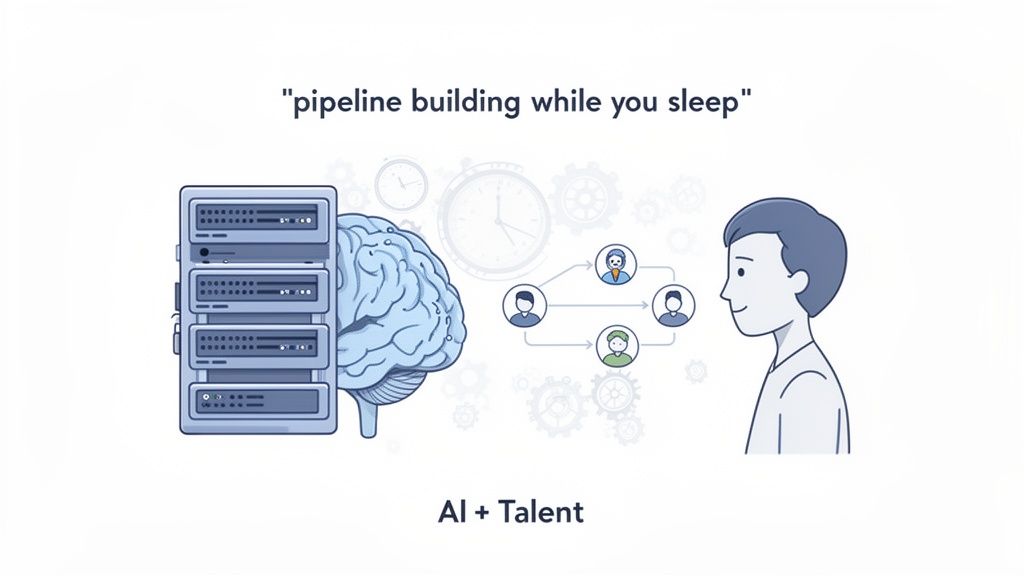
If you look closely, you can see the old, rigid talent management models starting to crack. In their place, something far more fluid and intelligent is emerging, all thanks to AI and automation. These tools are transforming talent acquisition from a slow, step-by-step process into a predictive engine that’s always learning.
But here’s the problem with most recruiting tools: they just automate tasks. They don’t actually make your organization smarter. The real shift comes from AI-native systems that learn from every single interaction, getting better at understanding what a great hire looks like for your company. This is how talent teams finally break free from the hamster wheel of repetitive work.
One of the first places you'll feel AI's impact is at the top of the hiring funnel. Sourcing has always been a volume game that burns out even the best recruiters. AI completely flips that script. A recruiter can now just describe their ideal candidate in plain English. The AI then gets to work, scanning millions of profiles from dozens of sources, ranking them by fit, and even kicking off personalized outreach campaigns with effective recruitment emails.
The AI recruiting platform Cognition saw a 5X jump in sourcing efficiency in just three months after bringing on an AI agent. Their team built pipelines for highly specialized technical roles in a fraction of the time it used to take. You can explore a range of AI automation solutions to see how this is reshaping talent workflows in the real world.
Beyond just filling open roles, AI gives you the power to make smarter, data-driven decisions about your entire workforce. It can analyze your internal performance metrics alongside external market trends to predict which skills will be critical 12–24 months from now.
AI transforms talent management from a reactive function that fills open seats to a proactive one that builds future organizational capability.
This is a complete game-changer. It means you can invest in training and development before a skills gap becomes a full-blown crisis. It ensures you always have the right people in place to execute your company’s vision. For a deeper look at this, check out our guide on modern talent intelligence software. The right platform makes this shift from reactive to proactive not just possible, but practical.
How does AI reduce bias in hiring models?
AI can focus on objective data like skills and performance metrics, while ignoring demographic information that can trigger unconscious bias in human reviewers.
Will AI replace recruiters in talent management?
No. It automates tedious work, freeing up recruiters to focus on high-value strategy: candidate engagement, complex negotiations, and advising leadership.
Can AI predict which candidates will be top performers?
It can identify candidates whose skills and experience match your current top performers, significantly increasing the probability of making a great hire.
Ultimately, the right talent management model shifts your organization from reactive to proactive. You stop putting out fires and start building a strategic talent engine that knows what’s coming next and fuels real, sustainable growth. This unlocks your team's power to hire and develop the people who will define your company's future.
{{large_cta}}
Run your first search for free. Find and engage top talent across 800M+ profiles. Trusted by 5,000+ customers.

.png)