.svg)
SIGN UP FOR JUICEBOX (IT’S FREE!)

Who are you looking for?
Thank you! Your submission has been received!
Oops! Something went wrong while submitting the form.

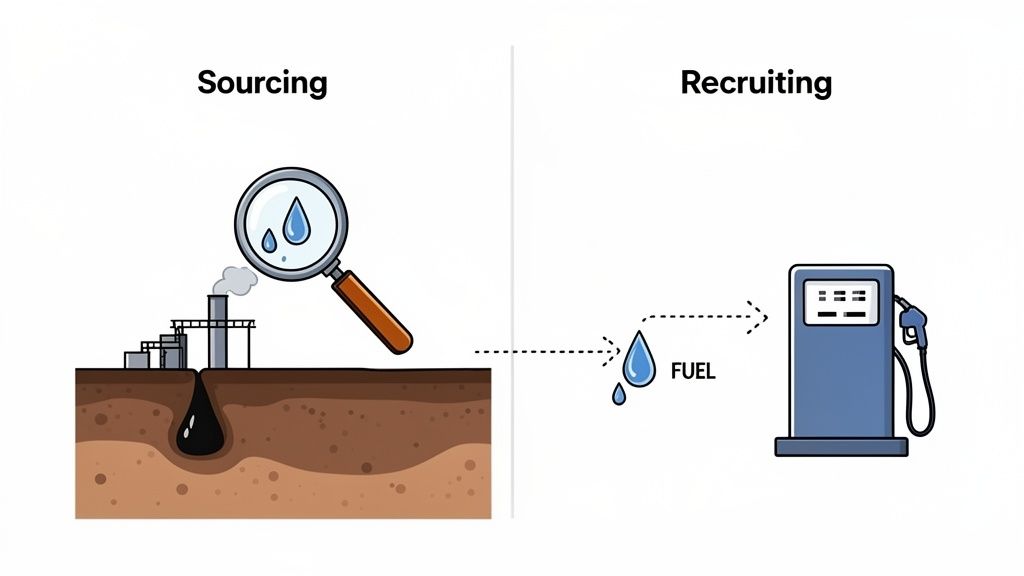
Sourcing is like discovering a new oil reserve—you're finding untapped potential that nobody else has tapped into yet. Recruiting is the entire operation that follows, from drilling and extraction to refining that crude oil into fuel that powers the company. This distinction is critical because, unlike generic HR platforms, we built Juicebox is fuse these two functions, creating a single, powerful talent engine.
The real difference between sourcing vs recruiting boils down to this: sourcing is the proactive hunt for passive talent, while recruiting is the structured process of guiding active candidates through your hiring funnel. It’s the essential first link in the recruitment process chain.
TL;DR: Sourcing vs Recruiting
In this guide, we'll go over the key differences between sourcing vs recruiting so you know both functions inside out.
Let's dive right in:
People throw the terms "sourcing" and "recruiting" around like they're the same thing, but they are two distinct—though deeply connected—parts of the talent acquisition machine.
What’s the bottom line?
Sourcing is the specialized, top-of-funnel work focused on finding and engaging people who aren't even looking for a new job. It's about building a pipeline before a critical role even opens up. This is a strategic game of research, outreach, and building genuine relationships.
Recruiting, on the other hand, is the full-cycle process that kicks in once a candidate shows interest. It’s everything from screening applications and running interviews to negotiating offers and handling onboarding. While a sourcer fills the pipeline, a recruiter is responsible for managing and converting the talent within it. To get that first stage right, you have to know how to source candidates in today's market.
To really get the sourcing vs recruiting dynamic, let's break down their core functions side-by-side. They’re both working toward the same goal—making a great hire—but their day-to-day actions, metrics, and even mindsets are completely different. Knowing which recruiting metrics to track can make or break your strategy.
This table cuts through the noise and shows exactly where sourcing ends and recruiting begins:
| Dimension | Sourcing (The Hunt) | Recruiting (The Funnel) |
|---|---|---|
| Primary Activity | Proactively identifying and engaging passive candidates. | Managing active candidates through the hiring process. |
| Candidate Type | Passive (not actively job hunting). | Active (applied directly or responded to outreach). |
| Timing | Continuous; often done before a role is open. | Reactive; starts when a job requisition is approved. |
| Core Goal | Building a qualified talent pipeline for future needs. | Filling a specific, open role with the best candidate. |
This view makes it pretty clear how the responsibilities are divided. But there’s a problem most tools ignore: they are built to reinforce this artificial separation, creating friction where there should be flow.
This kind of unified approach means a single person can handle high-level sourcing and recruiting tasks almost at the same time. To dive deeper into how proactive methods work in the real world, it’s worth exploring the nuances of HR headhunting. Adopting that forward-thinking mindset is how you secure top talent before your competitors even know they’re available.
Most teams think the best way to handle sourcing vs recruiting is to build a wall between them. The logic seems sound: create specialized roles for maximum efficiency. Sourcers hunt, recruiters close. Simple, right?
But this assembly-line approach is fundamentally broken. Here’s why.
A rigid separation often creates more problems than it solves. When sourcing and recruiting operate in silos, you get a disjointed, inefficient hiring process that bleeds talent, time, and money. Sourcers, tasked with finding top-tier passive talent, lob candidates over the wall to recruiters but rarely get detailed feedback on why someone didn't advance. Without that crucial feedback loop, sourcers can't refine their searches.
On the other side, recruiters get a list of names with little to no context. This makes their follow-up feel generic and impersonal, often tanking the candidate experience. According to a 2023 SHRM report, nearly 60% of job seekers have had a poor experience—a number that skyrockets when handoffs are clumsy. A unified strategy, like full-cycle recruiting, directly attacks these gaps.
Most believe that having dedicated specialists for each stage—sourcing and recruiting—is the peak of efficiency. But the opposite is true in modern talent acquisition because it ignores the human element.
Here's the deal:
Recruiting isn't a factory line; it's a relationship-building process. Every time a candidate gets passed from one person to another, momentum is lost. This friction creates countless opportunities for top talent to drop out.
Look at Ramp, a Juicebox customer. They were struggling with a slow, fragmented hiring process that kept their sourcing and recruiting functions separate. By empowering their entire team with a unified AI tool, they fused the workflow together. The result? Ramp cut its time-to-hire by 50% in a single quarter. This wasn't just about moving faster; it was about giving recruiters the sourcing context they needed to actually close candidates.
The traditional divide between sourcing and recruiting was largely a product of clunky technology. But modern AI platforms make this separation totally obsolete. A single, unified engine like Juicebox allows one person to:
This integrated approach doesn't just combine sourcing and recruiting; it multiplies their effectiveness. It ensures that valuable context is never lost. The old debate of sourcing vs recruiting becomes irrelevant when one seamless workflow can do both, better.
The whole debate around sourcing vs recruiting isn't just theory—it's happening because talent acquisition teams are getting squeezed. Hard. The market has cooked up a perfect storm: hiring targets are through the roof, but the budgets and headcount to actually hit them are shrinking.
We're all stuck in a 'do more with less' cycle, and it’s forcing a massive shift away from the old reactive model. You can't just post a job and pray anymore. That strategy is dead. The problem is real, with a wild 76% of employers globally reporting difficulty finding the talent they need, according to a 2024 ManpowerGroup study.
You might think the solution is just to tell your team to "work smarter." But that's a trap. Why that fails? It ignores the sheer amount of manual work baked into old-school sourcing. Without a force multiplier, you’re just asking people to sprint on a treadmill that's already maxed out. This is where so many well-intentioned talent acquisition best practices fall flat—they're great ideas without the engine to make them work at scale. For example, a freelance recruiter can only handle so much volume without burning out.
This disconnect is creating an unsustainable workload. The end result is what you'd expect: burnout, painfully slow hiring cycles, and candidates slipping through the cracks.
The real problem for modern talent teams isn't a lack of effort; it's a lack of leverage. When your hands are tied on headcount and budget, technology is the only dial you can turn to multiply your team's impact.
This is exactly why having a smart, AI-powered sourcing function is no longer a "nice-to-have." It's the only realistic way to bridge the canyon between those ambitious hiring goals and a budget that's stuck in neutral.
In this pressure-cooker environment, AI-driven sourcing isn't a luxury; it's a survival tactic. It directly attacks the bottlenecks that paralyze understaffed teams.
Think about what that actually means in practice:
This kind of tech leverage completely changes the sourcing vs recruiting conversation. To really get a handle on the current market and what it demands, checking out a comprehensive roadmap to effective talent acquisition is a smart move.
The old-school assembly line approach—sourcer builds a list, recruiter takes over—is officially broken. Sourcers spending their days wrestling with Boolean strings only to hand off a cold list is a recipe for inefficiency. AI isn't just tweaking this process; it's tearing up the playbook and starting over.
Instead of treating sourcing and recruiting like a clumsy relay race, AI merges them into a single, fluid motion. It automates the soul-crushing, repetitive tasks that eat up nearly 80% of a recruiter's day, finally freeing them up to build relationships and close candidates. This is especially true for those using advanced X-Ray search techniques manually.
The pressure is on, as this graphic captures perfectly.

This isn’t just a chart; it’s the daily reality for most TA leaders. Hiring goals are climbing, but budgets are not. Technology isn't a luxury anymore; it's a survival tool.
AI sourcing is a world away from simple keyword matching. It understands what you mean, not just what you type. With a tool like PeopleGPT, you can skip the complex search strings and just ask for what you want in plain English. For those still exploring their options, there are many Indeed alternatives that offer more advanced capabilities.
Think: "Find me backend engineers in San Francisco who have scaled systems at a Series B startup and contributed to open-source projects."
This is the biggest leap forward for talent acquisition in a decade. We're moving from a map and compass to a self-driving car that takes you right to your destination.
This shift is crucial because the burnout is real. A massive 51% of organizations expect recruiter turnover to be their biggest headache in 2025, mostly due to insane workloads. And for the companies actually increasing their budgets, 64% are putting that money into new recruiting tech to stop the bleeding, per Gartner's 2024 research.
You might think adding AI to your process sounds complicated, but it simplifies everything. Here’s a real-world workflow in Juicebox that takes you from a blank slate to a pipeline of interested candidates in minutes.
The Prompt-to-Shortlist Workflow:
This workflow collapses the entire traditional sourcing and initial outreach process into a single, automated sprint. It’s how the smartest teams use AI for recruitment to get ahead.
The whole sourcing vs recruiting debate often sidesteps the most critical question: what are we really looking for? For years, the answer was a simple checklist of credentials—a specific degree or time spent at a big-name company. But that model is broken. A modern 9-80 work schedule demands flexible, proven talent, not rigid resumes.
Job titles and degrees are becoming seriously unreliable proxies for actual talent. Relying on those labels is like trying to navigate a new city with an outdated map.
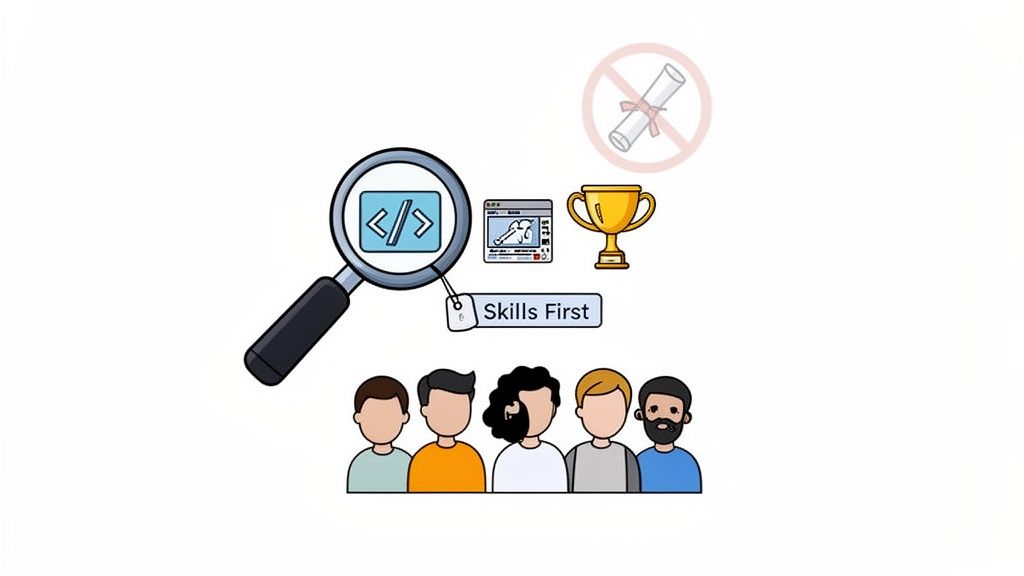
This is why the sharpest talent teams are making an aggressive shift to a skills-first mindset. It's a fundamental change in focus from what a candidate has done to what a candidate can do. It means hunting for demonstrated abilities and tangible proof of work.
This isn’t some niche strategy anymore. Skills-based hiring has exploded, with 81% of companies now using this approach in 2025. The data is impossible to ignore: 94% of employers are convinced it better predicts job performance, and over half are dropping degree requirements completely.
Making this switch starts with defining what real success looks like for the role, broken down into core competencies.
For instance, when sourcing a software engineer, your focus moves from "CS degree from a top university" to tangible proof of ability:
This approach immediately blows your talent pool wide open. You start finding incredible candidates who might lack traditional credentials but possess far superior, real-world skills. To really get this right, you need to understand what skills-based hiring is on a deeper level.
You might be thinking, "This sounds great, but digging up that kind of proof is incredibly time-consuming." And you're right—if you're doing it manually.
This is where AI becomes a complete game-changer. Modern sourcing tools like Juicebox are built for this exact challenge.
A skills-first approach is the ultimate sourcing advantage. It allows you to find elite talent your competitors are blind to because they’re still stuck filtering by outdated credentials.
For example, with PeopleGPT, you can use a simple prompt like, "Find me a machine learning engineer in Austin who has contributed to the PyTorch library." The AI scans for tangible evidence of that contribution, not just a keyword on a profile. It's one of the reasons it's considered one of the best sourcing tools for recruiters.
What is the main difference between sourcing and recruiting?
Sourcing is the proactive hunt for passive talent, while recruiting is guiding active candidates through the hiring process.
Can one person perform both sourcing and recruiting?
Yes, and AI tools make this more feasible than ever by automating time-consuming tasks and unifying the workflow.
Is sourcing or recruiting more critical for hard-to-fill roles?
Proactive sourcing is essential. The best candidates for specialized, senior roles are almost never actively applying for jobs.
Ultimately, integrating sourcing and recruiting into one cohesive engine transforms your team from a cost center that fills seats into a strategic function that builds a competitive advantage.
This unlocks the ability for any team, regardless of size, to compete for elite talent and scale hiring efficiently—without just throwing more people at the problem.
Juicebox can help you source top talent faster and automate the recruiting process with AI agents. See how Juicebox works.
{{large_cta}}
Run your first search for free. Find and engage top talent across 800M+ profiles. Trusted by 5,000+ customers.