.svg)
SIGN UP FOR JUICEBOX (IT’S FREE!)

Who are you looking for?
Thank you! Your submission has been received!
Oops! Something went wrong while submitting the form.


Sourcing in recruitment is the proactive hunt for qualified candidates to fill current and future job openings. It’s the art of identifying and engaging top talent—especially the passive candidates who aren't actively looking for a new role. But there’s a problem most tools ignore: the best talent isn't all in one place.
Think of sourcing as the detective work of talent acquisition. While traditional recruiting often kicks off after a job is posted, modern sourcing in recruitment involves strategically mapping the talent market long before a role even exists. This is the engine that builds a pipeline of high-potential people, giving your company a massive head start.
The goal isn’t just to stockpile resumes. It’s about uncovering clues—skills, side projects, career moves—that point to top performers your competitors are missing. This means looking beyond the usual applicants and digging into the 70% of the global workforce who are considered passive talent. You can learn more about this in our guide to streamlining the recruitment process.
For years, "sourcing" meant painstakingly crafting complex Boolean search strings and manually sifting through thousands of profiles on a single platform.
Here's the bottom line: that old-school approach is slow, clunky, and completely misses the mark today.
The real problem? The talent landscape has scattered. Top engineers are on GitHub, designers showcase their work on Behance, and leading researchers publish in academic journals. A single-source strategy no longer works.
This is where AI has flipped the script. We’re not just a tool; we see this firsthand. Modern tools let you use simple, natural language to scan dozens of sources at once, analyze thousands of profiles in seconds, and get a ranked shortlist of the most qualified people.
This shift means that a small team—or even a single founder—can now compete for global talent on the same level as a massive enterprise. It turns a manual, time-sucking task into a strategic, data-driven advantage.
Take Juicebox customer Anyscale. By using AI agents to source across multiple platforms, they filled 50 engineering roles in under three months. This isn’t just a small improvement; it's a fundamental change in how high-performing teams are built.
Let's bust a myth. Most people believe effective sourcing in recruitment is just about having a LinkedIn Recruiter subscription. The opposite is true.
The truth is, relying on one platform is like fishing in a single, overcrowded pond. Your talent pool shrinks, your costs skyrocket, and you completely miss the incredible candidates building their careers elsewhere. If you're feeling this pain, exploring Indeed alternatives is a great starting point.
Top-tier talent isn't just sitting on one social network, waiting for an InMail. The modern professional world is spread out across dozens of specialized platforms where the real work happens.
Just think about it:
These are the places where passion meets expertise. If you're not looking there, you're only seeing a fraction of the talent pool.
Now, you might think that managing dozens of sources sounds like an operational nightmare. And a few years ago, you'd have been right. Manually searching and cross-referencing candidates across these sites was a full-time job.
But here’s why that fails today: modern AI aggregation tools have made multi-channel sourcing not just possible, but ridiculously simple. These platforms use a single, natural-language prompt to search across all these scattered sources at once. What used to be a complex, soul-crushing task now takes seconds. Check out our list of the best sourcing tools for recruiters to see what's possible.
This table breaks down the key differences between the manual, single-platform methods of the past and the efficient, multi-channel approach that AI enables today.
| Aspect | Traditional Sourcing (The Old Way) | AI-Powered Sourcing (The New Way) |
|---|---|---|
| Primary Tool | Single platform (e.g., LinkedIn Recruiter) | AI aggregation engine (e.g., Juicebox) |
| Search Method | Manual Boolean strings, keyword-based | Natural language prompts, semantic search |
| Talent Pool | Limited to one platform’s user base | Aggregated from dozens of sources |
| Efficiency | Hours per search, high manual effort | Seconds per search, highly automated |
| Cost Model | High subscription fees per seat | More affordable, scalable pricing |
| Candidate Focus | Primarily active or semi-active candidates | Deep access to the entire passive talent market |
As you can see, the shift isn't just about a new tool—it's about a smarter, faster, and more effective way to find talent.
This move away from a single platform isn't just a trend; it's a strategic necessity backed by data. A 2023 ManpowerGroup report found that 77% of employers are struggling to fill roles, forcing them to find new talent channels.
While a paid LinkedIn Recruiter seat can run over $10,000 per year, companies realize a multi-source strategy is the only way to find talent beyond these walled gardens. This has forced recruiters to search 3–5 times more passive profiles per role than they did just a decade ago, making the old manual approach unsustainable.
This evolution is changing the economics of hiring. Teams embracing AI-augmented, multi-source strategies are seeing their talent acquisition costs plummet by 50–80% compared to those still leaning on expensive, single-platform subscriptions. The most impactful hires now come from sources outside the usual suspects. This isn't just a new tactic; it's the new standard for effective sourcing in recruitment.
Having the right tools is one thing; having a repeatable process is another. An effective sourcing in recruitment strategy hinges on a structured, modern workflow that drives speed, quality, and consistency into every search.
Let's walk through the five core stages of a modern sourcing workflow.
Every great search starts with a crystal-clear picture of who you're looking for. Modern sourcing starts with data, not gut feelings.
Before you write a search query, define your Ideal Candidate Profile (ICP). Analyze the top performers you already have in the role, or look at talent at similar, successful companies.
You might think this upfront analysis slows you down. That's a mistake. Spending 30 minutes to build a data-backed ICP can save you 10–15 hours of sifting through irrelevant profiles later. Atlassian used this exact tactic—leveraging internal performance data to build precise ICPs—and saw a 27% jump in offer acceptance rates for sourced candidates in just one year, as reported by SHRM.
Once your ICP is locked in, the next question is: where do these people actually live? This is where AI-driven market mapping becomes a superpower.
Sourcing in Action Example
A query like, "Show me the talent supply of senior backend engineers with Kubernetes experience in Austin vs. Raleigh" can spit out real-time charts comparing talent pools, salary bands, and top employers in seconds.
This intelligence helps you set realistic expectations with hiring managers and focus your energy on the most fruitful locations. It’s a core pillar of strategic sourcing in recruitment and a key feature in modern AI recruiting tools.
With your ICP defined and market mapped, it's time to find your people. This is where wrestling with monstrously complex Boolean strings completely falls apart.
The modern approach is all about using simple, conversational language to search across dozens of platforms at once.
Sourcing in Action Example
Instead of building a 300-character Boolean nightmare, you can just ask: "Find software engineers in San Francisco with experience at VC-backed fintech startups who have contributed to open-source projects."
An AI engine instantly translates that request, scans platforms like GitHub and LinkedIn, and brings back a ranked list of relevant profiles.
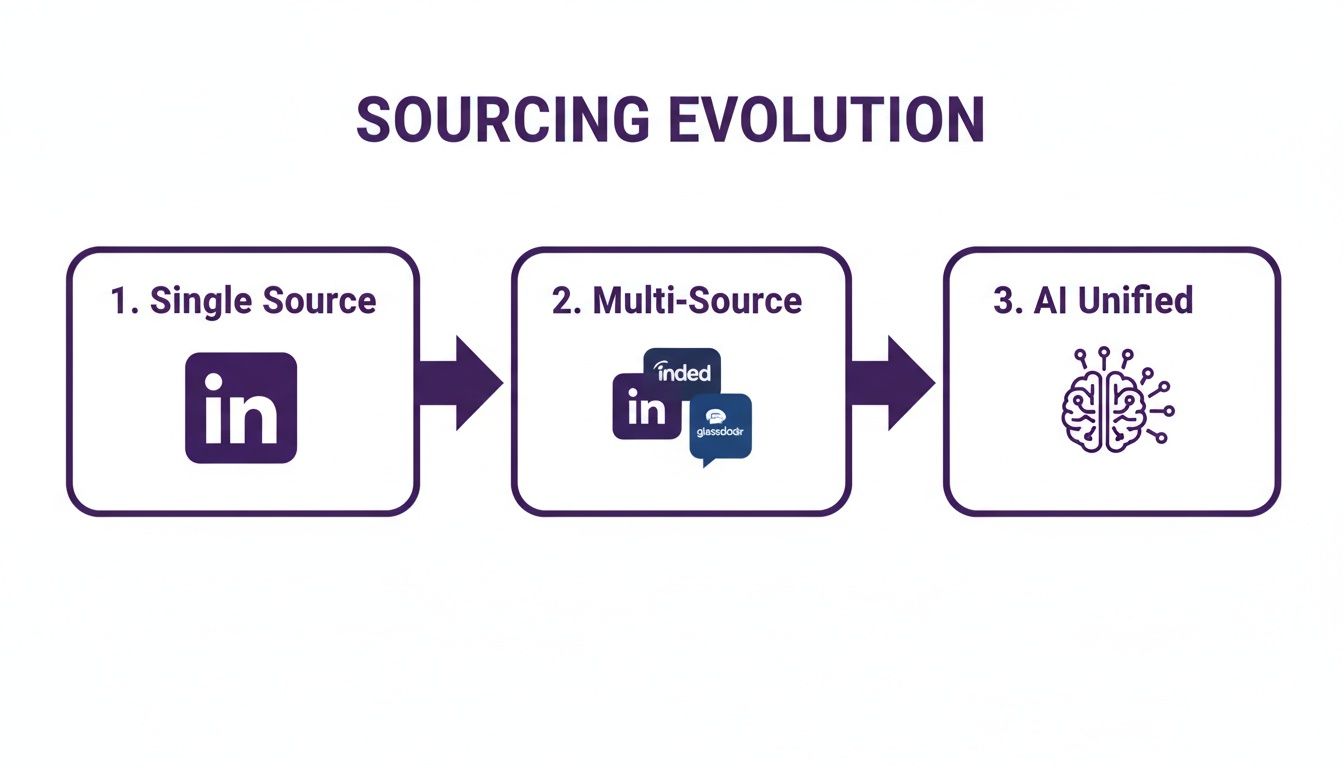
This evolution is clear: what started as a siloed, manual task has become an intelligent, aggregated function. To really nail this, borrow from proven sales prospecting best practices, which provide a great framework for engagement.
Finding a great profile is only half the battle. You need accurate, up-to-date contact info. Manually digging for emails is a huge time-sink with a notoriously low success rate.
The best sourcing platforms automatically find and verify personal and work email addresses for every candidate in your search results. This small step transforms a frustrating manual chore into a one-click action, ensuring your recruitment emails actually land in the right inbox.
Finally, it's time for outreach. Generic, bulk messages are dead. The key is personalization at scale.
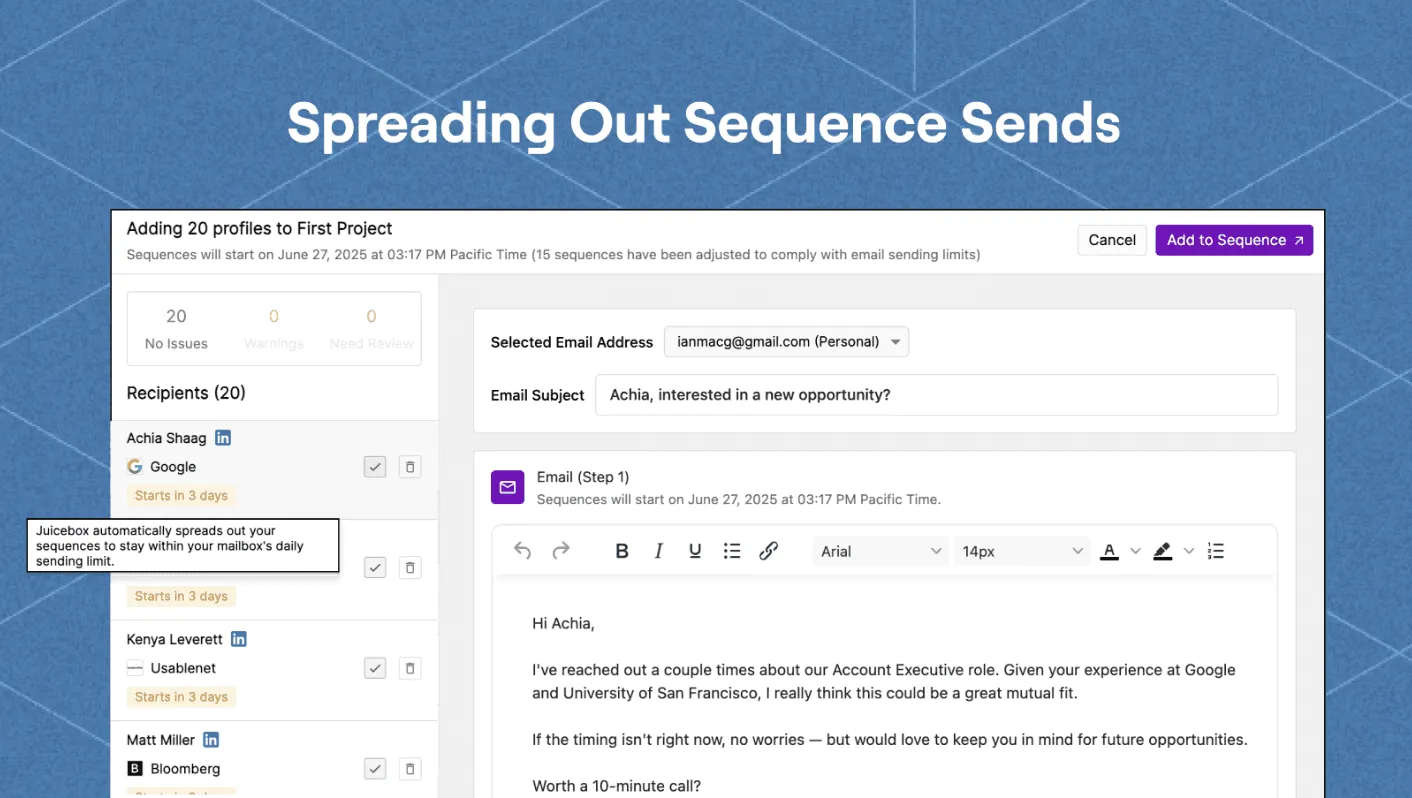
Modern sourcing tools have built-in sequencers that let you create multi-step email campaigns. You can even use AI-generated snippets based on a candidate's profile to make every message feel unique.
Sourcing in Action Example
You could set up a three-step sequence that sends an initial personalized email, a follow-up three days later if there's no reply, and a final, shorter message two days after that. The persistence is completely automated, dramatically increasing your response rate.
This five-stage workflow transforms sourcing in recruitment from a reactive chore into a proactive, strategic process.
The workflows we’ve covered are a massive leap forward. But even the best sourcing tools have a weakness: they only work when you’re actively using them.
Ready for what's next?
The real evolution isn’t just about faster active searches; it's about eliminating them entirely. That’s where autonomous AI sourcing agents come in, flipping the script from active work to passive, continuous talent monitoring.
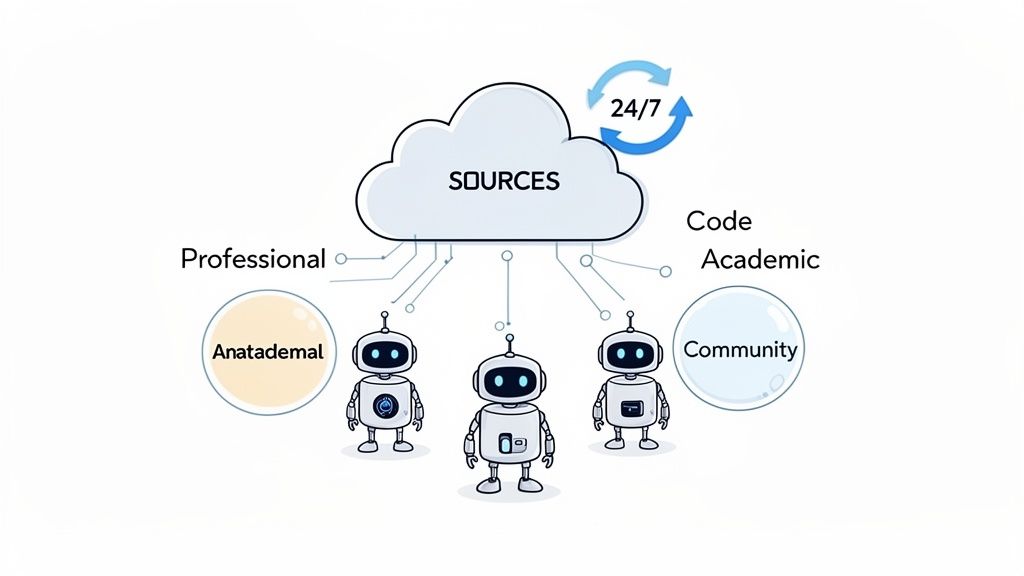
Think of an AI sourcing agent as your personal, 24/7 sourcing specialist. Instead of you running a search, the agent works tirelessly in the background, constantly scanning the market for fresh talent that fits your ICP.
Here’s the difference:
This changes sourcing from a reactive chore into a strategic, always-on function. While you sleep, your agent is finding your next great hire. According to a 2024 Deloitte report, this kind of agent-powered recruiting is a key trend, with autonomous agents predicted to handle most sourcing grunt work.
You might assume an automated system returns lower-quality candidates. But what if the opposite were true? The most powerful AI agents are designed to learn from your feedback.
It’s a simple loop:
This constant learning cycle ensures your talent pipeline is filled with candidates who are an increasingly perfect fit. A Juicebox customer, Anyscale, used this exact model to fill 50 engineering roles in under three months, calling their AI agents their "single highest-quality source of candidates." This frees up recruiters to focus on high-value, human work like building relationships with top talent. To see how this works in practice, check out our complete guide to AI sourcing.
Alright, let's talk about the final piece: proving your worth. If you can't measure your efforts, you can't show your impact. It’s time to move past vanity metrics and get serious about the numbers that actually move the needle. This is where a deep understanding of recruiting metrics becomes a superpower.
To get a clear picture, you need a framework that covers three core areas: Speed, Quality, and Efficiency.
Here are the essential metrics every sourcer should live by:
Just tracking numbers isn’t the point. The goal is to use them to make smarter decisions. If your Time-to-Shortlist is lagging, it might be a sign your ICP is too narrow. A low Offer Acceptance Rate could mean a mismatch between your pitch and the job's reality.
Look at Ramp. By tracking Source-of-Hire Quality, they discovered that candidates from niche engineering communities had a 30% higher one-year retention rate than those from big job boards, as noted by First Round Review. They immediately reallocated 50% of their sourcing budget to those high-performing channels—a decision driven entirely by data.
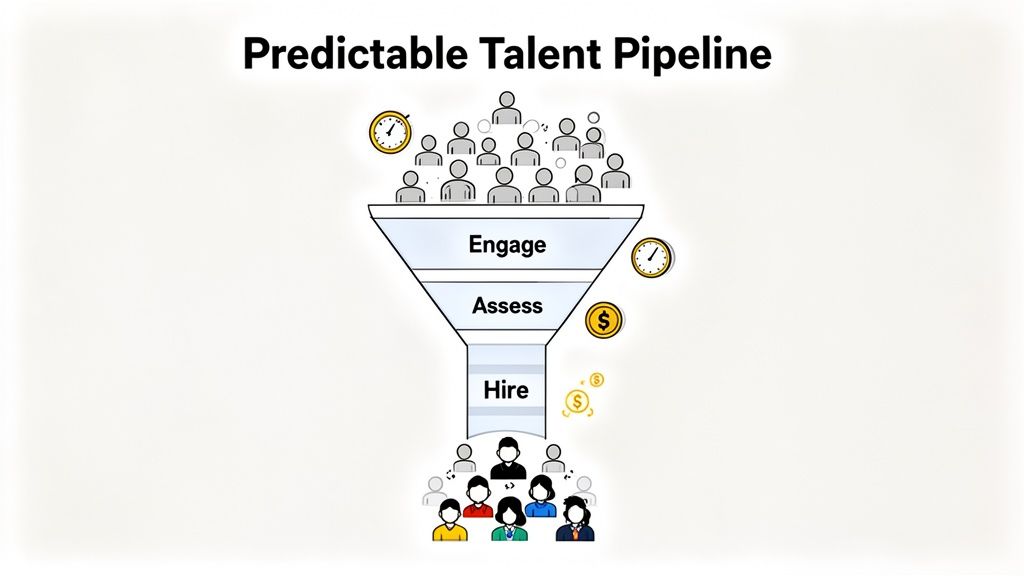
Mastering modern sourcing in recruitment isn't about filling today's open roles. It's about building a predictable talent engine that gives your organization a lasting competitive advantage.
What this unlocks is the ability for any team, regardless of size, to compete for elite global talent without an enterprise-level budget. An AI-powered, multi-source strategy transforms sourcing from a reactive chore into a proactive, strategic function that fuels growth. Knowing how to build a talent pipeline is the single most important skill for modern recruiting teams.
Sourcing is the proactive hunt for candidates, especially passive ones. Recruiting is the entire process, from sourcing to screening, interviewing, and hiring.
It depends on the role. For developers, try GitHub. For researchers, use Google Scholar. For creatives, check Behance. Go where the talent is.
AI automates the grunt work. It searches dozens of sources with natural language, scores profiles for relevance, and helps run personalized outreach at scale.
Focus on business metrics like Time-to-Shortlist, Quality-of-Hire, Offer Acceptance Rate, and Cost-per-Hire, not vanity metrics like emails sent.
The core benefit of mastering modern sourcing in recruitment is building a predictable talent pipeline that gives your organization a lasting competitive edge. What this unlocks is the ability for any team, regardless of size, to compete for elite global talent without needing an enterprise budget. This is the new standard for building high-performing teams.
Explore PeopleGPT inside Juicebox.
{{large_cta}}
Run your first search for free. Find and engage top talent across 800M+ profiles. Trusted by 5,000+ customers.