The 29 best sites like LinkedIn for recruiters in 2026
The 29 best sites like LinkedIn for recruiters in 2026
Bevin Benson
8
Min
Published:
Jan 12, 2026
• Updated:
Jun 29, 2026
LinkedIn is ideal for professional networking, but it’s not the strongest recruitment tool.
Recruiters on LinkedIn are all competing for the same top talent, while missing out on skilled candidates who don’t have profiles on the platform. They’re also likely spending a significant amount on LinkedIn Premium or LinkedIn Recruiter to gain access to recruiting-forward features.
If your team has hit these limiters and you’re looking for an alternative, there are plenty of focused tools for every use case. This guide breaks down the 29 best sites like LinkedIn by category to help you in your search.
Why people use LinkedIn alternatives
Teams seek LinkedIn alternatives when this tool fails to support their recruiting workflows adequately. Here’s a detailed look at typical frustrations with hiring on LinkedIn:
Core recruitment features are paywalled (e.g., LinkedIn Recruiter and LinkedIn Premium), so there’s pressure to upgrade from a regular account.
LinkedIn feeds are often full of irrelevant or outdated information on candidates and roles.
Not enough candidate data, despite LinkedIn’s broad user base.
LinkedIn alternatives give recruiters:
Niche communities with strong fit candidates and extensive proof of work experience.
Less-saturated discussion and collaboration spaces that foster real interactions and more reliable assessments.
Better networking experiences, whether startup-focused or event-based.
Improved candidate discovery for roles with specific work modes, like remote or freelance.
Beyond LinkedIn: How to choose the right platform
Hire better by using a LinkedIn alternative that more closely aligns with the needs of your specific use case. Consider:
Whether the alternative fits the niche industry and userbase you’re interested in: E.g., Dribbble for designers, or GitHub for software engineers.
How easy it is for candidates to search for jobs, or for you to evaluate them: Some sites support both workflows, but you may only need one if you’re solely operating an inbound or outbound hiring model.
What people are saying about the site: If company reviews are generally positive and praise the user experience, this is a good sign.
Core product features: Look for project management or escrow tools that make bringing on contract or remote talent less risky. ATS and CRM integrations are also key for full-cycle recruiting, not just sourcing.
The tool’s user experience and ease of adoption: User-friendliness often determines whether a team will be able to quickly integrate a tool into daily workflows and drive fast time-to-value.
Intuitive algorithms and filters: Ideally, these should match how you already network on LinkedIn, but go a step further in terms of data depth and coverage.
Communication and collaboration capabilities: These features enable you to engage and follow up with prospects as needed. Easy outreach is one of LinkedIn’s strengths, and you don’t want to give up this capability by switching to a tool that’s weaker in this area.
Sites like LinkedIn at a glance
Category
Purpose
Example
Job boards
Inbound recruiting
Indeed
Freelance and gig marketplaces
One-off or contract hires
Twine
Industry networks and portfolios
Proof-based hiring
Behance
Communities and event networking
Trust-driven recruitment
Meetup
Recruiting tools
Outbound talent sourcing
Juicebox
Job boards
Instead of posting open roles on LinkedIn, try dedicated job boards, which are full of active job seekers. The tradeoff here is that there’s heavy recruiting competition on these platforms, too.
Best general job boards
Indeed has over 600 million job seeker profiles, which means it houses nearly as robust a talent pool as LinkedIn. You’ll need to allocate funds to promote your job posting and improve its chances of attracting top candidates, though.
ZipRecruiter offers AI matching with strong prospects and distributes open roles across partner sites (not just its own). Have a well-defined vetting process in place before considering this board because the work experience and skill sets of job seekers vary widely by market and role.
Monster distributes job listings to its broad user base and provides a searchable resume database for recruiters to explore. As one of the earliest job boards, it helped define the category, though the market has shifted considerably since, with LinkedIn and Indeed now commanding larger shares of recruiter and candidate activity.
CareerBuilder provides easy resume search and employer tools. Though it was once a standalone platform, CareerBuilder now sits in Bold Holdings’ product hub (alongside Monster, FlexJobs, and a couple of other HRtech brands).
Best niche job boards
FlexJobs is a remote and hybrid job site with a rigorous vetting process that filters out scammy or too-good-to-be-true gigs. Assess candidates on the site based on skill (entry-level or senior) and job search flexibility (part-time or full-time).
Remote.co works just like FlexJobs, and is also part of Bold Holdings’ network of companies. The main difference between the two sites is that Remote.co leans more towards categorizing jobs by category instead of skill and flexibility level only.
Glassdoor is a site where employees can anonymously review their past and present employers. The platform also offers business access, through which HR teams can respond to employee reviews and create Glassdoor job listings.
Google for Jobs aggregates open roles from across the web and displays them on search results pages. Recruiters can get their listings to appear there by marking up their job postings with structured data, which signals to Google that the content is indexable as a job listing.
While Juicebox is not a job board, it lets you avoid them entirely, removing the waiting-for-applicants bottleneck through proactive talent sourcing and multi-channel outreach.
Freelance and gig work marketplaces
Freelance and gig marketplaces are solid LinkedIn alternatives when hiring for project-based or contract work rather than filling full-time roles. Some of the top options include:
Twine enables employers to hire freelancers from its global network, though it’s not as extensive as competitors like Upwork and Fiverr. Users can either list a job for free and pay only a service fee on freelancer payments, or opt for a managed per-project Twine subscription.
Upwork provides a large pool of freelancers, but high fees and too many applicants vying for limited roles make it less functional than competitor tools. The same goes for the platform’s lax vetting process, which allows poorly qualified candidates to dilute the pool’s quality.
Freelancer allows teams to post custom projects so gig seekers on the platform can bid for them. The quality of applicants on the platform varies, though, and its free structure is complex.
Fiverr matches clients with the right freelancers to get quality work done within scope. A Fiverr Pro account costs a small premium, while the platform charges a custom fee to help companies build a full freelance team.
Guru helps employers discover and recruit gig workers from around the world. It offers Safepay, an escrow feature, and dedicated project workspaces called WorkRooms.
Industry networks and portfolios
Industry networks mirror some of LinkedIn’s features. However, they go further by facilitating niche, sector-specific connections (these platforms aren’t open to all) and offering built-in portfolio sections where users can add work sample links from external sites.
Here’s a shortlist of top platforms by profession and how you can use them.
Behance is great for hiring creative professionals, e.g., designers and editors, enabling you to filter user profiles by skill and location.
Dribbble is home to a host of UX and visual designers. Review the Hire Me profiles of freelancers you’re considering and DM them if there’s a fit. You can also list full-time or part-time jobs on the platform by upgrading to a paid account.
GitHub houses code repositories for millions of software engineers worldwide, meaning that these professionals frequent the platform. As such, GitHub is great for filling tech roles that require specific programming languages or candidates based in certain locations.
Stack Overflow is like Reddit for tech professionals and developers, making it another site that these candidates regularly use. Recruiters can reach this audience by searching profiles and activity threads to identify candidates with relevant domain expertise, or by running targeted ads to promote open roles and company profiles.
ResearchGate is a space for researchers and academics to share their scientific knowledge and publications. Recruits can connect with relevant candidates on ResearchGate by exploring topic-based search and citation networks.
Kaggle is where data scientists and machine learning pros share ideas and compete. Recruits hoping to tap into the platform’s talent pool can host a competition or simply headhunt prominent contributors.
Why industry-specific tools can be the right choice
Industry networks with built-in portfolios let recruiters:
Review quality work samples with range and depth, not just a large volume of exaggerated profiles and resumes.
Analyze portfolio content, from problem to approach to measurable impact, for better candidate assessment and shortlisting.
Search user profiles not just by skills and location, but also by tool proficiency.
Assess candidates’ ability to collaborate through past employer reviews and community engagement (posts and comments).
Find candidates who are open to work via signals like “hire me” pages and posts or contact links.
Communities and event networking
Compared to LinkedIn’s feed-based networking, communities and events provide more authentic, trust-driven connections. Relationships form faster and feel more genuine in these smaller groups and around shared activities because they encourage 1:1 meetups (in person or virtual) and well-moderated chat communities.
If you source candidates this way, consider the following tools.
Meetup has over 60 million users and lets hiring teams find niche or location-specific groups and events where talent discovery flows naturally.
Eventbrite lists over 4.7 million curated events across 180 countries, allowing recruiters to attend meetups with people who match their ideal candidate profiles so they can make contact.
Discord has more than 200 million monthly active users and hosts various niche communities where admins or regular members also organize events. Hiring managers here can keep their eyes out for strong candidates when relevant roles open up.
Slack communities with dedicated job or hiring channels provide a space where decision-makers can observe and connect with standout candidates.
Facebook Groups on specific topics will attract a certain kind of talent, e.g., content marketing communities where freelance and fractional writers spend their time.
Recruiting and talent sourcing tools
DIY discovery and X-ray search give recruiters some reach beyond LinkedIn, but platforms that aggregate profiles across multiple networks and sources will surface a broader and more current candidate pool than manual search methods alone.
These recruiting tools are usually either niche communities with paid talent search engines or AI-native sourcing platforms that aggregate profiles and contact details for easier outreach. However, the latter is more cost-effective.
For example, a community like LinkedIn offers LinkedIn Recruiter, a paid recruiting tool that costs almost a thousand dollars per seat monthly. Meanwhile, an alternative like Juicebox with more sources (including LinkedIn) costs only about 10% of that amount.
The DIY approach: X-ray search and multi-platform sourcing
X-ray search involves phrasing Google and other search engine queries in a way that surfaces relevant candidate profiles at no cost. Say you want to find content marketer profiles on LinkedIn, an X-ray search to use on Google might be: site:linkedin.com/in “content marketer” “San Francisco”.
Beyond LinkedIn, you could also run X-ray searches on:
Reddit, looking for relevant chats in professional subreddits and topic or domain-specific threads. E.g., site:reddit.com “machine learning events” will surface get-togethers to find ML experts likely open to work.
AngelList Talent, now called Wellfound, where you can pull potential candidates with specific skills or startup job experiences. E.g., site:wellfound.com "developer" "people".
Medium, for finding prospects with writing and thought leadership skills for content or product roles. E.g., site:medium.com "product manager” "Jira".
A profile aggregator that combines signals from multiple sources into enriched candidate records will also support x-ray search. You won’t need to go this manual route, though, because profile aggregators typically encourage everyday-language prompts.
AI sourcing platforms and pre-vetted talent networks
Juicebox is an AI-native talent sourcing platform that floors traditional professional networks. It lets startup and enterprise recruiters search over 800 million profiles from over 30 data sources using everyday-language prompts rather than relying on limited Boolean searches. Juicebox also offers low-cost outreach and AI recruiting agents for autonomous sourcing.
Findem is an AI talent intelligence network that provides candidate data like work history and skills. It also provides relationship signals to enable warm intros and connections.
Toptal is a marketplace of pre-vetted freelancers for teams looking for contract workers. Toptal’s pricing is compelx and steep, though, from monthly talent search fees to initial deposits paid during trial periods and hourly billing for delivered work.
From LinkedIn-only recruiting to efficient multi-channel hiring
Competition for top candidates on LinkedIn is high. If you rely solely on the platform for your hiring needs, you may never reach the best candidates first. You also risk missing out on better fits who’ve posted their profiles elsewhere.
Juicebox enables more efficient, attuned hiring motions through AI candidate sourcing and multi-channel outreach. Plus, its built-in CRM helps you manage prospect profiles in one place. Start with a free search today and see first-hand how Juicebox allows you to build a more sustainable recruiting workflow.
FAQs
What is a better alternative to LinkedIn?
For inbound recruiting, job boards like Indeed and ZipRecruiter work well, while freelance marketplaces like Twine and Upwork are ideal for contract hires. If you’re aiming to reduce manual sourcing workflows, an AI sourcing platform like Juicebox is better.
Are there free alternatives to LinkedIn for recruiting?
Yes. GitHub and Stack Overflow enable free sourcing through public user profiles and activity signals. Wellfound offers a free tier for startups. And X-ray searches on Google cost nothing but involve heavy manual intervention.
Juicebox also offers a free trial, letting recruiters run searches (on its 800M-strong candidate database spanning over 30 sources) before committing to a paid plan.
How do I find passive candidates outside LinkedIn?
Find passive candidates not in job search mode through their professional outputs, e.g., portfolios on Behance or thought-leadership Medium blogs. Juicebox aggregates these signals along with traditional profile data to surface relevant candidates, whether they’re actively job hunting or not.
SIGN UP FOR JUICEBOX (IT’S FREE!)
Who are you looking for?
Thank you! Your submission has been received!
Oops! Something went wrong while submitting the form.
Who are you looking for?
Thank you! Your submission has been received!
Oops! Something went wrong while submitting the form.
Try Juicebox
Run your first search for free. Find and engage top talent across 800M+ profiles. Trusted by 5,000+ customers.
Indeed Reviews: An Unbiased Guide for Modern Recruiters
Explore our unbiased Indeed reviews to see if it's the right hiring platform for you. Compare its features against modern AI sourcing tools for top talent.
12 Best Talent Acquisition Software Platforms for 2026
Stop navigating the talent maze alone. Discover the 12 best talent acquisition software options that cut time-to-hire by 50% in 2026. Find your compass.
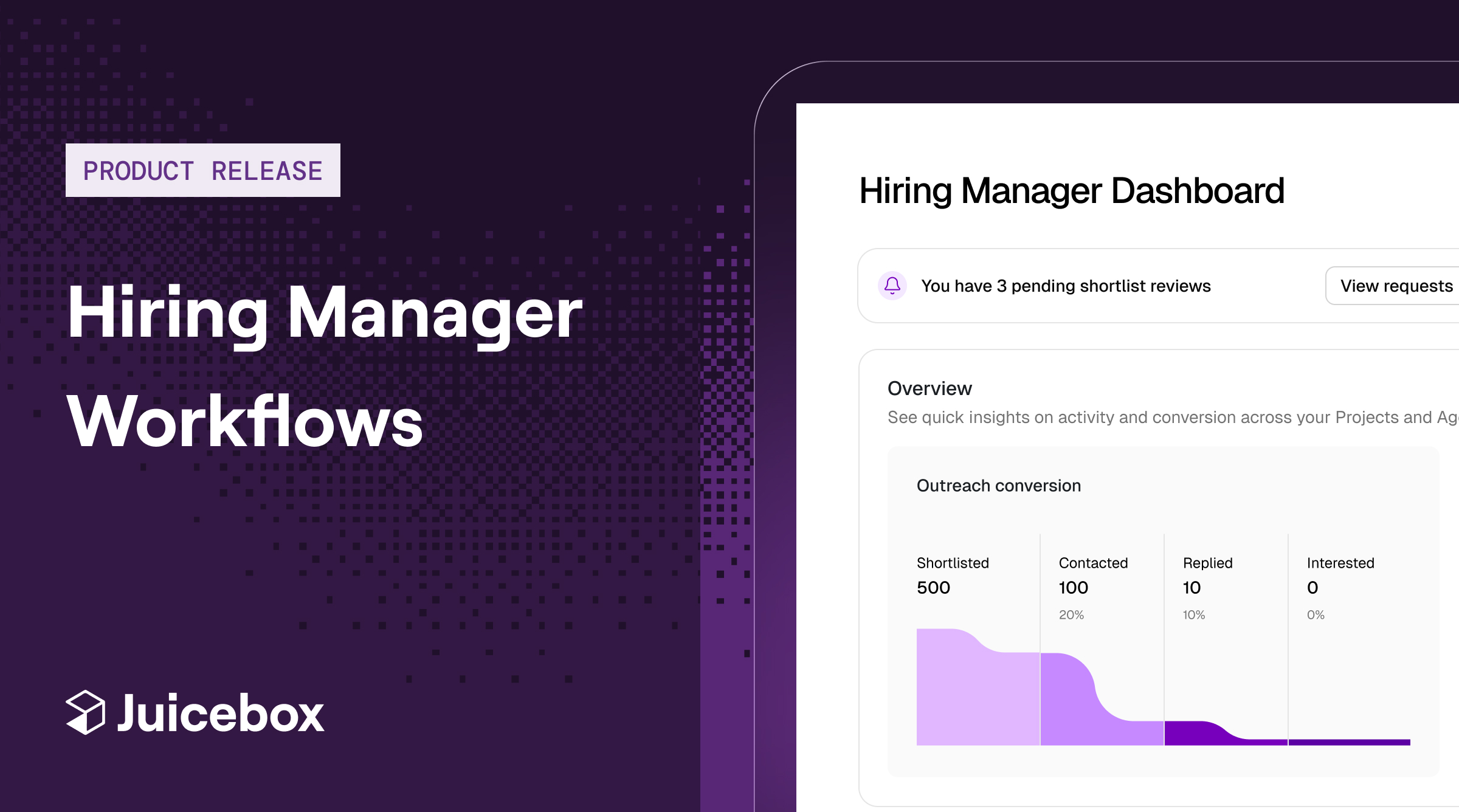
Today, we're introducing Hiring Manager Workflows, a new way for recruiters and hiring managers to get a shared way to review candidates, capture structured feedback, and turn feedback into more targeted Searches and Agents.

.svg)


.png)