.svg)
SIGN UP FOR JUICEBOX (IT’S FREE!)

Who are you looking for?
Thank you! Your submission has been received!
Oops! Something went wrong while submitting the form.


The real difference between semi-monthly vs bi-weekly payroll boils down to one thing: timing. With semi-monthly, you get 24 paychecks per year, paid on two specific dates each month, like the 15th and the 30th. Go bi-weekly, and you’re looking at 26 paychecks per year, issued every two weeks on the same day, like clockwork every other Friday.
It seems like a small detail, but this choice sends ripples through your company's cash flow, how you handle overtime, and even how your employees manage their personal budgets. Most companies pick a schedule and stick with it, never realizing that a simple switch could reduce administrative headaches and boost employee morale. Juicebox helps companies streamline operations, and we've seen firsthand how aligning payroll with your workforce composition is a critical, yet often overlooked, strategic advantage.
AttributeSemi-Monthly PayrollBi-Weekly PayrollPaychecks/Year24 (twice a month)26 (every two weeks)Best ForSalaried, exempt employeesHourly, non-exempt employeesOvertimeComplex; splits workweeksSimple; aligns with workweeksEmployee PerkLarger, predictable paychecksTwo "3-paycheck months" per yearCash FlowHighly consistent and predictableConsistent, with two larger payroll months to plan for
The semi-monthly payroll schedule runs on a simple, predictable rhythm: two paychecks per month, totaling 24 pay periods a year. Companies typically pay employees on two set dates, like the 1st and the 15th, or the 15th and the last day of the month.
This consistency is the system’s greatest strength. Because you divide an employee's annual salary by 24 instead of 26, each paycheck is slightly larger than it would be on a bi-weekly schedule. That structure lines up perfectly with the cadence of major monthly expenses like rent, mortgages, and car payments, making personal budgeting much more straightforward for salaried professionals.
For the business, this predictability simplifies cash flow management. Finance teams know exactly when payroll funds will be drawn and can forecast expenses with a high degree of accuracy. Check out some of the best sourcing tools for recruiters to see how other systems can improve your processes.

You might think fewer pay periods would always mean less administrative work. For salaried, exempt employees, that’s usually true. But there’s a major snag most tools ignore when it comes to hourly, non-exempt staff.
What's the issue?
The issue is that the federal Fair Labor Standards Act (FLSA) legally requires overtime pay to be calculated based on a seven-day workweek. A semi-monthly pay period, however, doesn’t neatly contain a set number of full workweeks.
This misalignment means a single workweek can get split across two different pay periods. For instance, if a pay period ends on the 15th (a Wednesday), any overtime worked on Thursday and Friday of that week falls into the next pay period. This forces payroll administrators into complex, manual calculations to ensure overtime is paid correctly and on time, dramatically increasing the risk of errors.
Stop and think about that for a second. The primary friction of semi-monthly payroll isn't the frequency, but its misalignment with the legally defined workweek. This creates significant compliance risk.
This is where the predictable "heartbeat" of semi-monthly payroll can get a little erratic. Imagine a design agency with a mix of salaried project managers and hourly designers. The project managers' pay is simple. But a designer who logs 45 hours in a week straddling the 15th of the month creates an administrative puzzle.
The first three days of their workweek land in one pay period, but the last two—including those 5 hours of overtime—fall into the next. The payroll manager now has to manually track these split hours and ensure the overtime premium is correctly applied, often delaying its payment. This headache explains why companies with a large hourly workforce, like those in manufacturing or retail, overwhelmingly avoid this schedule. Research from professional services firm PwC shows that payroll errors are a leading cause of employee dissatisfaction, and a complicated overtime process is a primary culprit. A good paid time off policy can also be tricky to manage.
Despite the overtime challenges, the semi-monthly schedule is highly effective in the right environment. Its administrative simplicity shines in organizations where the vast majority of the workforce is salaried and exempt from overtime.
In these contexts, the predictable schedule simplifies both payroll processing and employee budgeting. It also reduces the number of payroll runs per year, which can lead to minor cost savings with some payroll providers. For more insights on financial strategies, explore our guide on compensation intelligence.
A bi-weekly payroll system is the most popular choice in the United States, and for good reason. It runs on a simple, consistent rhythm: employees get paid every two weeks on the same day, like every other Friday. This structure adds up to 26 paychecks per year—two more than a semi-monthly schedule.
Most people believe more paychecks means more complexity. The opposite is true. This frequency creates a predictable cadence that aligns perfectly with the standard seven-day workweek defined by labor laws. For hourly employees, this is a total game-changer. It simplifies compliance and builds trust.

Here's the deal. The biggest win for bi-weekly payroll, especially for hourly workforces, is how it handles overtime. Because a bi-weekly pay period always covers two full workweeks, calculating overtime is dead simple. Any hours worked over 40 in a given week are captured and paid within that same pay cycle, ensuring compliance with the Fair Labor Standards Act (FLSA). A clean, error-free payroll process is essential for maintaining employee trust and avoiding costly legal headaches.
A mid-sized manufacturing company with 200 hourly workers slashed payroll errors by 40% within six months of switching from semi-monthly to bi-weekly. The tactic was straightforward: aligning the pay period directly with the workweek eliminated the need for manual overtime adjustments across pay cycles.
The data backs this up. BLS data shows that bi-weekly pay has a 43% adoption rate among private U.S. firms as of 2020. That number climbs past 50% in sectors like manufacturing and hospitality, where nailing overtime tracking is non-negotiable. This system removes the complicated puzzle of splitting workweeks between pay periods. Finding the right freelance recruiter can also simplify complex hiring needs.
The real draw for employees is the "extra" paycheck phenomenon. Twice a year, employees on a bi-weekly schedule get a three-paycheck month. This feature is a significant morale booster and a major perceived benefit for employees managing their personal finances. For employers, however, these three-paycheck months require careful budgeting.
But there’s a problem most tools ignore. While bi-weekly payroll solves the overtime puzzle, it introduces a different kind of complexity that trips up many HR departments: benefits deductions. How do you consistently deduct monthly premiums when some months have three paychecks instead of two? This administrative challenge requires a specific approach to avoid under or over-deducting. It's similar to understanding the nuances of tools like SeekOut pricing.
Choosing between a semi-monthly vs bi-weekly payroll isn’t just about keeping employees happy; it’s a strategic decision that directly hits your company’s financial health. It’s a bigger deal for your budget than most people think.
At first glance, the math seems simple. A bi-weekly schedule means running payroll 26 times a year, while semi-monthly only requires 24 runs. You might think that bi-weekly is automatically the more expensive option.
Why that thinking is flawed.
The per-run fee is just the tip of the iceberg. The real cost isn’t the processing fee; it’s the hours your team spends on manual work and the potential for expensive errors. With a semi-monthly schedule, your payroll team has to manually calculate overtime, a breeding ground for mistakes that can trigger penalties under the Fair Labor Standards Act (FLSA). For hourly teams, bi-weekly's simplicity almost always wins on total cost of ownership.

From a CFO's perspective, predictable cash flow is king. This is where the semi-monthly vs bi-weekly debate gets interesting because each schedule offers a distinct advantage.
While semi-monthly makes forecasting easier, bi-weekly is a clear winner for employee satisfaction. Research shows that 60% of employees prefer it because it aligns better with their personal bills. You can discover more insights about global pay frequency preferences. Tools like AI recruiting tools can streamline other aspects of your workflow.
Let's break it down. Another financial curveball is how each schedule handles benefits deductions. Monthly premiums for things like health insurance and 401(k) contributions have to be collected from employee paychecks, and the schedule you choose changes the math. On a semi-monthly schedule, it's simple: divide the monthly premium by two. But with a bi-weekly schedule, you have to divide the premium across 26 pay periods.
Most modern payroll systems have an elegant solution for this. They only take deductions from 24 of the 26 paychecks, leaving two checks per year deduction-free. While effective, this requires crystal-clear communication with employees so they understand why their take-home pay fluctuates. This is why linking compensation to outcomes, like in a pay for performance model, demands a payroll system that is both accurate and transparent.
You’ve picked a new payroll schedule—great. But making the switch between semi-monthly vs. bi-weekly is more than just a technical adjustment. Get it wrong, and you’ll be dealing with a tidal wave of confusion and anxiety.
The first part is all backend logistics. You’ll need to coordinate with your payroll provider to set up the new schedule, whether that’s 24 or 26 pay periods. This means locking in new pay period start/end dates, processing deadlines, and the actual check dates. At the same time, your Human Resources Information System (HRIS) needs to be updated to match. This kind of coordination is vital for many HR tasks, including developing effective recruiting metrics.
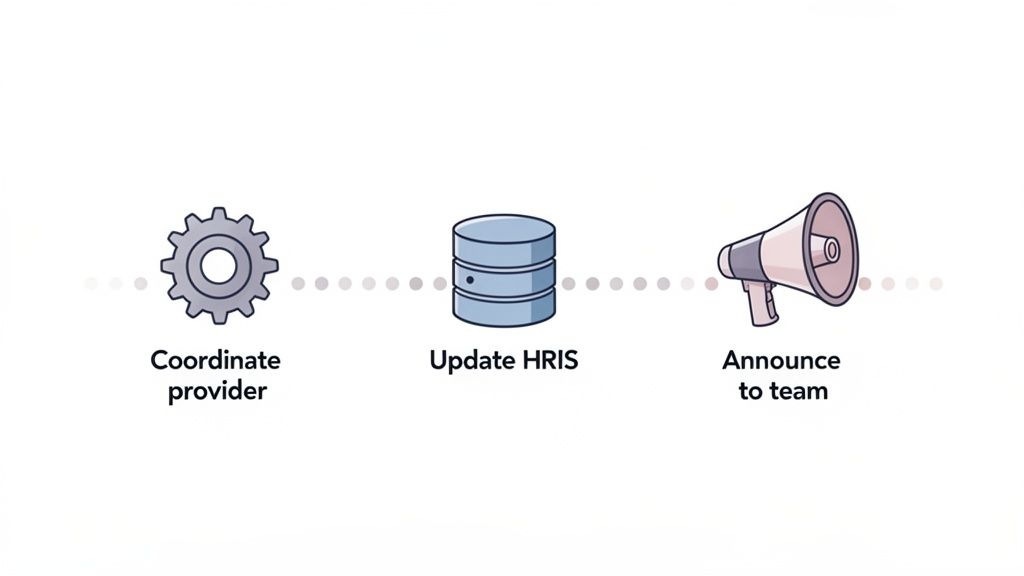
Here’s the thing. Solid change management is all about getting out in front of the narrative. A clear, well-structured announcement should go out at least one full pay cycle before the change kicks in.
Your communication needs to nail a few key points:
Here’s where most companies drop the ball: They announce the "what" and "when" but forget the "why." Explaining the logic behind a decision is what prevents backlash.
A good announcement is empathetic and direct. Use a simple tone and try to answer questions before they’re even asked.
Subject: An Important Update to Our Payroll Schedule
Hi Team,
Starting [Date], we will be transitioning from our current [Old Schedule] payroll to a new [New Schedule] system. This means you will now receive your paycheck [every other Friday / on the 15th and last day of the month].
Why are we making this change?
We’re confident this move to a [New Schedule] will [state the core benefit, e.g., create more consistent and predictable paydays for everyone].
What this means for you:
We’ve put together a detailed FAQ to answer more specific questions. Please take a look, and don't hesitate to reach out to HR if you need anything.
Handling this kind of proactive communication is a cornerstone of modern HR leadership. For a deeper dive into managing these responsibilities, check out our guide on the HR Generalist role.
It depends on their role. Salaried staff often prefer semi-monthly for its consistency with monthly bills, while hourly staff prefer bi-weekly for easier OT tracking.
Most systems deduct from 24 of the 26 paychecks. This gives employees two checks a year with no deductions, typically during the two "3-paycheck" months.
Yes, but it adds complexity. A common split is semi-monthly for salaried staff and bi-weekly for hourly teams to optimize for each group's needs.
Bi-weekly is the most common, used by over 43% of private firms, especially in industries with many hourly workers like manufacturing and retail.
Aligning your pay schedule with your workforce builds a system that’s efficient, compliant, and genuinely supports your employees' financial well-being. This operational clarity unlocks your team's ability to focus on high-impact work, like finding and hiring top-tier talent, instead of getting bogged down in administrative friction.
{{large_cta}}
Run your first search for free. Find and engage top talent across 800M+ profiles. Trusted by 5,000+ customers.

.png)

.png)