.svg)
SIGN UP FOR JUICEBOX (IT’S FREE!)

Who are you looking for?
Thank you! Your submission has been received!
Oops! Something went wrong while submitting the form.


In today's market, hiring isn't about filling seats—it's a race against the clock. The best candidates vanish in just 10 days, yet the average hiring process drags on for a staggering 44 days. To win, you must move faster than your competitors. This guide is your playbook to reduce time to hire by transforming your process from a leaky pipeline into a high-velocity engine. This is exactly why we built Juicebox: to unify the fragmented recruiting workflow so you can find, engage, and close top talent before anyone else.
Every open role is a leaky pipe in your revenue pipeline—an active drain on productivity, resources, and morale. Too many companies treat a long hiring process as a sign of thoroughness. That's a dangerous myth.
Most believe a longer process guarantees a better hire. The opposite is true. In today's market, speed is a prerequisite for quality. A drawn-out process doesn't signal diligence; it signals indecisiveness, and top candidates won't wait around for you to make up your mind.
The core problem is a massive disconnect. Globally, the average time-to-hire has ballooned to around 44 days, according to a recent SHRM report. But the candidates you actually want? They’re gone in about 10 days.
That 34-day gap is a graveyard for great hires. High-intent candidates accept faster offers, leaving you to settle for second-best or restart the search entirely. This isn't just lost time; it's about the compounding cost of every empty seat. To see the full picture, you have to calculate your true cost per hire.
Look at it this way.
High-growth companies like Ramp and Perplexity don’t have bloated, bureaucratic hiring. They treat talent acquisition like product development: agile, data-driven, and optimized for the candidate. They understand that hiring exceptional people faster is a direct lever for growth. This guide will show you how to do the same.
Before you can fix a leaky pipeline, you have to find the holes. To effectively reduce time to hire, you must diagnose precisely where your process is losing momentum. This isn't about guesswork; it's about mapping your entire hiring funnel and measuring the time spent at each stage.
You might think your hiring headaches are unique, but the root causes of delay are nearly universal. They usually hide in plain sight: chaotic interview scheduling, slow feedback from hiring managers, and the endless hours recruiters sink into manual sourcing and sifting through endless applications from sources like Indeed alternatives.
This infographic drives home the fundamental disconnect between how fast companies move and what candidates expect.
As you can see, there's a critical 34-day gap where top talent gets snapped up by faster-moving competitors.
And here’s where the real problem lies.
When every reschedule tacks on another 3–5 days to the process, a simple three-round interview can easily turn a 20-day plan into a 40-day reality.
Okay, time to get forensic. Break down your hiring process into clear stages and calculate the average time candidates spend in each one. This exercise will immediately shine a spotlight on your biggest time sinks.
This data-driven approach pulls you out of assumptions and into facts. Analyzing these specific recruiting metrics is the non-negotiable first step toward building a faster, more predictable hiring engine.
Once you know where the delays are, you need to figure out why.
The symptom might be slow scheduling, but the root cause is often deeper. This table connects common symptoms to the operational issues likely causing them.
| Bottleneck Stage | Common Symptom | Typical Root Cause |
|---|---|---|
| Sourcing | It takes weeks to build a qualified pipeline. | Reactive sourcing, lack of talent pooling, reliance on inbound applicants only. |
| Screening | Recruiters are overwhelmed with applications. | Poor job description filtering, no pre-screening automation, inconsistent criteria. |
| Scheduling | Coordinating interviews is a nightmare. | No centralized scheduling tool, lack of visibility into manager calendars, back-and-forth emails. |
| Feedback | We wait days for interview feedback. | No structured feedback process, unclear decision criteria, no accountability for hiring managers. |
| Offer | It takes over a week to get an offer out. | Slow internal approval processes, compensation indecision, lack of a clear offer workflow. |
Ramp and Perplexity live by this diagnostic approach. At Ramp, the team noticed the gap between the final interview and the offer was costing them top engineering talent. They rolled out a strict 24-hour SLA for hiring manager decisions and managed to slash their offer-stage time by a whopping 70% in just one quarter. A simple process change gave them a decisive edge. Fixing your biggest bottleneck can have a dramatic effect on your ability to reduce time to hire.
Let’s be honest: the biggest time suck in recruiting has always been sourcing. Even the best recruiters spend days chained to their keyboards, building complex Boolean strings with X-ray search techniques and running them across half a dozen platforms. This is where the clock really works against you.
But there's a problem most tools ignore. If you're only living in LinkedIn Recruiter, you're missing a massive chunk of the talent pool. The tedious, manual nature of old-school sourcing means you're moving too slowly.
What if you could collapse days of work into minutes?
That’s what an AI-powered sourcing engine delivers. Instead of wrestling with Boolean operators, you describe who you're looking for in plain English. This shift frees up your team to do what they do best: build relationships.
Let’s make this real. Imagine you're filling a tough role—say, a senior backend engineer. The old workflow means building a massive Boolean string, running it on LinkedIn, getting so-so results, tweaking it, running it again, and then starting over on three other sites.
Now, think about an AI-native approach using one of the top 10 AI recruiting tools for 2026. You can write a simple prompt:
“Find senior backend engineers in San Francisco who have worked at a YC-backed fintech company and have experience with Rust.”
This single sentence instantly scours 30+ platforms—from GitHub to academic sites—to surface a comprehensive list of qualified candidates. This isn't just a faster way to search; it's a fundamentally better one that uncovers talent you would have otherwise missed.
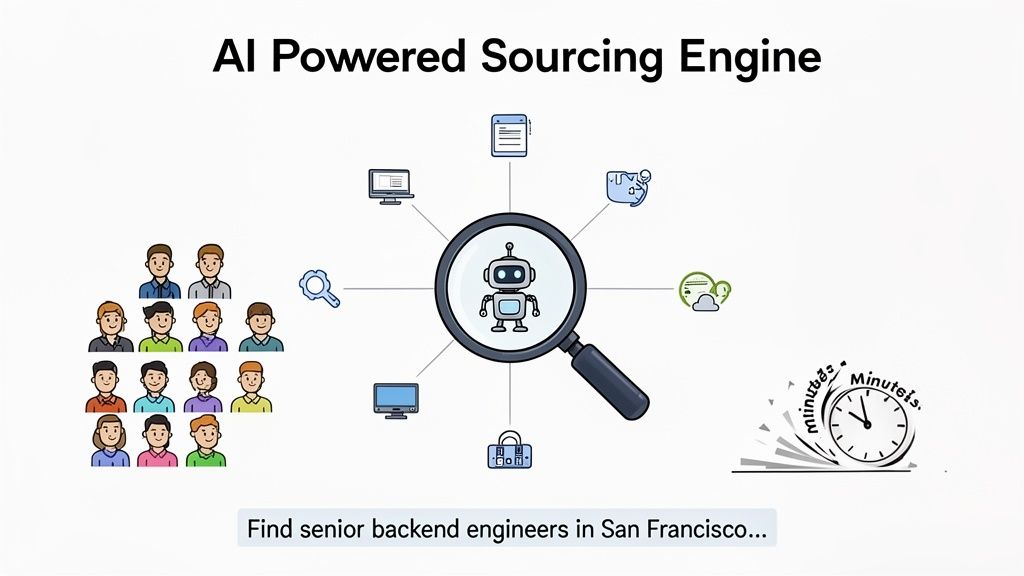
This kind of interface replaces complexity with the simplicity of a single command.
You might think, "This is great, but does it really work for complex, senior roles?" That's a fair question. The pushback is that AI can't handle the nuance needed for specialized searches. But that misses how modern AI models work. They don't just match keywords; they understand context, infer skills, and see patterns in career paths a human might overlook. A leading AI company used this method to hire three Principal Machine Learning Engineers in just 22 days—a process that used to take them over four months per hire.
Running one fast search is a huge leap forward. But the real game-changer is automation.
Here’s the breakdown:
This flips sourcing from a reactive chore into a proactive, automated engine that constantly feeds your pipeline. By embracing advanced strategies for AI sourcing, your team is always engaging with top prospects, not just searching for them. This creates a powerful flywheel effect: a full pipeline lets you close roles faster, which gives you more bandwidth to be strategic about your next hire.
Sourcing candidates is only the first leg of the race. The real momentum killer? That moment a promising list of profiles lands on a recruiter's desk, kicking off a painfully slow, manual process of screening and outreach.
To truly reduce time to hire, you must automate these next crucial steps—but without making candidates feel like just another number. The goal is to let automation handle the grunt work, freeing you up for genuine, high-touch interactions with your top prospects. The best AI recruiting tools are built on this principle.
Picture this: you have a list of 500 potential candidates. Manually sifting through each profile to find the top 5-10% could burn an entire day. With AI-driven scoring and advanced filtering, that task shrinks to seconds.
Modern systems analyze a candidate’s entire career arc—project history, inferred skills, and past company trajectories—to rank them against your ideal profile. This precision means you’re not just moving faster; you're starting outreach with a much stronger, more qualified shortlist. Best practices for automated resume screening use AI to augment your judgment, not replace it.
Okay, you've got your cream-of-the-crop candidates. Now what?
The very next bottleneck is the outreach itself. Trying to write individual emails, track replies in a messy spreadsheet, and remember to follow up is a surefire way to let great candidates slip through the cracks. An integrated, multi-step email sequence is your secret weapon.
A great sequence isn't about blasting inboxes. It’s about persistent, polite, and personalized communication. A recent Juicebox analysis found that a three-step sequence lifts reply rates by 3x compared to firing off a single email and hoping for the best.
Here’s a practical, proven template you can steal from our guide to recruitment emails:
Step 1: The Initial Outreach (Day 1)
Step 2: The Gentle Follow-Up (Day 4)
Step 3: The 'Break-Up' Email (Day 8)
This entire workflow can be automated within a single platform like PeopleGPT, eliminating the friction of juggling multiple tools—a common pain point that quietly adds days to your hiring timeline.
Sourcing and outreach are just the first half of the race. Even the most efficient engine can't save a process that grinds to a halt once a human gets involved. This is where the most critical disconnect happens: the chasm between your company’s internal clock and a candidate’s patience.
Here’s the stark reality. According to a 2023 Robert Half study, 57% of job seekers lose interest if the hiring process takes too long. Yet, multiple studies place the global average time to hire at around 44 days.
This isn't a minor inconvenience. It's a fundamental flaw that pushes top talent toward faster competitors. To shrink your time to hire, you must redesign your process around the candidate’s clock, not your own. Thinking like a freelance recruiter forces this kind of candidate-centric mindset.
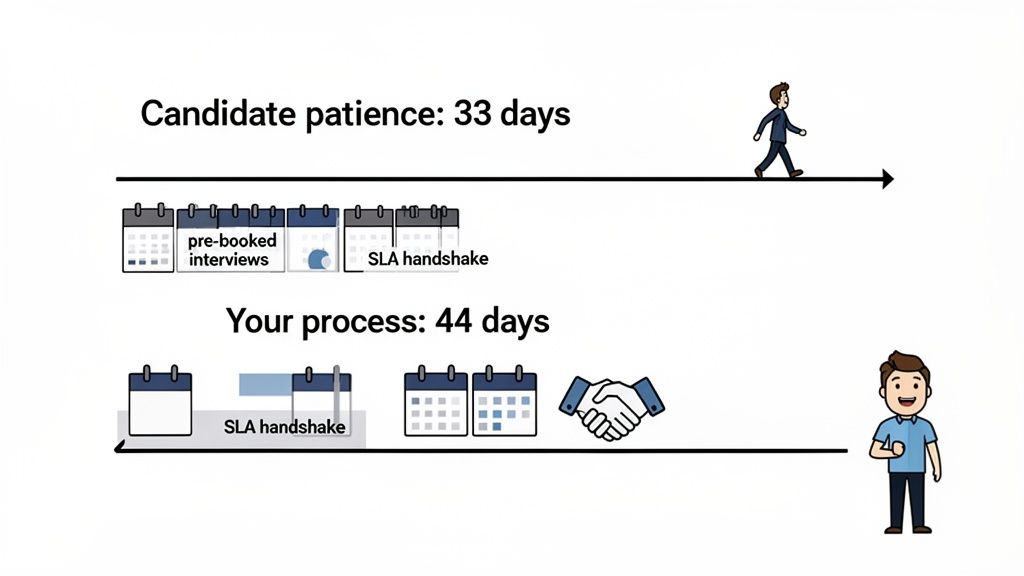
It's easy to blame hiring managers, but the real culprit is a lack of clear expectations. When you give them a clear framework, they become your greatest allies.
Establish non-negotiable timelines for each stage:
These aren't just suggestions; they are the operational rules of an efficient hiring culture.
The back-and-forth email chain to schedule an interview is a notorious time-killer. It can easily add three to five days to your timeline.
A powerful fix is pre-booking interview blocks.
At the start of a search, work with the interview panel to block off dedicated interview times in their calendars for the next two weeks. This transforms scheduling from a reactive mess into a proactive, streamlined step. It's a core component of learning how to improve candidate experience and a powerful way to accelerate your process.
The final piece of the puzzle is managing the candidate's perception of time. A wait feels infinitely longer when you have no idea what's happening.
From the very first conversation, give every candidate a clear roadmap of your entire process.
This sets clear expectations, reduces candidate anxiety, and creates internal pressure for your team to stick to the timeline. When your process is fast, clear, and respectful, it becomes a competitive advantage that helps you reduce time to hire by attracting and retaining the best people.
Will AI screening introduce bias into my hiring process?
If not configured properly, it can. Choose tools that allow for transparent criteria and focus on skills over demographics to ensure fairness.
How many follow-up emails are too many for a candidate?
Generally, more than three automated follow-ups for a cold outreach can feel like spam. Keep it concise and respectful of their time.
What's the best time of day to send recruiting emails?
Data from Yesware suggests mid-morning (9-11 AM) and early afternoon (1-3 PM) during the week often yield the best open and reply rates.
What's a realistic goal for reducing my time-to-hire?
Aiming to slash your current average by 30–50% within six months is an aggressive but achievable goal for teams adopting an AI-native workflow.
Let's reframe the entire conversation. The goal isn't just to reduce time to hire; it's about building a decisive, lasting advantage in the war for talent. Speed isn't about cutting corners; it's about closing the gap between finding great candidates and hiring them before your competitors even get a chance.
What this really unlocks is the ability to build higher-performing teams, hit your product roadmap deadlines, and drive tangible business growth. By compressing your hiring timeline with integrated, AI-native platforms, you transform talent acquisition from a slow-moving cost center into a high-velocity engine for innovation. You stop competing on the same old timeline and start operating on an entirely different level.
{{large_cta}}
Run your first search for free. Find and engage top talent across 800M+ profiles. Trusted by 5,000+ customers.
.png)