.svg)
SIGN UP FOR JUICEBOX (IT’S FREE!)

Who are you looking for?
Thank you! Your submission has been received!
Oops! Something went wrong while submitting the form.

Recruiting marketing is the practice of using marketing tactics to attract, engage, and nurture top talent. It means treating candidates like customers—building a strong employer brand and promoting it across multiple channels to create a predictable pipeline of amazing people, rather than scrambling when a role opens up.
Back in the day, recruiting was a straightforward, reactive process: post a job, collect resumes, and hire someone. Today, that "post and pray" method is a recipe for failure.
Talent acquisition teams are shrinking, yet they’re often drowning in applications. The real challenge isn't finding any candidate; it's finding the right one without wasting resources. This is where recruitment marketing flips the script, moving from a reactive firefight to a strategic engine for growth.
Here’s the deal. The best consumer brands don't just put a product on a shelf and hope people find it. They build a reputation, tell a compelling story, and meet people where they are. Recruitment marketing applies this exact logic to talent. It’s about proactively building your employer brand to attract a steady stream of qualified, engaged candidates who actually want to work for you. You can learn more about how AI is transforming the recruitment landscape in our detailed guide.
But there’s a critical mistake most companies make: they focus all their energy on active job seekers. That’s a tiny fraction of the workforce, which means they ignore the massive, untapped pool of passive talent—the high-performers who aren't looking but would be open to the right opportunity. A solid streamline recruitment process is key to engaging them.
Getting recruiting marketing right demands a fundamental change in mindset. It’s a move from a transactional function to a strategic one. You’re not just filling a single req; you’re building a sustainable talent pipeline for the future.
This strategic shift is fueling the massive growth of the global recruiting market, which is projected to surge to USD 989.32 billion by 2031. This explosive growth isn't just about more job ads; it's about the industry's move toward sophisticated, data-driven campaigns.
To really get a feel for this new approach, it's helpful to look at proven digital marketing strategies for recruitment agencies. But the core difference between the old and new way is clear.
This table breaks down the fundamental shift from the reactive, old-school way of hiring to the proactive, marketing-driven approach that wins today.
| Aspect | Traditional Recruiting (Reactive) | Recruiting Marketing (Proactive) |
|---|---|---|
| Focus | Filling immediate, open roles | Building a continuous talent pipeline |
| Audience | Active job seekers only | Active and passive candidates |
| Approach | Transactional and short-term | Relational and long-term |
| Tactics | Job board postings, resume screening | Employer branding, content, nurturing |
Ultimately, this modern approach ensures you're not just another job posting lost in the noise. Instead, you become a destination for top talent.
At Juicebox, our AI-native platform is built to empower even the leanest teams to run these sophisticated recruiting marketing strategies without the headache and cost of traditional enterprise software. We focus on this because, unlike generic HR tools, we believe precision sourcing and automated outreach are the only ways for small teams to compete for A-players.
Great recruiting marketing isn't just one thing—it's a complete system built on three core pillars. When all three work together, they create a powerful engine that pulls in and keeps top talent. But if you neglect one, the whole structure gets wobbly. Knowing these pillars is more valuable than just getting a list of freelance recruiter tips.
Most people believe a huge budget is the secret to great employer branding. The opposite is true. Consistency and authenticity will always matter more.
Your employer brand is simply your reputation as a place to work. It’s what people say about your company when you’re not in the room. This pillar is all about defining your unique employee value proposition (EVP)—that special mix of culture, benefits, and growth that makes you stand out—and then telling that story over and over. We have a whole guide on what is employer branding that goes much deeper.
The candidate experience is the entire journey someone takes with your company, from the first time they hear your name to the moment they get an offer (or a rejection). A smooth, respectful process can turn a passive browser into a huge fan, while a clunky one will send top candidates running for the hills.
Bottom line? Map this journey. Pinpoint every single touchpoint:
By ironing out the wrinkles at each stage, you build trust and show people you actually value their time.
Finally, you can't just build a great brand and hope people find it. You have to actively promote your company and open roles where your ideal candidates actually hang out. This isn't just about posting a job on LinkedIn and calling it a day.
Think about a smart mix of channels:
This multi-channel strategy ensures you're reaching both active job seekers and the massive pool of passive talent, creating a steady flow of great people into your pipeline. Check out some top AI recruiting tools that can automate this.
You might think your startup is too small for all this. That’s a common pushback, but it’s precisely why this is so critical for smaller companies.
You can't out-spend Google or Meta on salary. But you can compete with a strong, authentic brand and a killer candidate experience. These pillars give you the framework to punch well above your weight in the war for talent.
There’s a fundamental truth in recruiting marketing: if you try to talk to everyone, you end up talking to no one. Generic job descriptions pull in a flood of equally generic applicants, burying your pipeline in noise. The only way to cut through is with a candidate persona—a sharp, semi-fictional profile of your ideal hire.
A persona is so much more than a checklist of skills. It’s a deep dive into the motivations, career goals, communication styles, and even the daily frustrations of the talent you’re trying to win over. Think of it as upgrading from a blurry photo to a high-definition portrait. Once you know exactly who you’re talking to, every single touchpoint becomes exponentially more powerful. A great persona is more effective than just knowing HireEZ pricing and blasting emails.

Building a persona that actually works isn't a guessing game. It's a data-driven exercise, blending what you know internally with what's happening in the broader market to create a profile that’s grounded in reality.
Here’s a quick framework to get you started:
This isn’t a one-and-done task. Candidate priorities are always in flux. Right now, a staggering 90% of hiring managers are struggling to find skilled talent, partly because candidates’ desire for flexible work has shot up from 44% to 56% according to a 2024 RallyRM report. Personas force you to stay tuned in to what top talent actually wants today. You can get a deeper look at these shifts with more recruiting trends and statistics.
Having this level of detail is the bedrock of smart segmentation and targeting. It lets you craft your messaging with precision—a non-negotiable part of any modern candidate relationship management strategy.
The real magic happens when you put these personas to work. Take Cognition, a Juicebox customer, who slashed their time-to-hire for AI engineers by 60% in just three months.
What was the secret? They used PeopleGPT's Power Filters to build incredibly precise personas and source candidates with specific, verifiable accomplishments. This allowed them to completely bypass the noise on platforms like LinkedIn.
By defining exactly who they wanted—down to the specific types of projects those engineers had worked on—their outreach became hyper-relevant. Their pipeline quickly filled with qualified, engaged talent that was actually a fit. That’s the core of modern recruiting marketing: precision targeting that delivers results you can actually measure.
Alright, you've got your candidate personas dialed in. Now comes the fun part: moving from strategy to action.
Effective recruiting marketing isn't about carpet-bombing every channel out there. It’s about being in the right places with a message that actually connects. Think of it as orchestrating a handful of high-impact channels that work together to create a talent magnet for your company.
Your career site is home base. It’s not just a job board; it's the central hub for your employer brand. From there, your outreach needs to meet talent where they already are—think employee advocacy on social media, targeted recruitment emails, and content that shows off your team's expertise. When you're planning this, consider how you can explore social platforms like Saucial to amplify your efforts.
But this is where most outreach campaigns fall flat: they fail to personalize at scale.
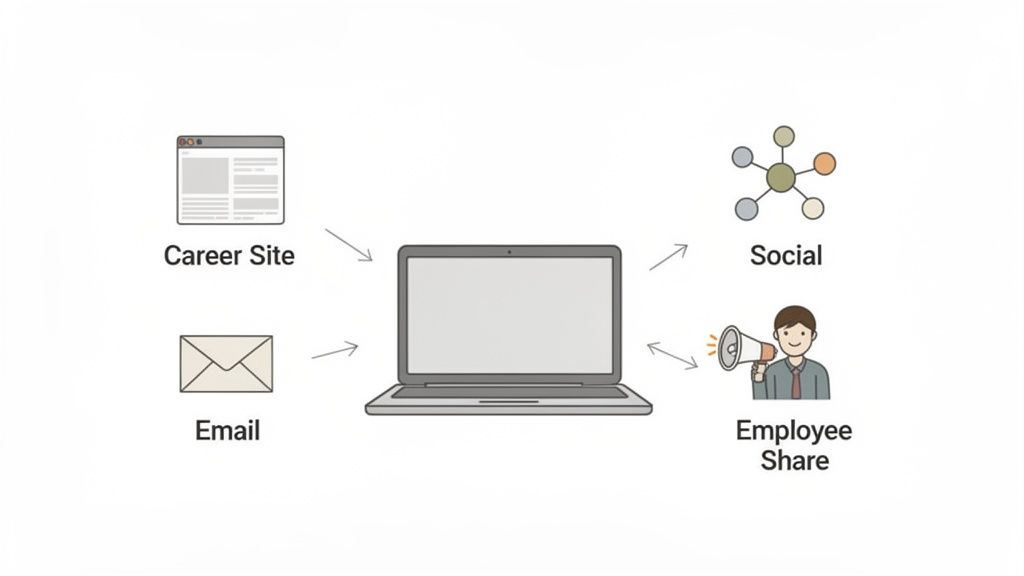
Most recruiters are stuck duct-taping a bunch of different tools together—one for sourcing, another for email, a third for tracking. This patchwork approach absolutely kills efficiency and makes genuine personalization next to impossible. The real key is to bring these functions into a single, cohesive workflow.
You might think you need a massive, expensive tech stack to run sophisticated campaigns. Why that fails is simple: a fragmented stack creates data silos, preventing you from seeing the full candidate journey and personalizing effectively. An all-in-one platform not only saves your budget but also connects your data, letting you move from finding a candidate to nurturing them in seconds.
The best campaigns don't just blast out messages; they build relationships. A 2023 study from Deloitte found that personalizing the hiring process can boost candidate engagement by a staggering 50% and improve the quality of hires by up to 70%. This is exactly why a unified approach is so important. Our guide on social recruiting dives deeper into how to build these kinds of connections online.
To help you prioritize, here’s a quick look at how different channels stack up for different needs.
This table breaks down which channels tend to work best for different roles and candidate types. Use it as a starting point to focus your energy where it will count the most.
| Channel | Best For (Role Type) | Primary Audience | Key Metric |
|---|---|---|---|
| Email Nurture | Technical, Leadership | Passive candidates | Reply rate |
| Social Media | Sales, Marketing, Design | Active & passive candidates | Engagement rate |
| Content / Blog | Technical, Product | Passive candidates | Qualified clicks |
| Career Site | All roles | Active candidates | Application rate |
| Referrals | All roles | Warm leads | Hire rate |
While channels like social media are great for brand awareness, nothing beats a well-crafted email sequence for engaging top-tier, passive talent. This is where AI-native tools really start to shine.
Modern AI-native platforms like Juicebox were built to solve this exact fragmentation problem. Instead of juggling multiple subscriptions and clunky workflows, you can run your entire recruiting marketing campaign from one place. This is more efficient than weighing SeekOut pricing against other point solutions.
Here’s what that looks like in practice inside PeopleGPT:
This AI-driven process collapses the old, clunky recruiting stack. It turns what used to be a multi-day task into a quick 10-minute workflow. This is how lean teams run world-class recruiting marketing without the enterprise-level bloat.
You can run the slickest campaigns on the planet, but without the right data, your recruiting marketing efforts are just shots in the dark. To prove your value, you have to move beyond vanity metrics like social media likes and zero in on the key performance indicators (KPIs) that tie your work directly to business outcomes. A deep dive into recruiting metrics is a great place to start.
Look, your recruiting function is a sales pipeline for talent. You need a dashboard that tells you what's working, what's not, and where your best leads—in this case, candidates—are coming from. This isn't just about tracking for the sake of it; it's about making smarter, data-driven decisions that fill roles faster with higher-quality talent.
And you don't need some complex, expensive analytics tool to get started. By focusing on a few core metrics, even small teams can punch well above their weight.
To build a dashboard that actually proves ROI, start by tracking these four essential metrics. Together, they give you a clear, 360-degree view of your recruiting engine's health and effectiveness.
Tracking these isn't just a "nice-to-have" anymore. A 2024 Gem benchmark report shows that 46% of sourced hires now come from rediscovered candidates already in a CRM or ATS—a huge jump from just 26% in 2021. You can discover more insights about recruiting benchmarks that underscore the power of nurturing the talent networks you already have.
The goal isn't just to collect numbers; it's to use them to tell a story and make better decisions.
For example, Juicebox relentlessly tracked source effectiveness from day one. As a 4-person team trying to scale to 2,000 customers pre-Series A, this data was our north star. It revealed that a whopping 80% of our best engineering hires came from outside LinkedIn, which completely validated our multi-source data strategy.
That single insight allowed us to allocate our tiny budget with surgical precision, which in turn fueled our growth. That’s the real power of measuring recruiting marketing effectively.
How can a small startup with no budget start recruiting marketing?
Focus on free, high-impact channels. Build a great career page, encourage team advocacy on LinkedIn, and write blog content about the unique problems you solve.
What is the difference between employer branding and recruiting marketing?
Employer branding is your reputation (the what). Recruiting marketing is the action plan to promote that reputation and get candidates to apply (the how).
How long does it take to see results from recruiting marketing?
Targeted ads can bring applicants in days. But a sustainable talent pipeline that delivers consistently takes 3-6 months to build momentum and show measurable ROI.
What is the most important metric to track in recruiting marketing?
Source of Quality Hire is the MVP. It tells you which channels deliver candidates who become your best employees, helping you invest your time and money wisely.
The old, reactive model of recruiting is broken. By treating candidates like customers and implementing a proactive recruiting marketing strategy, you build a predictable talent engine. What this unlocks is the ultimate competitive advantage: the ability to hire top talent on-demand, ensuring your company can innovate and scale without ever being held back by a lack of great people.
{{large_cta}}
Run your first search for free. Find and engage top talent across 800M+ profiles. Trusted by 5,000+ customers.
.png)
.png)