.svg)
SIGN UP FOR JUICEBOX (IT’S FREE!)

Who are you looking for?
Thank you! Your submission has been received!
Oops! Something went wrong while submitting the form.

Tired of sending outreach into a black hole? The average recruiter sends over 50 emails a day but gets barely 5 replies.
This isn't a volume problem. It's a strategy problem. Most templates are generic, impersonal, and instantly ignored by the talent you're trying to reach. Generic outreach fails because it makes the candidate do all the work of connecting their skills to a vague job description.
In this guide, we'll show you the eight essential recruitment email sample templates used by top sourcers at companies like Ramp and Perplexity to cut through the noise.
This isn't just another list of copy-paste templates. We’ll analyze the strategic psychology behind each email, showing you how to adapt them for different roles, from cold outreach to engaging passive candidates. You'll learn replicable methods behind high-performing outreach, see the exact language that compels a response, and discover how to automate this entire workflow to scale your sourcing efforts.
Let's dive right in:
TL;DR: 8 High-Impact Recruitment Email Templates
The cold outreach email is the cornerstone of proactive recruiting, especially when sourcing passive candidates who aren't actively looking for a new role. This initial touchpoint aims to introduce you, your company, and a specific opportunity in a way that feels personal, relevant, and respectful of the candidate's time. A strong cold email bypasses the noise of generic InMail and lands directly in a candidate’s personal space, demanding a higher level of personalization to be effective.
Hold on a second. What if your personalization is what's getting you ignored?
Unlike broad-stroke messages, a great cold recruitment email sample demonstrates genuine research and interest in the individual. It's the first step in building a relationship, not just filling a seat. For a deeper dive into the mechanics of these messages, explore our guide on how to write a recruiting email to master the fundamentals.
[Your Company] <> [Candidate's Company]Question about your work on [Project Name]This approach flips the traditional recruitment script. Instead of leading with an introduction to your company, this email immediately highlights the compelling aspects of the role itself. It focuses on what the candidate gains: career growth, significant impact, learning opportunities, or autonomy. This strategy is highly effective for senior talent, like principal engineers or directors at startups, who are motivated by the challenge and scope of a role, not just a brand name.
Here’s the deal: By putting the opportunity first, this recruitment email sample cuts through the noise and speaks directly to the candidate's professional ambitions. It assumes the recipient is a high-performer who is more interested in building something meaningful than joining an established machine. This method aligns perfectly with the mindset of talent in competitive markets like San Francisco and New York, where top candidates receive dozens of generic outreach messages daily. A well-crafted value prop is key to making your freelance recruiter efforts stand out.
Build our [Function] team from the ground upPrincipal Engineer, [Key Technology] at [Stealth Startup/Company]The warm referral email is one of the most powerful tools in a recruiter's arsenal. It leverages a mutual connection to establish immediate credibility and bypass the skepticism often associated with cold outreach. This type of message arrives with built-in social proof, dramatically increasing the likelihood of a positive response. Data consistently shows that referral-based outreach can achieve reply rates of 25-40% or higher.
But there’s a problem most recruiters ignore. They mention the referral but fail to explain why that person thought it was a good match.
Unlike a cold message that needs to build trust from scratch, this recruitment email sample enters the conversation with pre-established context. The referral acts as a powerful endorsement, signaling that the opportunity is worth the candidate's attention. This is a core tactic in high-trust networks, such as founder communities or venture capital portfolios where talent is frequently shared between companies. Building a robust system for these introductions is key, and you can explore the fundamentals in our guide to creating a successful employee referral program.
[Referrer's Name] suggested I reach outIntro from [Referrer's Name] re: [Your Company]Most candidates, especially passive ones, won't reply to your first email. Most recruiters believe sending more emails is the answer. The opposite is true. Sending smarter emails is the answer. The multi-step email sequence is a recruiting framework designed to combat this reality by engaging candidates over time. Instead of a single "all or nothing" message, a nurture series uses 3-5 strategically timed emails, each offering a different angle or value proposition. This approach leverages the psychological principle of repeated exposure, keeping your opportunity top-of-mind without being intrusive.
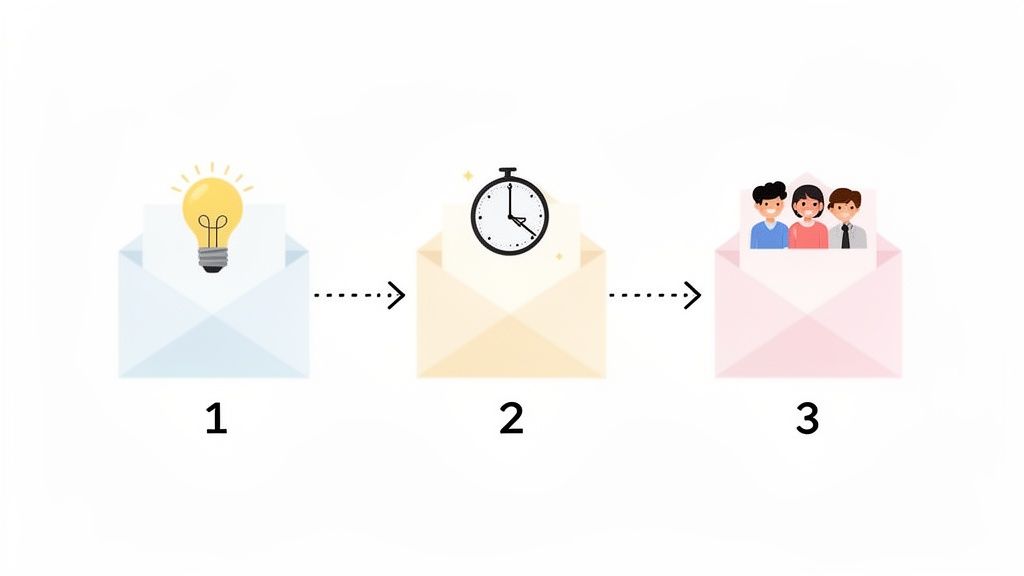
This method moves beyond the limitations of a single recruitment email sample and treats outreach as a campaign, not an event. By systematically varying your message, you increase the chances of hitting on a hook that resonates with a candidate’s specific motivations. For a deeper look at the mechanics, our guide on email sequencing strategies breaks down the entire process from start to finish. Using the right AI recruiting tools can automate this entire flow.
The passive-to-active engagement email is a strategic tool for re-engaging promising candidates who didn't move forward during a previous interaction. This touchpoint is crucial for long-cycle hiring, especially for senior or highly specialized roles where the talent pool is limited and timing is everything. It acknowledges your prior contact, introduces a compelling new reason to talk, and lowers the barrier to re-entry.
Think about it.
Unlike a first-time cold outreach, this recruitment email sample leverages a pre-existing, albeit dormant, connection. It shows persistence and genuine, long-term interest in the candidate's career, turning a past "no" or "not right now" into a future "yes." The key is to frame the outreach around what has changed for the better, whether it’s your company’s funding, the role's scope, or a shift in the market.
Mastering this follow-up is essential, and you can explore more strategies on how to engage passive candidates to build a robust talent pipeline.
Following up: [Your Company] + [Candidate's Name]A new opportunity at [Your Company]This approach moves beyond the traditional job pitch by initiating contact through genuine engagement with a candidate's public work. Instead of leading with an opportunity, this email starts a conversation based on their GitHub contributions, open-source projects, conference talks, or technical articles. It prioritizes building rapport and demonstrating authentic interest, making any subsequent job discussion feel natural rather than transactional. This method is especially potent for reaching top-tier technical talent who are often immune to standard recruiting messages.

This recruitment email sample is rooted in the philosophies of open-source community hiring, where credibility is earned through contribution and genuine peer appreciation. It’s about showing you’re a member of the community, not just an outsider looking to extract talent. For highly targeted outreach, especially when engaging candidates via professional networks, understanding platform nuances is essential. You can learn more about mastering LinkedIn as a recruiter to complement your email strategy with effective social engagement.
Loved your talk on distributed tracing at KubeConQuestion about your PR for the [Project Name] repoThe urgency or time-sensitive trigger email is a high-stakes tool designed to accelerate the hiring process with a promising but unresponsive candidate. It leverages genuine, time-bound constraints to re-engage prospects and prompt a decision. This approach reframes inaction as a missed opportunity, but its effectiveness hinges entirely on authenticity; manufactured urgency will quickly damage your credibility and future recruiting efforts.
So what's the bottom line?
This tactic is most effective in specific scenarios, such as when a venture-backed startup has board-mandated hiring deadlines or a key project is approaching a critical launch date. A well-crafted recruitment email sample of this type can cut through the noise by clearly articulating why the timeline is critical. It respectfully acknowledges the candidate's schedule while transparently stating that the window of opportunity is closing, compelling them to act if they have any underlying interest. To learn more about optimizing your hiring workflow, read about how to streamline the recruitment process.
Following up: [Role] at [Your Company] (Time-sensitive)Final thoughts on the [Role] opportunity?The value-add email flips the traditional recruiting script. Instead of leading with a job description, you lead by offering genuine, tangible value to the candidate. This approach immediately positions you as a trusted industry advisor rather than just another recruiter trying to fill a role. By providing valuable content-like market data, career insights, or exclusive research-you build credibility and earn the right to a conversation.
This strategy is exceptionally effective for engaging passive candidates who aren't actively looking but are always open to career intelligence. A well-crafted recruitment email sample of this type demonstrates that you understand their field and are invested in their professional growth, not just your immediate hiring needs. It’s a powerful way to build a long-term talent pipeline and establish your reputation as a resource, which is a key part of any strong set of recruiting metrics.
ML engineer salaries in SF (2024 data)A few thoughts on your [Skill] career pathPersonalization, a clear value proposition for the candidate, and a low-friction call-to-action are the three core pillars of a successful email.
Aim for 50-125 words. Keep it concise enough to be read on a phone, focusing on the hook and the next step without overwhelming the candidate.
A sequence of 3-4 emails is standard. Space them 3-5 days apart, varying the content and angle in each message to maximize response rates.
We’ve dissected eight distinct types of recruitment email samples, from cold outreach that sparks curiosity to value-add content that builds trust. But simply having a library of templates isn't the endgame. The real transformation happens when you move from having the right words to systematizing their delivery. Each recruitment email sample is a tool, and like any tool, its power is magnified by the system it's part of.
You might think, "This level of personalization and sequencing sounds like it would take all day for just a few candidates." And if you were doing it manually, you’d be right. This is precisely the problem that holds most talent teams back. They're trapped between sending generic, low-performing blasts and spending hours on deep research for a single outreach. This approach fails because it's not scalable.
But there's a different way:
By integrating AI-powered tools like PeopleGPT, you can automate the research and personalization that underpins these high-impact templates.
Instead of manually searching for a candidate's recent conference talk, PeopleGPT can surface that insight instantly, allowing your template to feel hyper-relevant without the manual effort. As proven by companies like Retool reducing time-to-hire by over 50%, this is what separates good recruiting from great recruiting.
The core benefit is clear: elite recruiting isn't about sending one perfect email. It's about executing a strategic sequence of personalized, context-aware messages that guide a candidate from passive awareness to active engagement. This unlocks a truly scalable sourcing engine. You're no longer just a recruiter sending emails; you become an architect of a talent pipeline that consistently engages top-tier candidates before your competitors even know they exist.
Run your first search for free. Find and engage top talent across 800M+ profiles. Trusted by 5,000+ customers.
.png)
.png)
.png)