.svg)
SIGN UP FOR JUICEBOX (IT’S FREE!)

Who are you looking for?
Thank you! Your submission has been received!
Oops! Something went wrong while submitting the form.

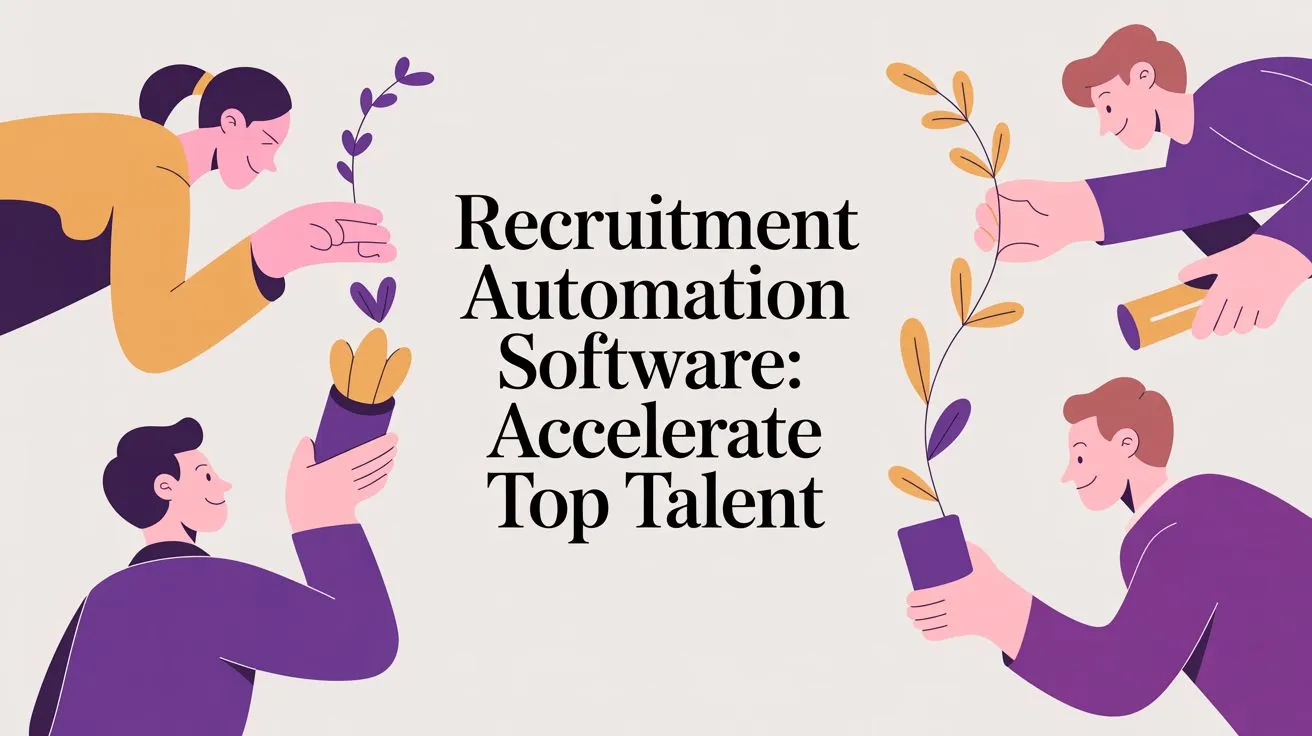
Navigating the talent market without the right tools feels like being lost in a vast, dense maze. Every resume is a dead end, every job board a winding path leading nowhere. Finding top candidates is like stumbling upon the maze's hidden center—a rare feat of luck, not strategy. This is the daily struggle for even seasoned recruiters.
Recruitment automation software is the modern compass that transforms this maze into a clear path. It's a sophisticated instrument that cuts through the complexity, systematically handling repetitive tasks like sourcing and outreach so you can focus on building relationships and closing critical hires. A 2026 Workato report found that HR automation has skyrocketed by 316% year-over-year, proving this is no longer a niche tool but a core strategic asset. Unlike generic recruiting posts, this guide shows real PeopleGPT workflows—not just theoretical advice.
It's easy to feel the sting of administrative overload—the endless hours manually sifting through applications and crafting outreach messages that keep you from the strategic work you were hired to do. You got into this field to connect exceptional people with career-defining opportunities, not to be an administrator. Recruitment automation software promises to slash your manual sourcing and outreach time by up to 70%, turning you into a strategic talent advisor. The solution is to use this technology not just for speed, but for unparalleled precision.
Most recruiters believe the main advantage of automation is speed. While it's true that recruitment automation software can save you hours each week, focusing solely on speed is like using a high-tech compass just to see which way is north. You're ignoring its real power: to guide you to a precise, unseen destination with incredible accuracy.
Here's the deal: the common myth is that automation is a volume game, designed to blast out more messages and screen more resumes faster. The opposite is true. Its greatest strength lies in precision, driven by AI's ability to understand the context behind millions of data points, not just match keywords. It deciphers the nuances of a candidate's actual experience, pointing you to the true north of your search—tangible expertise.
This shift from speed to precision is why the industry is all-in on these tools. But simply purchasing the software isn't enough. Understanding how it calibrates your sourcing compass is what separates top performers from the rest.
A manual search on any professional network is rigid. You're confined by basic filters and Boolean strings. Search for "Java," and you'll get every profile that mentions the word, often out of context. It's like navigating a maze by only taking right turns—you'll cover ground, but you won't find the center.
True north on your sourcing compass isn't a keyword; it's a collection of signals that point to genuine expertise. Here's how AI-powered sourcing is different: it analyzes context to infer skills that aren't even listed. For example, it might see a software engineer's public GitHub contributions and, from their project descriptions, understand they have advanced skills in distributed systems—even if those words are nowhere on their profile. This is the core of modern AI sourcing and how you uncover talent that others miss. This is especially powerful for finding passive talent, the hidden gems in the maze invisible to anyone using a basic map.
Let's make this real. Imagine you need a Machine Learning Engineer with experience in natural language processing who has deployed models on AWS. A manual search would be a brutal, time-consuming trek through the maze, with most paths leading to dead ends.
There's a better way.
With an intelligent platform, you describe your ideal candidate in plain English. The AI then navigates the entire talent maze for you.
PeopleGPT Workflow: Finding a Niche ML Engineer
Prompt: "Find me Machine Learning Engineers in the San Francisco Bay Area with 5+ years of experience who have worked on NLP projects and have public evidence of deploying models on AWS. Prioritize candidates from Series B or C startups."
Output:
Impact:
This isn't about running through the maze faster. It's about using a finely tuned compass to find a direct path to the exact talent you need, cutting through all the noise.

Once your sourcing compass is set, the journey begins. Knowing which tasks to hand over to your recruitment automation software is critical to maintaining momentum. This isn't about automating your entire job; it's about offloading the right things—the repetitive, predictable steps that slow you down and lead you off course.
A compass doesn't walk the path for you, but it ensures every step is in the right direction. Automation does the same. It handles the tedious navigational checks so you can focus on the terrain ahead: building relationships and making the critical judgments that only a human can.
Sourcing the right candidates is only the first checkpoint. Then comes the labyrinthine process of actually reaching them. Crafting personalized messages for dozens of candidates, following up at the right intervals, and tracking responses—manually, this feels like navigating the maze blindfolded.
Here's the workaround: recruit automation software intelligently manages this entire sequence. It doesn't just send bulk emails. Sophisticated systems learn from response data, automatically scheduling follow-ups when they're most likely to be read and personalizing messages at scale using AI-powered email cadences.
PeopleGPT Workflow: Automated Outreach Sequence
Step 1: After building a list of 30 target candidates, a recruiter sets up a 3-step automated email sequence. The first email is personalized by AI to reference each candidate's specific skills and recent projects.
Step 2: If no response after 4 days, a second email is automatically sent, offering a different value proposition (e.g., the exciting technical challenges of the role).
Step 3: A final, brief check-in is sent 5 days later, creating one last touchpoint before the sequence concludes.
Result:
The math is simple: automating the outreach maze reclaims hours every single week, hours you can spend actually talking to engaged candidates.
Even with great candidates in your pipeline, manual screening is another dead end. Reviewing resumes, checking for baseline qualifications, and ranking applicants is time-consuming and prone to inconsistency. It's a necessary navigational check, but one that doesn't require a human compass.
High-impact recruitment automation software handles this by using AI to parse, analyze, and score applications against a set of criteria. This creates an objective first-pass filter, ensuring only candidates who meet your baseline requirements land on your desk for a deeper look. This frees you up to focus your human judgment where it matters most: complex evaluations and relationship building. This kind of efficiency is central to what an AI recruiting tool is designed to deliver.
Introducing new technology always raises questions. Decision-makers want to see a clear return on investment. Recruiters might wonder if it will make their jobs obsolete. The truth is, a well-chosen recruitment automation software pays for itself by solving a core business problem: the spiraling cost of a bad or slow hire.
The real trick isn't proving the technology works. It's quantifying the cost of not using it.
A common objection to automation is its upfront cost. But this ignores the massive hidden costs buried in a manual workflow. Every hour a recruiter spends on low-value administrative tasks is an hour not spent on strategic hiring. Every week an open role sits unfilled costs the business in lost productivity, missed opportunities, and team burnout.
Let's put real numbers to it. Consider a Software Engineering hire with an average salary of $150,000.
Framing the investment in automation as reducing these hidden costs changes the conversation entirely. It's not an expense; it's a risk-mitigation strategy.
Beyond avoiding costs, recruitment automation software generates tangible, positive returns. The clearest metric is Time-to-Hire. A platform that cuts your time-to-hire by 30% means you're filling critical roles faster, getting new talent productive sooner, and beating competitors to the best candidates. Reducing time-to-hire is a key recruiting KPI that every talent leader should track.
Another key metric is Cost-Per-Hire. By automating sourcing and initial outreach, you can often reduce your reliance on expensive third-party agencies. A single in-house hire that would have gone to an agency (at 20-25% of salary) saves you $30,000-$37,500 on a $150k role. If automation enables your team to make just a handful of these hires in-house, the software pays for itself many times over in a single month. It doesn't just point you in the right direction; it clears the path so you can move faster and with more confidence.
Investing in recruitment automation software can feel like a leap of faith. You might think it's just another expensive subscription that adds complexity without a clear payback. Here's why that's wrong: the right tool provides a measurable return by making the entire hiring journey faster and more cost-effective. Calculating this return isn't an abstract exercise; it comes down to tracking core metrics that directly impact the bottom line.
Metrics are just numbers until you see them in action. The real value of recruitment automation software becomes obvious when you see how it moves the needle in the real world. For example, FinCorp, a major fintech company, used PeopleGPT's AI sourcing to build targeted talent pools before roles even opened. By doing this, they slashed their time-to-hire for senior software engineers by 40% in just six months.
But there's a problem most tools ignore.
Many platforms stop at sourcing, leaving recruiters to manually grind through the painful outreach process. A truly integrated system changes the game. A Series C startup saw their recruiter productivity jump by 60% in a single quarter by using automated, personalized email sequences. This tactic allowed them to engage five times as many qualified passive candidates without increasing headcount. It's no wonder the United States recruitment software market is projected to grow from USD 592 million in 2024 to over USD 1.36 billion by 2033, according to insights about the US recruitment software market.
The ultimate ROI isn't just about saving time; it's about reallocating that time to high-value activities. By tracking these foundational recruiting metrics, you build a rock-solid business case.
Choosing the right recruitment automation software is like selecting a compass for a high-stakes expedition. A cheap, decorative one might point north, but it won't help you navigate tricky terrain or find the quickest path through the maze. You need an instrument that is precise, reliable, and built for your specific journey.
On the surface, many platforms look the same. But the real difference is in the details—the elements that separate a tool that just adds to your busywork from one that genuinely clears a path to top talent.
But there's more.
This is the single most important question you can ask. A massive candidate database sounds impressive, but if the data is stale, you're navigating with an outdated map. A static database is a graveyard of old profiles and dead-end contact information. You need a compass that reads the terrain in real time.
Look for a platform that pulls from live, dynamic data streams across dozens of sources. According to a 2026 SHRM report, 92% of US hiring managers are already using AI for resume screening, showing a massive industry-wide move toward data-driven tools. A system that uses live information means you're seeing candidates as they are right now. It's the difference between chasing ghosts and engaging real, available people.

"We integrate with your ATS" is a common sales pitch, but "integration" can mean anything from a seamless, two-way data sync to a clunky tool that just creates more confusion. A shallow integration is like having a compass that isn't synced with your map. You end up manually copying notes, updating statuses in two different places, and losing the source of truth.
What you need is a deep, bi-directional sync where actions in the automation tool are instantly reflected in your Applicant Tracking System. No manual data entry, no toggling between tabs, and no data loss. For more on this, it's worth exploring the nuances of AI tools with ATS integration. A powerful compass should make navigation simpler, not add another layer of complexity to your journey.
For years, the conversation around automation felt like a threat. But recruitment automation software isn't here to replace your expertise; it's here to give you a better compass.
A finely tuned instrument doesn't make the navigator obsolete. It empowers them to find paths through the maze others can't see, allowing their strategic judgment to shine. The tool handles the tedious directional checks so you can focus on reading the terrain and guiding your team to its destination. The implication is clear: recruiters who master these tools will evolve into strategic talent advisors, capable of identifying candidates who are invisible to manual methods. Those who cling to outdated processes will find themselves lost in the maze. The compass has been invented; navigating without one is no longer a viable option.
Sign up for PeopleGPT—it's free
No, it elevates them. It acts as a compass, not an autopilot, by handling high-volume, repetitive tasks. This frees up recruiters to focus on the human side of hiring: building relationships, conducting insightful interviews, and advising hiring managers.
A well-designed AI can be configured to ignore demographic information like names or photos that may trigger unconscious bias. It focuses on objective, merit-based criteria like skills and project experience, ensuring every candidate is measured by the same yardstick.
Days, not months. For major Applicant Tracking Systems like Greenhouse, Lever, or Ashby, connecting a platform like PeopleGPT can be done in just a few hours with guided support, allowing you to see a return almost immediately.
{{large_cta}}
Run your first search for free. Find and engage top talent across 800M+ profiles. Trusted by 5,000+ customers.