.svg)
SIGN UP FOR JUICEBOX (IT’S FREE!)

Who are you looking for?
Thank you! Your submission has been received!
Oops! Something went wrong while submitting the form.

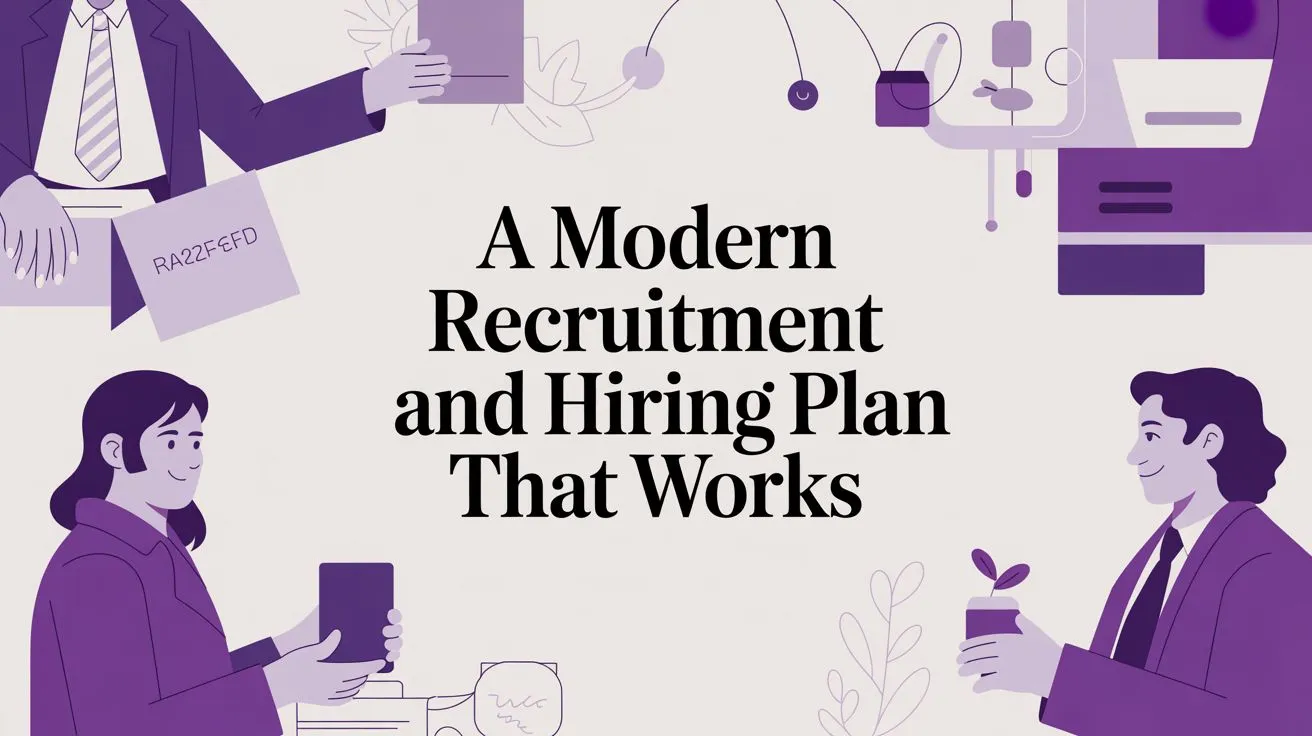
Hiring without a strategy feels like navigating a maze blindfolded. You know the exit is somewhere, but every turn is a guess, wasting time and energy. A recruitment and hiring plan is your compass in this maze, providing the direction needed to find the right talent predictably. It turns chaotic, reactive sourcing into a repeatable system that consistently delivers people who drive your business forward. A recruitment and hiring plan is a strategic document that outlines the process of identifying, attracting, assessing, and hiring new talent to meet organizational goals. According to a 2024 LinkedIn report, companies with a strategic hiring plan are 33% more likely to report above-average talent acquisition performance. Unlike generic recruiting posts, this guide shows real PeopleGPT workflows—not just theoretical advice.
Recruiting teams often feel the pressure of an urgent, open role with no clear path forward. This leads to blasting job descriptions across every platform, hoping the right person magically appears. This "spray and pray" method rarely works, leading to mismatched candidates and frustrated hiring managers. A data-driven recruitment and hiring plan promises to reduce your time-to-fill by up to 40% by aligning your efforts with clear business goals. The key isn't just working harder; it's about shifting from reactive tasks to a proactive, strategic compass.
TL;DR: Your Ultimate Recruitment and Hiring Plan
Before you can navigate the talent maze, you need a map. A recruitment and hiring plan that isn't directly tied to business objectives is just a list of tasks—it lacks direction and purpose. Aligning hiring with your company's core goals is what transforms recruiting from a reactive support function into a strategic growth engine. You have to move beyond filling headcount and start asking, "What business outcome are we trying to achieve with this hire?"
This requires a deep partnership between talent acquisition and department leaders, forcing everyone to focus on future needs, not just today's empty seats. The goal is to build a proactive plan that anticipates talent requirements based on product roadmaps and market expansion plans.
The first step in drawing your map is understanding the terrain you already hold. A strategic talent audit gives you a clear picture of your current team's capabilities, strengths, and—most importantly—its gaps. This isn't just a performance review; it's a full-blown organizational analysis.
Start by mapping your existing talent against the skills required to meet future business goals. For example, if the company plans to launch a new product line powered by machine learning in the next 18 months, you need to ask:
This process helps you identify whether you need to upskill your current team, hire externally, or use a mix of both. An honest audit keeps you from searching for talent you may already have and ensures every new hire directly addresses a verified strategic need, a key step in building a better recruitment process.

As you can see, moving from the chaos of the maze to a functional system requires a guiding compass—your business objectives.
Once you understand your talent gaps, the next move is to translate high-level business objectives into concrete hiring priorities. This is where you work hand-in-hand with executive and department leadership to build a shared understanding of what success looks like for each potential role.
Ditch the generic role descriptions. Instead, focus on the business impact.
If the goal is to increase market share in the EMEA region by 15%, the hiring need isn't just "a salesperson." It’s for a Senior Account Executive with a proven track record of breaking into the German manufacturing sector and experience navigating specific regional compliance laws.
You’re not just filling a seat; you’re acquiring the specific skills and experience needed to unlock a specific business outcome. This is the essence of strategic workforce planning.
This translation process also forces clarity and accountability. By defining the business problem a new hire is meant to solve, you create a much stronger foundation for the entire hiring process. It ensures that from the very beginning, everyone from the recruiter to the final interviewer is aligned on the strategic importance of the role, making your recruitment and hiring plan a true instrument of business strategy.
You’ve got your map and your destination is marked. Now, how do you actually find the path? A powerful sourcing strategy isn’t just about posting a job description and waiting. It's about creating a dynamic, multi-channel approach to uncover hidden talent pools and keep a steady flow of qualified candidates coming your way. Relying on a single channel is like trying to solve the maze with only one path available; you're guaranteed to miss all the shortcuts.
The key isn't to be everywhere at once, but to be in the right places with clear intention. Data consistently shows that focused, multi-channel strategies deliver higher-quality candidates much faster. Here's the deal: you need a blend of inbound and proactive outbound efforts.
But there's a problem most tools ignore...
How do you manage all these channels without getting overwhelmed? You need a system that brings them together.

This kind of multi-channel view is non-negotiable for modern sourcing. To illustrate, here’s how different channels stack up based on recent industry data.
| Sourcing Channel | Average Time-to-Fill (Days) | Candidate Quality Score (1-10) | Notes |
|---|---|---|---|
| Employee Referrals | 29 | 8.8 | High cultural fit and retention |
| AI Sourcing (PeopleGPT) | 22 | 9.2 | Best for passive, specialized talent |
| Niche Job Boards | 35 | 7.5 | Effective for mid-level technical roles |
| LinkedIn Recruiter | 42 | 7.1 | Broad reach but can be high-cost |
| Company Career Page | 45 | 6.5 | Good for inbound, high-volume roles |
This comparison highlights a crucial point: no single channel wins on all fronts. A blended strategy, informed by data, allows you to optimize for speed, cost, and quality depending on the specific role you're filling.
You might think you can get by with manual searches. Here’s why that's wrong: the sheer volume of talent data is impossible for humans to process effectively. The integration of AI into recruitment is no longer a luxury. A 2026 survey by Gartner revealed that 85% of talent acquisition leaders plan to increase their investment in AI recruiting technology.
This is where you make the switch from tedious manual searches to automated, precision-guided discovery.
PeopleGPT Workflow: Find a Lead Data Scientist in London
"Find a Lead Data Scientist in London with a PhD in Machine Learning, Python expertise, and experience building recommendation engines at a high-growth e-commerce company."This shift toward automation directly boosts the effectiveness of your entire hiring plan, letting you connect with more qualified people in far less time. It’s all about working smarter, not harder, to navigate the modern talent maze.
Finding a great candidate is only half the battle. The interview process is where you guide them through the final turns of the maze. A clunky, disorganized experience is the fastest way to lose top talent to a competitor. Your recruitment and hiring plan needs a structured interview path designed to reveal true potential, not just surface-level charm. It’s the difference between guessing and knowing you’ve found the right person.
A well-oiled interview process is your compass for making accurate hiring decisions.

Consistency is the bedrock of a fair and effective interview process. Unstructured, "go-with-the-flow" interviews are notoriously unreliable and riddled with bias. The fix is to create standardized interview kits for every single role.
An interview kit is more than a list of questions. Think of it as a comprehensive guide for the interviewer, ensuring everyone assesses candidates against the same core criteria. A solid kit includes:
This structure allows for much more accurate, apples-to-apples comparisons between candidates.
The best candidates are off the market fast. According to a 2024 Robert Half survey, 57% of candidates lose interest in a job if the hiring process is too long. Your plan must map out each stage with a clear timeline and a defined purpose.
A typical structure for a professional role might look like this:
The key is to communicate this timeline upfront to every candidate. Setting clear expectations shows you respect their time and that your company runs a professional, organized process. This transparency alone can be a powerful competitive advantage.
Most people believe unstructured interviews are more insightful. The opposite is true. That’s a myth. Research from Michigan State University has repeatedly shown that structured interviews are nearly twice as effective at predicting job performance. Why? Because structure reduces bias and forces a focus on job-relevant competencies.
A well-designed framework actually enables deeper, more meaningful discussions. It frees the interviewer to probe more deeply into a candidate's responses. Training your hiring managers is non-negotiable. Focus on:
A well-trained team turns your interview process from a series of casual chats into a high-precision diagnostic tool. This ensures the talent you find is truly the talent you need.
A recruitment and hiring plan is a living strategy, not a static document. Think of it as your compass in the talent maze, but that compass is useless unless you regularly check it. Focusing on the right metrics is how you validate your direction and prove your plan is a high-performance engine for company growth, not just a list of hiring activities.
This means getting real about what you track. The conversation has to shift to key performance indicators (KPIs) that directly tie back to hiring effectiveness and business impact. This data-driven feedback loop is what lets you spot bottlenecks and sharpen your strategies.
Too many teams get lost chasing numbers that don't connect to actual business outcomes. To get a real signal, you need to zero in on metrics that measure efficiency, cost, and quality.
These three metrics give you a foundational view of your operational health. They're the critical checkpoints on your map. Tracking them diligently is a core part of any strong recruitment metrics strategy.
While speed and cost are vital, the ultimate measure of success is the quality of the people you bring on board. It answers the fundamental question: Did this new hire make the business better?
A simple yet powerful way to start measuring quality of hire is by combining pre-hire data with post-hire performance. For instance, you can correlate a new hire's performance review score after six months with their interview scorecard ratings.
Over time, this helps you spot patterns. You can identify which competencies, interview questions, and even which interviewers are best at predicting on-the-job success. This feedback loop is what allows you to continuously refine your compass, making it more accurate with every hire.
You don't need a complicated business intelligence tool. A simple dashboard built in a spreadsheet or your ATS can provide immense value. The key is to get into a regular rhythm—monthly for operational metrics, quarterly for strategic reviews—to discuss the data with hiring managers and leadership.
Your dashboard should be a conversation starter.
When you see time-to-fill creeping up, it's a prompt to dig deeper. Is the bottleneck in the technical assessment? Are our compensation bands still competitive? This is how data turns into action, allowing you to make targeted adjustments to your plan and navigate the maze more effectively.
Your plan should be a living document. Review it quarterly to align with shifting business goals, and conduct a full deep-dive revision annually or after any major business pivot.
The most common pitfall is creating the plan in a silo. A plan built without input from finance and department leaders lacks buy-in and is doomed to fail.
Involve them in the creation process to foster a sense of ownership. Show them how the plan solves their biggest pain points and provide simple tools, like standardized interview kits, to make it easy to follow.
A well-crafted hiring plan isn't just another document; it’s the compass that shifts recruiting from a reactive fire drill into a strategic engine for growth. The implication is clear: without this strategic compass, you aren't just hiring slowly—you are actively hindering your company's ability to compete and innovate. Every hire must be a deliberate step toward building the future you envision.
Sign up for PeopleGPT—it's free
{{large_cta}}
Run your first search for free. Find and engage top talent across 800M+ profiles. Trusted by 5,000+ customers.
.png)
.png)