.svg)
SIGN UP FOR JUICEBOX (IT’S FREE!)

Who are you looking for?
Thank you! Your submission has been received!
Oops! Something went wrong while submitting the form.

A modern recruiting strategy is your company's offensive playbook for winning the talent war. It's not about passively waiting for applicants to trickle in; it's about proactively identifying, engaging, and hiring top-tier candidates before your competitors even know they exist. In today's market, having a proactive recruiting strategy isn't just a best practice—it's a non-negotiable survival tool.
In this guide, we'll help you build amodern, integrated, and AI-native recruiting strategy built for speed and precision. Unlike generic recruiting articles, we focus on a system that leverages real-time data and automation to build a team that fuels growth, rather than just plugging holes.
Let's ditch the textbook definition. Think of your recruiting strategy as the blueprint that directly connects your company's business goals to the people you need to hire.
It’s the entire system—where you look for talent, how you convince them to talk to you, and the experience they have from the first email to their first day. Without a solid plan, hiring becomes a chaotic, reactive mess of just trying to fill an empty seat as fast as possible.

Most recruiting plans fall apart because they’re built on a shaky foundation of disconnected tools and old-school, reactive habits. But there’s a problem most tools ignore: they speed up individual tasks without fixing the broken, fragmented system. We’ll show you how to build a unified system that doesn't just fill roles but fuels growth by consistently bringing in the best people.
The biggest shift in a modern recruiting strategy is moving from a defensive, reactive posture to an offensive, proactive one.
Here’s the deal. The reactive approach is what most teams are used to: a role opens up, someone posts a generic job description, and then the team sifts through whoever happens to apply. It’s slow, inefficient, and forces you to compete for the same small, exhausted pool of active job seekers.
A proactive strategy, on the other hand, anticipates future hiring needs. It’s all about building talent pipelines, nurturing relationships with passive candidates who aren't even looking, and crafting an employer brand that pulls great people in organically. This means when a critical role does open up, you’re not starting from scratch—you’re activating a warm pipeline of pre-vetted, engaged people. For a deeper dive, check out some of these top AI recruiting tools.
The tools and mindsets that worked for recruiting a decade ago can't keep up anymore. Most people believe that recruiting is a numbers game—more applications mean better hires. The opposite is true. The new playbook is all about precision, automation, and deep market insights. It's about finding the right few, not the most.
According to SHRM, 51% of organizations were already using AI in their recruiting process in 2022, with 32% relying on it to automate their candidate searches. This isn't a future trend; it’s what winning teams are doing right now.
The game has fundamentally changed. The old way of doing things—posting and praying—is a recipe for falling behind. To compete today, you need a system that's smart, fast, and proactive.
Here’s a quick comparison of how the game has evolved:
| Component | Traditional Recruiting (The Old Playbook) | Modern Recruiting (The New Playbook) |
|---|---|---|
| Sourcing | Posting on job boards and waiting for applicants | Proactive multi-source search with AI-driven outreach |
| Data | Relies on basic metrics like time-to-fill | Uses real-time talent insights and predictive analytics |
| Candidate Pool | Limited to active job seekers on major platforms | Engages a global pool of active and passive talent |
| Technology | Siloed tools for ATS, sourcing, and outreach | Integrated platforms unifying the entire top-of-funnel |
| Focus | Filling immediate, open requisitions | Building long-term talent pipelines aligned with business goals |
Switching to a modern recruiting strategy means you stop playing catch-up and start setting the pace. It gives you the power to build a world-class team that will become your company’s single greatest advantage. A systematic approach also helps you avoid issues like malicious compliance in your hiring process.
A powerful recruiting strategy isn't a single silver bullet—it's a system. Trying to fix your sourcing without thinking about your employer brand is like putting a fancy new engine in a car with flat tires. Sure, one part is better, but you're not going anywhere fast.
Bottom line? An unbeatable strategy is built on six core pillars, each one supporting the others. When they work together, you create a recruiting engine that becomes a genuine competitive advantage. If one crumbles, the whole structure gets wobbly.
Most hiring is reactive. A key person leaves, a panic button is pushed, and the race is on to fill the empty seat. This approach is a recipe for expensive, rushed, and often mediocre hires.
A truly strategic approach starts with effective workforce planning strategies that make your team resilient. This means looking beyond today’s open roles to figure out what you'll need down the road. It’s about asking the right questions before it's an emergency:
This simple shift turns recruiters from order-takers into strategic partners. You'll stop scrambling to find a Senior AI Engineer when a project is already behind because you saw that need coming a year ago and have been quietly building a pipeline of the best passive candidates ever since.
Your employer brand is what people say about working at your company when you're not in the room. It's the invisible force that either pulls top talent toward you or quietly pushes them away. You might think this is "big company stuff," but for a startup, it's your secret weapon.
Look, a strong brand is how a smaller company punches above its weight. With 83% of job seekers checking out company reviews before they even think about applying (CareerBuilder, 2018), your reputation is your best sourcing tool.
The heart of a great brand is a compelling Employee Value Proposition (EVP)—the unique promise you make to your people for their hard work. See how top companies nail theirs in our guide to employee value proposition examples.
The idea that all the best talent lives on LinkedIn is one of the most damaging myths in recruiting. Relying only on one platform is like fishing in a tiny, crowded pond while a massive, unexplored ocean sits right next to it.
The reality is, the A-players are scattered across dozens of platforms—from niche communities like GitHub and Behance to professional Slack groups and alumni networks. An unbeatable strategy diversifies its sourcing channels to find talent where competitors aren't even looking. Consider using the best sourcing tools for recruiters to expand your reach.
This multi-channel approach expands your talent pool far beyond the same recycled LinkedIn profiles everyone else is fighting over.
Tired of the post-and-pray model? A proactive strategy puts you in control, building talent pipelines before you even have an open role.
The candidate experience is every single interaction someone has with your company, from the first cold email to the final offer letter. A bad one—radio silence, chaotic interviews, zero feedback—doesn't just cost you a single candidate. It creates a detractor who will warn their network to stay away.
On the flip side, a fantastic experience can turn someone you rejected into a fan.
A CareerPlug study revealed that 66% of candidates said a positive hiring experience was a key reason they accepted an offer. Respect and transparency build goodwill, even for those who don't get the job.
A well-oiled hiring process is the machinery that moves talent from "applicant" to "new hire" without friction or bias. It should be structured, transparent, and built to objectively measure what actually matters: skills.
The key ingredients are simple but powerful:
A famous study showed that when a major symphony orchestra switched to blind auditions, the chances of a female musician advancing jumped by 50%. That's the power of removing bias from the process.
Finally, you can't build a modern recruiting strategy on gut feelings alone. You have to measure what matters. The right metrics give you a clear, honest look at what’s working and what’s a waste of time, helping you double down on your best efforts.
Skip the vanity metrics and focus on what drives business results:
By building on these six pillars, you graduate from just filling seats to constructing a strategic talent function that is a core driver of business growth. A freelance recruiter can also benefit immensely from this structured approach.
The old myth that A-plus talent lives within a 20-mile radius of your office is officially busted. If you're still fishing in that same small pond, you're getting outmaneuvered.
The new frontier for talent is global, and your recruiting strategy has to reflect this borderless reality.
For years, companies boxed themselves into local markets, creating an intense, zero-sum battle for a handful of candidates. But what if the perfect software engineer isn't in San Francisco, but in São Paulo? Or the ideal data scientist is in Bangalore, not Boston?
Here’s why this matters. According to the U.S. Bureau of Labor Statistics, there were 2.8 million more jobs than available workers in the U.S. alone in mid-2023—a talent gap mirrored across the world. This has pushed 77% of recruitment professionals to name skills shortages as their number one challenge. Discover more insights about these global recruitment trends.
You might be thinking that building a global team is a luxury reserved for massive companies with dedicated international HR departments. Not anymore.
Modern tools have leveled the playing field, making global hiring a reality even for early-stage startups. The real advantage isn't just about finding more talent; it's about finding better talent, often at a fraction of the cost.
This is what we call global talent arbitrage. By looking beyond saturated, high-cost markets like Silicon Valley or New York, you tap into high-caliber professionals in regions with a surplus of the exact skills you need.
It's a powerful competitive lever. Smaller, nimbler companies can now outmaneuver larger incumbents who are still stuck in a local-only mindset.
The infographic below shows how the six core components of a recruiting strategy must work together to make this happen.
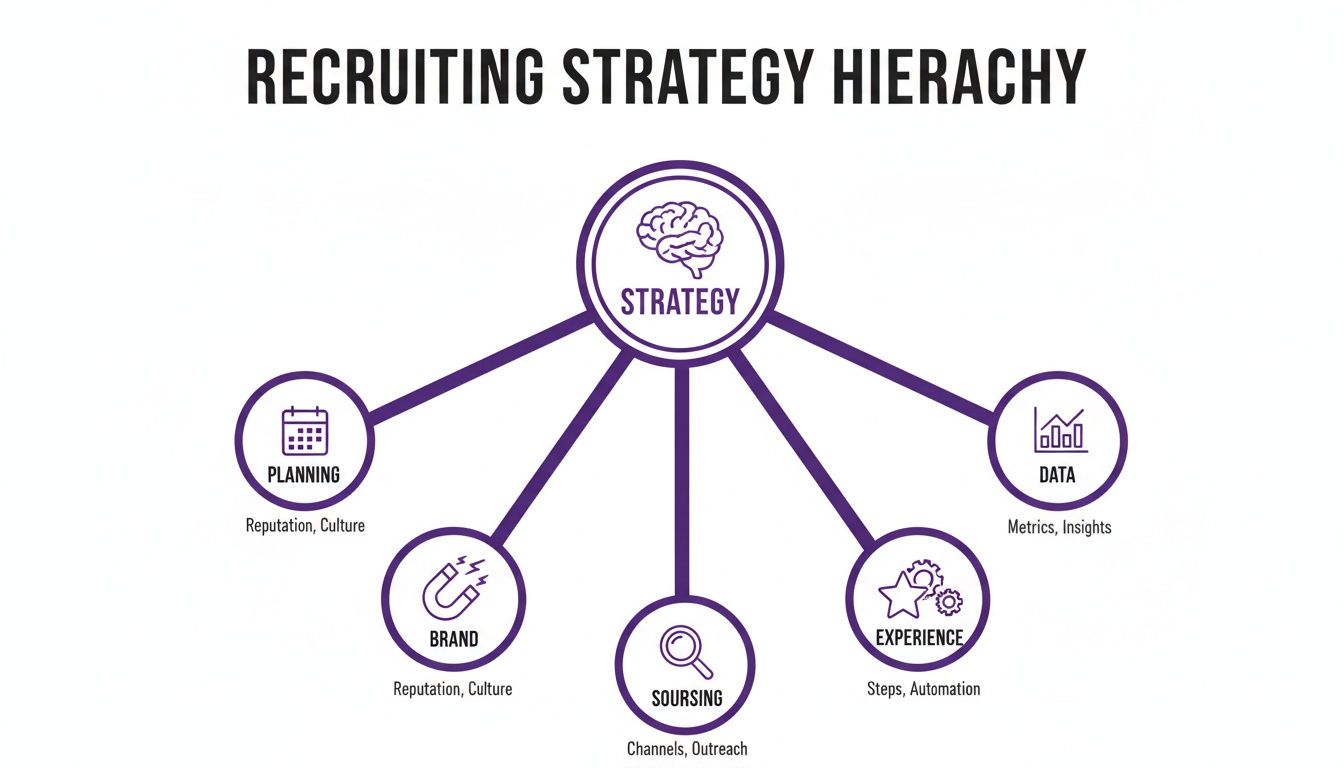
As the diagram shows, a solid plan requires balancing everything from your brand and sourcing channels to the candidate experience and the data you track. It all has to point toward the same strategic goal.
Ready to get started? You don't need a massive international expansion plan. Just a few smart moves.
By turning geography from a limitation into your greatest competitive edge, you can build a world-class team that your locally-focused competitors simply can't match.
A modern recruiting strategy runs on data, not gut feelings. Moving away from guesswork turns hiring from a reactive art into a predictive science, giving you a clear competitive advantage.
This isn’t about drowning in spreadsheets or tracking vanity metrics like résumé volume. It’s about using real analytics to answer the most important questions your team faces. Questions like: Where do our best long-term hires actually come from? and What is the real health of our diversity pipeline?
You might think that deep data analysis is a luxury reserved for huge enterprises with dedicated analytics teams. But why would that be true? Modern platforms have made these insights accessible to teams of any size. For instance, Ramp used Juicebox's talent analytics to discover that top engineers from fintech scale-ups were their best hires, allowing them to focus their sourcing efforts and hire critical roles 5x faster.
The first step is knowing what to measure. Too many teams get stuck tracking metrics that look impressive on a slide deck but don’t actually move the needle.
Here’s the difference:
Focusing on actionable data turns recruiters into strategic advisors. Instead of just reporting on activity, they can use concrete evidence to guide smarter, faster, and more equitable hiring decisions. To learn more about this approach, explore our complete guide on data-driven recruitment.
To build a solid data framework, you need to connect your recruiting efforts directly to business outcomes. Ditch the clutter and focus on these three core areas.
1. Sourcing Channel Effectiveness: The goal here isn't just to see which channel sends the most résumés, but which one delivers the best results. Track metrics like interview-to-offer ratio and quality of hire for each source (e.g., LinkedIn, employee referrals, niche job boards). This data will reveal your hidden-gem channels and stop you from wasting money on sources that only generate noise.
2. Funnel Health and Conversion Rates: Analyze the conversion rates between each stage of your hiring process. A big drop-off at a particular stage is a huge red flag. For instance, if you see lots of diverse candidates applying but few making it past the initial screen, it could signal unconscious bias in your screening process that needs to be fixed immediately.
3. Quality of Hire: This is the ultimate metric for any recruiting strategy. It measures the long-term value a new hire brings to the company, usually based on performance reviews, promotion velocity, and retention rates. While it takes longer to measure, it’s the most accurate indicator of whether your hiring process is actually working.
Fact: A well-executed recruiting strategy is a company's single greatest competitive advantage.
A brilliant recruiting strategy on paper is useless if you can't actually execute it. Think of your strategy as the blueprint for a race car—it's nothing without the engine. This is where modern recruiting technology comes in, acting as a force multiplier that connects your plan to real-world results at a speed that was impossible just a few years ago.
Tools like AI sourcing, autonomous recruiting agents, and multi-source search are what bring your strategy to life. They’re designed to elevate recruiters from manual operators grinding away on tedious tasks to strategic closers who spend their time building relationships.

The traditional way of sourcing is a painful grind. We've all been there: spending hours crafting complex Boolean strings, sifting through endless LinkedIn profiles, and then manually hunting for contact info. But what if you could automate that entire top-of-funnel process?
Instead of burning a full day just to find a handful of qualified candidates, you can get the same (or better) results in minutes. This isn't a small change; it allows recruiters to shift 90% of their time away from low-value sourcing and into high-value human connection—pitching candidates, telling your company's story, and closing roles.
You might think that adopting this level of automation is complicated or requires a dedicated tech team to set up. It’s actually the opposite. The whole point of these tools is to simplify your life, not add another layer of complexity.
Let’s walk through a real-world scenario. A single recruiter needs to find 50 qualified senior software engineers who have experience with both Python and distributed systems. The catch? They also need to have worked at a high-growth, VC-backed startup.
Doing this the old way would eat up an entire day. With an AI-native platform like PeopleGPT, the process is radically different.
A recruiter just types a simple, natural language prompt:
"Find me senior software engineers in the US with 5+ years of Python experience who have worked on distributed systems at a Series B+ startup. Prioritize candidates from top CS programs who have shown career progression."
That single sentence triggers a powerful multi-source search across 30+ platforms. In seconds, it delivers a ranked list of qualified candidates, complete with verified contact information. This workflow helps find talent missed by Indeed alternatives.
This isn't just a theoretical speed boost; it delivers a direct business impact. Replit automated this exact workflow to close critical engineering roles 5x faster than their old benchmarks. They automated the top-of-funnel grunt work, freeing their recruiters to do what they do best: engage and close A-players. That's the real, tangible result of a well-executed recruiting strategy powered by AI.
You can learn more about how modern teams are implementing AI for recruitment and transforming their workflows.
The next evolution is already here: the autonomous recruiting agent. Instead of a recruiter manually running a search, they deploy an AI agent that works for them 24/7.
Here’s a quick look at how it works in practice:
This system effectively clones your best sourcer, allowing a small team to achieve the output of a much larger one. It completely transforms the role of a recruiter from someone who hunts for talent to someone who curates a steady stream of warm, inbound conversations with top-tier candidates.
Flexible work is no longer just a perk; it's a core pillar of any competitive recruiting strategy. When you embrace remote or hybrid models, you shatter geographic barriers and dramatically expand your talent pool far beyond the limits of a daily commute.
This shift isn't just some passing trend. It's a fundamental change in how the best companies find and attract talent. Post-COVID, remote job listings tripled as 72% of employers scrambled to overhaul their processes to snag distributed talent (LinkedIn, 2021). You can dig deeper into these global talent acquisition trends to see just how much the landscape has changed.
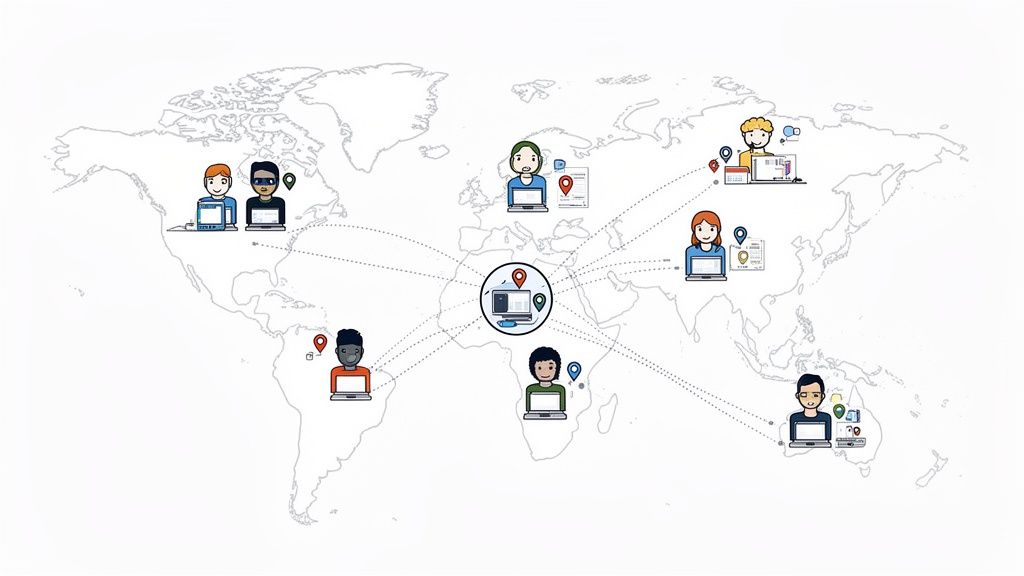
By making your company location-agnostic, you turn a major constraint into a powerful advantage. Suddenly, you're not fighting with every other tech company in your city for the same handful of engineers. You’re tapping into a global market of skilled professionals, a critical component of a modern recruiting strategy.
You might think hiring remotely adds a ton of complexity. The truth? A well-designed remote process forces you to build the kind of structured, equitable system you should have had all along.
The trick is to replace all those informal, in-person cues with deliberate, standardized processes. This ensures every candidate—whether they're down the street or across an ocean—gets the same fair and consistent experience.
Here’s what that looks like in practice:
When you systematize your process, you not only improve fairness but also move a heck of a lot faster. This gives you an edge over slower, less organized competitors. For more ideas on refining your approach, our guide to the streamlined recruitment process has you covered.
Getting the offer signed is only half the battle. A world-class remote onboarding experience is what sets new hires up for long-term success and prevents that dreaded early turnover.
A great onboarding process makes a new team member feel connected and productive from day one, no matter their time zone. It’s your first and best chance to really integrate them into your company culture.
Think of it as building a bridge, not just checking off a list:
By treating remote work as a strategic lever, you connect your hiring directly to what top candidates want most: flexibility and work-life balance. This transforms your work model from a simple policy into a powerful tool for attracting and keeping the best talent on the market.
Quality of Hire is the ultimate metric. It measures a new hire's long-term impact on the business, proving your recruiting strategy delivers A-players.
Review it quarterly and rebuild it annually. This ensures your strategy stays agile and aligned with your company's evolving business goals and market shifts.
Not at all—it's a massive advantage. A simple plan forces you to be intentional about where you find talent, giving you an edge over reactive competitors.
AI automates low-value tasks like sourcing and outreach. This frees up recruiters to focus on high-value work like building relationships and closing top candidates.
A modern recruiting strategy is not about filling jobs faster. It's about systematically building the exact team you need to win your market.
This shift—from reactive firefighting to a proactive, data-driven system—unlocks the true potential of your talent function. Hiring stops being a cost center and becomes your company's most powerful growth engine, consistently landing the A-players who give you a sustainable competitive edge.
{{large_cta}}
Run your first search for free. Find and engage top talent across 800M+ profiles. Trusted by 5,000+ customers.