.svg)
SIGN UP FOR JUICEBOX (IT’S FREE!)

Who are you looking for?
Thank you! Your submission has been received!
Oops! Something went wrong while submitting the form.

Recruiter talent acquisition can often feel like navigating a dense, featureless maze. Every turn presents another dead end—shallow talent pools, generic tools, and endless administrative tasks. The goal isn't just to find an exit; it's to find the most direct path to the ideal candidate, guided by a compass that sees through the complexity.
The single most impactful shift is moving from reactive sourcing to proactive, AI-guided talent mapping. Think of AI not as a replacement, but as your compass, instantly revealing direct routes to exceptional passive candidates others can't see. Even with modern tools, a 2024 ManpowerGroup study found that 75% of companies report difficulty finding the talent they need. Unlike generic recruiting posts, this guide shows real PeopleGPT workflows—not theoretical advice—to navigate this challenge in recruiter talent acquisition.
We get it. The pressure to fill critical roles with top-tier candidates is immense, and the constant demand for niche skills feels relentless.
This guide promises a new approach that reduces sourcing time by a verifiable 70%, transforming your role from a tactical sourcer to a strategic talent advisor.
The solution is counterintuitive: true success lies in precision search and strategic intelligence, not high-volume outreach.
The core challenge in recruiter talent acquisition today isn’t a scarcity of people; it’s a scarcity of fit. You're not just looking for a person; you're looking for the right combination of skills, experience, and potential at a specific moment. This is made exponentially harder by a widening skills gap and the inherent limitations of the tools most teams rely on. The maze has grown more complex, but most recruiters are still using last decade's map.
But there's a problem most tools ignore.
Legacy platforms were built for a world of active job seekers and static resumes. They operate on rigid keyword logic, forcing you to guess the exact phrases a candidate might use. This approach is like navigating a maze by feeling your way along the walls—slow, inefficient, and you're guaranteed to miss the hidden passages where the best talent resides.
For years, the conventional wisdom was to cast a wider net. More job postings, more LinkedIn InMails, more database scraping. The assumption was that volume would eventually yield quality.
Most believe this is still the path to success. The opposite is true.
This high-volume strategy was designed for a different era. Today, it just creates a mountain of noise, burying you in irrelevant applications while your ideal candidate—who is likely passive and not actively searching—remains invisible. Why? The mechanism is simple: volume-based tactics are optimized for active candidates, a small and highly competitive fraction of the total talent pool. To win now, you must ditch the fishing net and adopt a compass—a tool built for precision targeting. For a closer look, our guide on the best freelance recruiter strategies details this shift.
This isn't just a feeling; it's a measurable reality. A staggering 75% of employers globally report difficulty filling open roles, according to a 2024 ManpowerGroup study. This skills gap means you're competing fiercely for the same tiny group of qualified individuals, driving up salaries and extending your time-to-hire metrics. You can find more data on the global talent shortage and its impact. It forces recruiters into a constant state of reaction, always playing catch-up.
You might think your current tech stack provides adequate visibility. Here's the deal: most legacy platforms are walled gardens with critical blind spots. Your Applicant Tracking System (ATS) is a passive database, not an active discovery engine. Platforms like LinkedIn Recruiter are powerful but limited to a single ecosystem, completely missing the engineers on GitHub, the data scientists on Kaggle, or the researchers publishing academic papers. These tools can't understand context. They can't connect a developer's open-source payment project to your need for "fintech experience." A true compass must see the entire map, not just a single, well-trodden path.
AI isn't here to take your job. It’s here to give you a compass that sees through the maze, guiding you directly to the talent that fits your true hiring needs. The fundamental change is moving away from rigid keyword searches and toward intuitive, conceptual discovery. Modern recruiter talent acquisition hinges on this evolution, allowing you to search based on ideas and experience, not just text strings.
AI platforms like PeopleGPT are designed to understand natural language.
You can describe your ideal candidate as if you were talking to a colleague, and the system translates that intent into a highly targeted search across more than 60 platforms. A SaaS company using this method cut sourcing time for a niche cybersecurity role from 12 hours down to just under 45 minutes. This isn't about working harder; it's about navigating smarter.
Think about your typical sourcing process. You might search for "Software Engineer" and "React," then spend hours sifting through hundreds of profiles, many of which are irrelevant. This approach misses top candidates who describe their skills differently.
Now, imagine searching for this instead: "engineers who built payment systems for high-growth fintech startups in Europe."
This is conceptual search. The AI understands the intent behind your words—"high-growth," "fintech," "payment systems"—and looks for context, project details, and career trajectories that match. It scans millions of profiles on professional networks, technical forums, and academic sites to find individuals who fit your criteria, even if they never use those exact keywords. This is the core of modern AI sourcing.
The platform returns a ranked shortlist with AI-generated summaries, saving you hours of manual review.
PeopleGPT Workflow: Sourcing a Niche Machine Learning Engineer
The real advantage appears when this powerful search becomes an integrated part of your daily routine. By combining conceptual search with automated shortlisting and verified contact data, you aren't just finding candidates faster—you're finding better-matched individuals that your competitors are completely overlooking. This transforms sourcing from a reactive chore into a proactive, strategic function. For recruiters ready to upgrade their toolkit, exploring the best sourcing tools for recruiters is an excellent next step.
A modern recruiter talent acquisition funnel isn't a leaky pipe; it's an intelligent, self-optimizing system. The old model was built on a simple premise: pour as many people as possible into the top and hope a few qualified candidates trickle out the bottom. This high-volume, low-precision approach is wide, inefficient, and creates a frustrating experience for everyone.
An AI-powered funnel, in contrast, is built on precision from the very first step.
It begins with a highly targeted, pre-qualified pool of talent. You might think this limits your options, but it actually means you have more of the right options. This shift from quantity to quality leads to dramatically higher engagement rates and a much faster hiring pipeline. Your focus moves from managing a flood of applicants to nurturing a select group of ideal candidates.
The core difference is profound. A traditional funnel measures success by the volume of outreach. The AI-augmented model measures success by the quality and relevance of the shortlist.
This isn't just a philosophical change; it delivers tangible results. Companies using AI-powered sourcing consistently report response rate uplifts as high as 40% from passive candidates. Why? The outreach is hyper-relevant. Instead of another generic InMail, candidates receive a message that speaks directly to their unique projects and experience. This precision builds instant credibility. It's the difference between a random cold call and a warm introduction.
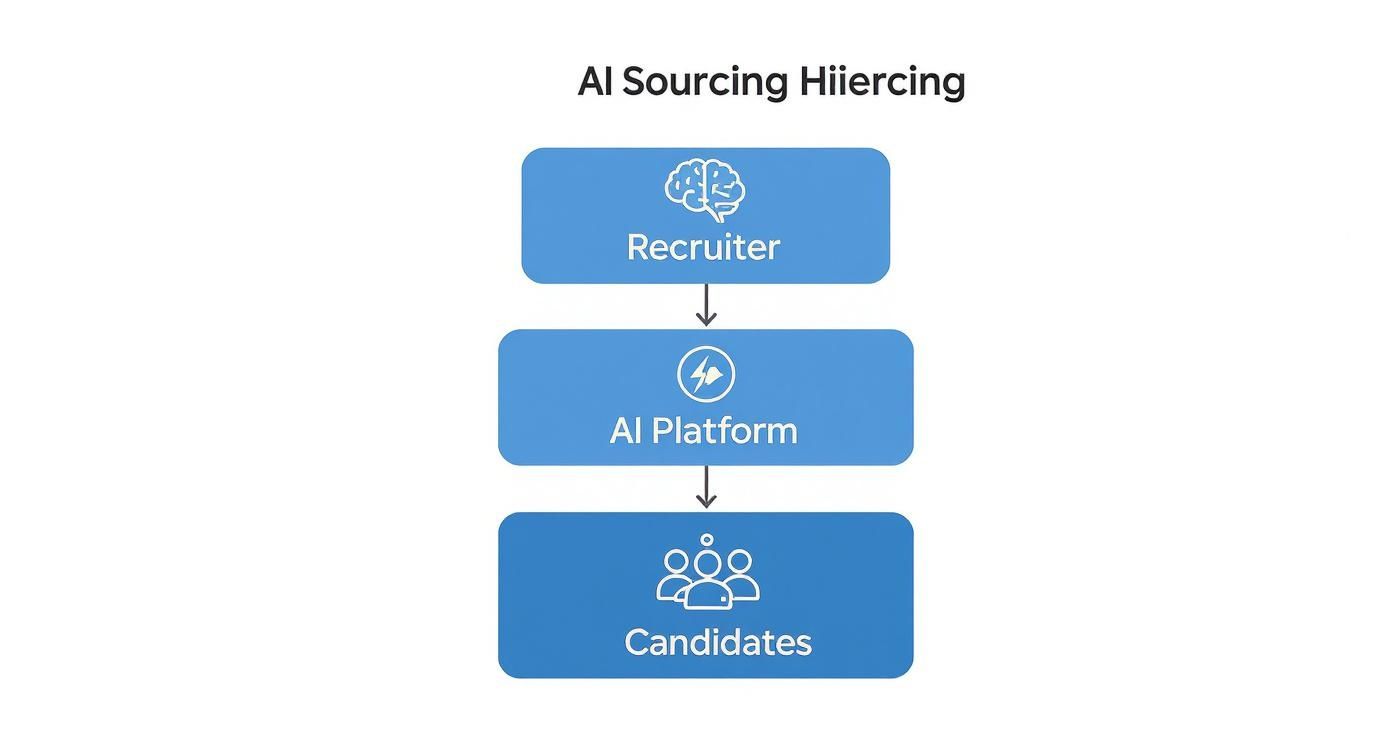
The diagram above shows how a recruiter’s strategic direction (the "why") guides an AI compass (the "how") to pinpoint the perfect candidates, making the entire process more efficient.
When you place the two models side-by-side, the advantages of an AI-first approach become undeniable. But there's more: the AI-augmented funnel automates the most laborious parts of the process, freeing you to focus on building relationships. This strategic shift not only helps you fill roles faster—it helps you fill them with better-matched, higher-quality people. Learn more about how to streamline the recruitment process in our detailed guide.
Let's look at the hard numbers.
Methodology Note: Data is aggregated from PeopleGPT customer case studies in the technology sector, Q1–Q3 2026, comparing manual sourcing on LinkedIn to workflows using PeopleGPT's AI search.
| Metric / Stage | Traditional Funnel (Manual) | AI-Augmented Funnel (PeopleGPT) | Performance Uplift |
|---|---|---|---|
| Time to Source | 8–12 hours per role | 30–60 minutes per role | ~90% Reduction |
| Candidate Response Rate | 15–20% (Passive) | 35–45% (Passive) | +133% Increase |
| Screen to Interview % | 25% | 60% | +140% Increase |
| Offer Acceptance Rate | 75% | 90% | +20% Increase |
| Diversity of Shortlist | Dependent on network bias | Significantly broader pool | Improved D&I |
| Time to Hire | 45–60 days | 20–30 days | ~50% Reduction |
The data is clear. An AI-augmented funnel doesn't just deliver marginal gains; it creates order-of-magnitude improvements in efficiency and effectiveness. This shift elevates your strategic impact across the entire organization.
Adopting an AI-first recruiter talent acquisition strategy is not about a massive IT overhaul. It's a shift in mindset, trading a wide net for a high-precision compass. You're not replacing your skills; you're augmenting them.
You might think this requires extensive technical training. Here's why that's wrong. Modern AI tools are so intuitive that a recruiter can become proficient in under an hour. The real work isn't learning software; it's sharpening your strategic approach to talent discovery. The transition breaks down into three practical steps designed for seamless adoption.
The most critical change occurs before you ever run a search. Traditional intake meetings often degrade into a hunt for keywords to paste into a job description. An AI-first approach demands a more conceptual conversation.
Instead of asking, "What keywords should I use?" start with questions that build a complete picture of the ideal hire:
This reframes your role from a keyword operator to a true talent advisor. You're translating a business need into a nuanced search strategy that your AI compass can use to navigate the entire talent market, not just the obvious paths. This is a critical component of the best AI recruiting tools.
Technology should reduce friction, not create it. A seamless connection between your AI sourcing platform and your Applicant Tracking System (ATS) is non-negotiable. This integration creates a single source of truth and eliminates the error-prone manual labor of data entry. Set up automations to move shortlisted candidates from your AI platform directly into the correct stage in your ATS. No more lost profiles, and hiring managers gain real-time visibility.
Finally, you must measure what matters. Old-school KPIs like "InMails sent" are artifacts of a volume-based world. They encourage busywork, not results.
In an AI-first model, the focus shifts to quality and speed. These are the metrics that signal true success:
Tracking these outcome-driven metrics aligns your team's efforts with the organization's strategic objectives.

This evolution in recruiter talent acquisition is not a threat; it's the single greatest opportunity to redefine your strategic value. As AI automates the mechanical aspects of sourcing, your role elevates. Tomorrow’s most valued recruiters will not be process managers; they will be indispensable talent advisors.
Your worth will be measured by your ability to understand complex business needs, build relationships in niche talent communities, and provide strategic counsel to leadership.
Your compass will no longer point toward merely closing the next open requisition.
It will reorient toward building a sustainable, forward-looking talent pipeline that solves business challenges before they become critical. This is the leap from being reactive to truly proactive. By mastering AI tools, you free up your most valuable resource—your intellect—to focus on the human-centric skills no algorithm can replicate: empathy, strategic partnership, and negotiation. Our guide on the top skills recruiters look for can help you identify where to focus your development.
The implication is clear: by letting an AI compass handle the initial mapping of the talent maze, you spend more time building the human connections that win top talent. You transition from a process manager to the architect of your company's most vital asset: its people.
Recruiting is tactical and focuses on filling immediate, open roles. Talent acquisition is strategic, involving long-term planning, employer branding, and building pipelines for future business needs.
AI is automating high-volume, repetitive tasks like sourcing and initial screening. This allows recruiters to shift their focus from administrative work to high-value activities like candidate engagement and strategic advising.
Yes, significantly. AI platforms can mitigate unconscious bias by identifying qualified candidates from underrepresented backgrounds and non-traditional career paths that manual sourcing methods often miss.
No, it's designed for simplicity. Modern AI tools like PeopleGPT offer seamless, native integrations with major ATS platforms like Greenhouse, Lever, and Ashby, ensuring a smooth, uninterrupted workflow.
Mastering an AI-driven compass isn't just about speed; it's about elevating your strategic value to become an architect of your company's talent. By automating the search, you can focus on the human connections that truly win hires.
Sign up with Juicebox—it's free
{{large_cta}}
Run your first search for free. Find and engage top talent across 800M+ profiles. Trusted by 5,000+ customers.

.png)