.svg)
SIGN UP FOR JUICEBOX (IT’S FREE!)

Who are you looking for?
Thank you! Your submission has been received!
Oops! Something went wrong while submitting the form.

Hiring a recruiter used to be about finding someone who could work a phone and manage a spreadsheet. Today, it’s about finding a strategic partner who can navigate a complex tech stack, leverage AI, and source talent from dozens of platforms beyond LinkedIn. The right recruiter doesn't just fill roles; they build the engine that drives your company's growth.
In this guide, we'll break down the essential recruiter interview questions and answers to help you identify candidates who think in terms of speed, data, and scalability.
There’s a problem most hiring guides ignore. They still focus on outdated metrics and traditional outreach methods. The truth is, the best recruiters now operate more like growth marketers, using tools like AI-powered sourcing platforms to find, verify, and engage candidates in a fraction of the time.
We’ll show you how to spot them and what questions to ask to reveal their true capabilities. Most people believe sourcing is a numbers game; the opposite is true. It’s a precision game, and AI provides thWe'll provide more than just questions; it offers model answers, strategic frameworks like STAR and CAR, and insights into assessing a candidate's comfort with modern sourcing technology.
We’ll cover everything from their high-volume recruiting strategies to their approach for building robust talent pipelines. Let's dive right in:
TL;DR: How to Nail Recruiter Interviews
This foundational question is more than just an icebreaker; it’s a strategic entry point to gauge a candidate's entire recruiting philosophy. It separates recruiters who merely follow a process from those who own and optimize it. For talent acquisition leaders, this is your first chance to see if a candidate thinks in terms of modern, multi-channel sourcing or remains stuck in a single-platform mindset.
When an interviewer asks this, they are probing for several key signals:
A strong answer moves beyond a simple chronological summary. Instead, frame your experience as a solutions-oriented journey. Showcase how you’ve adapted your methods to meet different hiring challenges.
Pro-Tip: Don't just list your past jobs. Tell a story about your evolution as a recruiter. For instance, describe how you transitioned from relying solely on LinkedIn Recruiter to adopting a multi-source strategy with tools like Juicebox to find candidates across diverse platforms like GitHub, Kaggle, and niche professional communities.
Here’s the deal. A great response demonstrates a clear understanding of modern challenges. For example, a TA Director shifting from an expensive tool like SeekOut might listen for a candidate who mentions consolidating data sources to improve both efficiency and budget. An agency sourcer might prioritize a candidate who talks about leveraging AI sourcing agents to generate candidate pipelines autonomously, even outside of working hours. This question sets the stage for all other recruiter interview questions and answers that will follow.
Pattern Interrupt: Most interviews focus on past actions. The best interviews test future adaptability. Ask them to whiteboard a sourcing strategy for a role they've never filled before. This reveals their process for learning, not just their existing knowledge.
This question is a direct test of a recruiter's proactivity, creativity, and technical sourcing acumen. It separates candidates who wait for applications from those who hunt for talent. For hiring managers, the answer reveals whether a recruiter understands modern, multi-source talent discovery or is limited to scanning LinkedIn for active job seekers. It’s a critical differentiator, especially for hard-to-fill roles where the best talent isn't looking.
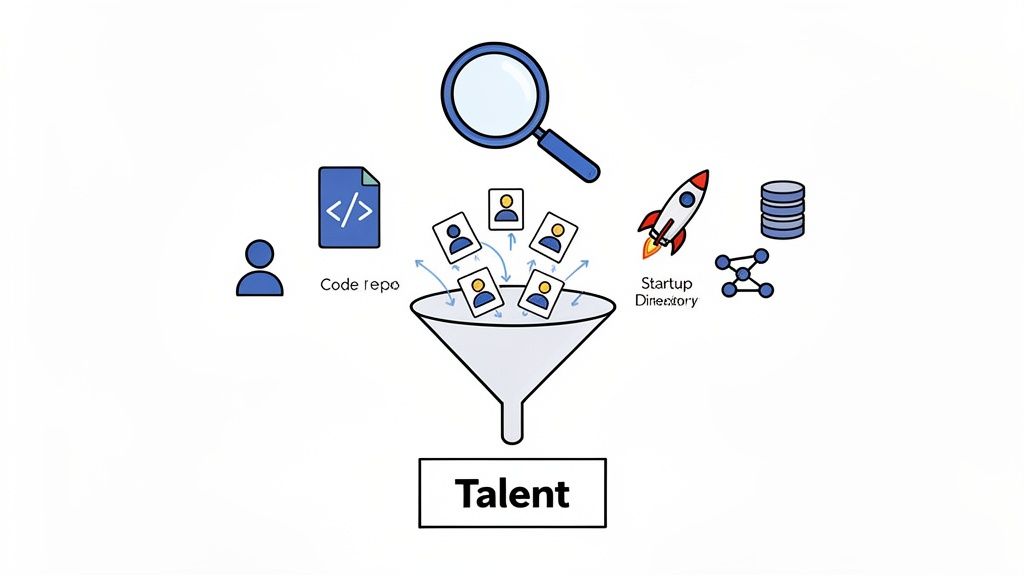
Beyond the surface, the interviewer is trying to understand your sourcing philosophy and technical skills:
A powerful answer demonstrates a strategic, multi-layered approach to finding hidden talent. Frame your response around specific examples where you successfully sourced and engaged a candidate who was not on the market.
Pro-Tip: Don't just list platforms. Explain why you chose them for a specific role. For instance, describe how you used an AI-native tool like Juicebox to find Machine Learning engineers by aggregating profiles from GitHub, Kaggle, and ArXiv, then cross-referenced that data to find verified contact information. This shows you understand that elite talent lives across multiple data sources.
You might be wondering how this works in practice. A top-tier response will also touch on data-driven decision-making. For example, a candidate could mention using Juicebox's DEI benchmarking charts to proactively identify and engage underrepresented talent pools. This signals a sophisticated understanding of how to build diverse, high-quality pipelines. Answering these types of recruiter interview questions and answers effectively requires a deep knowledge of how to engage passive candidates.
This question moves past theory and into the practical, day-to-day reality of a recruiter's workflow. It’s designed to assess a candidate's technical aptitude, their understanding of data integrity, and their ability to operate efficiently within a modern tech stack. For teams managing multiple systems, this reveals whether a candidate will be a seamless addition or a source of process friction.
Beyond a simple list of software, the interviewer is trying to understand:
Frame your response around efficiency and results, not just a list of logos. Explain how you use tools to solve specific recruiting challenges, demonstrating a strategic mindset. Your answer should show that you understand how a well-integrated system amplifies a recruiter's impact.
Pro-Tip: Connect your tool experience directly to the company's stack. For example, if they use Greenhouse, talk about your experience sourcing in a platform like Juicebox and pushing qualified candidates directly into the correct Greenhouse pipeline, eliminating manual data entry. Mentioning how you use built-in sequencers for outreach within the sourcing tool shows you value a consolidated, efficient workflow.
A standout response highlights an understanding of modern, integrated solutions. For a hiring manager using Juicebox, a candidate who talks about leveraging Juicebox Agents to autonomously build and sync candidate pipelines into Lever or Ashby demonstrates forward-thinking and a focus on scalability. This type of answer proves you don't just use tools; you master them to drive key business outcomes. For more context, exploring the features of the best ATS for recruiters can provide deeper insights into what top-tier integration looks like. This technical discussion is a crucial part of the recruiter interview questions and answers process.
Pattern Interrupt: Ask candidates to describe the worst tool they've ever used and why. This reveals their understanding of good UX, workflow efficiency, and what they truly value in a tech stack—far more than asking about their favorites.
This question cuts through the noise of day-to-day recruiting tasks to reveal a candidate's business acumen. It distinguishes recruiters who see their role as a strategic function from those who simply fill seats. You might think focusing on time-to-hire is the best metric, but that often fails. Why? Because a fast hire who leaves in 90 days is a massive net loss. A focus on recruiting metrics like quality of hire is a better indicator.
When a hiring manager asks this, they are looking for a data-driven mindset and a clear understanding of impact. They want to know:
A compelling response goes beyond listing common metrics. It tells a story of using data to solve a specific business problem. Frame your answer around a tangible result you achieved by focusing on the right KPIs. For instance, Gartner found that it takes an average of 42 days to fill a position; a great candidate will explain how they beat that benchmark.
Pro-Tip: Connect your metrics to modern tools. For example, explain how you reduced time-to-hire from 45 days to under 15 by using an AI-sourcing platform like Juicebox to generate a qualified shortlist in 60 seconds. This demonstrates you not only understand the "what" (the KPI) but also the "how" (the technology and process).
Look for this. A standout candidate will quantify their impact. Instead of saying you "improved efficiency," state that you "cut cost-per-hire from $8,000 to $1,500 by replacing a legacy tool like LinkedIn Recruiter with a more cost-effective, AI-driven solution." This type of specific, metric-backed answer is crucial when responding to these kinds of recruiter interview questions and answers.
This question targets a recruiter's operational scalability and strategic mindset. It’s designed to separate candidates who solve problems by adding headcount from those who solve them by leveraging technology and creating efficient systems. For a modern TA leader, the answer reveals whether a candidate can manage demanding pipelines without compromising on the quality of hires.
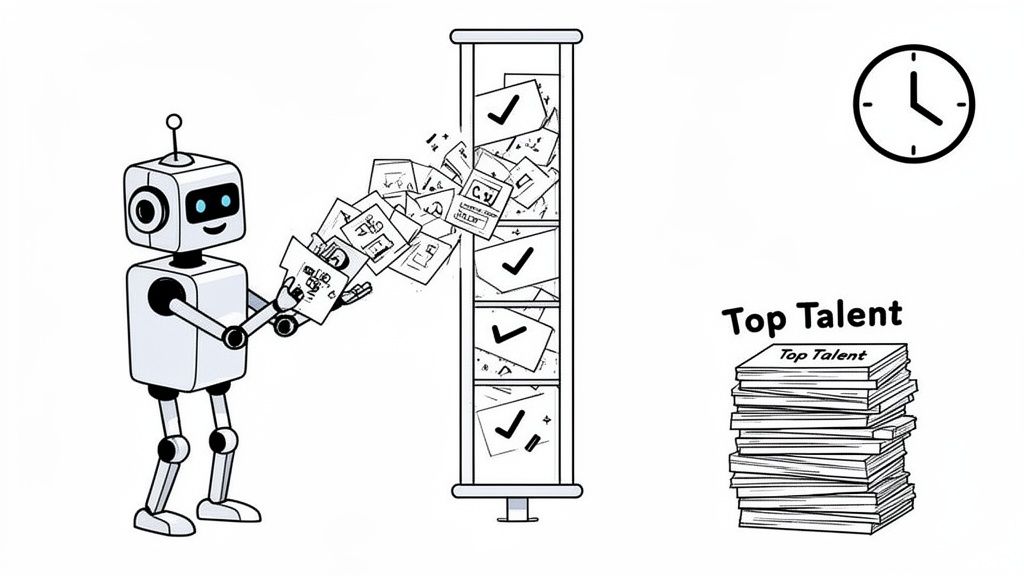
Behind this practical question, the interviewer is assessing several core competencies:
A compelling answer will focus on a clear framework of technology, process, and optimization. Avoid generic responses like "I work harder." Instead, detail the specific systems you use to manage volume while maintaining a high bar for talent. For more advanced approaches, you can learn about modern high-volume recruiting strategies that rely on automation.
Pro-Tip: Frame your answer around the concept of delegation-to-technology. For example, explain how you would use an AI sourcing agent to autonomously generate a pipeline for five engineering roles simultaneously. You could then describe how you'd use your time to vet the AI-scored shortlists, engage top candidates, and manage the interview process, effectively multiplying your output.
A standout response will also touch on feedback loops. For instance, a candidate might mention how they refine their AI agent’s instructions based on hiring manager feedback, continuously improving the quality of sourced candidates over time. This demonstrates a proactive, data-driven approach to one of the most common challenges in recruiting. Discussing this is a great way to showcase your value in any discussion about recruiter interview questions and answers.
Pattern Interrupt: Stop the interview and give the candidate a real-time sourcing challenge: "We need to find 10 qualified data scientists in Austin with experience in Python and AWS. You have 5 minutes. Go." Their immediate actions and tool choices will reveal more than an hour of talk.
This behavioral question is a powerful diagnostic tool. It moves past hypothetical scenarios to assess a candidate's real-world resilience, problem-solving skills, and, most importantly, their capacity for learning. Great recruiters don’t just fill roles; they analyze and iterate on their process, especially after a failure. This question separates those who blame external factors from those who take ownership and refine their strategy.
When a hiring manager poses this question, they are evaluating your professional maturity and analytical abilities. They want to understand:
Use the CAR (Context, Action, Result) or STAR (Situation, Task, Action, Result) method to frame your response. Focus less on the failure itself and more on the diagnosis and the solution you implemented. Acknowledge the failure, dissect the root cause, and explain how you prevented it from happening again.
Pro-Tip: Don't offer a vague story about a "challenging role." Be specific. For instance, describe a time you relied exclusively on LinkedIn for a niche engineering role, resulting in a tiny, unresponsive talent pool. Explain how this failure led you to adopt a multi-channel sourcing strategy, using a tool that aggregates data from platforms like GitHub, academic sites, and specialized communities to find talent where they are most active.
Here’s the key. A compelling answer demonstrates a clear grasp of modern recruiting challenges. For example, a candidate could describe a high-volume search where manual screening created a bottleneck, leading them to champion an AI-powered tool to score and prioritize candidates automatically. This shows an understanding of how technology solves tangible business problems and is a key indicator of a forward-thinking recruiter. Discussing failures in this way is a critical part of answering modern recruiter interview questions and answers effectively.
This question probes a candidate's learning agility and commitment to professional development. The recruiting landscape is shifting rapidly; the decline of traditional Boolean logic and the rise of AI-native platforms means recruiters must be continuous learners. This question separates candidates who are actively shaping the future of talent acquisition from those who are passively waiting for it to happen.
When hiring managers ask this, they are evaluating your forward-thinking capabilities and adaptability:
Frame your answer around a continuous cycle of learning, testing, and implementation. Show that you don't just consume information but actively apply it to improve your recruiting process. Mention specific thought leaders, publications, or communities you follow to demonstrate genuine engagement with the industry.
Pro-Tip: Provide a concrete example of a tool you've recently tested. For instance, describe how you transitioned from relying solely on LinkedIn Recruiter to testing a platform like Juicebox to access a wider, multi-source candidate pool from sites like GitHub and Kaggle. This demonstrates initiative and a data-driven mindset.
A standout answer will touch on emerging technologies. Mentioning your exploration of Juicebox Agents for autonomous 24/7 sourcing or using its Power Filters to proactively build diverse talent pipelines shows you're not just current but ahead of the curve. This is a critical question in a list of recruiter interview questions and answers because it reveals a candidate's potential for future growth.
This question is a stress test of a recruiter's operational discipline. It’s designed to separate candidates who have a structured, repeatable system from those who approach sourcing with random, ad-hoc tactics. For a hiring manager, the answer reveals a candidate's grasp of efficiency, tool integration, and their ability to manage a full-cycle process without letting quality candidates fall through the cracks.
Beyond a simple workflow summary, the interviewer wants to understand your strategic thinking at each stage:
Detail your process stage-by-stage, highlighting how you leverage tools to maximize efficiency and effectiveness. Frame your workflow not just as a series of steps, but as a cohesive system designed to streamline the recruitment process. A well-defined franchise recruitment process offers transferable lessons on creating a repeatable and scalable candidate pipeline.
Pro-Tip: Quantify your process. Instead of saying "I find candidates and then reach out," describe your velocity. For instance, "My goal is to go from job kickoff to a fully sourced, verified, and engaged list of 10 qualified candidates in under an hour. I use Juicebox to consolidate sourcing across platforms like LinkedIn, GitHub, and academic sites, then instantly verify contact data and launch a personalized outreach sequence from the same interface, populating our ATS automatically."
A top-tier response will preemptively address scalability. A candidate might mention using AI sourcing agents to build talent pipelines for multiple roles 24/7, freeing them up to focus on high-value activities like screening and interviewing. This demonstrates a forward-thinking approach to handling increased req loads, making it a critical part of any discussion around recruiter interview questions and answers.
This tactical question moves beyond sourcing to evaluate a candidate's ability to turn a name on a list into an engaged applicant. It probes their communication strategy, copywriting skills, and understanding of candidate psychology. For organizations using modern tools, this is a critical test of whether a recruiter can leverage automation for personalization at scale, rather than just sending generic spam.
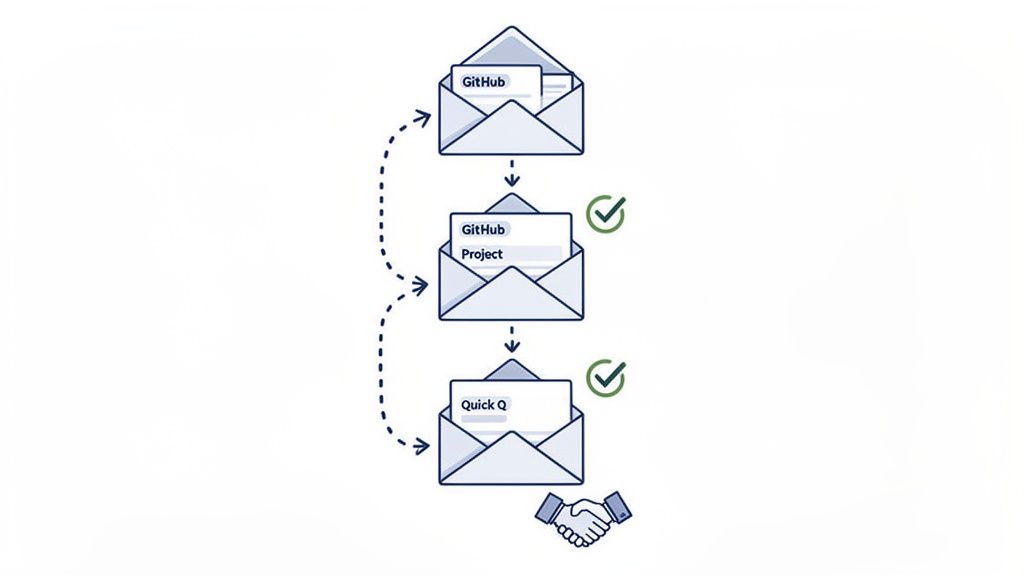
An interviewer asking this question wants to understand your entire engagement funnel:
Structure your answer around a specific campaign or role you filled. Start with the "why" (the role and its challenges), move to the "how" (your strategy and the tools used), and finish with the "what" (the results). This storytelling approach is far more compelling than a generic list of tactics.
Pro-Tip: Demonstrate your understanding of modern outreach by referencing specific, data-driven techniques. For example, explain how you A/B tested subject lines like "Rust opportunity at [Startup]" versus "Quick question about your Rust systems design," noting the latter achieved a higher open rate because it sparked curiosity rather than sounding like a generic recruiter message.
A standout answer will connect outreach strategy directly to platform capabilities. A candidate familiar with tools like Juicebox could explain how they use built-in email verification to maximize deliverability and then deploy a multi-step sequencer. For instance: Touch 1 (personalized intro based on a GitHub project), Touch 2 (follow-up with a link to a relevant company tech blog), and Touch 3 (a final, brief check-in). This shows you not only know the strategy but also how to execute it efficiently. This is one of the most practical recruiter interview questions and answers because it reveals a candidate's day-to-day executional skill.
This is a critical question that separates reactive, order-taking recruiters from strategic talent advisors. An interviewer asks this to see if you think ahead, understand talent market dynamics, and can build relationships that pay dividends months or even years down the line. It's about proactive sourcing versus just-in-time hiring, a key differentiator in competitive markets.
Beyond the surface-level query, the hiring manager wants to uncover your strategic capabilities:
Frame your response around a systematic, technology-enabled process. Show that you don't just collect names but actively cultivate a community of qualified, engaged talent. A powerful answer connects pipelining directly to core business metrics like hiring velocity and quality.
Pro-Tip: Detail your methodology. For example, explain how you use AI-powered tools like Juicebox Agents to run autonomous, 24/7 sourcing campaigns for evergreen roles like backend engineers. You can describe setting up an agent to continuously find and qualify new talent, adding 5-10 'warm' candidates to your pipeline each week, effectively building your bench before the need arises.
Show you understand the importance of market intelligence. A great answer would mention using a tool's Talent Insights to identify talent hotspots, such as specific companies known for strong engineering culture, and then building a targeted pipeline from that data. Discussing how you build and manage these relationships is key to excelling at modern candidate relationship management and a crucial part of answering these types of recruiter interview questions and answers.
What's the biggest red flag in a recruiter interview?An inability to discuss metrics or data. Top recruiters track outreach response rates and pass-through rates and speak to their performance quantitatively.
How important is experience with specific AI sourcing tools?Less about one tool, more about the mindset. A great candidate shows curiosity and a history of quickly adopting new tech to improve their workflow.
Should I prioritize agency or in-house recruiting experience?It depends. Agency experience builds resilience and sourcing skills, while in-house experience develops stakeholder management and strategic abilities.
How do you answer "Why do you want to work here?"Connect your skills to their challenges. Research their recent hires, funding, or product launches and explain how your recruiting expertise can help them grow.
The core benefit of mastering these questions isn't just hiring another recruiter; it's about onboarding a strategic partner who builds a scalable, data-driven talent engine. This unlocks the ability to hire faster, smarter, and more cost-effectively than your competitors, turning talent acquisition into a true competitive advantage.
{{large_cta}}
Run your first search for free. Find and engage top talent across 800M+ profiles. Trusted by 5,000+ customers.



.png)