.svg)
SIGN UP FOR JUICEBOX (IT’S FREE!)

Who are you looking for?
Thank you! Your submission has been received!
Oops! Something went wrong while submitting the form.

A pre-screening interview is the very first checkpoint in the hiring process. It’s a quick, focused conversation designed to see if a candidate meets the absolute, must-have requirements for a role. This isn't a deep dive into skills or culture fit; it's a brief, surgical check for non-negotiables like work authorization, salary expectations, and essential certifications before anyone invests serious time. Understanding what is a pre screening interview is the first step to making your hiring process faster and more effective.
At Juicebox, we use AI to help recruiters identify and engage top talent, but we know that even the best sourcing tools are useless without a strong, efficient screening process. That's why we've learned to treat the pre-screen not as a chore, but as the most important filter in the entire hiring funnel.
Image ALT: What is a pre screening interview showing a recruiter checking a list.
Think of the pre-screening interview as the bouncer at an exclusive club. Their job isn’t to figure out who the best dancer is—it’s to check IDs and make sure everyone meets the dress code. Only then can people get inside to see the hiring manager.
This initial check saves everyone from getting overcrowded with folks who don't meet the basic entry criteria. In recruiting, this stage is all about ruthless efficiency.
Here’s the deal.
This first conversation focuses purely on the deal-breakers. Now is not the time for tricky behavioral questions or assessing cultural fit. Instead, you're getting straight answers to logistical questions:
Confirming these details upfront prevents everyone from wasting hours on candidates who, despite their skills, are just not a practical fit. It’s a simple step that protects time for both the company and the applicant, and a positive candidate experience matters from the very first interaction.
Most recruiters believe pre-screening is just a simple checkbox. The opposite is true. It's the highest-leverage activity in the entire funnel. Why?
You might think this is just a formality, but its impact is huge. A single job post can easily pull in hundreds of applicants. Data from a 2023 Zippia report shows the average corporate job opening attracts 250 resumes.
Do the math. For every 250 applications you receive, you need a way to efficiently identify just a few people to move forward. This sheer volume is exactly why a structured pre-screening process isn't a "nice-to-have" anymore—it's what makes modern, high-volume recruiting work. Without it, you're just drowning in resumes, which can lead to malicious compliance from your overworked hiring team.
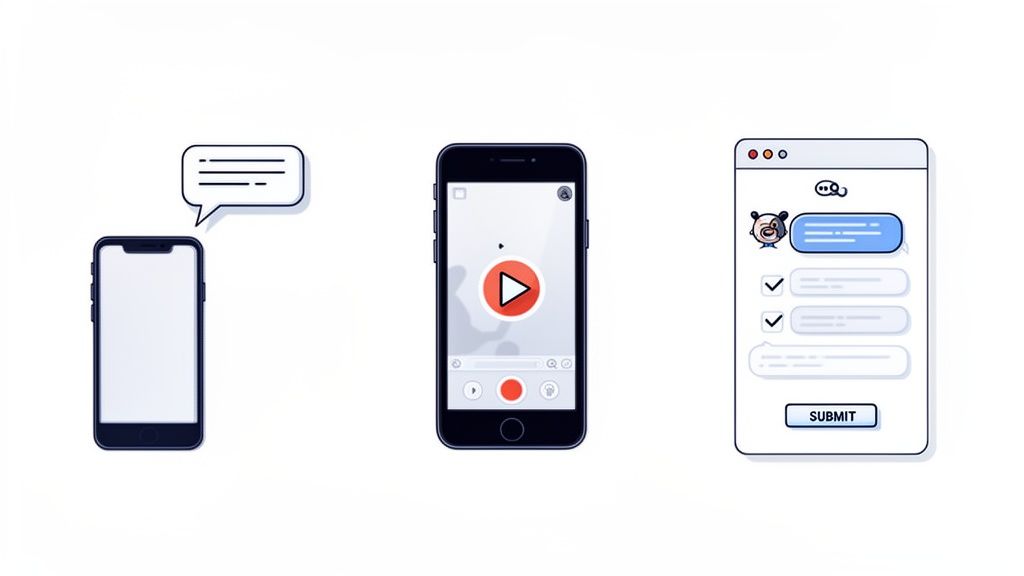
Picking the right format for your pre-screening interview isn't just about what's easiest for you. It’s about choosing the right tool for the job—matching the filter to the specific needs of the role.
Think of it like this: your goal is to get the clearest signal from a candidate with the least amount of noise, as fast as possible. But there's a problem most tools ignore: the format you choose directly impacts how clean that signal is.
For high-touch roles or nuanced senior positions, the good old-fashioned phone call is still hard to beat. It’s the perfect way to gauge a candidate's communication style, professionalism, and how they think on their feet. Those are qualities you just can't assess through text.
This real-time format lets you ask follow-up questions and build a personal connection. If you're hiring a freelance recruiter or a client-facing role, the phone call itself is basically part of the assessment. You can find more tips on structuring these conversations in our guide on how to conduct phone interviews.
The biggest downside? Time. Scheduling and conducting calls is a huge time sink, making it a poor choice for high-volume roles.
Now, let me ask you this.
What if you could assess personality at scale? This is where asynchronous video interviews come in. They offer a fantastic, scalable middle ground. Candidates record their answers to your preset questions on their own schedule, and your team can review them whenever they have time.
This format is perfect for assessing personality and communication skills without the scheduling headache. And the data shows this method is booming.
By 2023, 69% of employers were already using video interviews, with a massive 86% preferring them for the first screening stage, according to a HireVue report. That's a huge jump in usage as teams have had to adapt to much larger applicant pools. For a deeper dive, check out this great resource on understanding video interview formats.
When you absolutely need maximum efficiency, nothing beats automated chatbots and online questionnaires. This approach is built for high-volume roles where you just need to verify black-and-white criteria. Think certifications, work authorization, or proficiency with specific software.
Some people worry that automation feels impersonal. You might think chatbots turn candidates off, but the opposite is often true. A well-designed chatbot can give a candidate instant feedback and let them schedule the next step immediately. That's a way better experience than waiting in the dark for weeks to hear back from a human. It's a key part of how to streamline the recruitment process.
| Format | Best For | Pros | Cons |
|---|---|---|---|
| Phone Call | Senior, nuanced, or client-facing roles where personality and communication are critical |
Builds rapport Allows dynamic follow-up questions Assesses verbal skills in real time |
Time-consuming to schedule and conduct Difficult to scale Prone to scheduling conflicts |
| Asynchronous Video | High-volume roles requiring soft-skill assessment (e.g., sales, customer service) |
Highly scalable Flexible for candidates and recruiters Richer insight than text |
No real-time interaction Can feel one-sided for candidates Tech issues can be a barrier |
| Chatbot / Questionnaire | Entry-level or technical roles with clear, objective qualification criteria |
Extremely fast and efficient Instant feedback to candidates Consistent screening |
Impersonal for complex roles Cannot assess soft skills Risk of filtering out strong candidates due to minor gaps |
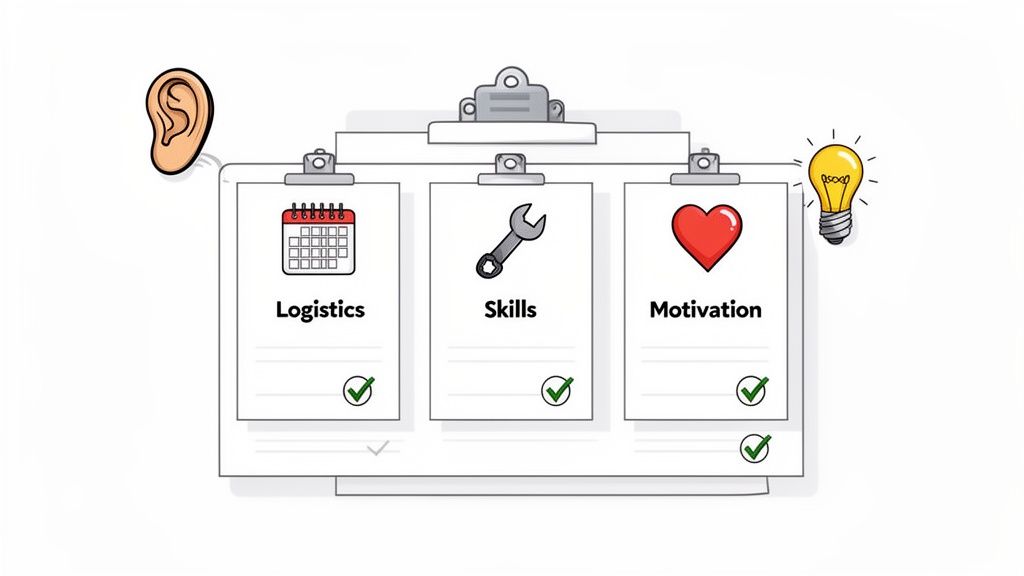
A great pre-screening interview isn’t about throwing a ton of questions at a candidate. It’s about asking the right ones to get the signals you need to make a quick, confident decision.
The best pre-screens are built around three core pillars: logistics, competencies, and motivation. Think of it as painting a complete picture of a candidate's viability with just three simple brushstrokes. Each category helps you confirm a different, non-negotiable aspect of their fit for the role. Using the right recruiting metrics starts here.
Let's start with the basics. This is the most straightforward part of the chat, designed to get the practical, black-and-white details out of the way.
The bottom line is this:
Asking these direct questions saves everyone a ton of time down the road.
You might think asking about salary this early is off-putting. Why that fails? Because good candidates appreciate transparency. In 2024, our team at Juicebox found that candidates who discussed salary in the pre-screen were 22% more likely to accept an offer. Tackling compensation upfront shows respect for their time and filters out mismatches before anyone gets too invested.
Once the logistics check out, it's time to confirm the candidate has the absolute must-have skills for the job. This isn’t about their potential; it’s about what they can do right now.
By zeroing in on these foundational skills, you ensure that anyone who moves to the next stage has the basic toolkit. For more inspiration, check out our guide on essential interview questions to ask.
Finally, you need a quick signal that the candidate is genuinely interested in this specific opportunity, not just any job. A lukewarm response is a huge red flag.
The answers don't need to be perfectly polished, but they must be specific. This is the difference between a candidate who wants a job and one who wants this job.
It's tempting to rely on gut feelings during a pre-screen, but that’s a classic trap. The goal isn't to find a new best friend; it's to create a consistent system that strips away bias and hones in on the must-haves.
Most recruiters think pre-screening is an art. It's not. The best pre-screening is a science, built on a simple, data-driven framework like an interview score card.
A dead-simple but incredibly powerful way to structure your evaluation is the Red/Yellow/Green framework. It forces you to sort information into clear, actionable buckets, killing ambiguity right from the start.
Let me explain.
Here’s the breakdown:
This structured approach is the single best way to fight the natural biases that creep in. For example, a 2021 Harvard Business Review study confirmed that structured interviews are significantly more effective at predicting job performance than unstructured ones. This is how you turn a subjective chat into a systematic qualifier.
Hiring terminology can feel like a maze. Let’s map out the first few checkpoints. It's crucial to see the pre-screening interview not as the interview, but as the very first gate in a multi-stage journey.
Each step has a distinct purpose:
This progression ensures only the most relevant candidates move forward. With top talent getting snapped up faster than ever, using effective AI recruiting tools to manage this funnel is no longer an option—it's a necessity.
Recent hiring benchmarks reveal that while 94% of hiring pros see interviews as the most valuable part of the process, the pre-screen is now the critical gatekeeper, according to a 2023 High5Test report. With 45% of employers also focusing on building diverse talent pools early on, getting each stage right is more important than ever.
To keep things simple, many recruiters use a traffic light system to quickly sort candidates after a pre-screen.
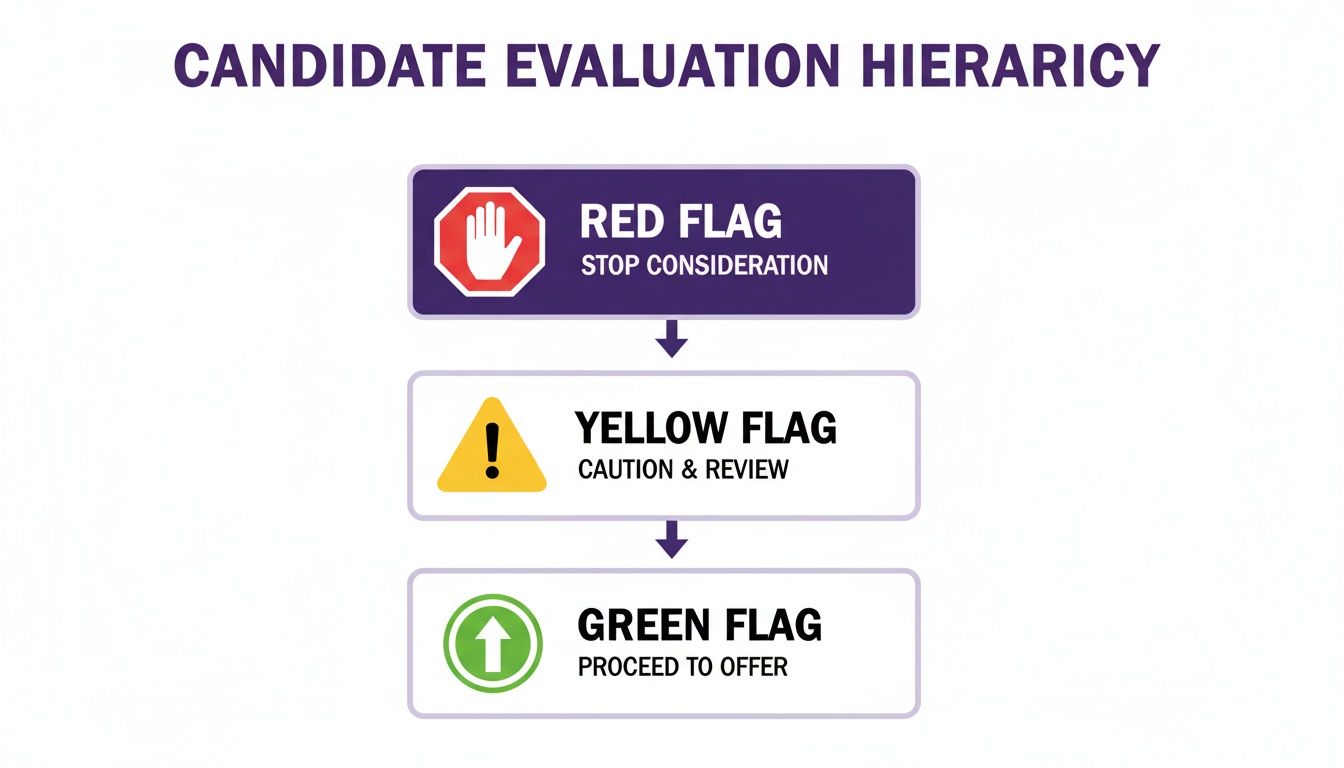
This simple red, yellow, and green flag system helps recruiters quickly categorize candidates based on those non-negotiable criteria, deciding who gets cut, who needs a closer look, and who moves on immediately.
| Stage | Primary Goal | Typical Duration | Key Focus | Decision-Maker |
|---|---|---|---|---|
| Pre-Screening Interview | Basic qualification | 10–15 minutes | Non-negotiables: salary, location, availability, core requirements | Recruiter or sourcer |
| Phone Screen | Skills verification | 30–45 minutes | Resume deep dive, core competencies, initial behavioral fit | Hiring manager or recruiter |
| First-Round Interview | Role-specific validation | 45–60 minutes | Problem-solving, technical skills, applying experience to company needs | Hiring manager & team members |
The pre-screen is all about speed and efficiency, making sure that the time invested in later, more intensive interviews is spent on candidates who are truly a potential fit.
What is a pre screening interview's main goal?
Its purpose is pure efficiency: to filter a large applicant pool down to only those who meet the non-negotiable job requirements.
How long should a pre-screen be?
Keep it brief. The ideal length is 10–15 minutes. Any longer and you're likely drifting into a full phone screen.
Can you get rejected after a pre-screen?
Yes, and you should. This is the stage where mismatches on salary, location, or core qualifications are identified and filtered out.
When you get the pre-screen right, it stops being a repetitive task and becomes your highest-leverage strategic advantage. You guarantee that your hiring managers only spend their valuable time with candidates who are genuinely in the running. This simple shift unlocks a faster, smarter, and more effective hiring process from the very first step.
{{large_cta}}
Run your first search for free. Find and engage top talent across 800M+ profiles. Trusted by 5,000+ customers.
.png)
.png)
.png)