.svg)
SIGN UP FOR JUICEBOX (IT’S FREE!)

Who are you looking for?
Thank you! Your submission has been received!
Oops! Something went wrong while submitting the form.

A performance review is supposed to be a formal check-in where managers evaluate an employee’s work, highlight what’s going well, and set goals for the future.
But for fast-moving startups, the traditional annual review feels less like a development tool and more like a dreaded obligation.
In this guide, we'll offer a lightweight, data-driven framework built for the unique pressures of tech startups, connecting effective reviews directly to smarter talent planning and hiring.
TL;DR: Performance Review Guide
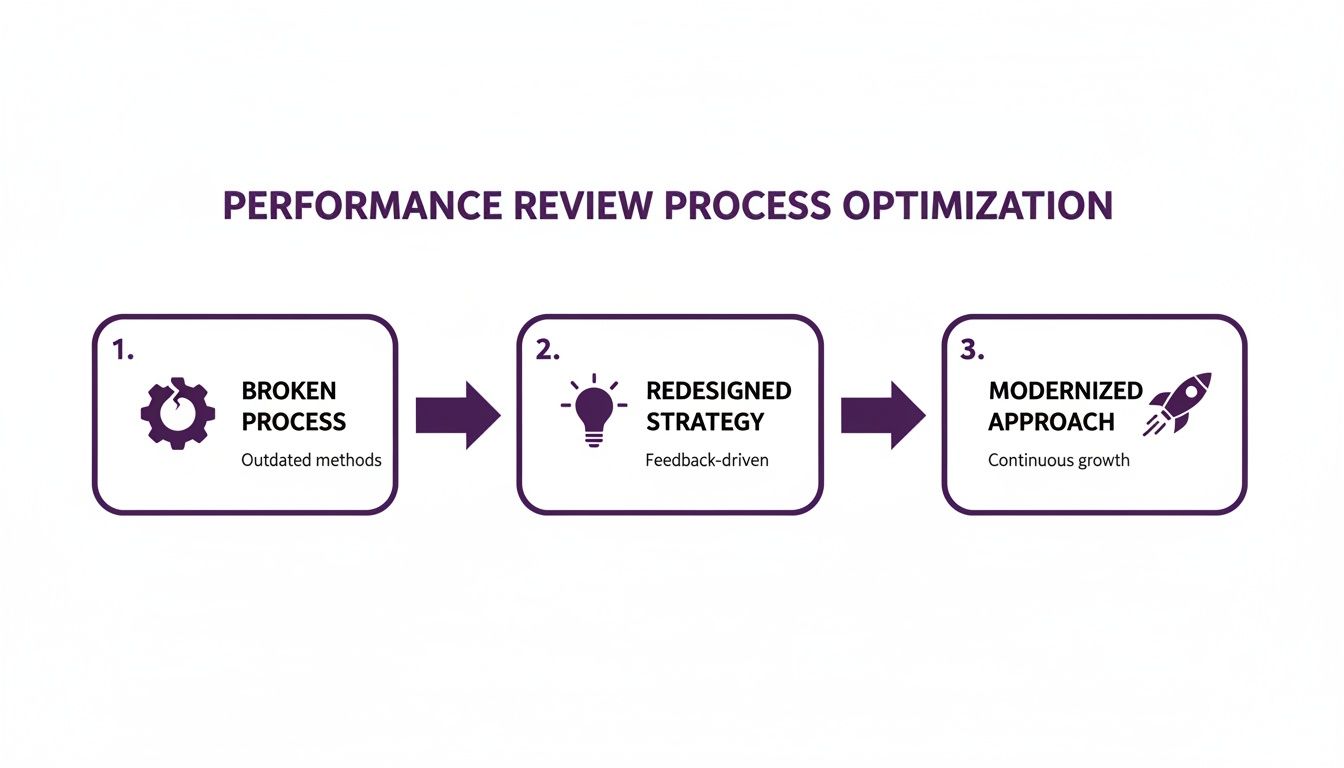
Let’s be honest. The traditional performance review process is fundamentally broken, especially in a startup environment. Too many companies think that small tweaks—like changing a rating scale from 1-5 to 1-4 or updating a form—have fixed a flawed system.
They haven’t. These minor adjustments are like putting a bandage on a broken bone; they completely ignore the underlying issue.
The core problem? The annual review is a backward-looking judgment, not a forward-looking growth engine. It creates a culture of anxiety where employees brace for criticism and managers scramble to recall wins and losses from months ago. This misalignment wastes countless hours and slowly erodes trust between managers and their teams.
Most people believe the stuffy, formal annual review is a relic of the past. The opposite is true.
Between 2019 and 2023, performance reviews were constantly being redesigned, with 80–88% of organizations overhauling their approach in some way. But here's the catch those redesigns missed.
The fundamental mechanics barely changed. The 2023 Global Performance Management Report found that about 90% of companies still use numeric ratings, the 5-point scale remains dominant, and 94% maintain an annual or semi-annual cadence. Despite all the talk of change, the same old subjective systems persist. You can dig into the specifics in the full performance management report. This shows a massive gap between good intentions and actual impact.
Quick Question: Is your review process a growth engine or a judgment machine?
Shifting from a judgmental review to a developmental conversation requires a completely new playbook. It’s all about moving away from a single, high-stakes annual meeting and toward a system of continuous feedback and alignment.
Here’s the bottom line.
This new approach transforms the performance review from a dreaded administrative task into a strategic tool that unlocks measurable gains in team productivity and retention. It’s built on a few core ideas:
By adopting this mindset, startups can create a culture where feedback is seen as a gift, not a threat—and that’s crucial for building resilient teams that can navigate the chaos of scaling. Once you identify high-potential employees, you can streamline your recruitment process to find more of them.
To put this shift into perspective, it helps to see the old and new approaches side-by-side. The traditional model is rooted in infrequent, backward-looking evaluation, while the modern framework is all about continuous, forward-looking development. This table breaks down the core differences.
| Component | Traditional Approach (To Avoid) | Modern Approach (To Implement) |
|---|---|---|
| Cadence | Annual or semi-annual, high-stakes events. | Quarterly check-ins with continuous, real-time feedback. |
| Focus | Backward-looking; focuses on past mistakes and ratings. | Forward-looking; emphasizes growth, goals, and skill development. |
| Tone | Judgmental and evaluative; manager-led monologue. | Collaborative and developmental; a two-way dialogue. |
| Data Source | Manager’s memory and subjective impressions. | Objective data from tools, peer feedback, and shared goal progress (OKRs). |
| Outcome | A single performance rating and compensation decision. | A clear development plan and stronger manager-employee alignment. |
| Goal | To justify compensation and rank employees. | To accelerate growth, boost engagement, and retain top talent. |
Ultimately, the modern approach isn't just a process change; it's a cultural one. It builds a foundation of trust where people feel supported to take risks, learn from failures, and grow their careers within your company.
A great performance review doesn’t just happen. It doesn't start when the meeting invite lands in someone's inbox. The real work begins weeks, sometimes even months, before anyone sits down to talk.
Success is all about what you do before the conversation. The old-school approach—saving up a year's worth of feedback for one high-stakes meeting—is broken. It’s a surefire way to kill morale and create anxiety.
What's the alternative? Shift from a once-a-year scramble to a rhythm of continuous preparation. This means grounding the entire review in objective data and shared context, not just fuzzy feelings or what happened last Tuesday.
Every fair and effective performance review is built on a foundation of clarity. If people don’t know what success looks like, how can you expect them to hit the mark? This is where measurable goals are non-negotiable.
Most startups think they set clear goals, but what I often see are vague intentions. "Improve code quality" or "increase sourcing speed" sound good, but they're not goals. They’re wishes.
Real goals are measurable. Frameworks like Objectives and Key Results (OKRs) are perfect for this.
See the difference? These metrics strip out the guesswork and anchor the entire review process in tangible outcomes. This level of clarity is also crucial when evaluating potential hires against your top recruiting metrics.
"I don't have time to track all this." I hear this from managers all the time. But here's the reality: this small, upfront investment saves you countless hours of painful recall later. Without a system, you're forced to rely on memory, which is notoriously biased.
This is why a simple 'performance data portfolio' is so powerful.
It's nothing complicated. Think of it as a running log of achievements, metrics, and feedback gathered over the review period. It can be a shared Google Doc, a project in Asana, or even a dedicated Slack channel.
So, what goes in it?
This isn't about micromanagement. It's about co-creating a single source of truth. By the time the formal review rolls around, both the manager and the employee have a rich, evidence-based record to pull from. This kind of continuous feedback culture, often championed by a strategic Chief People Officer, is what separates good companies from great ones.
Before you, the manager, write a single word of your review, the employee needs to complete a self-assessment. Don't treat this as a bureaucratic checkbox. It's a powerful tool for reflection and, just as importantly, for alignment.
But there’s a problem most self-assessments ignore.
They don't force employees to connect their work to business impact. A good self-assessment forces the employee to think critically about their own performance against their goals. It also surfaces disconnects early. If an employee rates their performance on a project as "Exceeds Expectations" but you saw it as a struggle, that's a perception gap you need to talk about. Top leaders from Netflix to Google use this exact technique to make sure the review is a genuine two-way conversation.
Your self-assessment template should ask direct questions like:
By getting this input first, you can write a more comprehensive, empathetic, and accurate evaluation. It transforms the performance review from a top-down verdict into a collaborative dialogue.
You’ve done the prep work. Now for the main event: the actual performance review conversation. This is the moment where all that feedback turns into real action.
Forget the stiff, one-sided monologues that pass for reviews in most places. The goal here is a genuine dialogue that sparks growth, not defensiveness.
But you can't just wing it. Relying on improvisation is a recipe for a conversation that gets sidetracked by emotion or random tangents. One of the best frameworks I've seen is the Past-Present-Future model. It gives the entire meeting a clear, logical flow.
This structure anchors the conversation in facts, connects those facts to what's happening now, and then pivots toward what comes next. It keeps the discussion constructive and forward-looking, even when you have to tackle tough topics.
Heads Up: The next three sections are a script. Follow it to make even difficult feedback feel constructive.
Always kick off the conversation by looking at past performance. You'll want to pull directly from the 'performance data portfolio' and the self-assessment you’ve both already worked on. This isn't about re-litigating old projects; it's about getting on the same page about the facts.
The trick is to use evidence, not opinions.
See the difference? This approach grounds the discussion in objective reality, which makes it much harder for defensiveness to creep in. It shifts the dynamic from an accusation to a collaborative look at the data. When you give employees a chance to add their own context, it builds trust and makes the feedback feel much more fair. For more on getting this self-reflection right, check out these helpful self-evaluation examples.
Once you’ve established a shared view of the past, the conversation naturally flows to the present. This is where you connect those past actions to their current impact—on the team, the product, or the company's bottom line. You're basically answering the "So what?" question.
For positive feedback, this is your chance to highlight the ripple effects of their great work. For example, "Because you shipped the new onboarding flow two weeks early, we saw a 15% lift in user activation last month. That was a huge win for the whole product team."
When giving constructive feedback, the focus is on the real challenges their performance created. You might say, "Because the bug fix for the payments API was delayed, the customer success team had to manually process 30+ support tickets, which pulled them away from their core projects." This frames the problem around business impact, not personal failure.
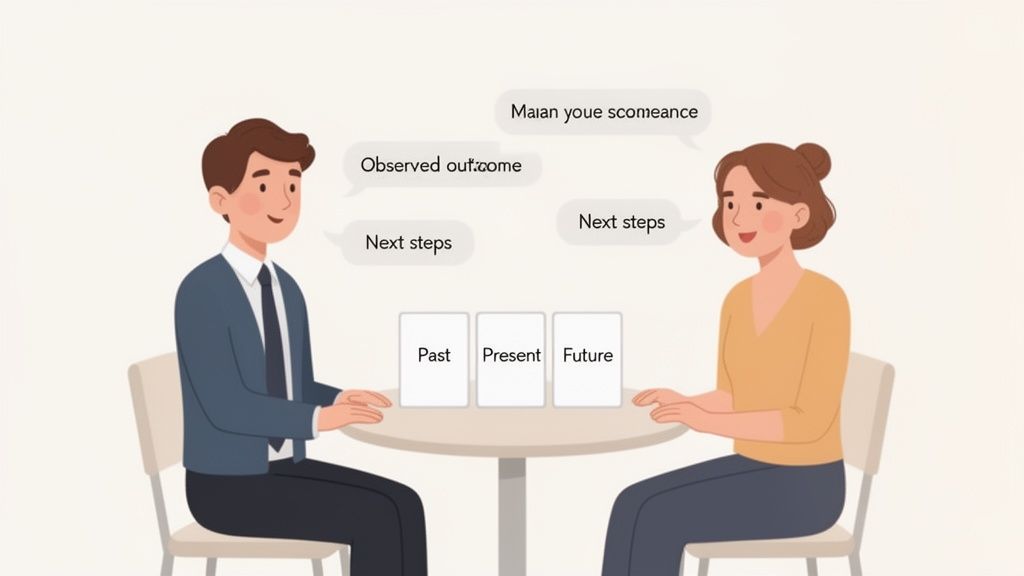
The best conversations are a two-way street, focusing on specific behaviors and their measurable outcomes. It's about finding a solution together, not just delivering a verdict.
The final and most important part of the meeting is the pivot to the future. Honestly, a performance review without a clear action plan is a complete waste of everyone's time. This is where you and your team member co-create a development plan that directly tackles everything you've just discussed.
"A great performance review doesn’t end with a rating; it begins with a plan. The goal is to leave the employee feeling energized and clear about exactly what they need to do to grow and succeed."
Don't just hand down assignments. Ask questions that encourage them to take ownership:
This collaborative approach turns your employee into a partner in their own development. You should walk away with 2-3 clear, measurable goals for the next quarter, written down and agreed upon by both of you. This creates a simple roadmap and a powerful tool for accountability, turning the review from a backward-looking exercise into a springboard for real progress. For struggling employees, this can become the foundation for a performance improvement plan.
A performance review that just ends when the meeting is over is a massive waste of everyone's time. Think of the conversation as the starting line, not the finish. The real value is unlocked by turning all those insights into a concrete, forward-looking plan.
Without that crucial next step, feedback just evaporates into thin air, and you lose all momentum for genuine growth. The goal here is to co-create a development roadmap that directly connects the feedback from your discussion to the goals for the next quarter. This isn't just about assigning tasks; it's a collaborative effort to pinpoint specific skill gaps and map out tangible opportunities.
This is where the performance review process evolves from a simple manager-employee interaction into a powerful strategic tool for the whole company. When you aggregate the data from all these conversations, you uncover a goldmine of insights for hiring managers and leadership.
For instance, at Juicebox, a client in the fintech space saw that their top-performing engineers consistently contributed to specific open-source payment gateway projects. By feeding that insight back into their sourcing strategy, they were able to target candidates with that specific experience, reducing their time-to-hire for senior roles by 22% in just one quarter. This is the power of connecting performance to hiring.
Research confirms this impact. A 2023 study by Gartner found that organizations with effective feedback cultures see a 12.5% increase in employee productivity. For your hiring managers, this data helps answer critical questions that shape the future of your team:
Trying to run a modern performance review process on spreadsheets is a recipe for inefficiency and bias. It’s like trying to navigate a new city with a paper map from a decade ago—you might get there, but it’ll be slow, painful, and you’ll definitely miss the best routes.
The right tech can turn this process around. Instead of a dreaded administrative chore, it becomes a data-driven system for growth. Modern platforms are fantastic at automating the basics, like sending reminders, wrangling 360-degree feedback, and pulling all your performance data into one place.
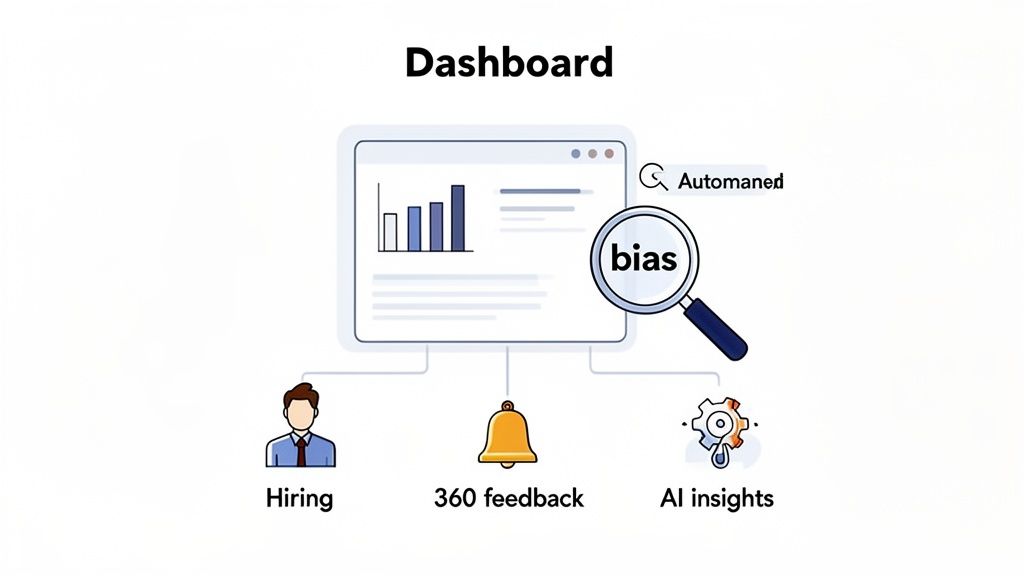
But here's the problem: most tools operate in a silo. They don’t pull in objective performance signals from the other systems you rely on, creating a massive blind spot. While a stunningly low 12% of companies incorporate analytics from systems like an ATS or HRMS, this is where a huge opportunity lies.
| Performance Review Tool Capabilities | Technology Feature | Adoption Rate (%) | Impact on Process |
|---|---|---|---|
| Appraisal Ratings | Standardized rating scales | 63% | Standardizes evaluation criteria but can be subjective. |
| Automated Reminders | Workflow nudges / notifications | 51% | Improves completion rates and reduces admin work. |
| 360-Degree Feedback | Multi-rater feedback collection | 45% | Provides a multi-perspective view of performance. |
| Goal Setting & Tracking | OKRs / goals management | 38% | Aligns individual efforts with company objectives. |
| Analytics from ATS/HRMS | Recruiting + HR data integrations | 12% | Connects performance to hiring and talent data (high-impact). |
As the table shows, the most powerful data integrations are also the least common. This is where the real competitive advantage lies—moving beyond basic automation to true people analytics.
You might think your current HR tech stack has this covered. But most tools are just digital filing cabinets—they store data without connecting it. They can’t tell you why certain hires succeed or which sourcing channels, like these Indeed alternatives, produce top performers. This failure to connect the dots means you’re leaving your most valuable talent insights on the table.
The real magic happens when you connect disparate data points to create a powerful feedback loop. Imagine linking your hiring data to actual performance outcomes. Suddenly, you can unlock incredible insights into people analytics d its impact.
Artificial intelligence adds another layer of sophistication to the performance review process, helping to catch the unconscious biases that even the best-trained managers have.
AI-powered tools can scan written feedback to spot problematic patterns and biased language before it does any damage.
This kind of tech also helps surface top performers whose contributions might otherwise get overlooked. By making the entire system smarter and more equitable, AI ensures your performance review process rewards true impact.
How often should a startup do performance reviews?
Most find a semi-annual or quarterly rhythm works best. It's frequent enough to keep up with the pace of a startup without becoming a major time sink.
Should performance be tied directly to compensation?
Keep the conversations separate. Performance outcomes are a huge input for pay decisions, but the development and compensation meetings should be separate.
What's the best way to handle reviews for remote employees?
Lean on documented outcomes over subjective observations. Use video calls and shared docs to walk through feedback together, making it a two-way session.
How can we reduce manager bias in reviews?
Calibration sessions are your best friend. Get managers in a room to discuss ratings as a group. It forces consistency and exposes outliers.
A great performance review isn't just an HR task—it's a retention engine. The old way is dead. By shifting to a continuous, fair system built for growth, you create an environment where high-performers want to stay.
What this unlocks is a culture of clarity and fairness that becomes a magnet for A-players. When you systematically identify and develop your internal talent, you build a resilient company where feedback is fuel and strong employee engagement is the default. This is how you win.
{{large_cta}}
Run your first search for free. Find and engage top talent across 800M+ profiles. Trusted by 5,000+ customers.