.svg)
SIGN UP FOR JUICEBOX (IT’S FREE!)

Who are you looking for?
Thank you! Your submission has been received!
Oops! Something went wrong while submitting the form.

When you hear "performance management," what comes to mind? For most people, it’s dreaded annual reviews, clunky forms, and conversations that feel more awkward than productive.
It’s often treated like a chore—a necessary evil—instead of the strategic tool it’s meant to be. This old-school approach is like trying to win a race by only checking the dashboard once a year. By the time you see the data, it’s way too late to make any real difference. Effective performance management isn't about looking backward; it's about building a high-performance engine for future growth, a distinction most generic guides miss. This starts with hiring people wired for success, a concept we'll explore using tools like PeopleGPT.
Stop for a second. Most companies think the fix for poor performance is a better review process. But what if the real problem isn’t the system? What if the issue is trying to manage the performance of people who were never set up to succeed in your environment in the first place?
Modern performance management flips the script entirely. It’s a dynamic, real-time system that acts like the central nervous system for a high-growth company. It’s the engine that keeps every team and individual aligned, engaged, and pulling in the same direction.
The biggest problem with the old way? It was all about process, not people. Those systems were designed for static, industrial-era companies, not the agile world we operate in today.
But there’s a problem most tools ignore. They focus on software, not conversations. A Gallup study shows only 14% of employees strongly agree their performance reviews inspire them to improve. This proves that a great system isn't about a better interface; it’s about fostering a culture of continuous feedback and improving employee engagement.
You might think fixing performance starts with better reviews. But that fails because it’s a reactive approach. The truth is, it starts before an employee even joins your team.
The most effective way to guarantee high performance is to hire people who are built to succeed in your specific environment from day one. This is where AI-powered sourcing becomes a massive strategic advantage. For example, a tech firm struggling with slow innovation used PeopleGPT to find engineers with prior experience at acquired, YC-backed startups. Within six months, their new hires led a project that shipped a core feature 30% faster than the previous team's average. This is proactive performance management.
By using natural language to find top-tier talent from places like Indeed alternatives, you start building a team that makes performance management an exercise in amplifying strengths, not just fixing weaknesses.
A modern performance management system isn't a one-off event; it's a continuous cycle designed to align, support, and grow your team. Think of it as building a high-performance engine for your company. You wouldn't just install a gas pedal (the annual review) and hope for the best. You'd want a full dashboard with real-time data on fuel, speed, and overall engine health.
What's the bottom line? Trying to operate without a complete framework is like driving a car on three wheels—you might inch forward, but it’s inefficient and definitely not built for the long haul.
An effective system moves beyond theory and into actionable practices. These are the pillars that provide the structure everyone needs to do their best work.
The graphic below shows this evolution—moving from old, calendar-driven reviews toward a dynamic system built for growth.
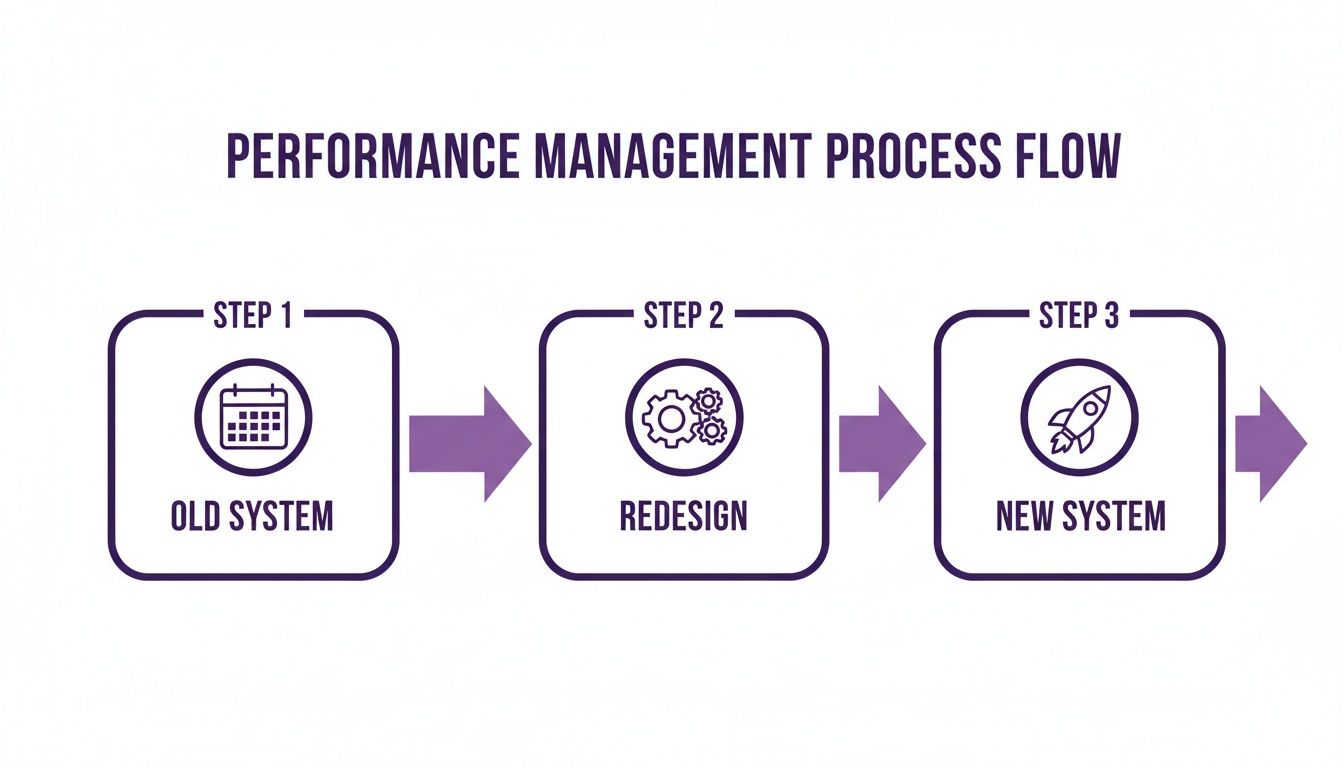
This visual drives home the point that shifting your approach is a deliberate redesign. You're moving from a static, reactive model to one that’s proactive and forward-looking. This also gives you the objective data needed to build a fair compensation strategy, making it much easier to implement a pay for performance model.
Great performance management isn't about tracking activity; it's about measuring impact. In a fast-moving tech environment, focusing on outdated, static metrics is like trying to drive forward while staring in the rearview mirror. You need a dashboard that shows where you're going (leading indicators) and confirms you've arrived (lagging indicators).
Here's the deal: To get there, you need a shared language for success. That’s where establishing clear and effective Employee Key Performance Indicators (KPIs) comes in.
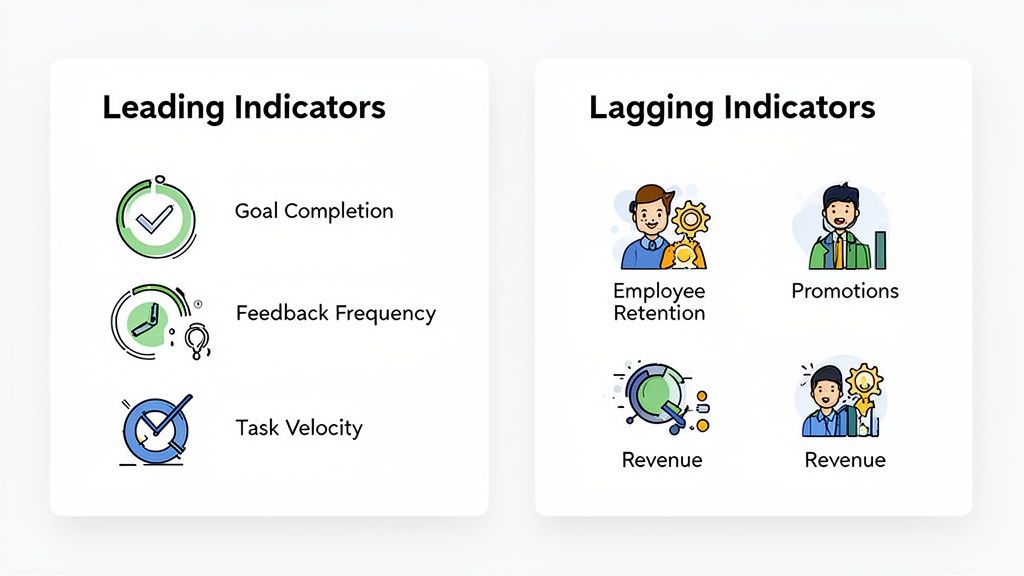
Think of leading indicators as the day-to-day actions that predict future success. They're the proactive things you can influence right now. For recruiters, this might mean tracking key recruiting metrics.
Lagging indicators, on the other hand, are the results.
But here’s the blind spot most performance tools have: they only track what happens after someone is hired. They don’t connect performance outcomes back to the source—the hiring decision itself. What if you could predict high performance before you even make an offer?
This is where understanding what people analytics is and using it to connect hiring to outcomes becomes a game-changer.
Even the best-designed performance management framework can crumble in practice. The system is only as strong as the people running it, and a few common pitfalls can quickly turn a tool for growth into a source of company-wide frustration.
Pattern Interrupt: We've been told for years that inconsistent managers and unconscious bias are the villains of performance management. And they are. But what if they’re just symptoms of a deeper problem? What if the root cause is that we’re hiring people who are a poor fit for our high-performance culture from the very start?
This gap almost always comes down to a few core problems.
This is one of the biggest failure points. When one manager gives detailed, weekly feedback and another barely remembers to do quarterly check-ins, it creates a chaotic and unfair experience. This erodes trust faster than anything else.
The fix isn't more complexity. It's giving managers simple, standardized tools like playbooks and calibration sessions. You can even streamline the recruitment process to include manager training on this from the outset.
Unconscious bias is the silent killer of a fair performance system. Things like affinity bias (favoring people like us) or recency bias (over-indexing on recent events) can completely skew evaluations.
How do you fight this? Rely on data, not just feelings. Ground performance conversations in objective metrics like OKR completion rates and 360-degree feedback rather than subjective manager assessments. This forces a more balanced and evidence-based discussion. For situations where performance consistently lags, a structured performance improvement plan ensures fairness and gives employees a concrete path to get back on track.
Let's be honest, performance management often feels like a constant battle to fix problems after they’ve already happened. But what if we're looking at it all wrong?
The best systems aren't about damage control; they’re about amplifying the strengths of a team that was built to win from day one. This flips the script entirely. The most powerful performance strategy isn't a better review cycle—it's a smarter sourcing strategy using the best sourcing tools for recruiters.
Forget sifting through endless resumes. Modern tools let you search for the actual signals of high performance, targeting candidates based on their real-world track record.
Think about what truly defines an A-player in a high-growth environment:
Tools like PeopleGPT let you turn these ideas into a razor-sharp search. Imagine being able to find "software engineers who worked at a YC-backed fintech startup that was acquired" in seconds. That's how you stack the deck in your favor.

A simple prompt like this instantly pulls up profiles that match the DNA of a high-achiever, turning your hiring process into a leading indicator of future success.
Finding great people is only half the battle. AI can also help you set them up for success once they’re on board. Talent insight tools give you real-world market data on salary ranges and necessary skills. This information is gold for crafting realistic performance benchmarks right from the start.
A 2023 McKinsey study found organizations with top-quartile talent practices see 2.5 times the revenue growth of their peers. This proves the link between proactive hiring and bottom-line results. When you combine AI-driven sourcing with data-backed role benchmarking, you create a powerful flywheel. It's a foundational advantage offered by the best AI recruiting tools.
Great performance management has nothing to do with paperwork. At its core, it’s the engine that builds a culture of clarity, growth, and high achievement—the operating system for your company’s talent.
A well-designed system aligns every individual's efforts with the most critical business goals. Suddenly, everyone is rowing in the same direction, and they know why. This isn’t just about hitting targets; it’s about creating an environment where your best people can consistently do their best work, an idea further explored in these strategies for fostering a positive workplace culture.
When your performance system works, your entire organization wins. The core benefit is shifting from reactive problem-solving to proactive potential-unlocking. This unlocks the ability to scale your culture and business results simultaneously, creating a competitive advantage that's nearly impossible to replicate.
Focusing on the process, not the conversation. A system that feels like a bureaucratic chore has already lost its strategic value.
Ditch the annual review. Use lightweight quarterly check-ins and weekly continuous feedback to stay agile and course-correct in real-time.
Yes, but only if managers are highly trained in delivering clear, unbiased coaching without the crutch of a numerical rating scale.
Decouple the conversations. Use performance data as one input for pay decisions, along with market data and role scope, to keep the focus on growth.
{{large_cta}}
Run your first search for free. Find and engage top talent across 800M+ profiles. Trusted by 5,000+ customers.

.png)