
.svg)
SIGN UP FOR JUICEBOX (IT’S FREE!)

Who are you looking for?
Thank you! Your submission has been received!
Oops! Something went wrong while submitting the form.


Offering a “competitive” salary no longer cuts it when top candidates have seen it all before. This guide promises a smarter way to turn your compensation strategy into a powerful talent magnet using pay for performance models.
You'll learn the frameworks, data, and communication tactics that leading teams use to attract and keep the very best talent.
Let's break it down:

Most standard salary models treat compensation as a fixed cost on a spreadsheet, not as a strategic investment in people. This approach has a critical flaw: it often ends up rewarding tenure over actual impact.
Before long, your high-achievers start to feel a disconnect. They’re crushing their goals, but their paycheck doesn't seem to notice. When your best performers feel undervalued, the risk of them walking out the door skyrockets.
This isn't just a morale problem; it's a costly one. Replacing skilled employees means shelling out for recruitment, absorbing lost productivity, and dealing with the disruption to your team's momentum. To get a real sense of the damage, it's worth understanding the true cost of the employee attrition rate and how it destabilizes a business.
At the end of the day, a static pay structure simply doesn't light a fire under anyone to innovate or push for that next breakthrough.
Forget the dry, textbook definition for a moment. The best way to think about pay for performance is as a strategic partnership. Imagine a world where everyone—from the front lines to the C-suite—shares in the success they create together. That’s the real spirit behind it. This approach directly ties financial rewards to tangible, measurable achievements, completely changing the conversation from a static salary to a dynamic opportunity for growth.
It’s all about making compensation a two-way street. Instead of just paying people for clocking in and out, you’re rewarding them for driving real results. This creates a powerful connection between an individual's daily grind and the company's big-picture success, naturally building a deep sense of ownership and accountability.
A smart pay for performance model isn’t just a one-off bonus. It’s a carefully blended compensation structure that balances stability with high-growth potential. It’s typically built on three key pillars.
This infographic gives a great visual of how these pieces might fit together in a performance-driven role.
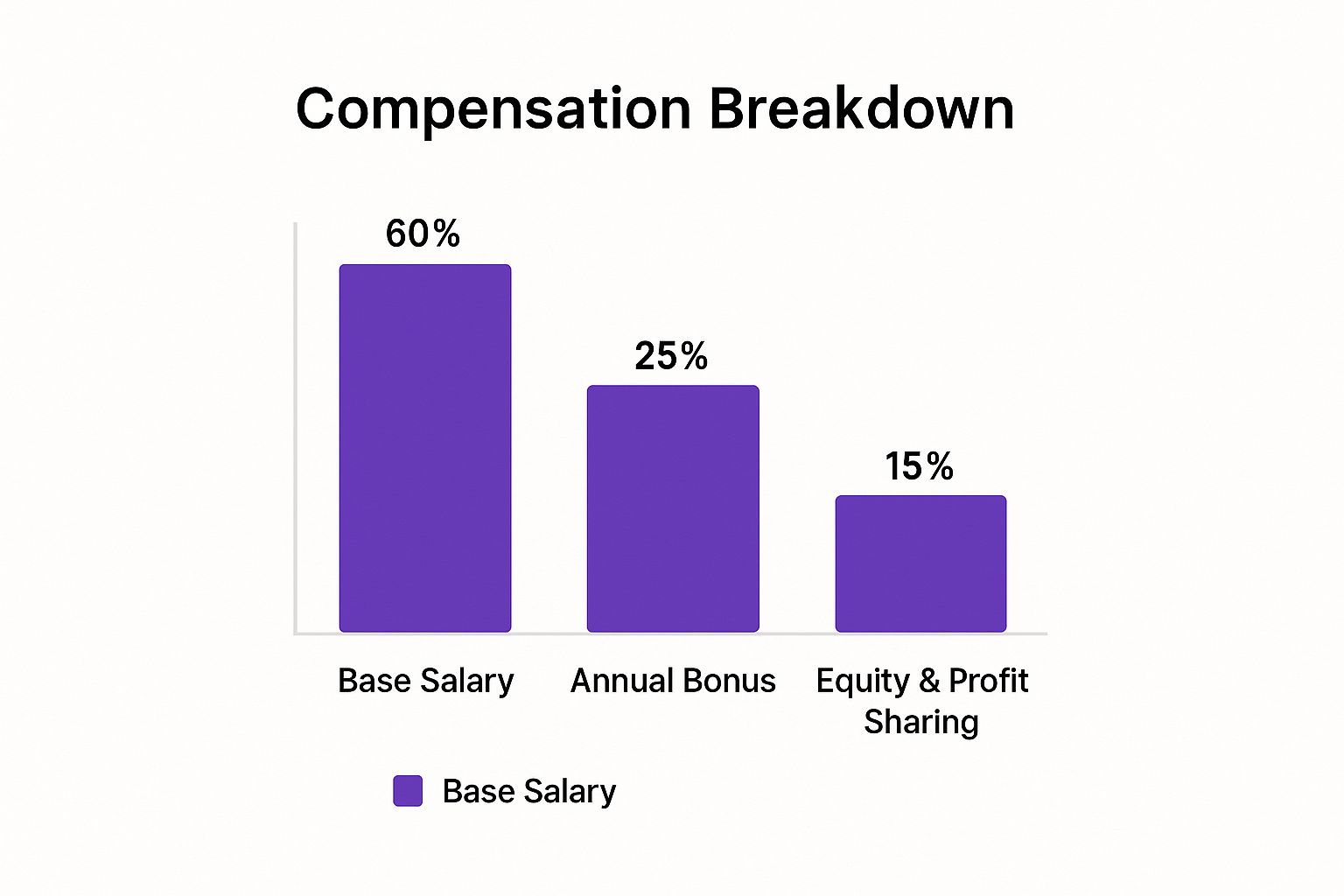
As you can see, a huge chunk of total earnings—in this case, 40%—is variable and directly linked to how well the individual and the company perform.
So, why does this actually work so well when it's done right? It taps into some fundamental human motivators that go way beyond just a bigger paycheck.
A well-structured plan gives employees a clear line of sight between their daily work and the company's bottom line. When people see that their contributions are not only noticed but also tangibly rewarded, their engagement and commitment deepen.
This framework shifts the employer-employee relationship into a true partnership. It reframes compensation away from being just another business cost and turns it into a shared investment in hitting ambitious goals. Once you get these psychological drivers, it becomes much easier to explain the value of a pay-for-performance model and pitch it as a shared journey toward success.

Not all pay for performance plans are created equal. The secret to making one work is picking the right tool for the job. After all, the model that supercharges a sales team might completely demotivate an engineering department.
Getting these nuances right is a huge part of shaping a compensation package that actually gets top candidates excited.
Let’s break down the most common structures, moving from rewards for individual rockstars to incentives that lift the entire company.
These models are all about rewarding personal contributions. They're often the simplest to roll out and explain because they create a direct, crystal-clear link between an employee’s effort and their paycheck.
But while individual rewards are powerful, they can sometimes have an unintended side effect: discouraging collaboration. That’s where team-based incentives come into the picture.
When success hinges on everyone working together, team-based models make sure the whole crew is pulling in the same direction. These plans reward groups for hitting shared goals, fostering a spirit of cooperation instead of competition.
A popular model here is gainsharing. Teams get a cut of the financial gains they create for the company, like cost savings or productivity boosts. This gets everyone thinking about operational excellence and solving problems as a unit. It's crucial to align these incentives with a clear talent strategy to ensure team goals are directly fueling bigger business objectives.
Think of these models as giving every employee a stake in the company's success. This creates a powerful sense of ownership that can drive long-term commitment like nothing else.
Globally, these models are catching on fast. Companies that implement performance-based pay report a 10–15% increase in overall employee output and a jump in engagement by up to 22%. Those numbers show just how much a well-designed incentive plan can move the needle on motivation and productivity.
To help you visualize how these models stack up, here’s a quick comparison:
| Model Type | Best For | Key Advantage | Potential Drawback |
|---|---|---|---|
| Merit Pay | Rewarding consistent, long-term performers in stable roles. | Encourages sustained high performance and loyalty. | Can feel subjective and lead to small, incremental raises. |
| Commissions | Sales and business development roles with clear revenue targets. | Directly ties reward to measurable business impact. | May foster unhealthy competition and neglect non-sales tasks. |
| Gainsharing | Teams in operations, manufacturing, or service departments. | Promotes collaboration and a focus on process improvement. | Can be complex to calculate and may not motivate everyone equally. |
| Profit Sharing | Entire companies looking to align all employees with financial goals. | Creates a strong sense of shared purpose and ownership. | Rewards are often delayed and disconnected from individual effort. |
| Stock Options | Startups and high-growth companies aiming for long-term alignment. | Motivates long-term thinking and employee retention. | Value is tied to market volatility and can be complex to understand. |
Ultimately, choosing the right blend of these models lets you build a dynamic compensation structure. It won't just help you attract top talent—it will keep them motivated and invested in your company’s journey for the long haul.
Building a successful pay-for-performance system isn't something you can just guess at. It demands a carefully constructed framework—one that’s built on fairness, clarity, and a solid connection to your company's goals. Without a smart design, even the best intentions can backfire, leaving you with confused and unmotivated teams. Think of this as your playbook for creating a plan that actually inspires people to do their best work.
The whole thing starts with clear, measurable goals. Vague targets like "improve customer satisfaction" are impossible to reward fairly and will only cause frustration. A much better approach is to use the SMART framework.
Once the goals are set, your evaluation process has to be just as straightforward. No employee should ever be surprised by how their performance is measured. A transparent process means regular check-ins, consistent feedback, and a standardized way of assessing everyone's work.
This is where a lot of companies trip up. If managers apply the rules differently from person to person, or if the evaluations feel totally subjective, the system loses all credibility—fast. For a deeper look at the nuts and bolts of building a fair system, it’s worth exploring these top performance management best practices.
A truly effective system makes the connection between daily effort and potential reward obvious. When an employee knows exactly what they need to do to succeed—and trusts the process for measuring that success—they are empowered to take ownership of their performance.
Fairness isn't just a nice-to-have; it's non-negotiable. Any pay-for-performance model has to be built on a solid foundation of pay equity. This means compensation is determined by an employee's role, their impact, and their results—not by any form of bias. To get this right, you need a robust compensation intelligence strategy to benchmark roles properly and audit your outcomes for fairness.
The global compensation landscape is already moving in this direction.
After a period of rapid salary growth, budgets are leveling out, and the focus is shifting to transparency and fairness. WTW’s Salary Budget Planning Report highlights this trend, showing that while salary increases are projected to be around 4% globally, a whopping 70% of organizations are planning specific pay equity adjustments to make sure their performance-based rewards are truly fair.
Finally, even the most brilliantly designed plan will fall flat if nobody understands it. You have to communicate it clearly and often. Make sure everyone knows:
By focusing on these core pillars—clear goals, transparent evaluation, pay equity, and great communication—you can build a system that doesn't just reward top performers, but also fosters a lasting culture of trust and high achievement.

A well-designed pay for performance model can light a fire under a team, but get it wrong, and you’re walking through a minefield. A poorly structured plan doesn't just fail to motivate; it can breed resentment, accelerate burnout, and create a culture you’ll spend years trying to fix.
Getting this right is what separates a compensation strategy from a genuine competitive advantage. By steering clear of the common mistakes, you can build a program that’s both fair and incredibly effective.
This is the fastest way to kill a performance pay system. When goals feel impossible to reach or are so vague that nobody knows what they're aiming for, motivation tanks. The incentive stops feeling like a reward and starts looking like a constant source of stress.
Every objective needs to be grounded in reality. That means digging into historical data to set targets that are a stretch, but still achievable. Crucially, every single employee needs a crystal-clear line of sight from their daily work to the metrics being measured. Without that, the whole system just feels random.
A bit of friendly competition can be a good thing, but when you pit employees against each other for a limited bonus pool, collaboration grinds to a halt. Suddenly, knowledge sharing stops, silos go up, and team members might even start to undermine one another to get ahead.
Rewarding only individual achievements can inadvertently punish the collaborative behaviors that drive real innovation. The most successful systems find a balance, rewarding both personal milestones and collective team wins.
To dodge this bullet, weave in team-based incentives or gainsharing models. This structure gets everyone pulling in the same direction, making sure individual ambition doesn’t sabotage the team’s overall success.
Fairness is the absolute bedrock of any compensation plan. The second your team suspects that rewards are based on favoritism or a manager's subjective "gut feeling," you lose all trust. This gets particularly dicey when managers aren't trained to conduct truly objective performance reviews.
Unchecked biases can snowball into massive issues, even creating conditions for adverse impact where certain groups are unintentionally held back. Holding regular calibration meetings—where managers align on performance ratings—is a non-negotiable for keeping things consistent and fair across the board.
The promise of performance pay also has to survive contact with economic reality. Zeren & Renoir's Compensation Trends survey found a tough disconnect: 53% of employees got no salary increase last year. For those who did, 47% saw raises that didn't even match inflation, meaning they took a real-terms pay cut.
By sidestepping these common pitfalls, you can build a pay for performance model that not only motivates but actually strengthens your company culture from the inside out.
A brilliant pay-for-performance strategy is only as good as the people you bring on board to make it happen. You can design the perfect compensation model to reward high achievers, but the real trick is actually finding them in the first place. This is where modern recruiting tech closes the gap between theory and reality.
Old-school recruiting often gets stuck on keyword matching. This can't tell you the difference between someone who just lists a skill on their resume and someone who has actually used that skill to drive real, measurable results. AI-powered sourcing tools, on the other hand, go so much deeper.
They can sift through millions of online profiles to spot candidates with a proven history of crushing their goals. Suddenly, you can pinpoint people with quantifiable achievements—like consistently blowing past sales quotas, shipping complex projects ahead of schedule, or moving the needle on specific business metrics. It’s a total shift from looking at paper qualifications to focusing on tangible impact.
Instead of drowning in a sea of mediocre resumes, AI lets recruiters build a shortlist of talent who are practically wired for a performance-driven culture. These platforms can analyze entire career paths, project outcomes, and even public contributions (like code repositories or published articles) to identify patterns of high achievement.
It's also worth knowing how savvy candidates are using tech to get on your radar. By defining what high performance actually looks like for a specific role, you can basically train an AI to find people who already fit the mold.
The image below gives you a glimpse of how an AI sourcing platform can take a simple, natural language prompt and instantly turn it into a curated list of qualified candidates.
This shows how recruiters can use specific criteria like "exceeded quota" to immediately surface talent with a documented track record of success. If you want a full playbook on these techniques, our guide on how to use AI in recruitment lays out the actionable workflows.
AI doesn't just find people with the right skills; it finds people with a history of applying those skills to achieve exceptional results. This is the critical link for any successful pay-for-performance system.
Ultimately, bringing AI into your sourcing process means you're not just crossing your fingers and hoping to find top performers. You're systematically identifying and engaging them from the very start. It aligns your hiring engine with your compensation philosophy, creating a powerful, self-reinforcing cycle of high achievement.
Even the best-designed pay for performance model is going to get a few questions—from your leadership team, from managers, and definitely from candidates. Being ready with clear, straightforward answers is how you build trust and get everyone on board.
Here are a few of the most common questions you'll likely run into.
This one comes up a lot. When a role's success isn't a straight line to a revenue number, you have to get a bit more creative. The trick is to use a balanced scorecard of Key Performance Indicators (KPIs) that actually reflect how that role impacts the business.
Think beyond just one number. You could track things like:
The key is to define these metrics upfront, making sure everyone understands how they tie back to the team's and the company's biggest goals.
Absolutely. In fact, it can be a secret weapon for startups and small businesses. It’s one of the best ways to get the entire team pulling in the same direction toward those critical growth goals.
When cash is tight and you can't offer massive base salaries, performance-based incentives like profit sharing or phantom stock give employees a real stake in the company's success. It makes them feel like owners.
Just keep the system simple and transparent. Tie the rewards to major milestones that everyone understands—like closing a funding round, nailing a product launch, or hitting a specific user acquisition number.
This is a big one, especially for candidates trying to understand their total compensation. While they both reward great work, they operate in completely different ways.
Merit pay is a permanent raise added to an employee's base salary. It’s a reward for consistent, long-term performance. A bonus, on the other hand, is a one-time, lump-sum payment that doesn't increase base pay.
Bonuses are usually tied to hitting specific, short-term goals and have to be earned again each period. This makes them a more direct and flexible type of pay for performance, letting you reward immediate wins without permanently bumping up your fixed salary costs. Nailing this distinction helps you paint a much clearer picture of the total rewards package.
Finding talent that actually thrives in a performance-driven culture is about more than just matching keywords. Juicebox uses AI to spot candidates with a proven history of crushing goals and delivering results you can measure.
Book a demo and see how you can build a pipeline of high-impact talent ready for your pay for performance model.
{{large_cta}}
Run your first search for free. Find and engage top talent across 800M+ profiles. Trusted by 5,000+ customers.

.png)


.png)