.svg)
SIGN UP FOR JUICEBOX (IT’S FREE!)

Who are you looking for?
Thank you! Your submission has been received!
Oops! Something went wrong while submitting the form.

A modern paid time off (PTO) policy isn't just a line item in your benefits package. It's a secret weapon in the war for talent. While many companies see it as an administrative task, top recruiters understand its real power: PTO is a strategic asset for attracting and retaining elite candidates.
The idea seems simple: roll vacation, sick leave, and personal time into one bank. But there's a problem most tools ignore. A policy that looks great on paper often masks a culture of burnout, a disconnect top candidates are trained to spot.
This guide is different. We'll show you how to build and communicate a paid time off policy that acts as a genuine recruiting superpower, backed by a culture of rest that top talent craves.
TL;DR: How to Create a Winning Paid Time Off Policy
Think of your company's paid time off policy as its 'recharge mechanism.' A broken one leads to system-wide failure—think burnout, high turnover, and stagnant innovation. A well-designed one, however, fuels creativity, loyalty, and a culture people clamor to join.
The issue is that many companies offer policies that look generous but fail to support genuine rest. This is the exact disconnect top candidates hunt for during interviews. They aren't just counting days; they're assessing whether your company truly values employee well-being.
A strong, authentic paid time off policy acts as a magnet for the best candidates. It signals you understand that rest isn't a luxury—it's a strategic necessity for peak performance.
Not long ago, generous PTO was a nice-to-have perk. That thinking is now obsolete. Today's workforce, especially in competitive fields like tech, views a robust time-off policy as a fundamental expectation.
Here’s why that matters.
Your strategy must go beyond simply offering days off. You have to build a system—and a culture—that actively encourages people to use them. The best approach requires understanding different employee benefits and how they combine into a total rewards package that truly stands out.
You might think a big number of PTO days on an offer letter is enough. It's not.
That’s a preemptive objection many recruiters face. Candidates are skeptical and look for proof that your policy is more than marketing. They check Glassdoor, talk to current employees, and ask pointed questions. This is where proof patterns become critical.
Look at Zapier: they famously offered a "$10,000 de-location package" to help employees move out of the Bay Area. This single tactic sent a powerful message about their commitment to work-life balance, making their unlimited PTO policy far more believable and attractive.
Your policy needs that kind of cultural backing to be truly effective. It must be supported by a workplace where taking time to disconnect isn't just possible—it's expected.
How you handle paid time off speaks volumes to candidates. It's more than a number of days—it’s a direct reflection of your company's philosophy on trust, autonomy, and work-life balance.
Think of the models this way:
Let's break down what each means for attracting top talent.
Here's a quick side-by-side look at the three main PTO models. Pay close attention to how candidates might perceive each one, as that's your key to framing it as a compelling benefit.
| Sourcing Stage | Traditional Workflow (Est. Time) | AI-Powered Workflow (Est. Time) | Key Difference |
|---|---|---|---|
| Search Strategy | 1–2 hours | ~10 minutes | Building complex Boolean strings vs. writing a simple natural-language prompt. |
| Profile Identification | 3–5 hours | ~30 minutes | Manually combing hundreds of profiles vs. reviewing an AI-curated shortlist. |
| Candidate Screening | 2–3 hours | ~45 minutes | Reading every profile vs. scanning AI summaries of top contenders. |
| Data Entry & Admin | ~1 hour | ~5 minutes | Manual ATS entry vs. single-click export with verified contact data. |
| Total Time Spent | 7–11 hours | ~1.5 hours | Over 80% reduction in manual sourcing time. |
Ultimately, the best policy is one your company culture can genuinely support. A great policy on paper means nothing if nobody feels comfortable using it, a key differentiator when evaluating LinkedIn Recruiter pricing and other platforms.
A much more modern approach is the banked PTO system. Here, all types of leave are merged into a single pool of days that employees earn over time. For example, an employee might accrue 8.67 hours of paid time off each month, adding up to 15 days over the year.
This is a huge step up in flexibility.
A banked system is all about empowerment. It trusts your team to manage their own time for any reason—a vacation, a sick kid, or a much-needed mental health day—without asking for a justification.
This model is also predictable, making it a stable and easy-to-understand benefit. It strikes a great balance between freedom and structure, appealing to a wide range of candidates.
The unlimited PTO model is the most progressive and often the most debated. There’s no formal limit on days off; employees take time as needed, as long as work gets done.
But here’s the catch:
Candidates are often skeptical. They've heard stories about companies where "unlimited" means "never take a vacation."
A 2023 Pew Research study found that 46% of U.S. workers with PTO don't use all the time they're given, showing a policy is only as good as its supporting culture. For this model to be an asset, you must prove people use it with data and anecdotes.
It's crucial to explore the pros and cons of unlimited PTO to ensure it aligns with your company.
When sourcing talent across borders, your paid time off policy becomes a legal minefield. What’s generous in one country can be a non-compliant, deal-breaking misstep in another.
Let's bust a myth right now.
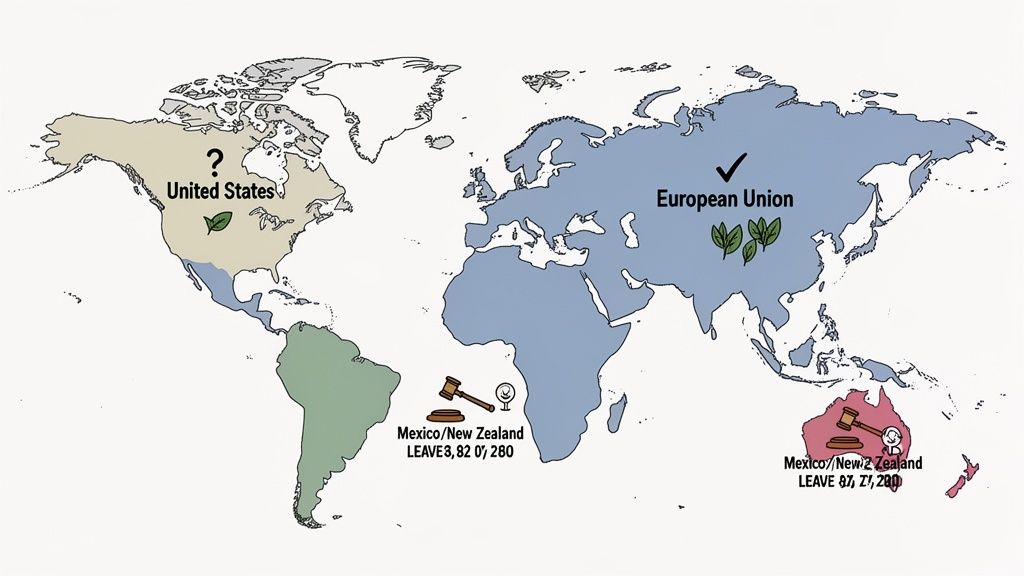
Most US-based leaders believe a competitive US offer translates globally. The opposite is true. The United States is an outlier among developed nations with no federal mandate for paid vacation. This creates a huge knowledge gap when hiring internationally, where robust paid time off is a fundamental legal right.
You might think your standard 15-day PTO package is a solid starting point. The problem is, that assumption can get you screened out by top international candidates before you even get a chance to talk.
In the European Union, for example, countries typically guarantee 20–30 days of paid annual leave, not including public holidays. You can dig deeper into the PTO differences between the USA and Europe to see the stark contrast.
Here’s the bottom line: presenting a US-standard offer to a candidate in Paris isn't just uncompetitive. It's a red flag that your company doesn't understand their local labor laws.
PATTERN INTERRUPT
You might think creating localized policies sounds like a logistical nightmare. But what’s the alternative? Offering a single, non-compliant policy alienates entire talent pools and puts you at legal risk. The smart move is to set a high global minimum (e.g., 25 days) that covers most of your hiring regions, then add small addendums for local specifics. This approach, which we've seen companies like GitLab use to scale their remote teams, simplifies compliance and makes you instantly competitive worldwide. It's a strategic investment, not an administrative burden.
So, how do you build an offer that's both compliant and attractive? Shift from a one-size-fits-all mindset to a localized approach. Treat regional legal minimums as the floor, not the ceiling.
Start by researching statutory requirements:
Using the best sourcing tools for recruiters provides access to talent market data, helping you benchmark benefits packages. Platforms like Findem offer analytics to ensure your paid time off offer is both legally sound and highly attractive.
A generous paid time off policy looks fantastic in an offer letter. But what happens when it’s just a smokescreen for a culture of burnout? The most telling metric isn't the number of days you offer. It’s the gap between that number and the time your team actually takes off.
When employees consistently leave vacation days on the table, it’s a massive red flag.
This isn’t just an HR problem—it's a direct threat to your retention. Your top performers feel immense pressure, see leaders who never disconnect, and quickly learn that taking time off is a career-limiting move. The result is a slow exodus of your best talent.

Most leaders fall for the myth that "more PTO is always better." In reality, the opposite is often true. A company with an unlimited policy but a culture that discourages rest is far worse than one with a modest policy where people feel genuinely empowered to unplug.
How does this happen? A policy is just words; culture is what people do. If managers email at 10 PM and celebrate weekend warriors, no amount of paid time off will convince a high-performer to book a vacation. They see the unspoken rules, adapt, and head straight for burnout and a higher employee attrition rate.
This isn't just a hunch. A 2023 Pew Research Center survey found that 46% of U.S. workers with paid time off take less than they're offered.
The problem is most severe among those driving your company forward. The same study showed 54% of managers reported leaving paid days unused. You can dive into the full Pew Research findings on PTO usage to see how deep this issue runs.
This proves that simply offering time off is not enough. Without a supportive culture, your generous policy is a hollow promise. It also highlights the need for effective recruiting metrics to track the health of your workforce.
Crafting a standout paid time off policy isn’t about grabbing a template. It’s about designing a system that mirrors your company’s values. A great policy does more than tick a legal box; it becomes a tool to compete for the best people.
The process boils down to defining your policy's core components, checking it against the market, and weaving it into your company culture.
First, lay down the ground rules. Getting these details right removes guesswork and builds trust. Clarity is essential.
Your policy must spell out these four areas:
Including a practical guide on employee time off request forms can make a world of difference for your team's understanding.
You might be thinking a detailed policy sounds more restrictive than a trendy "unlimited" approach. But the opposite is often true.
A well-defined policy provides psychological safety. Employees know exactly what they're entitled to and feel more empowered to use it without guilt. This clarity is a powerful retention tool many startups miss in their rush to seem flexible. The goal isn’t restriction; it’s predictability and fairness.
Once you have a framework, you need to ensure it can compete. Don't rely on gut feelings. Use data to build a policy that stands out.
Here’s a simple workflow:
A great paid time off policy is worthless if candidates don't get it. Crafting the policy is half the battle; the real test is how your recruiters talk about it. This is your chance to turn a boring line item into a compelling story about your company culture.
The goal is to get away from dry statements and paint a picture of what life is really like at your company.
Top candidates want to know why your policy matters to them. Reframe details into tangible benefits.
Before (Factual Statement):
"We offer 15 days of PTO per year, which accrues bi-weekly."
This is accurate but uninspiring.
After (Benefit-Driven Narrative):
"We're serious about preventing burnout. We have a flexible PTO policy starting with 15 days because we trust you to manage your time and energy in a way that keeps you creative and engaged for the long haul."
See the difference? The second version tells a story. Framing benefits this way can massively improve your candidate engagement strategies and set you apart.
Smart candidates will ask questions to uncover the reality of your PTO culture. Recruiters need to be ready with honest, specific examples.
Here’s how to prep your team:
When you equip recruiters with these benefit-driven narratives, your paid time off policy transforms into a powerful testament to your values, especially when compared to Indeed alternatives that may not offer such transparency.
What's the biggest mistake when creating a global PTO policy?
Ignoring local laws. A US-centric policy is often non-compliant and will repel top international candidates instantly.
Do we need a separate policy for every country we hire in?
Not always. A common strategy is to set a global minimum (e.g., 25 days) and then use regional addendums for specific local laws.
How do public holidays factor into global PTO compliance?
Public holidays are almost always separate from and in addition to statutory annual leave. Account for both when creating offers.
How should we list PTO on a job description?
Frame it as a benefit. Instead of "PTO: 20 days," try "Generous PTO to support a healthy work-life balance (20 days annually)."
A winning paid time off policy isn't about offering the most days. It's about creating a system of trust and clarity that proves you invest in your team’s well-being. Getting this right moves beyond simple benefits and becomes a core part of your employer brand.
This unlocks a more resilient, engaged, and loyal workforce, giving you a distinct competitive advantage in a cutthroat market.
{{large_cta}}
Run your first search for free. Find and engage top talent across 800M+ profiles. Trusted by 5,000+ customers.

.png)