.svg)
SIGN UP FOR JUICEBOX (IT’S FREE!)

Who are you looking for?
Thank you! Your submission has been received!
Oops! Something went wrong while submitting the form.


Employee offboarding is the formal process for an employee's departure, covering everything from knowledge transfer and asset return to final payroll and revoking system access. Think of it less as an administrative checklist and more as building the final, crucial bridge in the employee lifecycle—one that protects your company and preserves your employer brand.
A smooth offboarding process is your organization's final handshake. Done right, it secures vital institutional knowledge, mitigates security risks, and turns a departing employee into a lifelong brand advocate. This guide provides a recruiter-centric framework for building that bridge.
TL;DR: The Bottom Line on Offboarding
Picture offboarding as the final, and often forgotten, leg of the employee journey. It's like expertly navigating a ship back to harbor. A smooth docking ensures the crew departs safely, the ship is secure, and the port remains a trusted destination for future voyages. A chaotic departure, however, leaves the harbor vulnerable and damages its reputation.
When you structure the offboarding process, you create a respectful and secure end to the employment relationship. This transforms departures from a chaotic scramble into a strategic advantage, building a bridge that supports your organization long after an employee has left.
Ignoring a formal offboarding process isn't just a missed opportunity—it's a massive risk. The numbers don't lie.
Even with all the talk about employee experience, a shocking 71% of companies globally still don't have a formal offboarding process as of 2022, according to an Aberdeen Group study. This is a huge oversight, especially when you consider that a 2023 report found that 20% of companies report security breaches linked to former employees whose system access wasn't properly revoked.
A bad exit experience can also poison your employer brand, making it much harder to attract top talent and potentially driving up your overall attrition rate.
A thoughtful offboarding process is your last chance to leave a positive impression. It shows your organization truly cares about its people, even after they’ve moved on.
The visual below breaks down the core pillars of a strategic offboarding process.

This flow really highlights how securing knowledge, enforcing security, and protecting your brand are all interconnected pieces of a successful employee exit.
Seeing offboarding as just another administrative checklist is incredibly shortsighted. It should be treated as a crucial function that safeguards your institutional knowledge and strengthens your company culture.
When you manage departures with care and precision, you turn a potential liability into a lasting asset. Former employees who leave on good terms are far more likely to become brand advocates, refer new talent, and maybe even return as "boomerang" employees down the road. The goal here is simple: create a respectful, secure, and professional conclusion for every single person who leaves your team.

A solid offboarding process isn’t something you improvise. It’s a detailed architectural blueprint where every piece—from legal compliance to asset return—is meticulously planned to keep the entire structure secure. This is your guide to drafting that blueprint.
Scrambling to figure things out after a resignation notice lands is a recipe for chaos. The goal here is to build a proactive, repeatable system that minimizes risk, boosts efficiency, and ensures every departure is professional and predictable.
First things first: assign clear ownership. A smooth offboarding is a team sport, not just an HR task. Every department has a part to play, and ambiguity is your worst enemy.
Without clear roles, things inevitably fall through the cracks. IT might forget to revoke access to a critical system, or a manager might neglect to transfer key client relationships. These small oversights can easily snowball into major security vulnerabilities or operational headaches.
A well-defined offboarding process ensures accountability at every stage. When everyone knows their part, from HR to IT to the direct manager, the entire transition becomes seamless and secure, preventing critical steps from being overlooked.
To sidestep this mess, you need to map out who is responsible for what. The Chief People Officer usually oversees the high-level strategy, making sure the offboarding experience reflects the company culture and manages risk.
With roles locked down, it's time to get it all in writing. A formal policy is the foundation of your offboarding structure, driving consistency and ensuring you’re legally compliant. Think of it as a living document that you'll review and update as regulations and your own processes evolve.
Your policy needs to cover a few critical areas:
When building this out, weaving in a comprehensive HR security policy is non-negotiable. It’s what defines your procedures for employee exits and is your first line of defense against data breaches.
Consistency is everything. To make your offboarding process scalable and effective, you need standardized checklists and templates. These tools ensure every departure follows the same secure, respectful protocol, no matter the employee's role or department.
To bring this to life, it helps to create a responsibility matrix. This table clarifies who does what, turning a potentially confusing process into a clear, actionable plan.
A clear breakdown of key tasks and ownership across different departments to ensure a smooth offboarding process.
By turning these responsibilities into a standardized checklist, you transform offboarding from an unpredictable art into a repeatable science. This simple step ensures nothing gets missed and every departing employee is treated with fairness and professionalism.

The logistics are one thing, but the human side of a departure is where things get tricky. This is your chance to move beyond a simple procedural checklist and turn offboarding into a meaningful, empathetic interaction.
It's all about ensuring the person leaving feels genuinely valued right up until their last minute with the company.
When you get this right, you transform a potentially awkward farewell into a bridge. Instead of leaving with negative feelings, former employees become brand ambassadors who speak highly of your organization long after they're gone.
So many companies treat the exit interview as a box-ticking exercise. Big mistake. It's one of the most powerful feedback mechanisms you have. This is a rare opportunity to get unfiltered insights into your culture and operations from someone who has little left to lose.
To make it count, you need to dig deeper than "So, why are you leaving?" The real goal is to uncover actionable information that can help you prevent future turnover and make the workplace better for everyone who stays.
An exit interview isn't an interrogation; it's a conversation. Frame it as a way for the departing employee to leave a positive, lasting impact on the company they helped build. This approach fosters honesty and yields far more valuable feedback.
Think about the 'Great Resignation'—a period where 50.5 million US workers quit in 2022 alone, according to the U.S. Bureau of Labor Statistics. That chaos drove home just how critical it is to manage departures smoothly. Gathering feedback and maintaining a positive employer brand isn't just nice to do; it directly impacts your ability to retain talent.
Recommended Reading: 8 Exit Interview Questions That Reveal Why.
Gathering feedback is only half the battle. The real value is in what you do with it. An exit interview should feel less like a survey and more like a collaborative debrief.
To get the most candid responses, try a few of these tactics:
This turns a simple chat into a vital source of data for improving retention and overall organizational health.
When someone leaves, it sends ripples across their team. Your remaining employees are watching closely to see how the company handles it. A poorly managed exit can spark uncertainty, gossip, and a serious dip in morale.
Clear and empathetic communication is everything here. The manager should be the one to inform the immediate team first, keeping the conversation direct and professional. The message should be simple, positive, and forward-looking.
In your announcement, focus on three key points:
By handling the departure with grace and transparency, you show respect for everyone involved—both the person leaving and those who remain. It's a powerful way to reinforce a culture of stability and trust.
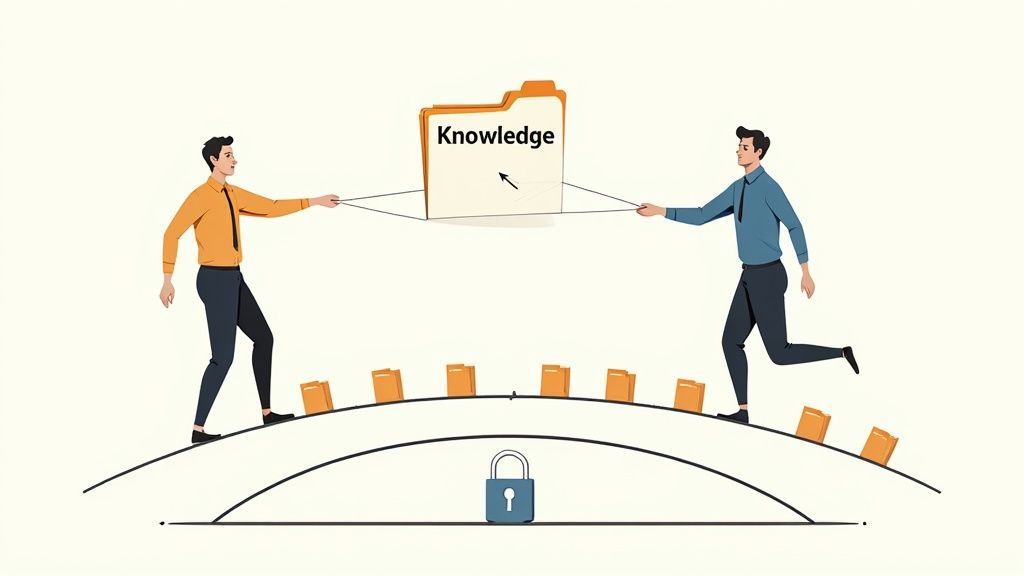
When an employee walks out the door for the last time, they take more than just their personal belongings. They leave a knowledge vacuum in their wake. Managing this transition well is like building a sturdy bridge, allowing their expertise to cross back into the organization before they’re gone for good.
If that bridge is shaky, you're looking at lost information, delayed projects, and institutional memory that just vanishes into thin air.
This is a two-front process. One front is about systematically capturing and documenting what they know to keep business moving. The other is a security operation focused on getting company gear back and locking down data. Both are absolutely critical.
The foundation of your knowledge bridge is a formal transfer plan. This isn't a casual chat over coffee on their last day; it’s a structured process designed to pull out and preserve the departing employee's unique insights.
This plan should be a joint effort between the employee and their manager, methodically mapping out every critical piece of the role.
A solid plan like this prevents that all-too-common nightmare where a new hire spends their first month just trying to piece together what their predecessor actually did. Building out an internal skill map can be a game-changer here, helping you spot knowledge gaps long before someone puts in their notice.
With the plan documented, the next step is the handover meeting. This is a dedicated session where the departing employee walks their replacement or manager through everything they've written down. It’s a chance to ask questions and get the kind of context that never makes it into a document.
For more complex roles, a short period of shadowing is invaluable. It lets the incoming person see the tasks being performed in real-time, which helps solidify their understanding and makes for a much smoother handoff.
The goal of knowledge transfer is not just to copy information but to transfer understanding. A well-managed handover ensures that the 'why' behind the 'what' is preserved, safeguarding the strategic intelligence of the role.
This is more important than ever. Employee turnover is a moving target, with recent data from the Eagle Hill Consulting Employee Retention Index showing the largest quarterly drop in two years. Notably, women's retention scores fell 8.5 points compared to just 2.4 points for men in Q1 2023. These trends underscore the urgent need for a robust offboarding process that can effectively capture knowledge when turnover spikes.
While you're building the knowledge bridge, you need to start securing the castle gates. This means having a foolproof system for recovering all company property and, just as importantly, revoking all access to digital assets.
Your asset recovery checklist needs to be ironclad, managed jointly by the employee's manager, HR, and IT.
Timing is everything. All access must be revoked at the exact end of the employee's last working day—not a minute later. And it’s not just about getting the hardware back; you need a clear protocol for the data on it. Knowing how to safely and securely dispose of old laptops is critical to preventing future data breaches.
This final step slams the door on potential security holes and ensures your organization's data stays protected.
Let's be honest, manually juggling the dozens of tasks in an offboarding process is a recipe for mistakes and wasted time. It's an administrative maze that you don't have to navigate by hand. By bringing in AI-powered tools, you can turn this complex chore into a smooth, reliable, and efficient operation.
AI doesn’t replace you—it makes you smarter. By augmenting your workflow, it ensures every single step is followed, keeping you accurate and compliant every time.
The second an employee hands in their notice, the clock starts ticking. A whole cascade of notifications needs to go out to IT, payroll, and the departing employee themselves. Drafting and sending these one by one is a huge time sink and opens the door to inconsistent messaging.
AI can instantly standardize and execute this entire communication flow.
By automating these notifications, you guarantee every stakeholder gets the right information at the right time—no manual follow-up needed. This not only frees up countless hours for your HR team but also builds a clear, auditable trail of communication, which is a lifesaver for compliance. The right tools can elevate how you use AI in recruitment and manage the employee lifecycle from start to finish.
The relationship doesn't end on an employee's last day. Or at least, it shouldn't.
The final piece of a great offboarding strategy is building a bridge to something new: a valuable alumni network. This is where you shift the dynamic from a transactional goodbye to a lasting asset for your talent pipeline and employer brand.
This isn't just about being nice. It’s a smart, strategic move. By thoughtfully extending the relationship, you cultivate a community of brand ambassadors, potential re-hires, and a killer source for future referrals. A positive offboarding experience is the handshake that makes this transformation possible.
A long-term connection starts with a respectful departure, but it continues long after the final paycheck clears. The real goal is to create a community that former employees actually want to be part of.
You can start small. A simple quarterly newsletter sharing company milestones and celebrating alumni achievements keeps that connection warm. As your program grows, you could build out a dedicated online portal for networking or sharing exclusive job opportunities.
A great offboarding experience is the foundation of a strong alumni network. It's the last impression you make, and it determines whether a former employee becomes a silent spectator or an active advocate for your brand.
By building this bridge, you keep communication lines open, making it natural for past employees to send great candidates your way or even think about coming back themselves.
The "boomerang employee"—someone who leaves and later returns—is more than just a buzzword.
With competition for top talent getting fiercer, companies are realizing that a known quantity with a proven track record is an incredible asset. In fact, a 2022 survey found that 29% of workers who quit during the Great Resignation later boomeranged back to their old employer.
A well-managed offboarding process is the single most important factor in making that happen. When someone leaves on good terms, feeling valued, the door stays open. Their institutional knowledge and understanding of your culture mean their re-onboarding will be miles faster and more effective than starting from scratch with someone new.
This requires a forward-thinking mindset. Instead of seeing a departure as a loss, view it as a chance for an employee to gain new skills and experiences that could benefit your company down the line. It's a long-term investment in your talent ecosystem.
To really make the most of these relationships, a formal alumni program is your best bet. It puts a system in place for engagement and provides real value to former employees, giving them a reason to stay in touch.
Here are a few practical ideas for building a program that works:
Ultimately, turning former employees into advocates is about playing the long game. It takes a real commitment to maintaining relationships, but the payoff—in referrals, re-hires, and a stellar employer brand—is more than worth the effort.
Even with a solid plan, offboarding can feel like navigating complex territory. Questions always pop up. Here are some of the most common ones we hear from HR pros and managers, with direct, no-fluff answers.
If I had to pick just one thing, it's consistency.
Every single step matters, but a standardized, documented process is the absolute bedrock. It guarantees that every single employee gets the same respectful and secure send-off, no matter their role or why they're leaving.
This isn't just about being fair; it's your safety net. Consistency minimizes legal risks, protects company assets, and shores up your employer brand. It stops crucial tasks—like revoking system access or capturing institutional knowledge—from falling through the cracks during a hectic departure. It turns a chaotic, person-dependent task into a reliable system.
People clam up when they feel scrutinized. To get genuinely candid feedback, you need to create a sense of psychological safety. The easiest win here? Have a neutral third party, like an HR business partner, run the interview instead of the employee's direct manager. This simple switch immediately lowers the pressure.
Also, reframe the entire conversation. It’s not about grilling them on their decision to leave; it’s about making the company better for the people who are still there.
Instead of the classic, "Why are you leaving?" try asking something more forward-looking, like, "What's one thing we could change that would have made your experience here even better?" And always, always guarantee confidentiality. It’s non-negotiable for getting the real story.
By a long shot, the biggest security risk is incomplete or delayed de-provisioning. It’s the digital equivalent of leaving the front door wide open.
When former employees keep their access to email, cloud drives, or internal software—even by accident—they become a massive vulnerability. In fact, a 2023 report found that 20% of companies had suffered a data breach because of a former employee's unrevoked credentials.
A close second is failing to get back all company property, especially laptops, phones, or hard drives loaded with sensitive data. Your best defense is a detailed, automated checklist that both HR and IT have to sign off on. It makes sure that bridge is not just crossed, but securely closed behind every departing employee.
{{large_cta}}
Run your first search for free. Find and engage top talent across 800M+ profiles. Trusted by 5,000+ customers.