
.svg)
SIGN UP FOR JUICEBOX (IT’S FREE!)

Who are you looking for?
Thank you! Your submission has been received!
Oops! Something went wrong while submitting the form.

What if there was a massive talent pool full of incredible problem-solvers, innovators, and hyper-focused specialists that your competition is completely ignoring?
That's not a hypothetical. It’s the neurodivergent workforce, a group that makes up an estimated 15-20% of the global population. This guide isn’t about ticking a DEI box; it’s about seizing a powerful competitive advantage by building smart neurodivergent hiring programs. By implementing these strategies, you tap into a wellspring of innovation and productivity that outdated hiring practices consistently overlook.
Our experience building AI sourcing tools at Juicebox shows that companies actively seeking cognitive diversity build stronger, more resilient teams.
TL;DR: Building a Neurodivergent Hiring Program
Most organizations believe neurodiversity initiatives are simply a social responsibility. That’s a myth. The opposite is true: it's a strategic imperative. The real story is about boosting performance, driving innovation, and accessing a deep well of talent that old-school hiring funnels are designed to filter out.
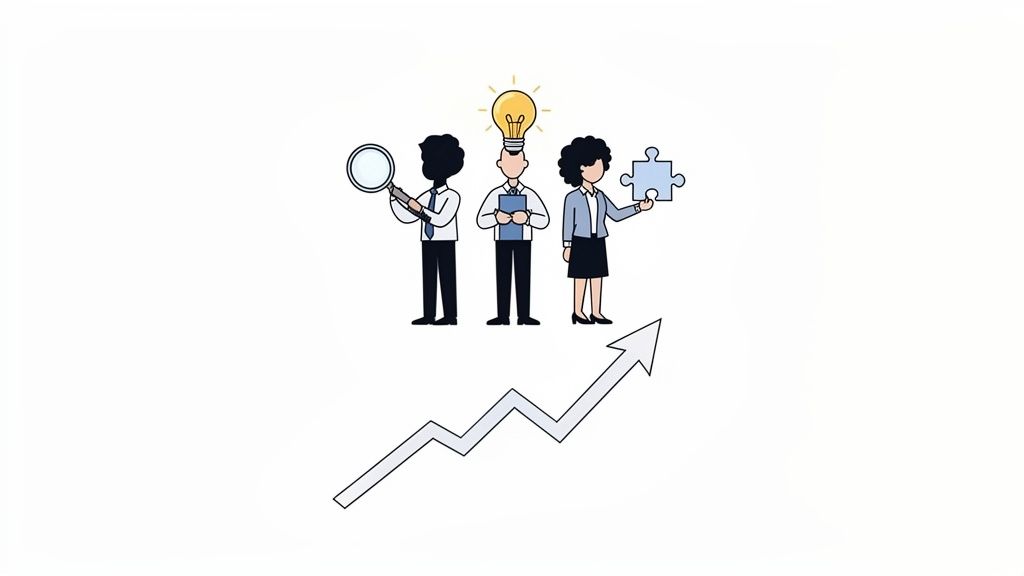
Here's the bottom line: wanting to be inclusive isn't enough. You need scalable systems to actually unlock results and pull away from the companies just going through the motions. That's what this guide delivers.
The disconnect between available talent and open opportunity is staggering. Unemployment rates for neurodivergent adults can skyrocket to 30-40%—eight times higher than for the neurotypical population.
What's going on here?
This gap exists because traditional hiring practices, often unintentionally, screen out this incredible talent. The real question is, what practical, scalable systems separate the companies seeing a real ROI from those who don't? It all starts with recognizing that neurodivergent individuals often possess traits that are superpowers in today's workplace. A more effective way to bridge this gap is by focusing on skills-based hiring.
By adapting your approach, you gain access to candidates with exceptional skills in areas like:
Building a real neurodivergent hiring program isn't about good intentions. It’s a strategic move that delivers measurable business outcomes. The first step is admitting that the standard playbook is broken. Your current process is likely filtering for candidates who fit a certain social mold, not for those with the highest potential to succeed. We'll dig into why that is next.
But there’s a problem most tools ignore: traditional applicant tracking systems (or ATS) are built to find conformity, not capability. They reward linear career paths and standard keywords, automatically filtering out the very candidates who think differently. The breakthrough comes from bypassing these broken filters entirely.
Most companies think their hiring process is a meritocracy. The reality is often the opposite. The standard recruiting playbook is packed with hidden biases that unintentionally sideline neurodivergent talent. It’s a system built to find a specific type of candidate, not necessarily the best one.
This isn’t about bad intentions; it’s about broken, outdated mechanics. The first major crack? The resume screen.
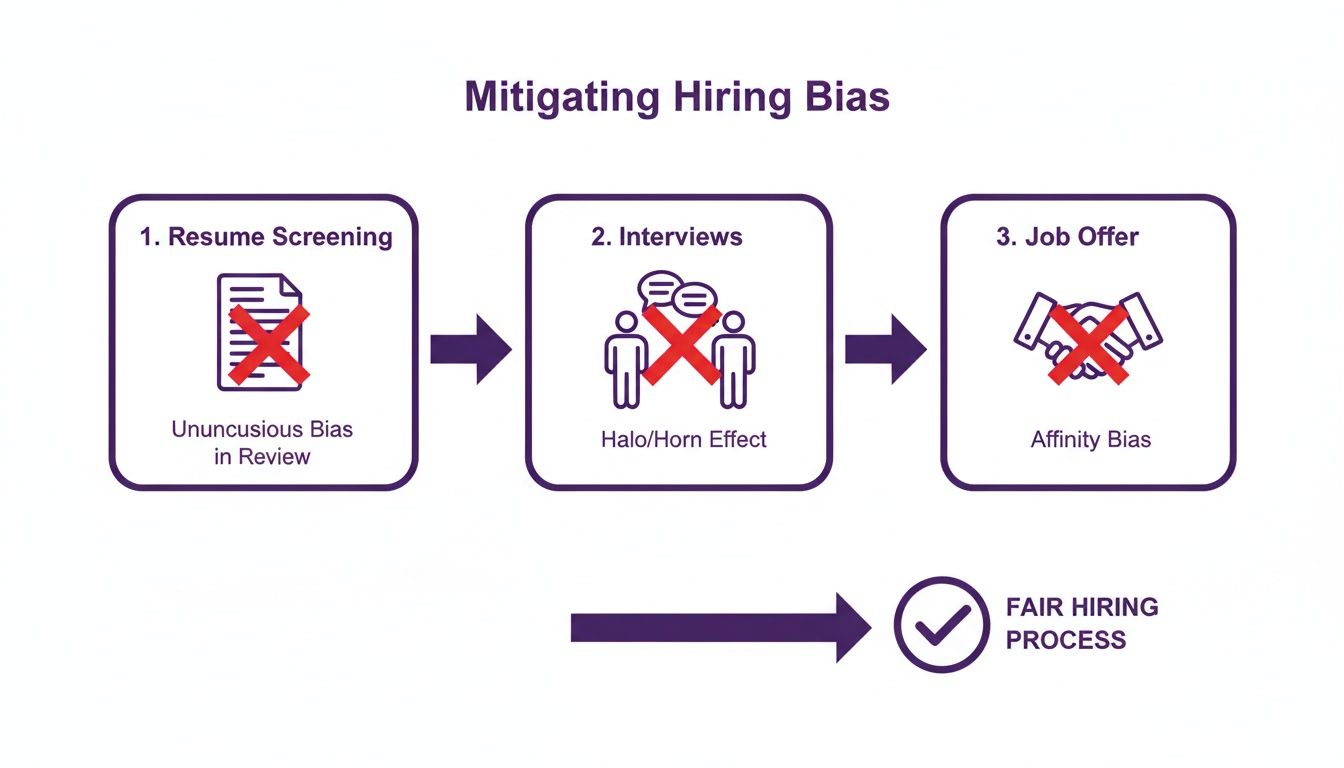
Automated systems and human screeners are both trained to spot linear career paths and familiar keywords. But what about the brilliant developer with a resume gap from burnout? Or the data analyst who describes their skills with non-standard—but totally valid—terminology? They get filtered out long before a human ever sees their potential.
You might think your go-to behavioral questions are the gold standard. Questions like, “Tell me about a time you handled conflict with a coworker,” are meant to assess soft skills.
Here’s the catch: they often end up measuring conformity and communication style over actual competence. For a neurodivergent candidate, these questions can be a minefield.
These interviews become a test of social performance, not job capability. This is a critical point of failure. By sticking to a narrow definition of "good communication," companies screen out the very people who have the deep focus and unique problem-solving skills they claim to be looking for. Fixing this is fundamental, as we cover in our guide on how to improve candidate experience.
It’s not just the questions; the entire structure of a traditional interview is often a barrier. Vague agendas, last-minute changes, and high-pressure "gotcha" questions create enormous stress. This doesn't show you a candidate's true abilities—it only shows you how well they handle unexpected social pressure.
Think about it.
Microsoft’s Neurodiversity Hiring Program figured this out early on. Instead of classic interviews, they switched to multi-day hiring events with hands-on projects. One approach is performative; the other is predictive. Ultimately, legacy hiring practices filter for candidates who fit a comfortable, pre-defined mold. Recognizing these systemic flaws is the first step toward building neurodivergent hiring programs that actually work.
Alright, so you get the "why." Now for the "how." Building an effective neurodivergent hiring program isn't about adding a line to your diversity statement; it's about fundamentally redesigning the old, creaky machinery of recruiting.
Let's get practical. This is your blueprint for turning good intentions into a repeatable hiring process that actually works. A core part of this is understanding the best recruiting metrics to track for inclusive hiring.
The table below breaks down how subtle changes at each stage can completely transform your hiring outcomes. It’s about moving from a system that tests conformity to one that identifies capability.
| Hiring Stage | Traditional Approach (Exclusionary) | Inclusive Approach (Neurodiversity-Affirming) |
|---|---|---|
| Job Descriptions | Filled with jargon, vague personality traits (“rockstar,” “team player”), and long lists of unprioritized requirements. | Uses clear, literal language. Focuses on concrete tasks and skills. Separates must-have from nice-to-have qualifications. |
| Application Process | Lengthy, multi-step forms that may time out. Requires candidates to manually re-enter resume information. | Streamlined, mobile-friendly applications. Allows resume uploads without re-entry and offers alternative submission formats. |
| Interviews | Relies on abstract behavioral questions (“Tell me about a time…”). Unstructured, high-pressure conversations that test social performance. | Provides questions in advance. Uses work-sample tests or practical challenges. Offers multiple formats (video, text, in-person). |
| Onboarding | Assumes new hires will “figure out” unwritten rules. Relies on verbal instructions and social osmosis. | Provides structured, written documentation. Assigns a dedicated buddy or mentor. Creates a “user manual” for communication styles. |
This isn't about lowering the bar; it's about building a better, wider gate.
Your job description is your first handshake with a potential candidate. Most are loaded with corporate jargon that creates instant friction.
The fix? Ruthless clarity.
You end up with candidates who can actually do the job, not just those who are good at decoding corporate-speak.
The standard interview is often a test of social performance, not professional competence. For a neurodivergent hiring program to have any real impact, this is the stage that needs the most radical overhaul.
Here's how to do it.
With this approach, you're measuring genuine competence, not just a candidate's comfort with ambiguity.
You might think that launching neurodivergent hiring programs is a costly endeavor with intangible benefits. Why that fails: it ignores the hard data. This isn't just a feel-good initiative; it’s a direct investment in your company's bottom line.
Just look at the proof.
These aren't just isolated wins; they're repeatable outcomes. These metrics represent a real, measurable competitive advantage.

Many companies mistakenly assume that accommodating neurodivergent employees is a cost center. The truth is, it's an engine for productivity and innovation that traditional metrics often miss.
JPMorgan's finding that neurodiverse employees were not only faster but flat-out more productive translates directly into more output per employee and quicker project timelines. This isn't about working harder; it's about leaning into innate cognitive strengths like intense focus and pattern recognition. To understand how to measure these shifts, it helps to learn the basics of people analytics.
The real game-changing ROI comes from innovation. Neurodivergent thinkers approach problems from completely different angles. This cognitive diversity is the fuel for genuine breakthroughs.
The financial upside goes way beyond initial productivity. One of the biggest, yet most overlooked, benefits is employee retention. High turnover is a massive drain on resources.
The data is clear: neurodivergent employees often show much higher loyalty in supportive environments. SAP's 90% retention rate is the perfect example. That kind of loyalty slashes churn and its associated costs, creating a stable, experienced workforce. This long-term commitment comes from building a place where people feel valued for their unique contributions.
You might be looking at giants like Microsoft or SAP and thinking, "That's great for them, but our team doesn't have that kind of budget." It's a fair point. The common wisdom is that effective neurodivergent hiring programs require massive resources.
But that's not true anymore.
Modern AI sourcing platforms have leveled the playing field, making it possible for teams of any size to tap into diverse talent pools. Instead of getting tangled in manual screening or biased Boolean strings, you can now deploy AI agents to find candidates based on what actually matters: their skills.
Let's be honest, traditional sourcing is a numbers game built for speed, not precision. Recruiters skim profiles for keywords, unintentionally filtering out fantastic candidates with unconventional career paths—profiles that are incredibly common among neurodivergent professionals.
AI flips that model on its head. With a platform like PeopleGPT, you can simply describe the skills you need in plain English. The AI then autonomously scans over 800 million profiles to find people based on their actual capabilities.
This helps recruiters find qualified candidates up to five times faster. It’s the difference between hunting for a needle in a haystack and having a curated set of needles delivered right to you. This approach is central to building better recruitment emails that resonate with top talent.
But here's the trap most AI tools fall into: just finding more profiles faster doesn't fix the root problem of bias. If your search criteria are flawed, AI will just serve you flawed candidates at lightning speed. The real breakthrough is using AI to define better search criteria—zeroing in on skills, projects, and tangible achievements instead of old-school proxies for success.
The real magic of this technology is its precision. Instead of a vague search for a "software engineer," you can ask for "engineers with experience in Python and data visualization who have contributed to open-source projects."
This skills-first approach is a game-changer. It naturally bypasses the resume gaps and non-linear career histories that cause so many talented neurodivergent candidates to be overlooked. This focus on practical application is what makes scaling your neurodivergent hiring programs not just possible, but practical. For a deeper look, check out our guide on modern AI sourcing.
For smaller companies, these efficiency gains are transformative.
You no longer need a dedicated sourcing team to build a diverse pipeline. A single recruiter, armed with the right AI, can now outperform an entire team of manual sourcers.
This isn't just about finding more people; it's about finding the right people who were previously invisible to your old process. By automating the top of the funnel, you can pour your human resources into the stages that really count: adapting interviews and creating an amazing candidate experience. That’s the key to making your program a scalable, strategic advantage.
Hiring is just the first step. The real value of a neurodivergent hiring program is unlocked when you can keep the incredible talent you’ve worked so hard to find.
Without an environment where every employee can thrive, even the most brilliant hiring initiative will fall flat. This is about shifting your workplace from a rigid, one-size-fits-all model to a flexible and adaptive ecosystem. The ultimate goal is to create genuine psychological safety—the bedrock on which innovation and loyalty are built.
A successful transition starts day one with a structured and empathetic onboarding process. One of the most effective tools is creating a "user manual" or personal guide. This gives new hires a way to share their communication preferences and work styles from the get-go. For more on this, see our onboarding new employees checklist.
Of course, support can't stop after the first few weeks.
A supportive culture needs concrete action. A huge piece of this is implementing practical reasonable adjustments for neurodivergent employees at work. This isn't about lowering the bar—it's about removing unnecessary hurdles that get in the way of high performance.
Small adjustments can make a world of difference. This could be as easy as providing agendas before meetings or offering written instructions to back up verbal ones.
What's the bottom line?
Ask, don't assume. Find out what each individual needs to do their best work. This is how your neurodivergent hiring program evolves from a simple tactic into a sustainable, long-term talent strategy.
1. What are the first metrics to track for ROI?
Track retention rates for neurodivergent hires vs. the company average, time-to-productivity, and qualitative manager feedback.
2. How does neurodiversity impact team-wide performance?
Neurodiverse teams often see a boost in problem-solving. Track project completion rates and innovation metrics to see the difference.
Reframing your hiring process to be neuro-inclusive isn’t just a diversity initiative—it’s a direct investment in innovation, productivity, and a more resilient workforce.
What this unlocks is access to a pool of exceptional talent—problem-solvers, innovators, and loyal team members—that your competitors are actively filtering out. By moving beyond traditional, biased practices, you build a sustainable engine for growth and secure a lasting competitive advantage.
{{large_cta}}
Run your first search for free. Find and engage top talent across 800M+ profiles. Trusted by 5,000+ customers.
.png)
![The Complete Guide to Talent Pipeline Management [2026]](https://cdn.prod.website-files.com/68c2f83ae8165ab45cf529f8/6953a268c9a0db82016c122a_talent-pipeline-management-workforce.webp)
.png)
.png)
