.svg)
SIGN UP FOR JUICEBOX (IT’S FREE!)

Who are you looking for?
Thank you! Your submission has been received!
Oops! Something went wrong while submitting the form.

Natural language search is simple: you find candidates by describing who you’re looking for in plain English, just like you’d talk to a colleague. It completely replaces rigid, headache-inducing Boolean strings, helping you uncover top talent faster by focusing on what you actually mean, not just the keywords you type.
It’s the difference between fumbling through an old library card catalog and just walking up to an expert librarian and asking for exactly what you need. While most sourcing tools still rely on outdated keyword-matching, platforms like Juicebox are built from the ground up on true AI, allowing recruiters to find candidates 5x faster.
For years, recruiters have been sold a myth: mastering complex Boolean search is the mark of a great sourcer. We've all been there—spending hours crafting and tweaking ridiculously long strings packed with "AND," "OR," and "NOT," just hoping to strike gold.
But let’s be honest. That old way of doing things is slow, clumsy, and often misses the best people. How many times have you built the perfect query, only to realize the ideal candidate used a slightly different job title on their profile and slipped right through the cracks?
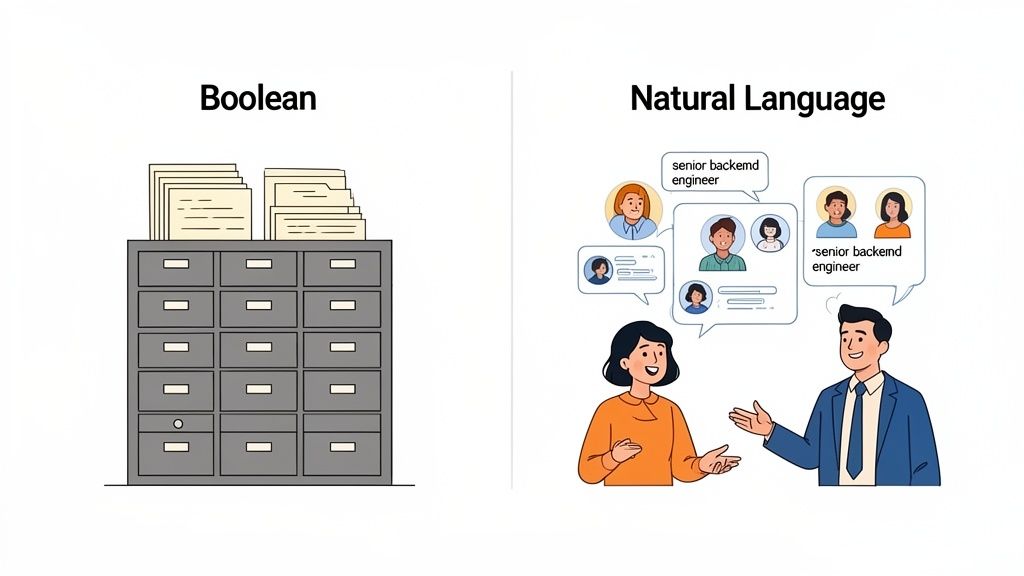
This is exactly where natural language searches change the game. Instead of forcing you to think like a database, this AI-powered approach understands the intent behind your words. It gets what you're looking for, even if your phrasing isn't perfect. This isn't just a minor upgrade; it's a fundamental shift in how we approach the entire process of what is HR sourcing.
You might be thinking, "My current sourcing tool says it has AI." But there’s a critical detail most tools won’t tell you. Many platforms just slap a thin AI layer on top of their old, clunky Boolean systems. It's like putting a touchscreen on a flip phone—it looks modern, but the underlying tech is still stuck in the past. True AI-native platforms like Juicebox were built from the ground up for natural language searches. The system was designed from day one to understand context, nuance, and the subtle relationships between skills. This core difference is what delivers such incredible accuracy and speed.
The technology fueling this is exploding. According to MarketsandMarkets, the Natural Language Processing (NLP) market is projected to skyrocket from $26.4 billion in 2022 to $91.0 billion by 2027. That’s not just hype; it's a clear signal that this tech is becoming a core business tool. To really get into the weeds of how this technology works, check out this guide to Natural Language Processing.
To put it plainly, relying on Boolean today is like trying to navigate a new city with a paper map. Sure, you might get there eventually, but you'll waste a ton of time and miss all the shortcuts. A natural language search is your GPS for talent, guiding you straight to the best candidates without any of the frustrating detours, and is especially critical for sourcing passive candidates who aren't actively searching job boards with standard keywords. You can read more about this in our guide to the best sourcing tools for recruiters.
Still not convinced? Let's break down the differences head-to-head. The table below shows just how much has changed, moving from the old, rigid way of searching to the intuitive, AI-powered approach.
| Feature | Boolean Search (The Old Way) | Natural Language Search (The New Way) |
|---|---|---|
| How It Works | Rigid keyword matching using operators like AND, OR, NOT. | Understands intent, context, and semantic meaning. |
| Required Skill | Deep knowledge of complex syntax and Boolean logic. | Simple, conversational English. No training required. |
| Search Speed | Slow; requires repeated tweaking and trial-and-error. | Fast; delivers relevant results on the first attempt. |
| Accuracy | Error-prone; easily misses candidates using different terminology. | High accuracy by understanding concepts, not just keywords. |
| Candidate Pool | Constrained to exact keyword matches, often shrinking the pool. | Expanded pool by identifying conceptually similar profiles. |
| User Experience | Frustrating, manual, and unintuitive — feels like coding. | Effortless and intuitive — feels like a conversation. |
The takeaway is clear. While Boolean had its day, it was built for a different era of data and technology. Today, the systems that can think and understand like a human are the ones that give you a real competitive edge.
So, how does an AI sourcing tool actually get what you mean when you ask for something like, "Find me a senior Python developer who has worked at a high-growth fintech startup"? It's not magic, but it’s a world away from the rigid logic of Boolean. It all comes down to two core AI concepts: semantic search and entity recognition.
Think of semantic search as the AI's ability to grasp the meaning and intent behind your words, not just the keywords themselves. It’s smart enough to know that "lead dev," "engineering manager," and "senior software engineer" all point to the same concept of seniority in tech, even if you only type one of them. The AI has learned these connections by analyzing millions of job titles, skills, and company profiles, which is a core part of building the top 10 AI recruiting tools for 2026. This move from keywords to intent is exactly why things like semantic SEO are becoming so important—it’s all about understanding what someone is really looking for.
Then you have entity recognition. This is how the AI spots and categorizes the specific pieces of your request—like a person's role, a skill, a company type, or a location.
When you type in your prompt, the AI instantly breaks it down:
It doesn’t just see a string of words; it sees a structured set of requirements. This lets it search for candidates based on a complete picture of your ideal hire, not just a simple checklist. The entire value of AI for recruitment hinges on this ability to turn plain English into actionable data.
Here's a common misconception: Most recruiters think AI search is just a fancier keyword finder. The truth is the complete opposite. A true natural language search focuses on your intent. A system that just matches keywords better is like building a faster horse—it’s not a new way to travel. The real breakthrough is when the tool understands what you mean, not just what you type.
But there’s a catch. Many so-called "AI" platforms are still running on Boolean logic behind the scenes. They just use AI to translate your natural language prompt into a messy Boolean string for you. This is a massive flaw because it brings back all the old problems, like accidentally filtering out great candidates who just use different words on their profile. A truly AI-native platform like PeopleGPT processes your request as a whole concept.
Here, a simple prompt for a senior engineer returns candidates with nuanced experience that the AI understands from looking at their entire career path.
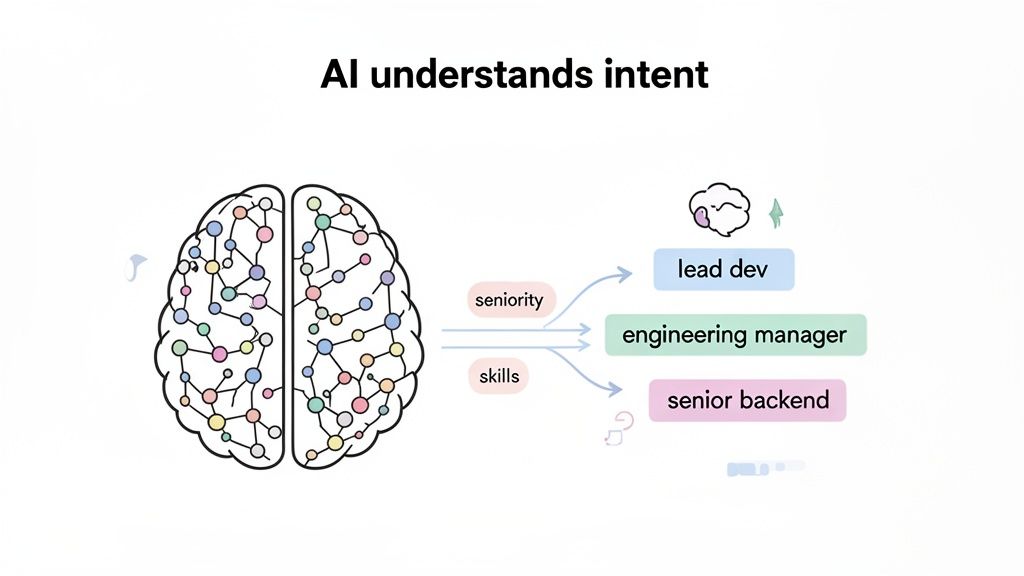
The system gets concepts like career progression and a company’s growth stage without you having to spell it out with Boolean operators. The result? A much richer and more relevant pool of candidates.
For a long time, mastering complex Boolean strings was a badge of honor for recruiters. It made you feel like an elite sourcer, and in many ways, you were. Entire careers were built on the ability to write queries that looked more like code than a search for an actual human.
But that era is over. The very tool that promised surgical precision is now creating a Boolean black hole—a place where great candidates vanish simply because they don't use the exact keywords you guessed they would.
Every hour you spend tweaking a query is an hour you're not spending talking to candidates. It's as simple as that.
Picture this: you've spent half the morning crafting the perfect string for a "Senior Growth Marketer." You’ve packed it with every synonym you can think of—"demand generation," "user acquisition," "performance marketing"—and carefully negated all the junk titles. You hit search, feeling pretty good about it.
Meanwhile, your perfect candidate describes her experience as "leading customer lifecycle strategy to scale revenue." She has every skill you need, but because she didn't use your magic words, she’s completely invisible. She’s lost in the black hole.
This isn't a fluke; it happens on almost every search. The rigid, unforgiving logic of Boolean actively works against you in today's dynamic talent market. You might think that more complex strings give you more control, but that's a trap. What you're actually getting is a false sense of precision while a huge pool of qualified candidates—people who just describe their work differently—slips right past you. It’s an illusion of control that costs you real hires.
The problem runs much deeper than just missing out on a few good people. Relying on Boolean puts a serious drag on your team’s efficiency and ability to scale. It creates friction everywhere:
You can dig deeper into the pitfalls of this old-school method by exploring the fundamentals of Boolean search, but the takeaway is clear: the system forces you to become an expert in technical syntax instead of an expert in human potential. A modern team needs to streamline the recruitment process, not create more bottlenecks.
Theory is one thing, but results are what really matter. So, let's stop talking concepts and see how a real natural language search actually plays out, turning a complicated hiring request into a qualified shortlist in seconds. This is where you really see the power of an AI-native sourcing tool in action.
Let's use a classic, hyper-specific request. Imagine your hiring manager pings you:
"I need a senior backend engineer in San Francisco who has worked at a Series B fintech startup and has experience with AWS and Golang."
If you’re using a tool like LinkedIn Recruiter, you're now staring down the barrel of a 10-15 minute session of building, testing, and re-building a monster Boolean string. You'd have to dream up synonyms for "senior," manually list out dozens of fintech companies at that specific funding stage, and pray you didn't miss a parenthesis somewhere.
With PeopleGPT, you just type that sentence in. Exactly as you got it.
The platform gets it instantly. This is what advanced AI sourcing looks like in practice, and it completely eliminates the tedious, error-prone step of manual query building. A freelance recruiter can especially benefit from this speed, turning around shortlists in record time.
This whole workflow is designed to break the cycle so many of us are stuck in—what I call the "Boolean Black Hole."
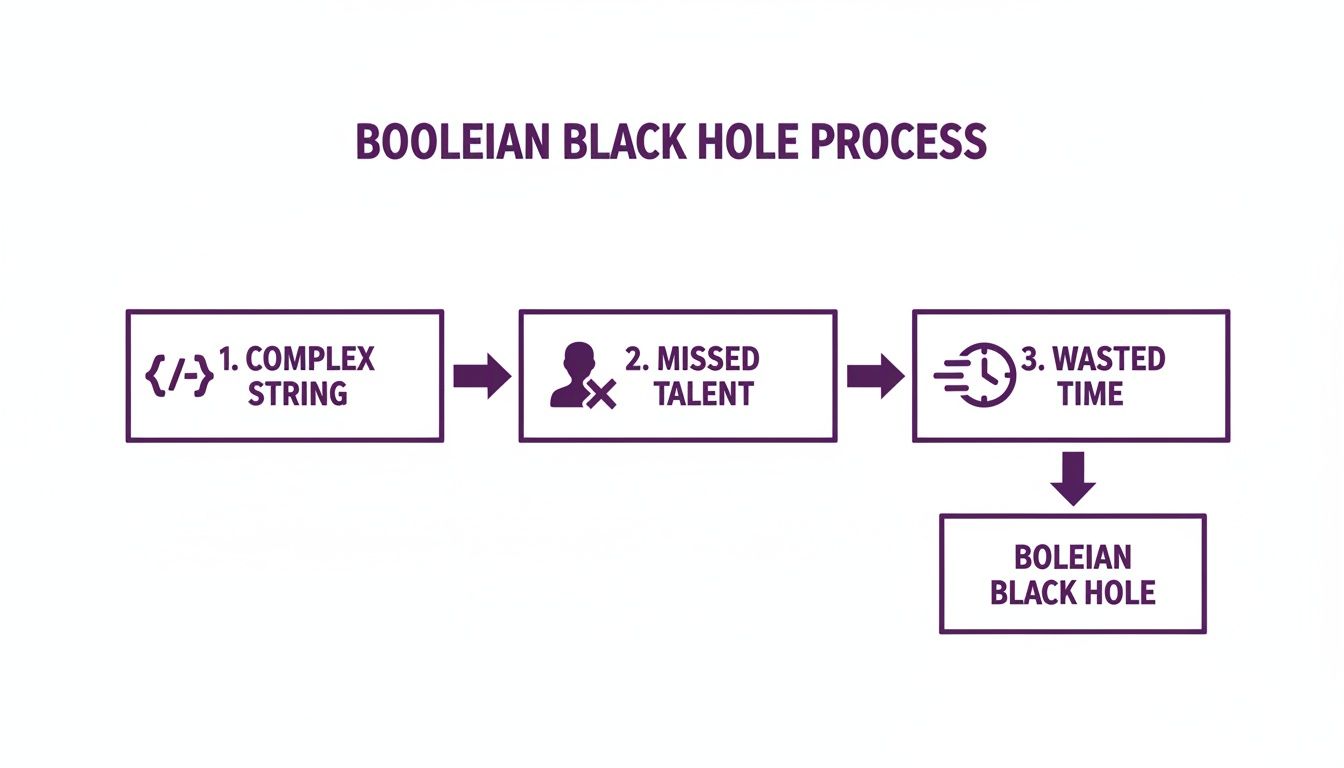
As the diagram shows, it's a frustrating loop of complex strings, trial and error, missed talent, and wasted time. Natural language search is the way out.
The results you get aren't just faster; they're smarter. The AI is smart enough to find engineers with the right career path, who have worked in environments that match the "Series B fintech startup" vibe, even if their profile doesn't spell it out in those exact words. It’s about context, not just keywords.
This isn't just a hypothetical advantage. Take Cognition, a top-tier AI research lab. They switched to PeopleGPT and used natural language searches to fill highly specialized roles 5x faster than with their previous methods. They completely skipped the Boolean bottleneck and went straight from a simple prompt to a pipeline of qualified candidates. This kind of impact on key recruiting metrics is why teams are making the switch.
| Step | Action in PeopleGPT | Recruiter Benefit |
|---|---|---|
| 1: The Prompt | Type the hiring manager’s exact request into the search bar — no Boolean required. | Eliminates 10–15 minutes of complex string-building and guesswork. |
| 2: Instant Analysis | AI deconstructs the request, understanding seniority, location, skills, and company profile. | No need to brainstorm keyword variations or manually list target companies. |
| 3: Contextual Search | Scans 800M+ profiles to match the concept, not just keywords. | Surfaces hidden gems and passive candidates missed by rigid Boolean logic. |
| 4: Curated Shortlist | Delivers a ranked list of the most relevant candidates in seconds. | Drastically reduces manual screening and focuses effort on best-fit talent. |
| 5: Actionable Insights | Provides verified contact info and key profile details for immediate outreach. | Moves from sourcing to engagement in under a minute, accelerating the hiring cycle. |
Ultimately, this ability to translate a simple sentence into a powerful, targeted search is the core advantage. It frees you up from being a query-building technician and lets you focus on what actually matters: talking to great candidates and building relationships.
Finding a solid list of candidates is a huge win, but it’s just the first step. The real work begins after you have that list. This is where a platform truly built on natural language searches shows its hand. The intelligence doesn't just stop at the search bar.
A modern sourcing platform weaves that same natural language understanding through your entire process, from the initial search all the way to the final offer. It’s about transforming a static list of profiles into a dynamic, intelligent engine for engagement. It's time to find an Indeed alternative that works smarter.
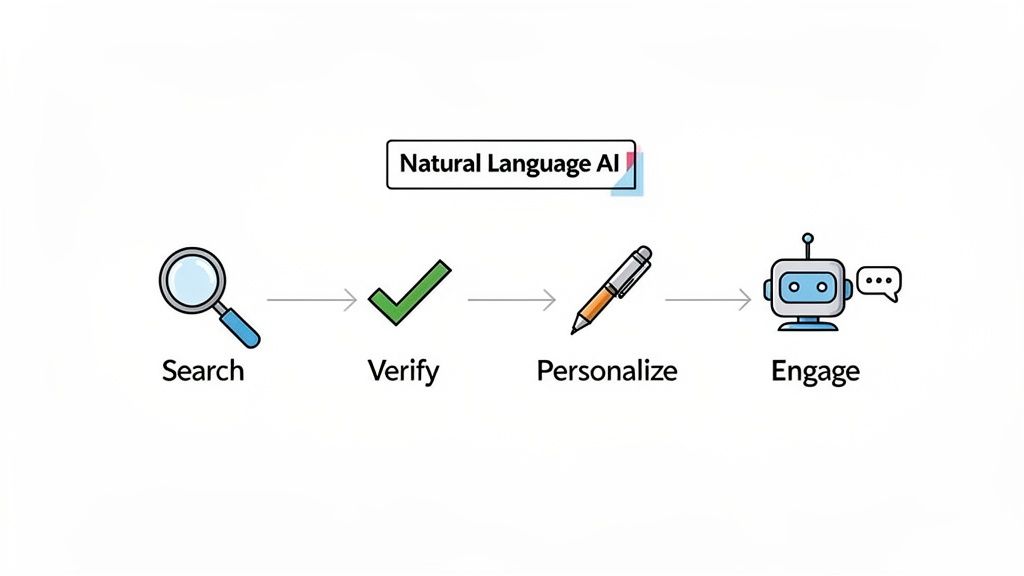
Once you’ve locked in your ideal candidates, the platform seamlessly pivots from finding to connecting. Here’s what that actually looks like:
This is the whole point. The same AI smart enough to understand the nuances of your search is also smart enough to understand the key details of a candidate's career and spin them into a compelling message. This is a non-negotiable part of effective automated recruitment software that delivers real results.
What if your sourcing could run 24/7, constantly learning and getting better on its own? That’s the idea behind autonomous sourcing agents. These aren't just simple bots; they’re AI-driven systems you can deploy to continuously hunt for candidates based on your exact criteria. You give the agent a prompt, just like you would a natural language search. It then works around the clock, uncovering new candidates and—most importantly—learning from your feedback.
Every time you approve or reject a profile, the agent refines its understanding of what a great fit looks like for that specific role. Over time, it becomes an extension of your own sourcing expertise, constantly feeding your pipeline with highly qualified talent. This integrated approach flips the old recruiting equation on its head.
Yes. It understands context and intent, making it powerful for finding a marketing leader with specific brand experience or a niche machine learning engineer.
The learning curve is almost zero. If you can describe your ideal hire to a colleague, you can use it. You can get a qualified list in under 60 seconds.
Absolutely. Top platforms layer natural language on top of the granular filters you're used to—like diversity, company stage, and funding. It’s the best of both worlds.
No. While it enhances your searches on platforms like LinkedIn, true natural language tools search across hundreds of millions of profiles from the entire open web, not just one network.
Let's be honest. Relying on old-school sourcing methods is like bringing a knife to a gunfight. While your competitors are stuck wrestling with Boolean strings, you could be tapping into hidden talent pools they’ll never see.
The core benefit of adopting natural language search is reclaiming your time. You stop spending hours fighting clunky syntax and get back to what you do best: building relationships with candidates. This shift unlocks a faster, smarter, and more effective sourcing engine, allowing you to consistently deliver top-tier talent without the manual burnout. The future of finding talent is conversational, and the teams who get on board first are the ones who will win.
{{large_cta}}
Run your first search for free. Find and engage top talent across 800M+ profiles. Trusted by 5,000+ customers.


![The Complete Guide to Talent Pipeline Management [2026]](https://cdn.prod.website-files.com/68c2f83ae8165ab45cf529f8/6953a268c9a0db82016c122a_talent-pipeline-management-workforce.webp)
.png)