.svg)
SIGN UP FOR JUICEBOX (IT’S FREE!)

Who are you looking for?
Thank you! Your submission has been received!
Oops! Something went wrong while submitting the form.

![The Best Lattice Alternatives for Performance & Sourcing [2026 Guide]](https://cdn.prod.website-files.com/68c2f83ae8165ab45cf529f8/6968954604aebd8ce85eb6ce_lattice-alternatives-alternatives-comparison.jpeg)
Lattice is a solid tool for performance and talent management, but let's it's not a silver bullet. Modern HR teams are increasingly seeking Lattice alternatives because they need best-in-class features for critical jobs like talent acquisition, something all-in-one platforms tend to treat as an afterthought.
In this guide, we'll cover guide provides a clear framework for choosing the right HR tools, whether your priority is internal engagement or external hiring. We'll show you why the "all-in-one" dream often fails and how a modular HR stack can save you money and deliver far better results.
This isn't just about swapping one tool for another; it's about building a modern, high-performance HR function.
Let's dive right in:
The hunt for Lattice alternatives isn't about a simple one-to-one swap. It's about a fundamental shift in how high-performing companies build their tech stacks. While Lattice excels at managing your internal talent with performance reviews and engagement surveys, it hits a wall right where external talent acquisition begins.
But there's a problem most tools ignore...
This gap forces a critical question: Do you want one platform that does everything okay, or do you want the best tool for each specific job?
Most HR leaders believe a single, unified HR platform is the key to efficiency. The opposite is true. A monolithic system forces every team—from People Ops to Talent Acquisition—to make compromises.
Think about it: the features that make a great performance management tool are worlds apart from what an elite sourcing team needs. When you smash them together, you get a clunky, jack-of-all-trades experience where nothing really shines.
What happens next?
Your recruiters are stuck with subpar sourcing tools while your People Ops team is drowning in features they'll never use. You might think an integrated suite cuts down on complexity, but it just creates hidden bottlenecks. A recruiter trying to find scarce engineering talent inside an all-in-one HRIS is like trying to fish in the ocean with a bucket. It's just the wrong tool for the job.
The AI-powered talent sourcing market has exploded. For instance, Juicebox’s PeopleGPT platform showed how modern AI tools scale efficiently by reaching $10M+ in Annual Recurring Revenue with 10x year-over-year growth, serving over 2,500 paying customers. This proves the massive trend of companies ditching expensive legacy platforms for multi-source AI solutions that cost up to 80% less.
Instead of betting everything on one vendor, forward-thinking teams are building a "disaggregated" or modular HR stack. This just means picking the best tool for each core function and making sure they talk to each other.
This approach gives you a massive strategic advantage. By combining specialized tools, you create a system that’s more agile, cost-effective, and way more powerful than any single platform could ever be. Modern HR teams are always looking for innovative tools to boost employee engagement, and a modular stack lets them pick the perfect solution without being locked into one vendor's ecosystem. Our guide to the best sourcing tools for recruiters explores this further.
Picking the right HR platform isn't about finding a mythical, one-size-fits-all solution. It's about matching the right software to the right job at the right time. The best Lattice alternatives aren't just copycats; they’re specialists that dominate in the specific areas where all-in-one platforms inevitably compromise.
This means you need to ditch the simple feature checklist.
Instead, get laser-focused on your team's most critical "job-to-be-done." Are you trying to dial in employee engagement, or are you in a street fight for top-tier engineering talent? The answer completely changes the tool you need. A classic mistake is thinking a single, integrated suite will make life easier. Sure, bundling performance management with recruiting sounds efficient on a sales call, but it rarely works in the real world. A much smarter approach is to evaluate tools based on their core purpose.
First things first: what is the single biggest problem you need to solve right now? Is it keeping your top performers engaged with better feedback cycles, or is it building a candidate pipeline to double your headcount this year? Be brutally honest about your priorities.
Getting this first step right is everything. It immediately narrows the playing field and stops you from overpaying for a bloated platform packed with features your team will never touch. For more details on HR systems, see our human resources software guide.
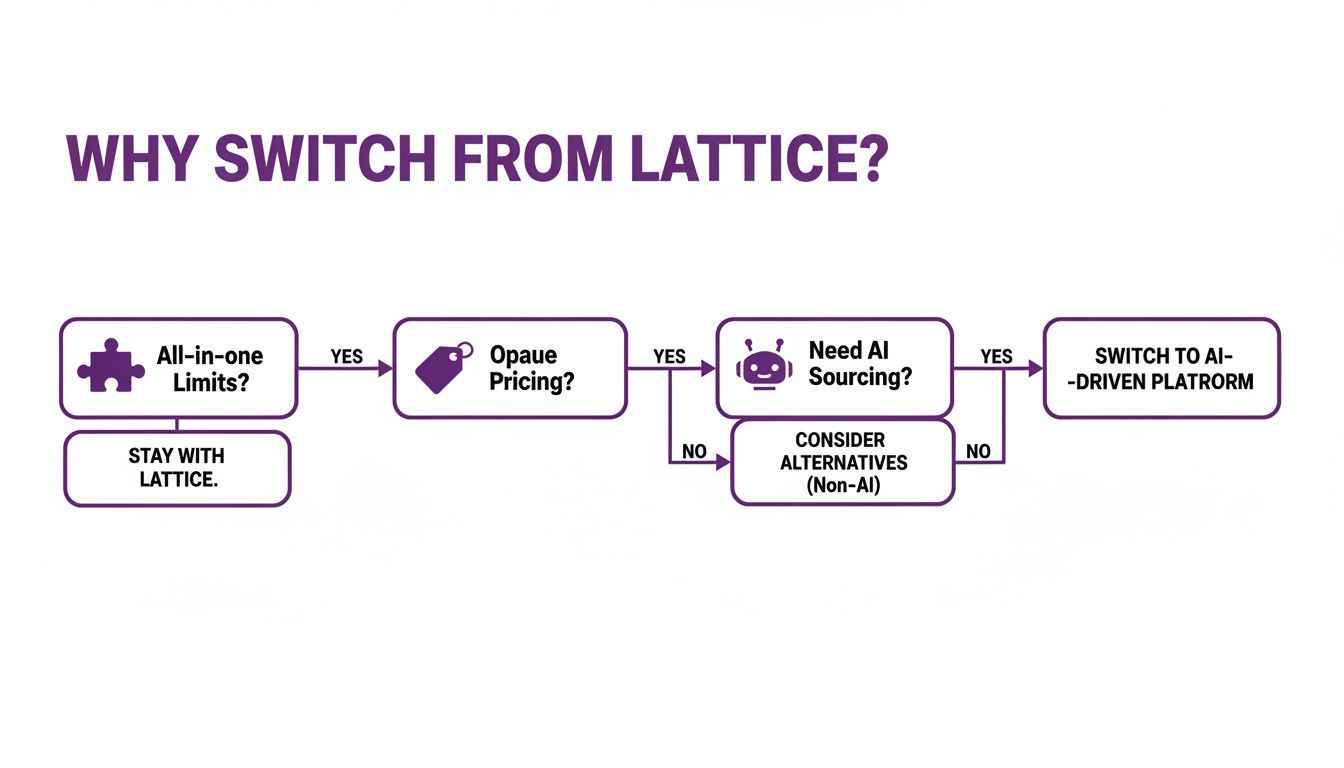
As you can see, the main drivers for exploring new platforms come down to functional limitations, opaque pricing, and the need for dedicated AI sourcing capabilities.
This matrix is a quick way to pinpoint the best category of tool based on your primary goal and company size. It helps cut through the noise and focus on what will actually move the needle for your team.
| Primary HR Goal | Best for Startups (10–100 Employees) | Best for Mid-Market (101–500 Employees) | Best for Enterprise (500+ Employees) |
|---|---|---|---|
| Performance Management | 15Five, Leapsome | Culture Amp, Lattice | Workday, Oracle HCM |
| Employee Engagement | Officevibe, Culture Amp | Glint, Lattice | Qualtrics, Medallia |
| Talent Sourcing | Juicebox (PeopleGPT) | Juicebox, SeekOut | Beamery, Eightfold AI |
| All-in-One HRIS | Rippling, Gusto | Rippling, BambooHR | Workday, SAP SuccessFactors |
Whether you're a startup needing agile sourcing or an enterprise focusing on engagement analytics, matching the tool to the context is key.
Once you know your core need, think about your company's size and current tech stack. A 50-person startup has wildly different needs than a 500-person scale-up.
A startup will probably prioritize speed and ease of use, while a mid-market company needs robust integrations with their existing Applicant Tracking System (ATS) and HRIS.
Look for a platform that solves today's problem but won't hold you back tomorrow. Does it have a flexible pricing model that scales as you grow? More importantly, how well does it play with the tools you already use daily? A SHRM report found that seamless integration is a top priority for 74% of HR professionals. Your new tool has to fit into your ecosystem, not force you to rebuild it from scratch.
Finally, look past the sticker price. You need to analyze the total cost of ownership and the actual return on investment. Too many enterprise platforms hide their real costs behind demo gates and pushy multi-year contracts.
Transparent, self-service pricing is the new standard for modern software. You should be able to see costs upfront and know exactly what you're paying for. This isn't just about building trust; it allows you to calculate a clear ROI. For example, if an AI sourcing tool costs $1,500 a year but helps your team close just one extra senior role, the ROI is immediate and massive. Go with a partner who has a clear, predictable pricing model that aligns with the value they deliver, unlike the opaque structures seen in our SeekOut pricing analysis.
Thinking about Lattice alternatives isn't about finding a one-to-one replacement. It’s about deciding which job is most critical for you to solve right now and picking the specialist tool built to crush it. The "all-in-one" dream often leads to a reality where no single function is truly best-in-class.
Let's break this down.
If your main bottleneck is nurturing and keeping your internal talent, you need a platform that’s obsessed with feedback cycles, goal tracking, and employee sentiment. This is Lattice’s playground, but a few focused competitors offer a much deeper, more intuitive experience.
You might think more bundled features are always better. But this logic is flawed. A tool trying to be the best at performance reviews and talent sourcing will inevitably be just okay at both. Why does that fail? A specialized tool pours all its R&D into perfecting one critical workflow, delivering far better results for that specific job. For a deeper look at HRIS options that often pair with these tools, check out our guide comparing popular BambooHR alternatives.
This is where all-in-one platforms like Lattice completely miss the mark. Sourcing top talent, especially for competitive tech roles, demands a specialized, data-intensive tool that scours the entire web—not just your internal employee directory. Lattice simply wasn't built for this job.
Let’s look at the leaders in this space.
Juicebox is built from the ground up for speed and precision, designed to obliterate the slow, manual work of old-school sourcing.
Juicebox's real magic is its blend of simplicity and power. It turns a painful, multi-step research project into a single command, letting one recruiter build a pipeline of 5,000+ scored profiles in minutes.
These platforms are powerful sourcing aggregators, but they represent an older way of working.
The fundamental difference is philosophical. SeekOut and HireEZ give you a giant database and a complex toolkit to manually dig through it. Juicebox uses AI to understand exactly who you're looking for and brings the best matches directly to you.
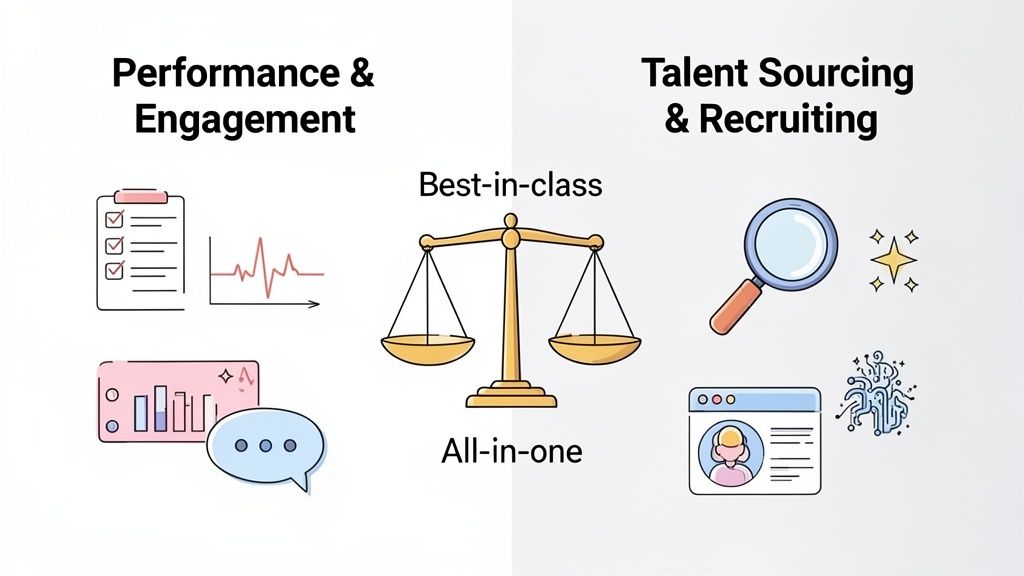
Ultimately, choosing the right Lattice alternatives is about pinpointing your biggest bottleneck. If it's internal engagement, a tool like 15Five or Culture Amp is your answer. But if it's external hiring, a specialized AI platform like Juicebox is the only way to compete.
Let's get one thing straight: Lattice is not a sourcing tool. Trying to use it to find external candidates is like bringing a hammer to a software problem—it’s just the wrong instrument for the job. High-stakes recruiting demands a platform built to scan the entire web, not just your internal employee list.
This is where dedicated alternatives to Lattice for talent acquisition are no longer a nice-to-have, but a necessity.
The old way of sourcing is a fragmented mess. You're juggling LinkedIn Recruiter for the search, another tool to verify emails, and a third to run outreach sequences. This disjointed process is a huge reason why recruiters report wasting an average of 13 hours per week on sourcing for just one role.
An AI-native platform like Juicebox pulls this entire process into a single, cohesive workflow. Here’s what that modern cycle actually looks like:
When you're looking for innovative ways to find top candidates, especially in today's market, it's also worth tapping into specialized remote-first talent platforms that connect you directly with a global talent pool.
This is what an AI-generated candidate search looks like in Juicebox.
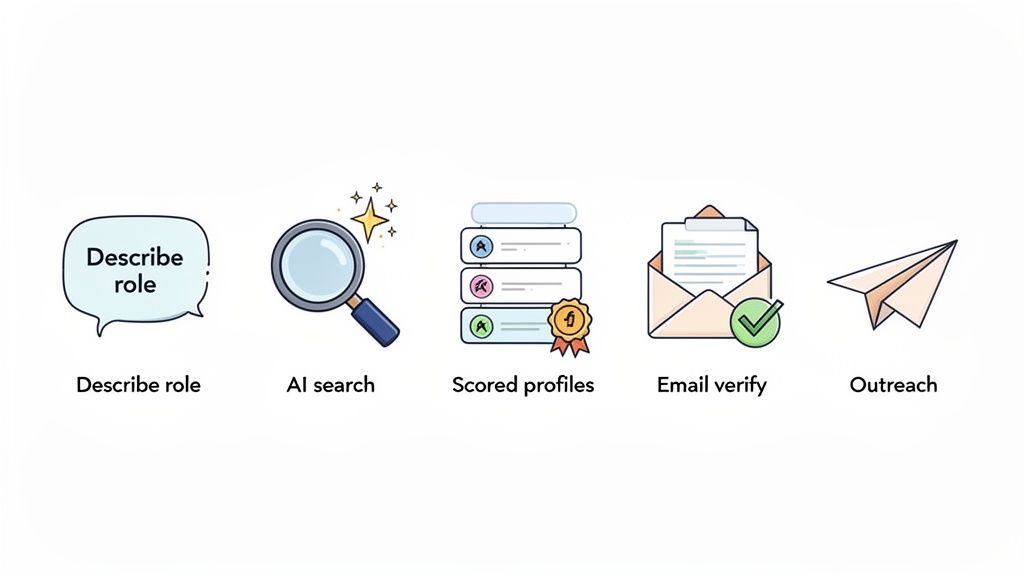
The interface takes a simple prompt and immediately returns a rich, scored list of candidates, completely wiping out the need for manual Boolean construction.
Finding profiles is only half the battle. The critical next steps are verifying their contact info and starting the conversation—all from the same place.
This unified workflow is the core advantage. By handling search, verification, and outreach in one place, teams can source up to 80% of their hires from outside the saturated LinkedIn ecosystem and close roles 5x faster.
This is a capability that's entirely outside the scope of an internal-facing performance tool like Lattice. For a deeper look at this workflow, check out our complete guide on AI sourcing and see how it’s reshaping talent acquisition.
When you're looking at Lattice alternatives, the conversation always seems to drift toward features. But the real kicker, the one most vendors hope you'll ignore, is the staggering, often hidden, cost of a bundled, all-in-one HR suite.
It sounds smart on paper, right?
The reality is that this approach almost always leads to overpaying for modules you barely use or, worse, underperforming tools in critical areas like talent sourcing.
The HR software world really comes down to three different pricing philosophies.
The biggest problem with bundled suites is value dilution. You’re forced to accept a mediocre sourcing module as part of a package deal, even when you know it can't hold a candle to a dedicated, specialized tool.
Let's put some real numbers to this. Imagine you're a 150-employee tech company trying to decide on your stack.
To make this even clearer, here’s a table breaking down the annual costs for our hypothetical 150-person company.
| Tool or Stack Component | Primary Function | Pricing Model | Estimated Annual Cost |
|---|---|---|---|
| All-in-One Suite | HRIS, performance management, recruiting | Bundled PEPM | $35,000 – $50,000+ |
| Culture Amp | Performance & engagement | PEPM | $10,000 – $15,000 |
| Juicebox | AI sourcing & recruiting | Credit-based | $5,000 – $10,000 |
| Total for Specialized Stack | Best-in-class tools | Transparent | $15,000 – $25,000 |
The financial difference is stark, isn't it? But the real story is in the results.
We see companies consistently slash their sourcing spend by up to 80% just by switching from legacy tools like LinkedIn Recruiter to an AI-powered alternative like PeopleGPT. The pricing models between modern tools and older platforms are worlds apart, something a deeper look into HireEZ pricing often highlights.
Forget about finding a single Lattice alternative that does everything. The real goal is to build a smarter, more agile HR stack—one that's modular by design.
The future of HR tech isn't about forcing every team into a one-size-fits-all suite. It’s about giving your specialized teams the absolute best tool for their specific job. No compromises.
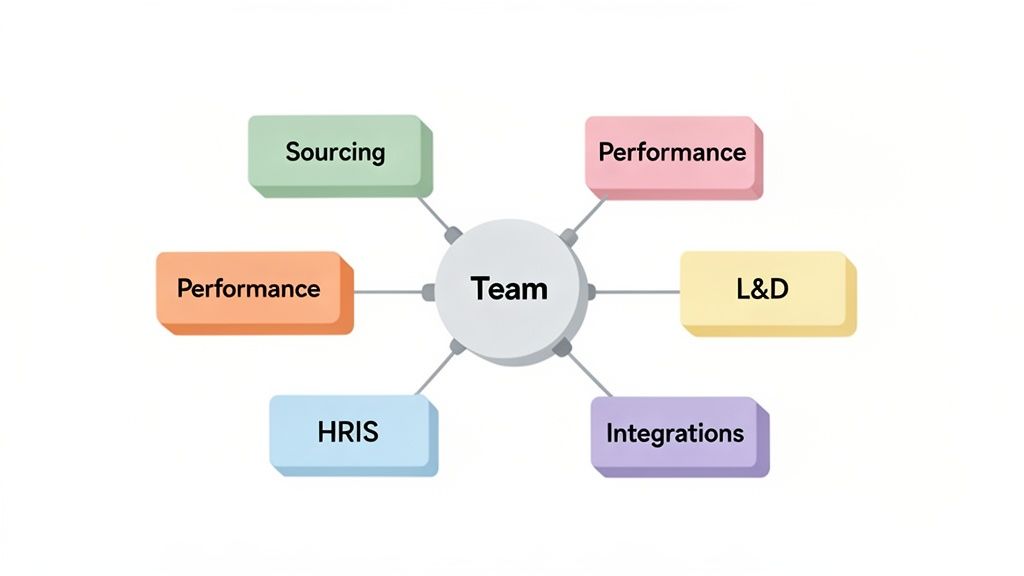
This modular approach gives you speed, saves money, and ultimately leads to better hires.
A modern HR stack lets each piece of software do what it does best, all while feeding data back to a central system. Think of it as a hub-and-spoke model:
The beauty of this unbundled approach is that you can upgrade or swap out a single tool—say, your sourcing platform—without having to rip out your entire HR infrastructure.
Why not use an all-in-one HRIS for sourcing talent?
Most HRIS platforms are designed for internal employee management, not for searching external candidate databases across the web.
How does AI improve upon traditional sourcing methods like Boolean?
AI understands natural language, eliminating the need for complex, error-prone Boolean strings and delivering more relevant results faster.
Is an AI sourcing tool difficult to integrate with my ATS?
Modern platforms like Juicebox are built with over 40 native integrations for leading ATS and CRM systems, ensuring a seamless data flow.
The core benefit of breaking up your HR stack is functional excellence without compromise. You get a world-class sourcing engine, a top-tier performance platform, and a reliable HRIS—all working in concert. This strategic unbundling empowers your teams to operate at their absolute peak, unlocking the ability to not just fill roles reactively, but to proactively build a talent pipeline that becomes a lasting competitive advantage.
{{large_cta}}
Run your first search for free. Find and engage top talent across 800M+ profiles. Trusted by 5,000+ customers.