
.svg)
SIGN UP FOR JUICEBOX (IT’S FREE!)

Who are you looking for?
Thank you! Your submission has been received!
Oops! Something went wrong while submitting the form.

The global workforce is in the middle of a massive shift. Bringing on an independent contractor is no longer just a stopgap measure for temporary projects; it's a core pillar of modern business strategy. For smart, agile companies, this isn't about cutting corners—it's about gaining a serious competitive advantage.
Think of the global talent pool like a vast ocean. For years, most companies only fished from the small, local pond of full-time employees. But now, a perfect storm of economic, tech, and cultural changes has opened the floodgates to a global ocean of elite, specialized talent who choose to work this way. This guide isn't about drowning you in compliance talk. Instead, it’s a playbook for leveraging the independent contractor model to build a world-class, flexible team.
The core benefit is as simple as it is powerful: access to specialized skills on demand.
But there's a problem most companies ignore... they try to manage contractors with an employee-centric mindset, creating legal risks and operational friction. Juicebox helps companies like yours build scalable, compliant contractor workforces, avoiding the common pitfalls that slow down growth.
This simple shift unlocks the ability to:
And the data backs this up. The U.S. Bureau of Labor Statistics found that 11.9 million people worked as an independent contractor in their main job as of July 2023. That's 7.4% of the entire workforce.
Pattern Interrupt: Your Talent Reservoir Awaits
Most companies are still hiring with an outdated playbook, focusing only on W-2 employees. This leaves the massive, skill-rich reservoir of independent talent completely untapped. The myth is that contractors are a "last resort" or less committed. The reality? Top-tier professionals now actively prefer contract work for the autonomy and focus on high-impact projects it provides. If you don't adapt your hiring strategy, you're left competing for a shrinking talent pool while your competitors tap into a global network of on-demand experts. This is bigger than just filling roles; it's about building a dynamic, resilient organization ready for what's next. For more on this, see how to find a freelance recruiter.
TL;DR: Your Quick Guide to the Contractor Economy
The independent contractor model has gone from a niche hiring tactic to a central piece of global business strategy. This isn't by accident—it's driven by a growing wave of elite talent who prefer flexible, project-based work. For businesses, this creates a huge strategic advantage, allowing them to access specialized skills on demand, scale with precision, and build more agile teams. Mastering contractor hiring is no longer optional; it’s essential for staying competitive.
Getting worker classification right is easily the most critical step when you bring on an independent contractor. It’s the bedrock of your entire flexible talent strategy. Mess this up, and you’re not looking at a minor compliance headache—you’re facing down six-figure fines, retroactive benefit claims, and legal battles that can seriously destabilize your business.
What's the bottom line? A lot of hiring managers think a signed contract that says "contractor" is an ironclad defense. That's a common and incredibly expensive myth.
Government agencies like the IRS and state labor departments care about the reality of the working relationship, not just the paper it’s written on. They look at what you do, not what the contract says.
Instead of getting bogged down in legal jargon, think of classification as a balancing act. The IRS generally looks at the degree of control and independence across three key areas:
This flowchart offers a straightforward way to think through whether a role is a better fit for a contractor or a full-time employee.
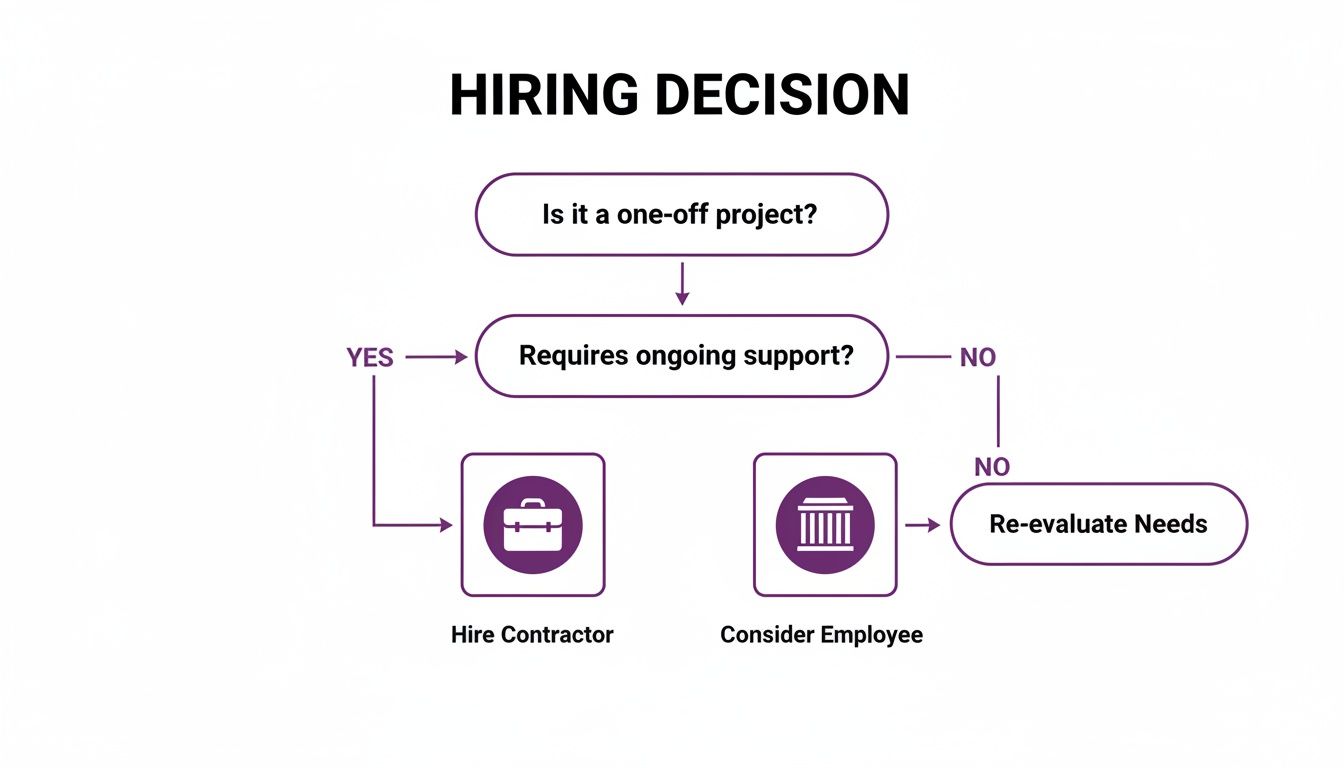
As the visual shows, roles tied to specific, one-off projects are perfect for an independent contractor. If the need is ongoing and requires continuous support, an employee is almost always the right call. The wrong choice can lead to issues like malicious compliance.
While the IRS framework is a good starting point, many states—like California, New Jersey, and Massachusetts—have adopted a much stricter standard called the ABC Test.
Here's the deal. Under this test, a worker is automatically presumed to be an employee unless the company can prove all three of the following conditions are met. Fail just one, and they’re an employee in the eyes of the law.
That "B" prong is the real tripwire. If you run a marketing agency and you hire a freelance copywriter, it’s tough to argue their work is "outside the usual course" of your business. This is where so many companies get into trouble.
And the consequences are massive. In August 2025, GrubHub had to agree to a $24.75 million settlement for a class-action lawsuit involving 60,000 drivers who claimed they were misclassified. This stuff isn't theoretical; it’s a major financial risk. You can learn how to streamline your recruitment process to build these checks in from the very beginning.
To help you keep these distinctions straight, here’s a quick-glance table breaking down the core differences.
FactorIndependent ContractorEmployeeControl Over WorkControls how the work is done.Company directs how, when, and where work is done.Tools & EquipmentUses their own equipment and tools.Company provides necessary equipment (laptop, software, etc.).Financial IndependencePays their own business expenses; can take on other clients.Company reimburses expenses; usually works for one employer.PermanenceEngaged for a specific project with a defined end date.Hired for an ongoing, indefinite relationship.Core FunctionPerforms work that is ancillary or supplemental to the business.Performs work that is a key part of the company’s core business.
Ultimately, it all comes back to a single theme: demonstrating genuine independence. The more control you exert, the more likely the worker will be seen as an employee.
Sourcing a top-tier independent contractor requires a completely different playbook than recruiting for W-2 roles. Forget about long-term company culture, benefits, or PTO. This game is all about speed, the value of the project, and flexibility.
The best contractors are business owners, not job seekers. They're evaluating your opportunity based on the project's challenge, the clarity of your scope, and, of course, the rate.
But here’s the problem: most sourcing tools are built from the ground up to find full-time employees. Their filters, their data, their entire search logic is geared toward permanent hires. This makes trying to isolate a true freelance professional an absolute nightmare, forcing recruiters into a manual slog through thousands of profiles, guessing who might be open to contract work.
To attract elite independent talent, you have to go where they are and speak their language. That means looking beyond the traditional ponds like LinkedIn and using tools designed to specifically identify professionals who list 'contract' or 'freelance' on their profiles. Consider these Indeed alternatives to expand your search.
And believe me, the talent is out there. They're increasingly choosing this model. An estimated 59 million Americans now freelance, and a whopping 80.3% of them prefer it over a traditional W-2 job. More importantly for hiring managers seeking specialized skills, 20% of full-time independent contractors earn over $100,000 per year. The best of the best are operating in this space.
Pattern Interrupt: Your Sourcing Tools Are Working Against You
You might think your current recruiting stack is good enough. But why does that fail? Legacy platforms are designed to find loyal employees, rewarding tenure and punishing "job hopping"—which is the very definition of a successful contractor's career. When you use these tools, you're systematically filtering out the most experienced and versatile contractors whose resumes are a mosaic of high-impact projects, not a straight corporate ladder. This conventional approach leaves you competing for the same tiny pool of candidates while the real experts remain completely invisible to your searches.
This is where AI-powered sourcing tools give you a massive edge. Instead of wrestling with complex Boolean strings, you can use natural language to describe exactly who you need. It’s a total game-changer. For example, GitLab used AI to source 150+ qualified engineering candidates in just one week, a process that would have taken months.
For example, a search in PeopleGPT shows just how fast you can find freelance data engineers with a specific tech stack.
This simple, AI-driven search pulled up over 50 qualified freelance data engineers in under a minute. That's a task that would take hours—if not days—using old-school methods. The key is the ability to search across dozens of platforms and understand the unique nuances of a contractor's profile. You can see how this works in our detailed guide on how to use AI sourcing to find talent faster.
Once you've found a few potential candidates, your outreach needs to be completely different. Ditch the standard recruitment email that talks about company perks and culture. Your message needs to read like a project proposal.
An effective pitch for an independent contractor gets straight to the point:
This kind of direct, business-to-business communication respects their time and instantly positions you as a serious client. It tells them right away if the project is a good fit, which means you get faster, more qualified responses. Check out these templates for recruitment emails.
So, you've found a fantastic independent contractor. Great. The next step is locking in the relationship with a rock-solid agreement. This isn't just about ticking a box for HR; it's the architectural blueprint for the entire project. A well-written agreement, often called a Statement of Work (SOW), is your best defense against scope creep, misaligned expectations, and legal headaches down the road.
Think of it as the "rules of the road" for your engagement. Without one, you're essentially driving at night with the headlights off. Ambiguity is the sworn enemy of successful contract work, and a vague SOW is an open invitation for misunderstandings and disputes.
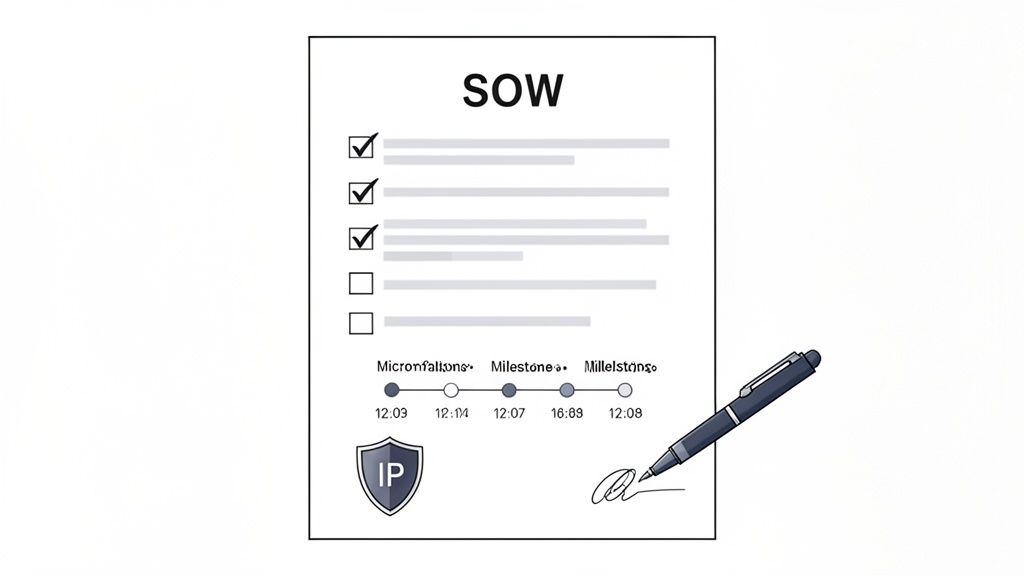
A strong SOW leaves nothing up for debate. It translates your project goals into clear, actionable terms that both sides agree on before a single minute of work begins. Here's what every single agreement needs to include.
Getting these details right sets the stage for a professional and productive partnership from the start.
Once the ink is dry on the contract, you’ve got to tackle the operational and financial side of working with an independent contractor. This isn't anything like running your standard W-2 payroll, and getting it right is crucial for staying compliant and keeping your projects running smoothly.
For any contractor based in the U.S., the entire process kicks off with one non-negotiable document: Form W-9. Before a single dollar changes hands, you must have a completed and signed W-9. This form gives you their legal name, business structure, address, and Taxpayer Identification Number (TIN). Think of it as your official record for the IRS.
Here's the most important difference from hiring an employee: you do not withhold any taxes from a contractor's pay. They're on their own for income and self-employment taxes. Your only job is to report what you paid them.
If your payments to a contractor hit $600 or more in a calendar year, the IRS requires you to send them a Form 1099-NEC (Nonemployee Compensation). The deadline for this is January 31st of the following year.
This isn't a friendly suggestion; it's a hard-and-fast legal requirement. Failing to file 1099s can lead to some pretty hefty IRS penalties. It's the contractor's version of a W-2 and the primary way the government tracks their income.
This reporting step reinforces their status as a separate business. From their perspective, the game is all about maximizing legitimate write-offs. It's helpful to see their side of the coin by checking out a 1099 tax deductions list to understand their financial motivations.
Pattern Interrupt: Your Payment Process Is a Compliance Risk
You might think paying a contractor through PayPal or a simple wire transfer is easy enough. But as you start working with more contractors, this manual approach quickly turns into a compliance minefield. You end up with inconsistent payment schedules, misplaced W-9s, and a frantic scramble at the end of the year to tally up payments for 1099s. This messy process doesn't just cause administrative headaches—it can actually weaken a contractor's independent status by making the whole arrangement feel too informal, less like a proper business-to-business deal.
The move toward hiring independent contractors isn't just a U.S. trend; it's a global one. The World Bank estimates a staggering 435 million people are now working through online gig platforms, with demand for that work jumping by about 40% since 2016. In the U.S. alone, the 73.3 million freelancers counted in 2023 are expected to blow past 90 million by 2028. The Bureau of Labor Statistics offers even more detail on these labor trends.
This global talent pool is a massive strategic advantage, but it also brings a whole new layer of complexity to payments and compliance. Paying an engineer in Brazil is a world away from paying a designer in California. You've got to think about:
This is where specialized contractor payment platforms become absolutely essential. At Juicebox, we see fast-growing companies build incredible global teams by using platforms that automate all this. These tools handle currency conversion, generate locally compliant contracts, and make cross-border payments simple. It frees companies up to hire the best person for the job, no matter where they live. If you're looking at your options, there are plenty of great Deel alternatives out there built specifically for managing global contractors.
A great onboarding experience is the secret sauce for turning a one-off project into a long-term strategic advantage. Get it right, and you’ll build a reliable bench of on-demand talent, making you the first person top-tier professionals want to work with again.
The goal isn't to mirror your employee onboarding. Far from it. This is about creating a lightweight, efficient process that gives them the access and context they need without blurring the lines of their independent contractor status.
It should be quick, clear, and professional—arming them with what they need to deliver stellar work, not immersing them in company culture. While it needs to be distinct from traditional employee integration, some core principles from an effective onboarding new employees checklist can be adapted to ensure everyone starts on the same page.
Think of contractor onboarding as a project kickoff, not a welcome party. The focus is squarely on the work at hand. Your only goal is to get them productive as fast as humanly possible.
Here are the absolute essentials:
Pattern Interrupt: Why Your Employee Onboarding Fails for Contractors
You might think using a stripped-down version of your employee onboarding is efficient. It's actually a massive compliance risk. Employee onboarding is designed to integrate someone into your company’s culture, systems, and long-term vision.
Applying that same mindset to an independent contractor can easily be seen as exercising excessive behavioral control—a major red flag for misclassification. This approach muddies the legal waters and signals to the contractor that you see them as a temporary employee, not a separate business partner. The key is separation, not integration.
Just as important as a smooth start is a clean finish. A professional offboarding process ties up all loose ends, protects your company, and leaves the door wide open for future collaborations.
Once the final deliverable is approved, run through this simple checklist:
To help structure your approach, a comprehensive 7-step onboarding process checklist can be a useful reference for building out your own lightweight version.
No. Contractors are responsible for their own benefits like health insurance and retirement savings. Offering them is a major red flag for misclassification.
A 1099 reports payments to non-employees (contractors), while a W-2 reports wages and taxes withheld for employees. They signify different legal relationships.
Generally, no. Restricting a contractor's ability to work for others can be seen as control, which risks misclassification. Use a strong NDA instead.
Yes. Their freedom to work with multiple clients is a core part of their independent status. Trying to restrict this is a major compliance risk for you.
Mastering the art of hiring an independent contractor is about more than just filling a temporary gap; it's about gaining the strategic advantage of access to specialized skills on demand.
What this unlocks is the ability to build a truly modern, agile organization. You can assemble project-based dream teams, tap into a global talent pool, and scale your capabilities without being weighed down by fixed overhead. This isn't just a hiring tactic—it's the new operating system for competitive businesses.
{{large_cta}}
Run your first search for free. Find and engage top talent across 800M+ profiles. Trusted by 5,000+ customers.



.png)