.svg)
SIGN UP FOR JUICEBOX (IT’S FREE!)

Who are you looking for?
Thank you! Your submission has been received!
Oops! Something went wrong while submitting the form.

When you hear HR outsourcing, what comes to mind? For many, it's delegating tasks like payroll or benefits administration to an outside company. That's true, but it's only a sliver of the story. Modern HR outsourcing is less about offloading work and more about installing a critical operating system that lets you scale without getting tangled in administrative knots—a strategic advantage that sets high-growth companies apart. We don't just offload HR; we embed expertise to move faster.
But there’s a problem most tools ignore…
Traditional outsourcing models are broken. They were built for a slower, more predictable business world. For a tech company that needs to hire 20 engineers this quarter, a classic provider becomes a bottleneck. This is why a new, tech-first approach is essential for survival.
TL;DR: The Modern HR Outsourcing Playbook
Let's get one thing straight: modern HR outsourcing isn't just about saving a few bucks—it’s a massive strategic advantage.
Think of it like adding specialized 'apps' to your business. Need flawless payroll and compliance? There's an app for that. Facing the headache of managing complex employee benefits? There's an app for that, too. This approach frees up your internal team to do what they do best: focus on innovation, build a killer product, and nurture a world-class culture.
What's the bottom line?
This isn't just theory. The market swelled from an already impressive $190.68 billion in 2018 to $248.97 billion in 2023 and is projected to hit $291.59 billion by 2026, according to reports from Research and Markets, cementing its place as a core part of modern business.
So, what's driving this massive shift? The scope of HR itself has exploded. It’s no longer just about hiring and firing. A modern people operations team has to juggle:
For a startup or a rapidly scaling company, trying to handle all of this internally isn't just inefficient—it's a huge risk. One payroll mistake or compliance slip-up can have serious consequences. Handing these functions over to a dedicated expert is often the smarter, safer play. It allows your internal leaders, who might already be stretched thin acting as a fractional HR generalist, to focus on high-impact work like employee engagement and performance management.
Trying to understand HR outsourcing can feel a bit like picking a new phone plan—there’s a sea of acronyms and confusing terms. But once you cut through the noise, it really comes down to one question: How much control do you want to keep versus how much you’re willing to hand over?
Let's break down the main players.
Think of a Professional Employer Organization (PEO) as entering into a "co-employment" relationship. You’re essentially leasing a fully-formed HR department. The PEO becomes the employer of record for your team, handling everything from payroll and benefits to compliance, all under their own tax ID.
This model can be a total lifesaver for early-stage startups. You get instant access to enterprise-level benefits that would be impossible to secure on your own, which gives you a fighting chance when competing for top talent against giants like those on this Indeed alternatives list.
With a PEO, you typically get:
But here's the catch, especially for agile tech companies. While a PEO seems like the safest bet, you’re often forced to use their systems and processes. This can mean giving up strategic control over how you attract talent and shape your company culture—a potential dealbreaker when you need to innovate and move fast.
Unlike the all-in PEO model, Human Resources Outsourcing (HRO) is more like hiring a specialist for a specific job. You get to pick and choose which functions you want to offload while keeping everything else in-house. It’s a straightforward service contract—no co-employment needed.
This approach is perfect for companies that already have a good internal HR foundation but need expert help in a few key areas. For instance, you could keep your strategic talent management in-house but outsource the messy, time-consuming task of benefits administration. This is often called "selective HRO."
Business Process Outsourcing (BPO) is just a broader category that includes HRO. BPO covers outsourcing any business function, like customer service or accounting, while HRO is strictly focused on the people part of the business.
This visual shows the main drivers behind the move to HR outsourcing.
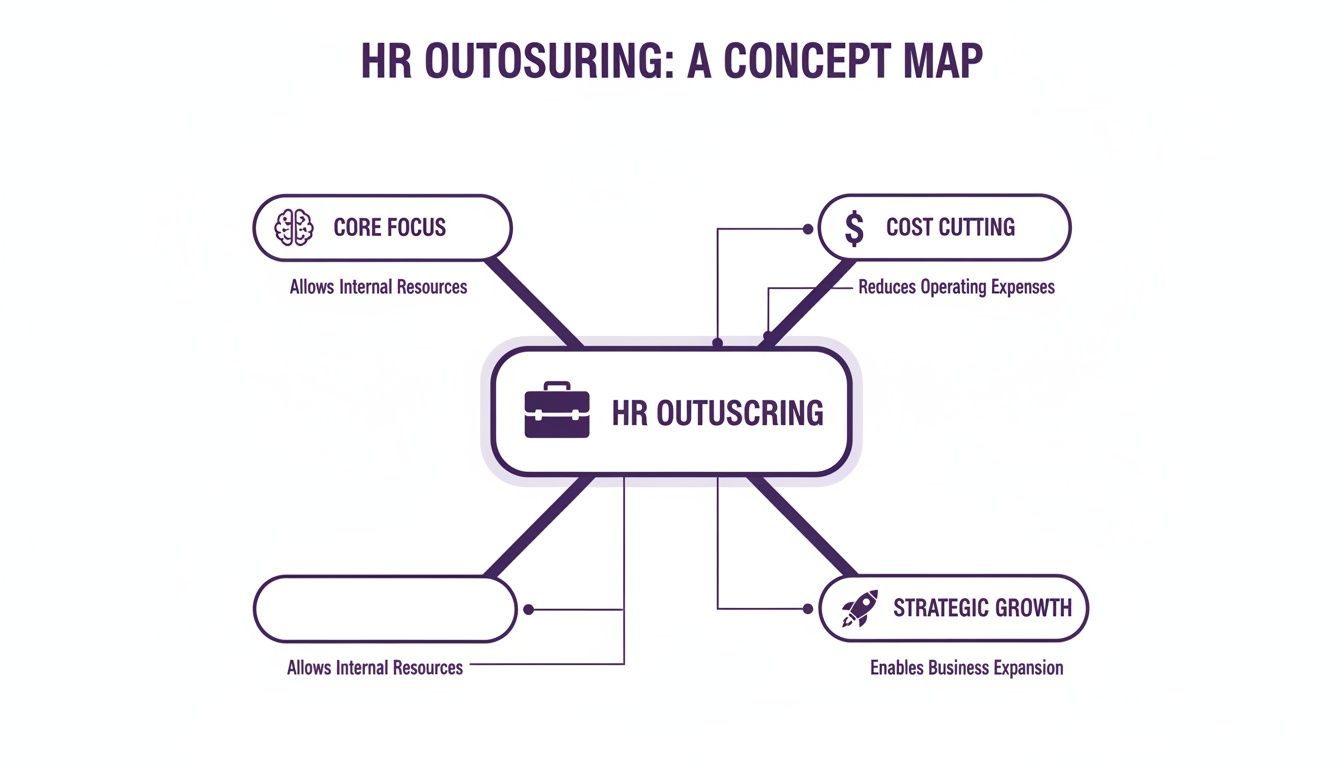
It’s clear that this isn't just about cutting costs. It’s about freeing up your team to focus on what they do best and paving the way for strategic growth.
A very popular and specific type of HRO is Recruitment Process Outsourcing (RPO). This is when an external partner takes over some or all of your company’s hiring functions. A great RPO provider becomes a true extension of your team, handling everything from sourcing and screening candidates to scheduling interviews and managing offers. You can dive deeper into the specifics in our detailed guide on recruitment process outsourcing.
Many RPOs are masters of using powerful recruitment marketing strategies to find top-tier candidates who aren't even looking for a new job. That kind of proactive sourcing is absolutely critical for filling specialized roles in today’s market. The downside? Traditional RPOs can sometimes lack the speed and tech-first mindset that fast-growing startups demand, which has opened the door for more modern, AI-driven solutions.
Most leaders believe HR outsourcing is purely a cost-saving move. That’s one of the biggest myths in the game. The opposite is true.
For any company in growth mode, it’s a strategic investment in speed and specialized expertise. Looking at it through a simple cost-cutting lens means you’re missing the bigger picture. The real return isn't just about what you save; it's about what you gain.
Let’s break down the true ROI into three critical areas.
This is the most straightforward piece of the puzzle. The tangible savings usually pop up in a few key places.
These direct savings are great, but honestly, they just scratch the surface.
You might think your team is handling HR just fine, but what's the hidden cost? The real loss is in founder and manager time—precious hours getting sucked into administrative quicksand instead of building the product or closing deals.
Think of it this way. Every time a manager spends half a day wrestling with a tricky payroll issue or a founder gets bogged down in compliance paperwork, that’s time stolen directly from revenue-generating work. Outsourcing gives you those hours back.
By offloading routine HR tasks, you free up your most valuable internal resources—your leaders and innovators—to focus exclusively on core business objectives that drive growth. This shift from administrative burden to strategic focus is where the true productivity ROI is unlocked.
This is also where a modern, tech-first approach completely changes the game. For example, Ramp, a Juicebox customer, augmented its small talent team with AI sourcing tools instead of a traditional RPO. The result? They slashed their time-to-hire by 60% in just three months—a massive efficiency leap that a conventional outsourcing model just couldn't match.
Beyond the numbers on a spreadsheet, the strategic impact of expert HR management is immense. This is where you see the effects of faster, higher-quality hiring and airtight legal compliance.
A specialized partner brings deep market knowledge to the table, helping you craft competitive compensation packages and find talent more effectively. That’s a huge advantage when you're up against bigger, more established companies. Calculating your cost per hire can put a hard number on the financial impact of a more efficient recruiting process.
North America currently dominates the HRO market, holding about 42.6% of the global share in 2024, largely because companies here are quick to adopt advanced HR tech. This trend highlights how leading markets use expert partners and AI-driven solutions to manage complex workforces and stay competitive.
And then there's compliance. A single misstep with employment law can lead to crippling fines and legal battles. A good partner acts as your shield, making sure your policies, contracts, and procedures are always current and defensible. This risk mitigation alone can justify the entire investment.
Choosing an HR outsourcing partner is a massive decision, especially when your company is scaling. Get it right, and you supercharge your growth. Get it wrong, and you're stuck with expensive problems and frustrating bottlenecks.
Forget the generic advice. You need a partner that's built for speed, understands your world, and can keep up as you scale. Here’s how to find one that will be a genuine growth partner, not an anchor holding you back.
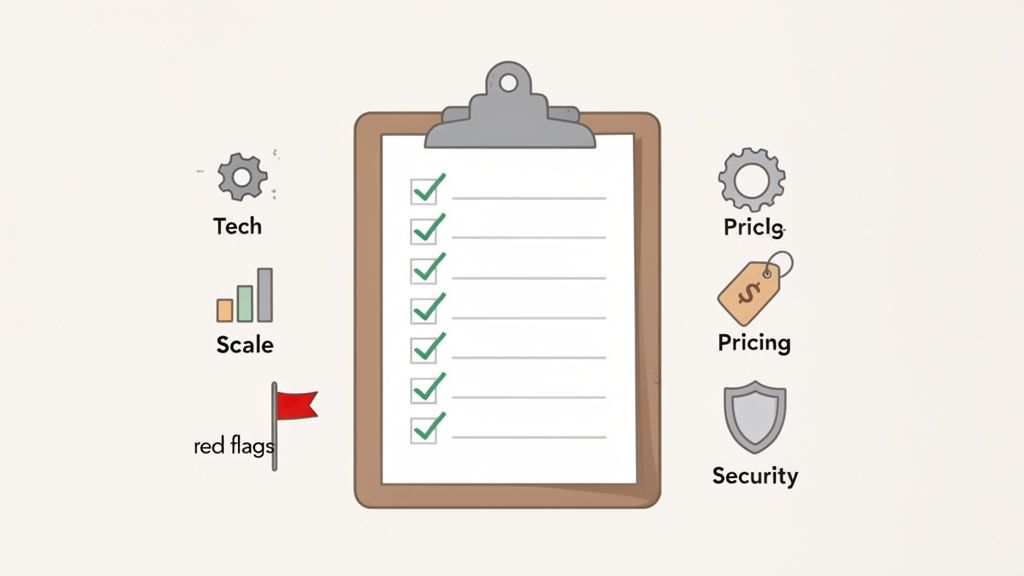
Before you even glance at a price sheet, you have to screen potential partners on four non-negotiable pillars.
It’s tempting to think a big, established HR firm is the "safe" bet. But often, these legacy providers are the most rigid. Why does this fail? Their one-size-fits-all model and ancient technology can actively slow you down. This is exactly why nimble startups are increasingly turning to more agile, tech-forward partners who can match their pace, a critical step to streamline the recruitment process.
Here's the proof: a traditional firm might take weeks to get a new recruiting campaign off the ground. A modern partner with a solid tech platform can have you up and running in days, maybe even hours. That's a serious competitive advantage.
The Service Level Agreement (SLA) is where the sales pitch meets reality. Don't just skim it—dissect it.
A strong SLA is your primary tool for accountability. It should clearly define performance metrics, response times, and penalties for non-compliance. Without it, you have no recourse when service inevitably falters.
Here are the key clauses to scrutinize:
Let’s be honest: traditional HR outsourcing, especially for hiring, has a speed problem. Legacy Recruitment Process Outsourcing (RPO) models bring structure, but they often move at a snail’s pace. For high-growth companies that needed top talent yesterday, that’s a dealbreaker.
This sluggishness creates a massive bottleneck in your growth. This is where a more agile, modern approach comes into play: tech-first HR augmentation. Instead of handing over a core function like recruiting entirely, you arm your in-house team with specialized AI platforms that act as a force multiplier. It’s not about replacing your recruiters; it’s about giving them an unfair advantage.
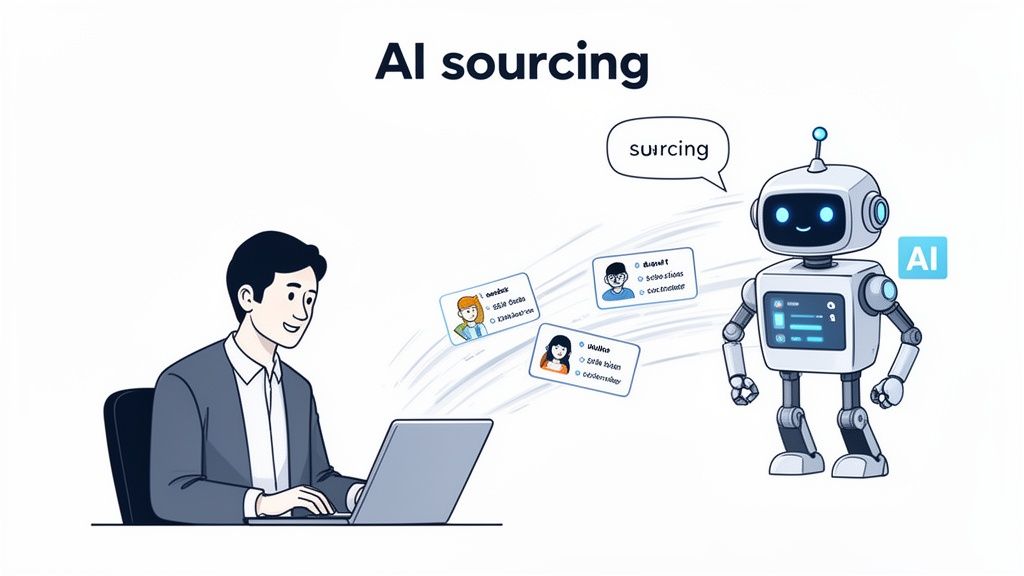
The central idea is to automate the most grueling parts of the hiring process—sourcing and outreach—so your recruiters can focus on what humans do best: building relationships and closing candidates.
Imagine this workflow:
How to source 50 qualified software engineers in under 5 minutes
A task that would take a traditional agency days—or even weeks—is now done in the time it takes to make a cup of coffee.
This tech-first strategy isn't just a theory. It’s the exact playbook the world’s fastest-growing companies are using to dominate the talent market.
Companies like Cognition and Perplexity use this approach to fill critical roles 5x faster than their peers. A huge part of their success comes from finding talent where others aren't even looking. By sourcing over 80% of their hires from outside saturated platforms like LinkedIn, they tap into a fresh, high-quality talent pool that traditional methods completely miss.
You might think your internal team doesn't have the bandwidth for this level of sourcing. But that’s precisely why this model is so effective. AI augmentation doesn’t add to their workload; it removes the most painful, inefficient parts of it. Instead of spending 80% of their time hunting for candidates and 20% actually talking to them, that ratio flips.
This shift has a profound impact, allowing small teams to outperform much larger, traditionally structured recruiting departments. To learn more about this modern approach, explore our guide on the top 10 AI recruiting tools in 2026.
What are the biggest red flags in an HR outsourcing contract?
Look for hidden fees, vague data ownership clauses, long-term lock-ins with steep termination penalties, and a lack of specific, measurable KPIs.
Should I choose a niche provider or a large, generalist firm?
For tech companies, a niche provider with deep industry experience is almost always the better choice. They’ll understand your unique talent challenges.
When is the right time for a startup to outsource HR?
The sweet spot is usually between 10–20 employees. This is when the administrative load starts to bog down the founders and steal focus from growth.
Smart HR outsourcing isn't about offloading tasks; it's about plugging in specialized expertise to grow faster. When you choose the right partner, you build a compliant, efficient people operations engine.
What this unlocks is your leadership's most valuable asset: time. With administrative burdens handled by experts, your team is free to focus entirely on building your product, serving your customers, and winning your market.
{{large_cta}}
Run your first search for free. Find and engage top talent across 800M+ profiles. Trusted by 5,000+ customers.