.svg)
SIGN UP FOR JUICEBOX (IT’S FREE!)

Who are you looking for?
Thank you! Your submission has been received!
Oops! Something went wrong while submitting the form.


Sourcing candidates effectively isn't about posting a job and hoping for the best. That "post and pray" approach is a blueprint for failure in today's market. To win, you must become a talent architect, engineering a robust, multi-channel talent pipeline supported by sourcing tools that identify passive candidates before you even have an open role
This is the key to turning a reactive, stressful process into a core strategic function. Unlike generic checklists, this guide integrates real recruiter workflows and AI sourcing examples powered by PeopleGPT, giving you the tools to identify passive candidates and an actionable blueprint to build your own talent engine.
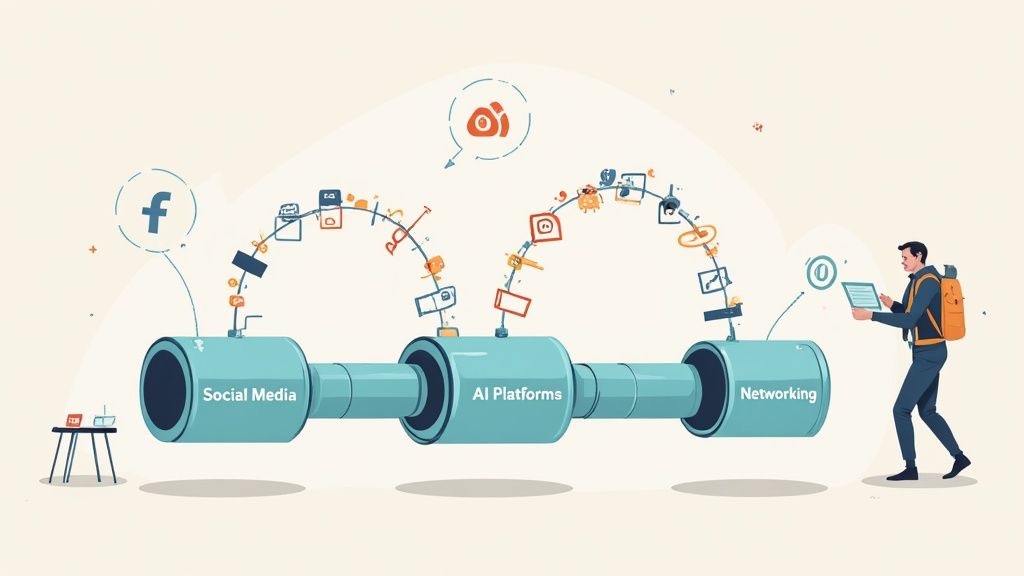
Think of yourself as a talent architect. Your job isn't just to fill a single vacancy; it's to design and build a sustainable infrastructure that delivers qualified candidates on demand. Every channel—from professional networks to AI-powered platforms—is a critical component of your blueprint. A truly effective pipeline can't be built on a single source; it demands a diversified mix of channels tailored to the roles you're filling. Modern pipelines rely heavily on talent sourcing tools that identify passive candidates, enabling recruiters to find professionals who aren’t actively applying but are open to the right opportunity.
This mindset shift is everything.
It's why something like 98% of talent acquisition leaders (2022) now use social media for hiring, a massive move toward digital platforms.
The goal is to create a system where you are always sourcing, not just when a req opens. This proactive stance stops the frantic scramble to fill urgent roles and builds a real, sustainable advantage.
The channels we use to find talent have evolved dramatically. Sticking to old methods means you're likely missing out on the best candidates who are active on newer, more dynamic platforms.
Here’s a quick look at how traditional approaches stack up against their modern counterparts:
| Sourcing Method | Traditional Approach | Modern Approach |
|---|---|---|
| Job Postings | Posting on one or two major job boards. | Distributing across niche boards, social media, and professional communities. |
| Candidate Search | Manual keyword searches on a single platform. | AI-powered search across multiple databases using natural language. |
| Networking | Attending in-person career fairs and local events. | Engaging in online communities, forums (like Reddit or GitHub), and virtual events. |
| Referrals | A basic, often forgotten, internal program. | A structured, gamified referral program with consistent promotion. |
| Outreach | Generic, templated messages sent in bulk. | Highly personalized, data-driven outreach tailored to the individual. |
This shift isn't just about using new tools; it's about adopting a more targeted, proactive, and relationship-focused mindset. The modern approach acknowledges that the best talent isn't always actively looking—you have to go find them where they are.
The best candidates are rarely looking for a job. They're usually too busy excelling in their current role. If you're just waiting for applications, you're missing this entire pool of A-players. Proactive sourcing is about becoming a talent scout, strategically identifying top-tier professionals in the passive talent pool by using tools to source passive candidates before you have an urgent need.
LinkedIn is a foundational tool, but it's also incredibly crowded. Relying on it exclusively means you're competing with every other recruiter for the same talent. In fact, a 2023 HireEZ study found that 75% of recruiters struggle with low response rates on platforms like LinkedIn.
To find those hidden gems, recruiters diversify their hunting grounds by leveraging AI talent sourcing platforms that surface:
To get a better sense of how top candidates position themselves online, it's worth understanding how to build an online presence that gets results.
Nothing gets your message deleted faster than a generic template. Effective proactive sourcing is about personalized outreach that shows you’ve done your homework.
A great outreach message doesn’t just sell a job; it acknowledges the candidate's unique expertise and connects it to a compelling opportunity. It’s a conversation starter, not a sales pitch.
Instead of leading with the job description, reference something specific—a project they shared on GitHub or an article they wrote. This small act of personalization shows you value their work. An intelligent system like Juicebox.ai outreach lets you build multi-step campaigns that feel personal but run on autopilot, freeing you to focus on building human connections.
AI doesn't replace great recruiters; it makes you a smarter architect. Think of it as your ultimate co-pilot—a hyper-intelligent tool that maps direct routes to qualified candidates, saving you from the dead ends of manual searching. AI automates the repetitive parts of sourcing, freeing you up to do what you do best: build relationships.
This isn't just a trend. A recent analysis found that 67% of recruiting leaders (2023) see adopting AI as critical for staying competitive. For more on this, tmi.org has some great insights on the future of talent acquisition.
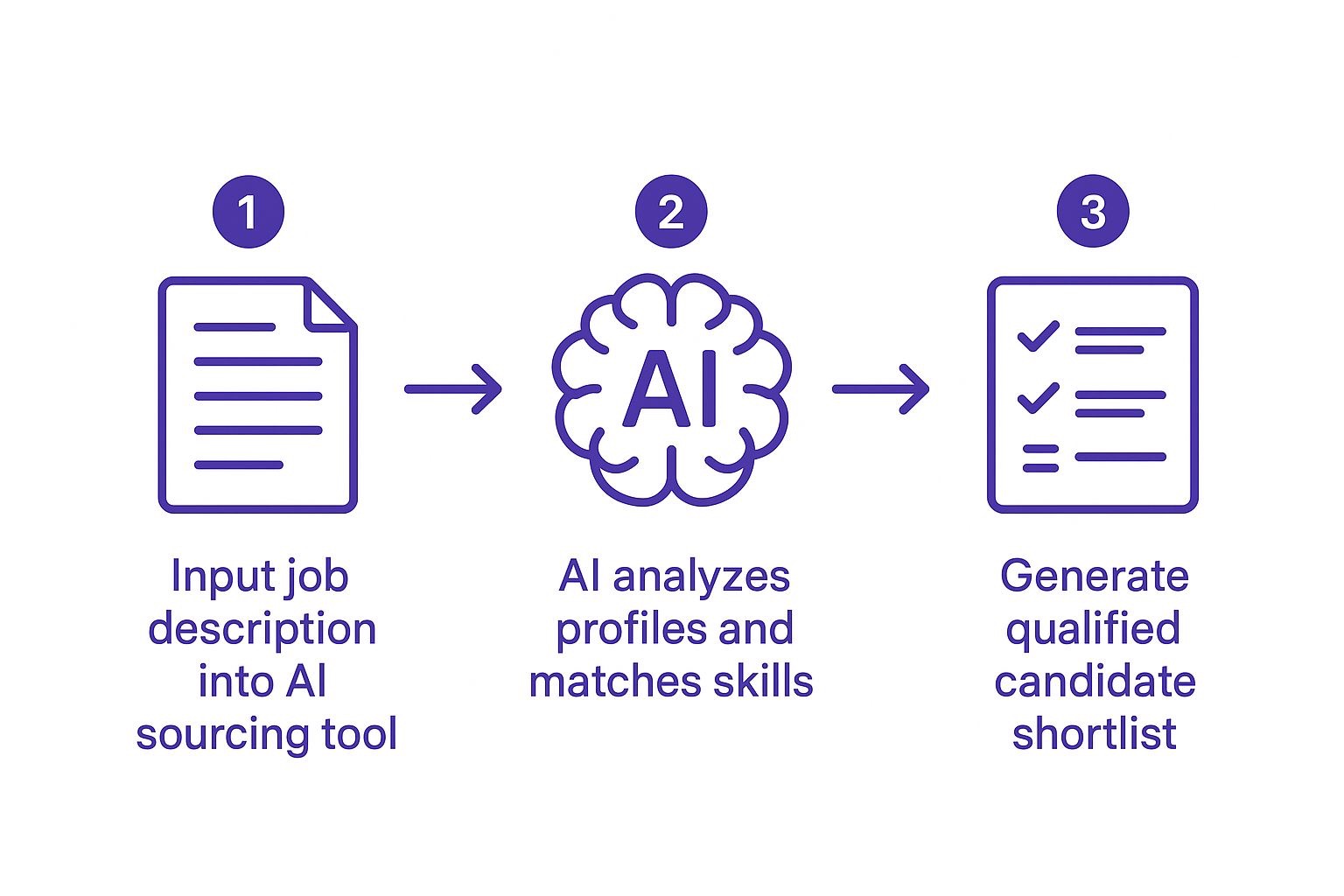
At its core, AI sifts through millions of online profiles with a speed and precision impossible for a human. A good AI tool can digest a job description, understand its nuances, and scan the digital world for matching profiles. This not only slashes sourcing time but also helps reduce unconscious bias by focusing purely on qualifications. This is how the sharpest recruiters are building stronger shortlists in a fraction of the time.
This modern AI talent sourcing strategy transforms your role from a manual searcher into a strategic reviewer. Instead of getting bogged down in the weeds of the search, you can immediately jump into evaluating promising profiles and planning your personalized outreach. It makes you a smarter, faster, and more effective recruiter.
Theory is one thing, but seeing an AI co-pilot dismantle a complex search is where you see the magic. Let's walk through how to take a challenging job description and turn it into a targeted candidate list in minutes.
Imagine you need to find a "Senior AI Engineer specializing in Natural Language Processing for Healthcare." The JD is loaded with non-negotiables: a PhD, hands-on experience with transformer models, publications in top-tier journals, and HIPAA compliance knowledge. A manual search for this profile is a nightmare of Boolean strings and endless browser tabs.
With an AI sourcing engine, the approach changes. You have a conversation, not a query.
This workflow flips the script, turning the most time-consuming part of how to source candidates into the most efficient. This is a core function of the PeopleGPT platform. It handles the heavy lifting so you can focus on the strategic work of building relationships.

Finding great candidates is only half the battle. A true talent architect constantly measures and optimizes their pipeline. Creating a data-driven feedback loop is what separates good recruiters from great ones. It turns guesswork into a repeatable, strategic process.
Data is your blueprint for improvement. Focus on a few core metrics to fine-tune your approach:
If you really want to go deep on turning data into a strategic weapon, check out these professional strategies in data analytics.
The best candidates are almost never looking when you first find them. Nurturing a talent pool of these passive candidates is a non-negotiable long-term play. It's about building relationships before you need to fill a role.
Sourcing is a marathon, not a sprint. The relationships you build today with passive candidates become your warm-lead pipeline for tomorrow's urgent roles.
Maintain engagement without being annoying. Send them relevant company news, an interesting industry article, or a quick project update. This light touch keeps you top-of-mind and positions you as a genuine connection, not just another recruiter. Over time, your reputation starts doing the heavy lifting for you, making the entire process of how to source candidates that much easier.
Modern sourcing isn't about one-off tactics; it's about engineering a reliable talent engine. By mastering how to source candidates with a blueprint that blends smart outreach, AI-powered precision, and genuine relationship-building, you transform recruiting from a reactive fire drill into a strategic advantage.
When you learn how to source candidates with platforms like PeopleGPT, you reclaim hours in your day—time you can invest in cultivating deeper connections and making data-backed decisions. You shift from hunting for today’s open role to engineering a predictive talent pipeline, ensuring you’re always prepared for what’s next.
At Juicebox, we understand how a proactive sourcing engine can turn recruiters from order-takers into true strategic partners. Ready to build yours? See how our suite of AI recruiting software can help.
The best sourcing tools that identify passive candidates use AI to search beyond traditional job boards. Platforms like Juicebox analyze public data, professional contributions, and inferred intent to surface qualified candidates who aren’t actively applying. These tools help recruiters find hidden talent faster, reduce manual searching, and build proactive pipelines that deliver long-term hiring advantages instead of reactive, last-minute results.
There's no single magic bullet. The most effective strategy is a diversified, multi-channel approach. This means combining proactive outreach on niche platforms, a strong employee referral program, and smart AI recruiting tools to tap into the passive candidate market. Your "best" method will always depend on the specific role, industry, and seniority level you're targeting.
AI tools like Juicebox act as a force multiplier, automating the time-consuming grunt work of sourcing. Instead of you spending hours building complex search strings and manually screening profiles, the AI can scan millions of data points and surface qualified candidates in minutes. This not only speeds up the process but also helps reduce unconscious bias by focusing purely on skills and experience, freeing you up for the human side of recruiting.
Sourcing passive candidates is a long game built on personalization and trust. First, identify where these professionals spend their time online—niche communities, professional forums, or even personal blogs. Then, craft outreach that speaks directly to their work and accomplishments. The key is to build the relationship before you have an immediate need. If you want to dive deeper into nurturing these connections, check out the insights on the Juicebox recruiting blog.
Ready to stop searching and start sourcing with architectural precision?
{{large_cta}}
Run your first search for free. Find and engage top talent across 800M+ profiles. Trusted by 5,000+ customers.