.svg)
SIGN UP FOR JUICEBOX (IT’S FREE!)

Who are you looking for?
Thank you! Your submission has been received!
Oops! Something went wrong while submitting the form.


To find your next generation of leaders, you need to learn the difference between current performance and future potential. It’s a subtle but critical distinction. It means looking past the daily metrics and quarterly reports to find people with the agility, mindset, and drive to take on bigger, more complex roles.
Learning how to identify high potential employees is a core competency for any scaling company.
Most talent identification strategies focus on past performance, creating a critical blindspot. Juicebox's approach, however, is built on forward-looking indicators and AI-driven sourcing, allowing you to find future leaders—both internally and externally—before your competitors do.
TL;DR: How to Identify High Potential Employees
So many companies fall into the same trap: they mistake their top performers for their high-potentials.
It’s an easy mistake to make. Your high performers are the ones crushing their targets. They’re reliable, efficient, and make their managers’ lives easier. But here’s the problem most talent strategies completely miss: the skills that make someone a rockstar individual contributor often have nothing to do with what makes a great leader.
Here’s the bottom line: Your best salesperson isn't automatically your best future sales manager.
Excelling in a current role is about mastery and execution. Thriving in a future, undefined role is all about adaptability and vision. The myth that great performance equals great potential is incredibly expensive. In fact, research from Gartner shows that only 15% of high performers actually have high-potential attributes.
You might think, "I'll just promote my top performers and train them on leadership." But that often fails because you can't easily train innate traits like drive or learning agility. For example, Google discovered that after promoting top engineers to management, they saw a dip in both innovation and morale until they revamped their process to assess for leadership traits before promotion. This shift saved them millions in lost productivity.
A High-Potential Employee (HiPo) is someone who shows the ability, engagement, and aspiration to rise into more senior, critical roles and succeed when they get there.
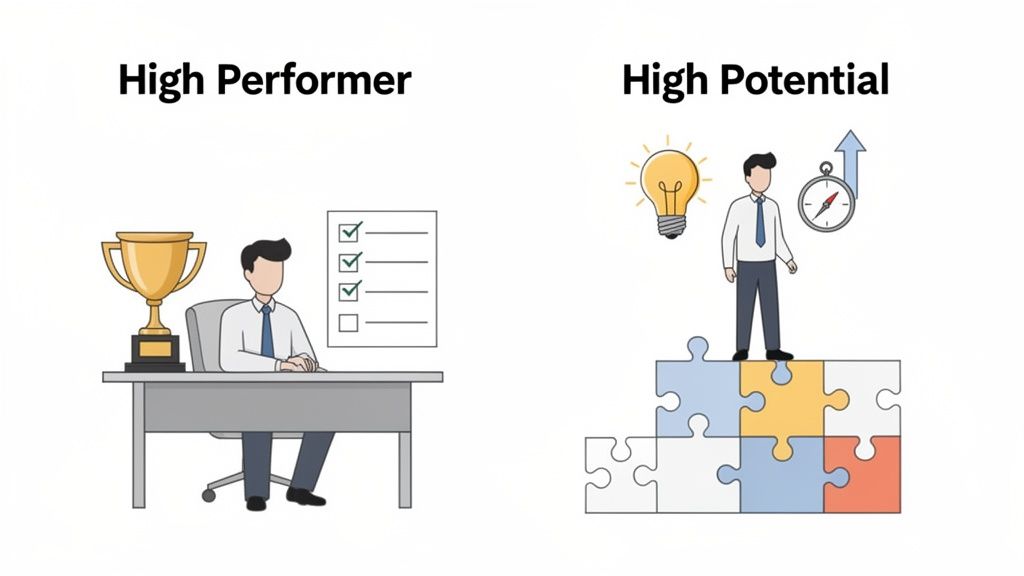
This table breaks down the distinct traits of a high performer versus a high potential employee across a few key areas.
| Attribute | High Performer | High Potential (HiPo) |
|---|---|---|
| Focus | Delivers exceptional results in their current role. | Demonstrates the skills and behaviors needed for future roles. |
| Ambition | Aims for mastery and recognition within their current position. | Aspires to take on greater responsibility and broader impact. |
| Skillset | Deep expertise in a specific function or domain. | Broad capabilities such as strategic thinking and learning agility. |
| Contribution | Adds value through consistent execution and meeting targets. | Adds value by challenging the status quo and driving innovation. |
| Mindset | “How can I do my job better?” | “How can we do this better as a company?” |
Recognizing these differences is the first step toward building a more strategic talent pipeline. The journey to find these future leaders often starts with looking at past accomplishments. Even though we’re looking beyond raw performance, solid and consistent effective performance review documentation is an invaluable starting point. From there, you can look for more subtle signals of potential, which often hide in your internal talent pool—something you can surface using various best sourcing tools for recruiters.
To reliably spot future leaders, you have to move beyond gut feelings. What you really need is a solid framework that helps you consistently assess the underlying qualities that truly matter. It’s about looking past someone's current performance to see the raw materials of leadership.
What does this look like in practice?
Instead of a vague checklist, we can boil it down to three core pillars. Think of it as a three-legged stool—if one leg is weak, the whole thing wobbles.

CQ isn't about raw IQ. It's about how someone navigates ambiguity and connects seemingly unrelated ideas into a coherent strategy. A person with high CQ can zoom out to see the big picture, then immediately zoom back in to execute. These are the people who ask the clarifying questions that expose hidden assumptions in a project plan.
Drive is the engine of potential. It’s a mix of ambition, resilience, and a deep-seated need for achievement. Someone with a high DQ is relentlessly resourceful and bounces back from setbacks. They have what Angela Duckworth famously calls "grit." But this isn't just about grinding out long hours. It’s about a proactive, ownership mindset.
You could argue that EQ is the most critical pillar for leadership. It’s the ability to build consensus, show genuine empathy, and lead through influence rather than sheer authority. An employee with high EQ is self-aware, keeps their cool under pressure, and can read a room with uncanny accuracy. Investing in targeted executive communication skills training is one of the best ways to develop this in your rising stars.
They build strong relationships across the entire organization, and it's no surprise that companies focusing on EQ see 45% lower turnover among their high-potential employees, according to a study by TalentSmartEQ.
So, you’ve got the framework down. Now it’s time to move from theory to action. A solid playbook isn’t some bureaucratic document; it’s a lightweight system that brings clarity and fairness to how you spot and nurture future leaders.
Now, you might be thinking: this sounds complicated. But it doesn't have to be.
First, translate the CQ, DQ, and EQ pillars into a simple, practical scorecard. This gets your managers on the same page, forcing them to evaluate candidates against objective criteria.
For each pillar, pick 2-3 observable behaviors:
Then, assign a simple 1-5 rating scale for each behavior. This gives you a quantifiable way to compare candidates and calibrate assessments across different interviewers. It's a critical step in using recruiting metrics to pull unconscious bias out of the hiring process.
A scorecard on its own is useless. You need to design assessments that actually gather the data.
Instead of asking, "Tell me about a time you led a project," try digging deeper. To get at Drive (DQ), you could ask, "Describe a time you received difficult feedback. What was it, who gave it to you, and what specifically did you do next?" Their answer tells you far more about coachability and resilience than any canned success story ever could. We have a whole guide on creating consistent evaluation criteria if you want to go deeper on building rubrics for interviews.
Honestly, the best way to see potential is to watch it in action. If you're hiring a potential marketing leader, give them a real-world case study. Hand them a brief and a small data set, and ask them to outline a go-to-market plan. This puts their CQ (strategic thinking) and DQ (resourcefulness) to the test. It’s the difference between hearing someone talk about swimming and actually watching them swim.
Knowing the framework is one thing, but translating it into real, observable signals is where the magic happens. How do you actually measure something as fuzzy as "potential"? You get out of the land of gut feelings by focusing on concrete behaviors that are proven predictors of future success.
To really nail how to identify high potential employees, you have to connect high-level qualities to what people actually do day-to-day. This is how you strip out the subjectivity and give your managers a clear checklist.
Here’s how these big ideas break down into behaviors you can actually see:
This playbook gives you a simple way to structure your process, moving from a defined scorecard to structured interviews and practical tests.
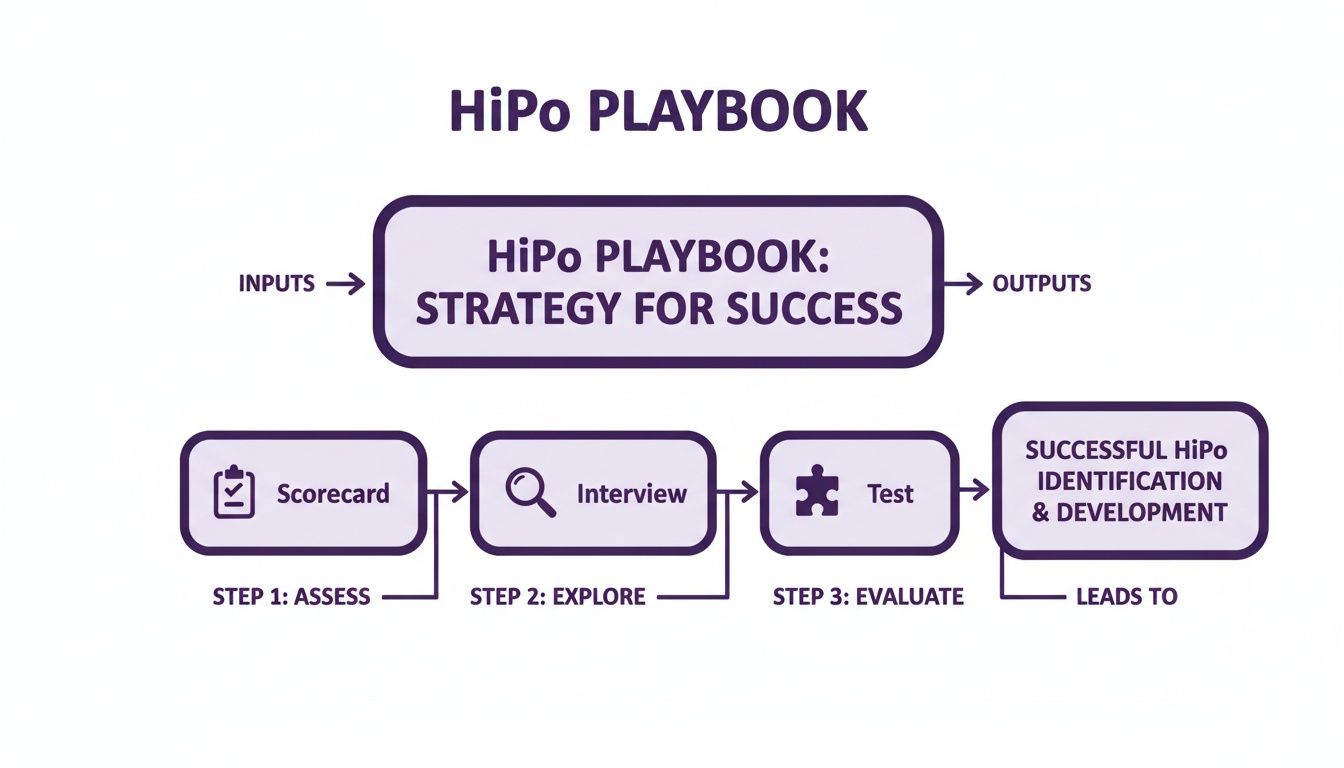
The solution is triangulation. This table will help you and your team get on the same page by linking competencies to observable actions and specific interview questions.
| HiPo Competency | Observable Behaviors | Sample Interview Question |
|---|---|---|
| Learning Agility | Actively seeks and incorporates feedback, learns from mistakes, applies past lessons to new situations, and experiments with new approaches. | “Tell me about a time a project you were on failed. What did you learn from the experience, and how have you applied that lesson to a different situation since?” |
| Proactive Initiative | Identifies and solves problems without being asked, sees opportunities others miss, builds coalitions to drive change, and takes ownership. | “Describe a time you identified a significant problem or opportunity that was outside of your direct responsibilities. What did you do about it, and what was the outcome?” |
| Strategic Orientation | Connects daily tasks to company goals, asks “why” to understand the bigger picture, and makes decisions that support long-term objectives. | “Can you walk me through a decision you made recently where you had to balance a short-term need with a long-term company goal? What was your thought process?” |
This is where predictive analytics for HR becomes a game-changer. When you combine a manager's observations with 360-degree feedback and performance trends, you build a much richer profile. In fact, research from the Center for Creative Leadership has pinned down key indicators, giving you data-backed benchmarks. This kind of data-driven approach shifts potential identification from an art form into more of a science.
Identifying your internal rising stars is a massive win, but what about all the incredible talent currently working for your competitors? Sourcing high potentials from the outside gives you a decisive competitive edge, and this is where modern AI tools completely change the game. Instead of just reacting to whoever applies, you can proactively hunt for the exact HiPo traits you need.
The real trick is to translate your HiPo framework—Cognitive Capability, Drive, and Emotional Intelligence—into powerful, targeted searches. This is how you move beyond basic keyword matching and start spotting the signals of genuine potential.
Forget messing around with complex Boolean strings. With platforms like PeopleGPT, you can use natural language to find candidates who demonstrate the core pillars of potential.
Take Drive (DQ), for example. It often shows up as someone taking on significant risks and proving their resilience. You can find these people by searching for profiles that old-school tools would completely miss:
These prompts target individuals who have survived and thrived in high-stakes, ambiguous environments.
Cognitive Capability (CQ) can be a bit harder to spot on a resume, but a person’s career progression tells a powerful story. You're looking for evidence of rapid learning and the ability to handle increasing complexity. You can use one of these top 10 AI recruiting tools for 2026 to pinpoint these signals with prompts like:
Searches like these immediately surface candidates who’ve shown exceptional learning agility.
This screenshot shows exactly how you can layer signals of potential—like founding a company and securing investor backing—to surface a highly relevant talent pool in seconds. This approach to AI sourcing automates the tedious discovery phase, freeing you up to spend your time actually engaging with qualified, high-potential candidates.
Ambition is the desire to climb; potential is the capability to succeed. Look for a hunger to learn and solve team-wide problems, not just a focus on the next title.
Confusing past performance with future potential. Promoting a top performer into a leadership role without assessing for leadership skills is a recipe for failure.
Absolutely. Look for raw ingredients like drive and learning agility. Do they actively seek feedback and take initiative beyond their job description? Those are powerful early signals.
Formally, assess annually as part of your talent review. Informally, managers should be empowered to spot and coach potential continuously throughout the year.
Ultimately, learning how to identify high potential employees boils down to a simple shift: stop rewarding past achievements and start investing in future capabilities. When you move beyond simple performance metrics and adopt a structured framework built on Cognitive, Drive, and Emotional intelligence, you make smarter bets on your next generation of leaders. What this unlocks is a powerful strategic advantage—a resilient leadership pipeline that fuels sustainable growth for the long haul.
{{large_cta}}
Run your first search for free. Find and engage top talent across 800M+ profiles. Trusted by 5,000+ customers.