.svg)
SIGN UP FOR JUICEBOX (IT’S FREE!)

Who are you looking for?
Thank you! Your submission has been received!
Oops! Something went wrong while submitting the form.

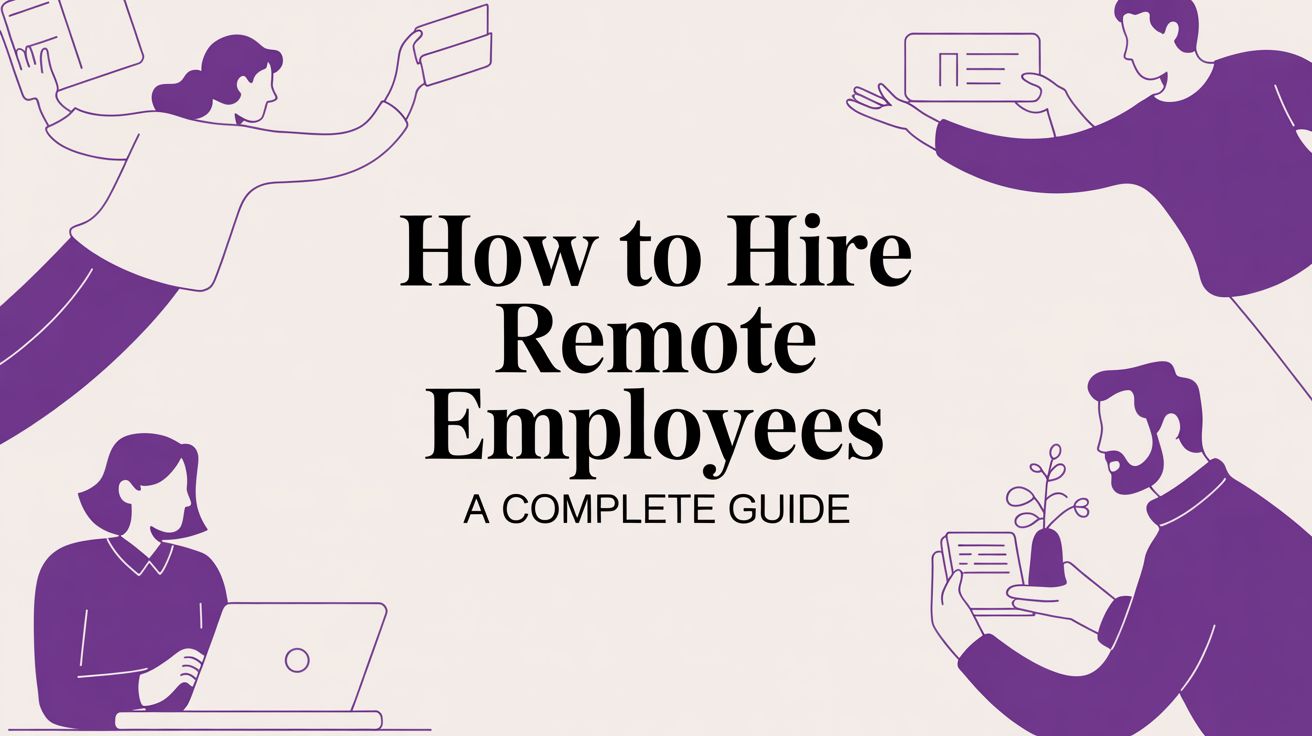
Learning how to hire remote employees comes down to four critical shifts. You have to treat it as a core business strategy, not a perk. You need to define roles by outcomes over office hours.
You should use modern AI-sourcing tools like PeopleGPT to tap into a global talent pool across diverse sources.
And finally, you have to master remote-first interviews and onboarding.
Get this right, and you stop competing for talent in your own backyard and start sourcing the best people on the planet.
TL;DR: A Guide to Hiring Remote Employees
Let's reframe this whole conversation. Hiring remote employees isn’t just a reaction to a trend—it’s a foundational business strategy for unlocking growth and building a more resilient company. The real win isn't saving a few bucks on office space; it's getting access to a massive, untapped global talent pool.
Most leaders believe remote work is a compromise on productivity or culture. But the opposite is true. When done right, remote work forces you to be crystal clear in your communication, improve documentation, and focus relentlessly on results.
Think about it.
The old way of hiring was stuck in a 30-mile radius. You were basically fishing in a small pond, hoping the best person for the job just happened to live nearby.
Embracing remote work means you can stop fishing in that pond and start fishing in the ocean. The data is undeniable: according to a 2023 Upwork report, companies that embrace remote work gain access to a 53% larger talent pool.
This isn't just about volume; it's about quality. A staggering 89% of remote applications now come from outside a company's headquarters. This access to global talent is why 68% of companies find higher-quality candidates than they ever could locally.
But there’s a problem most tools ignore.
Legacy platforms were built for an era when talent was geographically shackled. To capitalize on this shift, you need modern, AI-native platforms like Juicebox that help you build a powerful talent pipeline instead of just posting and praying. Your entire approach should align with a modern talent strategy that values skill over proximity.
To really put this into perspective, let's look at how remote hiring directly impacts core business metrics. These aren't just small improvements; they represent a significant operational upgrade across the board. A quick comparison shows just how much of a strategic advantage this is.
| Metric | On-Site Hiring | Remote Hiring |
|---|---|---|
| Talent Pool | Geographically limited | Global and significantly larger |
| Diversity | Restricted by local demographics | Access to diverse backgrounds and perspectives |
| Time-to-Hire | Longer due to travel and scheduling constraints | Shorter and more flexible interview processes |
| Operating Costs | High (office space, utilities, on-site overhead) | Lower due to reduced real estate requirements |
| Employee Retention | Lower, often tied to location constraints | Higher due to flexibility and work–life balance |
Ultimately, learning how to hire remote employees is less about logistics and more about smart business design. It's your ticket to building a world-class team, completely unbound by the limitations of the past.
Before you even think about posting a job ad, you need to get the foundation right. This is where you shift from talking about remote work as a concept to building the actual role for a distributed team. It's a total mindset change—you stop supervising activity and start measuring outcomes.
What's the bottom line?
You can't just recycle your old in-office job descriptions. I see this mistake all the time, and it’s a fast track to attracting the wrong people. Remote roles need a different blueprint, one that’s built for collaboration across time zones and relies heavily on asynchronous communication.
To get this right, you have to architect the role from the ground up, detailing not just the "what" but the "how" of remote work at your company. This detailed guide on how to hire a remote DevOps engineer breaks this down perfectly.
Think of your remote job description as a marketing document, not just a list of tasks. You're competing for global talent, so it needs to sell your culture and clearly define what success looks like when no one is looking over a candidate’s shoulder.
Here’s what a great remote-first profile includes:
This infographic really nails the evolution from old-school hiring to the modern remote approach.

It highlights the move from fishing in a local pond to an entire global ocean of talent—a massive strategic advantage if you do it right.
For remote roles, performance metrics have to be crystal clear and measurable. They should tie directly to business goals, removing any guesswork about what a successful contribution looks like. One of the best ways to improve your process is by tracking key recruiting metrics.
Let's take a remote Content Marketer. Their KPIs might look something like this:
This defines success in black and white. It gives employees the autonomy they need to hit their goals without someone micromanaging them.
This prep work makes a huge difference. A 2022 Owl Labs report found that remote workers are 22% happier than their in-office counterparts, leading to better retention.
Ultimately, a strong foundation makes every step that follows—from sourcing to onboarding—so much smoother. It also ensures your process can scale, especially when you start bringing in modern tools. If you're curious about how these platforms work, you can check out what an applicant tracking system is in our guide.
Alright, you've got a killer role profile. Now for the hard part: finding the right person.
Most recruiters are still fishing in the same small pond—endlessly scrolling through LinkedIn, praying for a hidden gem. But what happens when the best talent isn't even looking there? If you want to hire the best remote employees, you have to think bigger than the obvious channels.
Ready for a change?
The game has completely changed. Forget relying on those clunky Boolean strings that barely work. Modern sourcing is a multi-channel, AI-driven hunt that uncovers incredible candidates your competitors will never find. Why? Because they're not even looking in the right places.
There's this myth that if a candidate isn't on LinkedIn, they don't exist. The truth is often the exact opposite.
The most sought-after engineers, designers, and product leaders? They’re busy on niche platforms like GitHub, Behance, or academic sites—not polishing their LinkedIn profiles. Sticking to a single source is a surefire way to miss out on 80% of the available talent pool.
The trick is to think like an intelligence agency, piecing together signals from dozens of diverse recruitment sources to build a complete profile of a candidate. This is where AI gives you a massive leg up.
For instance, imagine you're hunting for a very specific specialist. Instead of wrestling with a convoluted Boolean string, you could just ask a simple, conversational prompt in PeopleGPT:
"Find software engineers in Latin America with experience in fintech startups and Python who have contributed to open-source projects."
A prompt like this can instantly scan over 30 sources—not just one—and deliver a hyper-relevant list of people. Cognition, a nimble AI startup, used this exact tactic to source niche AI researchers, slashing their time-to-hire by an incredible 5x. They stopped fishing where everyone else was and went straight to where the talent actually lives online.
To see this in action, check out our deep dive on AI-powered talent sourcing.

This screenshot from PeopleGPT shows how a single, natural-language search can pull candidates from all over the web, complete with verified contact info. It saves you hours of grunt work and surfaces talent that your competitors, still stuck on legacy platforms, are completely missing.
So you've found these hidden gems. What now? The next hurdle is getting them to actually talk to you. Generic, templated outreach messages are deleted on sight. Let's be real, top talent—especially passive candidates—get dozens of these every single week.
You might think personalizing at scale is impossible. But with the right data, it's not only possible but also incredibly effective. The goal is to show you've done your homework. Why that fails? Because without proof of research, your message is just noise.
Here’s a dead-simple framework that works:
When you combine the built-in advantage of remote flexibility with genuinely personalized outreach, you create a powerful combination that attracts the 56% of remote job seekers who are passive candidates. You can discover more insights about remote hiring statistics here.
By breaking free from single-source dependency and leveraging tools like these best sourcing tools for recruiters, you build a powerful system for hiring the best remote talent, no matter where they are.
Evaluating candidates from a distance requires a totally different playbook. Forget the generic advice about checking your Wi-Fi and having good lighting. To truly figure out how to hire remote employees who will thrive, you need a process that tests for the skills that actually matter in a distributed team: autonomy, written communication, and self-discipline.
But wait, there's more.
A well-designed remote interview process can reveal more about a candidate's alignment with your values than a casual office chat ever could. It forces you to be deliberate and data-driven instead of just relying on gut feelings.
The key is to move beyond conversational interviews and implement a multi-stage process that includes structured interviews, asynchronous assessments, and virtual work-sample tests.
Let's be honest: standard, unstructured interviews are notoriously unreliable predictors of job performance. For remote roles, this problem is amplified. A structured interview process—where every candidate gets asked the same set of questions and is scored against a consistent rubric—is non-negotiable.
Here’s how you can build one:
This shift toward structured, remote-first assessments is crucial. We've seen remote job growth surge 156% in Latin America and 143% in Eastern Europe, opening up incredible, cost-effective talent pools for businesses that adapt.
Here's the bottom line: a video call can only tell you so much. The real magic in remote assessment happens when you test a candidate's ability to work asynchronously—the true day-to-day reality of a remote job. This is where work-sample tests come in.
These mini-projects should take no more than 1-2 hours. The goal isn't free work; it's to see how they think, communicate, and execute in a remote setting. It's the single most predictive part of the entire process. For more ideas on what to ask, explore these 9 essential interview questions to ask candidates.
Here's a curiosity gap for you: Most people believe assessing culture fit is the biggest challenge when you hire remote employees. But "culture fit" often becomes a proxy for "is this person like me?" which introduces a ton of bias.
A much better approach is to assess for values alignment.
Instead of a casual "get to know you" chat, schedule a final-round collaborative session with 2-3 team members. Give the candidate and the team a small, hypothetical problem to solve together on a virtual whiteboard tool like Miro.
Observe how they interact. Do they listen? Do they contribute constructively? This reveals far more about their collaborative spirit and how they'd mesh with your team's values than any coffee chat ever could.
Getting a "yes" from your top candidate feels like crossing the finish line, but it’s not. Far from it. This is where the real work begins. The next steps—crafting a compelling offer, running a flawless onboarding, and navigating global compliance—are where so many companies stumble.
Your goal isn't just to get a signature. It's to build a repeatable system that turns a promising candidate into a productive, engaged, and long-term team member, no matter where they live. To really dial this in, you'll want to streamline your recruitment process.

Figuring out compensation for remote employees feels messy, but it doesn't have to be. The best approach is a geo-neutral salary band. This just means you define a role's value to the company first, then adjust within that band based on location.
Here’s a simple way to think about it:
Be upfront about this strategy. It builds trust from day one and shows you’ve actually thought about fair global pay.
Let's be blunt: shipping a laptop and a Slack invite is not onboarding. A bad onboarding experience is one of the top reasons new hires quit. For remote employees, who can’t just lean over a cubicle to ask a question, a structured process is non-negotiable.
Here's the secret.
You can create a powerful, scalable process by nailing three key areas:
A killer onboarding experience is a major differentiator. A 2022 Gallup report confirmed that great onboarding can improve new hire retention by 82%. For a deeper dive, our onboarding new employees checklist breaks it all down.
Let’s be honest, the legal and tax side of international hiring can feel terrifying. This is exactly what an Employer of Record (EOR) service is for. An EOR acts as the legal employer in your new hire's country, taking care of all the compliance headaches. They handle payroll, taxes, and mandatory benefits, letting you hire someone in Germany or Brazil as easily as hiring someone down the street. If you want to explore more strategies, check out this practical guide to employee onboarding.
How long should a remote interview process take?
Aim for 2-3 weeks from application to offer. A drawn-out process risks losing top candidates who have multiple options in this market.
Should we conduct paid trial projects?
For larger, multi-day projects, yes. It respects the candidate's time and gives you a much more realistic and valuable work sample.
How can we reduce bias in remote interviews?
Use a diverse interview panel, stick to your scoring rubric, and lean heavily on asynchronous assessments to focus on skills over personality.
What is the first step to start hiring remotely?
Start with your job description. Rework it to be remote-first, focusing on outcomes over hours logged and being clear about communication protocols.
Learning how to hire remote employees isn't just about filling seats more efficiently; it's a fundamental shift in your growth strategy. When you master this, the core benefit is clear: you are no longer limited by geography.
What this unlocks is the ability to build a truly world-class team. You stop competing for the best person in a 30-mile radius and start sourcing the absolute best person for the job, period. This is the ultimate competitive advantage, allowing you to build a more diverse, skilled, and innovative company than your geographically-bound rivals ever could.
{{large_cta}}
Run your first search for free. Find and engage top talent across 800M+ profiles. Trusted by 5,000+ customers.