.svg)
SIGN UP FOR JUICEBOX (IT’S FREE!)

Who are you looking for?
Thank you! Your submission has been received!
Oops! Something went wrong while submitting the form.

Hiring often feels like a high-stakes coin toss.
You think you've found the perfect candidate, but months later, the costly mismatch becomes painfully clear.
This guide is designed to stop that cycle by providing a repeatable framework for turning interviews into a reliable engine for hiring top talent.
You'll learn the structure, questions, and data-backed workflows that top recruiting teams and AI sourcing tools rely on to build winning teams.
Let's break it down.

Without that foundational work, you’re just having conversations. You aren't systematically collecting the data you need to make a smart hiring decision.
The first step is to move past the job description. While you absolutely need a compelling JD to attract candidates (we've got a guide on how to write a job description if you need a refresher), it’s fundamentally a marketing document. For internal alignment, you need a role scorecard. This is your internal blueprint, defining the exact outcomes, skills, and cultural traits that spell success for this specific role.
A scorecard forces you to translate vague requirements like "strong communicator" into tangible, measurable behaviors. It’s the difference between hoping for a good hire and designing a process to find one.
By creating a scorecard upfront, you establish an objective benchmark. Every question asked, every evaluation made, should map directly back to this document. It’s the single best way to strip out ambiguity and keep unconscious bias in check.

To build a solid scorecard, the hiring manager and recruiting team need to agree on what really matters. Any fuzziness here will cause chaos later. I always break the role down into three core areas:
This level of detail isn't just a "nice-to-have"—it's critical. According to the National Association of Colleges and Employers, a staggering 91% of employers prefer candidates with work experience. Nearly 65% of them prioritize experience directly relevant to the role. A sharp scorecard is what allows you to design questions that accurately probe for that specific, relevant experience.
Here’s a simple template you can adapt to build your own scorecards.
This table is your starting point for creating a clear, objective evaluation framework. It ensures every interviewer is assessing candidates against the same well-defined criteria, moving you from subjective "gut feelings" to data-driven decisions.
| Core Competency | 1 (Poor) | 3 (Average) | 5 (Excellent) |
|---|---|---|---|
| Problem-Solving | Relies on others for solutions; describes problems without offering ideas. | Can identify and solve routine issues; needs guidance on complex challenges. | Proactively identifies root causes; develops and tests novel, effective solutions independently. |
| Stakeholder Management | Provides updates only when asked; communication is reactive. | Keeps key stakeholders informed on progress and roadblocks. | Anticipates stakeholder needs; builds consensus and influences outcomes across teams. |
| Technical Proficiency (e.g., Python) | Basic theoretical knowledge but struggles with practical application. | Can write functional code for standard tasks with some supervision. | Designs and implements complex, scalable, and efficient code with best practices. |
| Bias for Action | Hesitates to make decisions; waits for perfect information or consensus. | Takes initiative on clear tasks but seeks approval for ambiguous ones. | Acts decisively with incomplete data; prioritizes speed and learning from execution. |
By filling this out for each of your must-have competencies, you give your interviewers a shared language. They know exactly what "good" looks like before they even speak to a candidate.
Ultimately, this preparation transforms the interview from a subjective chat into a structured, data-gathering exercise. It’s the single most important step in learning how to conduct effective interviews that consistently land you the talent you need.
Let’s be honest, generic interview questions get you generic, rehearsed answers.
Asking "What's your biggest weakness?" is practically an invitation for a candidate to serve up a well-polished, meaningless response about being "too passionate" or a "perfectionist." This tells you nothing about how they'll actually perform on the job.
To run interviews that work, you have to shift from asking about abstract traits to requiring candidates to demonstrate their skills through past experiences. This is where behavioral and situational questions become your most powerful tool. They move the conversation from "telling" to "showing."
The goal is to design questions that compel candidates to share specific stories—stories that reveal how they think, operate, and solve problems. Every question you ask should be a strategic tool, mapped directly back to a core competency on your role scorecard.
A great question doesn't just ask what a candidate did. It forces them to unpack the context, their specific contribution, and the measurable outcome. This is how you separate real experience from resume buzzwords.
The STAR method is a simple yet profoundly effective framework for structuring these questions and evaluating the answers. It makes sure you get the full story, not just a high-level summary.
It stands for:
This structure forces candidates to provide concrete evidence of their skills. Instead of asking a sales candidate, "Are you good at closing deals?" you can frame it using STAR: "Tell me about a time you had to turn a skeptical prospect into a signed client. What was the situation, what was your approach, and what was the outcome?"
Let's apply this to a few common roles. To truly gauge a candidate's abilities, it helps to be aware of the common job interview practice questions they might be preparing for. Knowing this allows you to design more insightful, less predictable questions that get past the canned answers.
Here are a few examples that dig deeper:
Notice how each question is open-ended and demands a specific, detailed narrative. For a deeper dive into question design, check out our guide on the best interview questions to ask for any role.
By thoughtfully designing your questions around competencies and using the STAR framework, you transform the interview from a casual conversation into a reliable data-collection exercise. That's how you get the insights you need to predict on-the-job success.
Remember, the interview is a two-way street. While you’re carefully evaluating the candidate, they’re doing the exact same thing—sizing up you, your team, and your company culture.
A clunky, disorganized, or painfully long process doesn’t just risk losing top talent; it actively hurts your employer brand. Flawless execution is about creating an experience that feels respectful, engaging, and efficient. Every single touchpoint matters.
Speed and thoroughness can feel like they're at odds, but the best hiring processes strike a careful balance. Dragging candidates through six or seven rounds of interviews is a surefire way to lose them, especially if they're in high demand. You need a structure that gives you enough signal without causing interview fatigue.
Research from MRI Network actually found that candidates who go through three interviews have the highest probability of receiving an offer, at 51%. That feels like a sweet spot. You can dig into more job interview statistics here.
A high-efficiency structure I’ve seen work wonders looks something like this:
This flow shows how everything connects—from your scorecard to your questions—to set you up for a successful hire.
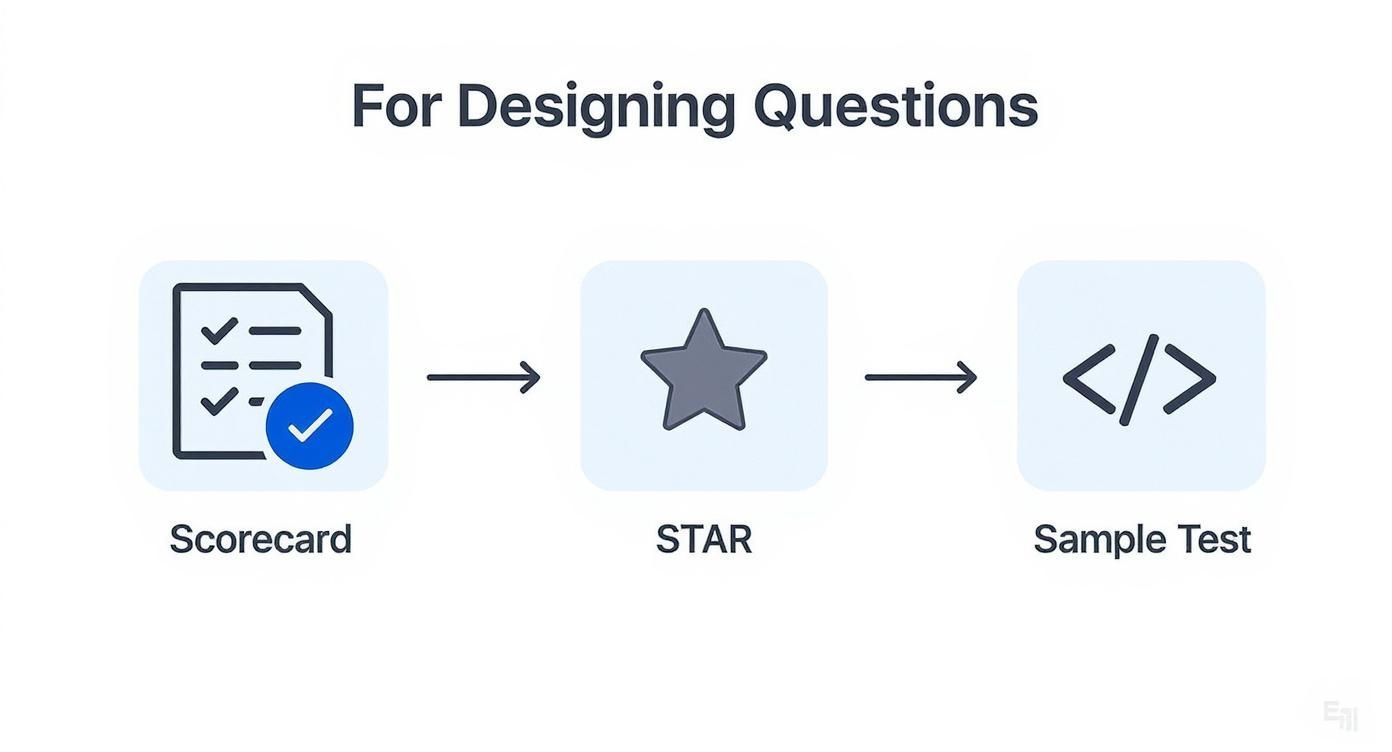
As you can see, a well-defined scorecard is the foundation. It directly informs the STAR method questions you'll ask and helps you design a relevant skills test.
Every format—phone, video, and in-person—has its own unwritten rules. Nailing each one is critical for getting the clear signals you need to make a confident decision.
Phone Screens:
The goal here is pure efficiency. Keep the conversation focused on the absolute must-haves and potential deal-breakers. Since you can't rely on visual cues, a friendly and energetic tone is everything for building that initial rapport.
Video Calls:
This is the new normal. Make sure your tech is solid before the call starts. Look at the camera to simulate eye contact and be aware of what’s in your background. Non-verbal cues like nodding are still powerful signals of active listening.
In-Person Meetings:
This format gives you the richest data on interpersonal skills. Greet candidates warmly, offer them a drink, and create a comfortable setting. This is your prime opportunity to let your company culture shine.
No matter the format, your number one job is to create an environment where the candidate can do their best work. A stressed or uncomfortable candidate isn't going to give you the authentic signals you need to make an accurate call.
By structuring your process thoughtfully and mastering the mechanics of each format, you shift the interview from an interrogation to a productive conversation. You'll gather better information, and just as importantly, every candidate will walk away with a positive impression of your company.

Hiring isn't just a local game anymore. The modern talent pool is global, and companies are catching on—with 71% of teams now recruiting internationally to land the best people. This means mastering the remote interview is no longer a "nice-to-have" skill; it's a core competency for any serious recruiter.
But interviewing candidates across different time zones and cultures adds a whole new layer of complexity. It's not just about hopping on a video call. It's about designing an experience that feels fair, consistent, and genuinely insightful, no matter where your candidate is dialing in from.
Video interviews are here to stay. After the pandemic, nearly 60% of hiring managers embraced video platforms to break down geographic barriers and get interviews scheduled faster. Yet, there's a catch: 70% of candidates still say they prefer the human connection of meeting in person.
So, how do you bridge that gap? You get the fundamentals right.
Your tech stack is a huge part of the candidate experience, so choosing the right tools is critical. To make sure every conversation is smooth, check out some of the best video conferencing software for remote work and find a platform that’s reliable and easy for candidates to use.
A seamless video interview should feel like a productive, in-person conversation. Any friction caused by technology detracts from your ability to accurately assess the candidate and harms their perception of your company.
Hiring globally means you'll encounter a wide range of communication styles and professional norms. What’s considered direct and confident in one culture might come across as arrogant in another.
To keep things fair, your hiring team needs to be culturally aware. This means ditching assumptions and sticking to the core competencies you've defined in your scorecard. It also means being considerate when scheduling. Booking an interview at a reasonable hour for the candidate—even if it's outside your normal 9-to-5—shows you respect them and their time. It’s a small gesture that says a lot about your company culture.
For more on creating a great virtual experience, check out our guide on virtual meeting etiquette.
The interviews are over. Now the real work begins. The next step is to translate hours of conversation and pages of notes into a clear, defensible hiring decision. This is where you shift from gut feelings to objective, data-backed analysis.
First things first: get everyone in a room for a debrief. Schedule this session immediately after the final interview. Don’t let a few days pass—memories fade fast, and unconscious bias has a way of creeping in when you do. This meeting isn't just about sharing opinions; it's a calibration session.
The entire point of the debrief is to ground the conversation in actual evidence. Every single interviewer needs to show up with their completed scorecard. Make this a non-negotiable rule. It’s the single best way to stop the discussion from being dominated by the loudest or most senior person in the room.
Go through the scorecard competency by competency. For each one, ask every interviewer to share the specific evidence—direct quotes and examples from the candidate—that led to their rating. This forces the conversation to stay focused on performance, not just personality fit.
This process is how you systematically dismantle the "I just have a good feeling about them" argument. If that feeling is real, it will be backed by concrete examples that map directly to your scorecard. If it's not, it’s probably bias.
This approach also throws a spotlight on any inconsistencies. If one interviewer gives a candidate a 5 on "Problem-Solving" while another gives a 2, you have a tangible starting point. You can dig into what questions were asked, what answers were given, and figure out what happened. Was it a genuine performance gap, or did an interviewer misunderstand something?
Tracking these patterns over time also gives you incredible insight into your hiring process as a whole, which is a crucial part of monitoring your most important recruiting metrics.
Once the team has calibrated and reached a clear consensus, a couple of final steps remain to verify your decision and seal the deal.
By sticking to this systematic approach, you ensure every hiring decision is built on a solid foundation of evidence, not just emotion. It’s the most reliable path to picking the right person and building a team that truly performs.
Even with a solid plan, questions pop up. Here are some of the most common things recruiters and hiring managers ask when they're dialing in their interview process.
For most roles, the magic number is three rounds. Anything more and you risk losing great people to companies that move faster.
Think of it like this: an initial recruiter screen to check the basics, a hiring manager interview to dig into core skills, and a final team interview to see if they’ll click with the culture. This gives you a complete picture without dragging things out. Pushing past four rounds almost always leads to diminishing returns and a terrible candidate experience.
The single most effective weapon against bias is the structured interview. It’s simple: you ask every single candidate the exact same set of questions, and you grade their answers using the same pre-built scorecard.
This forces everyone to focus on objective, job-related skills instead of vague "gut feelings." To really lock it down, try blind resume reviews at the start of the process and make sure your interview panels are made up of people from different backgrounds.
First, you have to figure out if it's just nerves or a real lack of skill. Some brilliant people are just plain bad at interviewing under pressure. Try to put them at ease—rephrase a question, shift to a more casual tone, and see if they open up.
If their portfolio or references are stellar but they're bombing the behavioral questions, give them a practical work sample test. Let them show you what they can do. It's often a much better predictor of future performance than how well they can tell a story about a past project.
A good training program is non-negotiable if you want consistency. It really comes down to three things:
The best way to make this stick? Run mock interviews. Role-playing is where the theory becomes real, helping your team build the confidence to do it right when it counts.
Ready to stop guessing and start building a world-class hiring process? Juicebox uses AI to help you find and engage top-tier talent with precision. Sign up for free and see how much faster you can fill your pipeline with qualified candidates.
{{large_cta}}
Run your first search for free. Find and engage top talent across 800M+ profiles. Trusted by 5,000+ customers.
.png)