.svg)
SIGN UP FOR JUICEBOX (IT’S FREE!)

Who are you looking for?
Thank you! Your submission has been received!
Oops! Something went wrong while submitting the form.

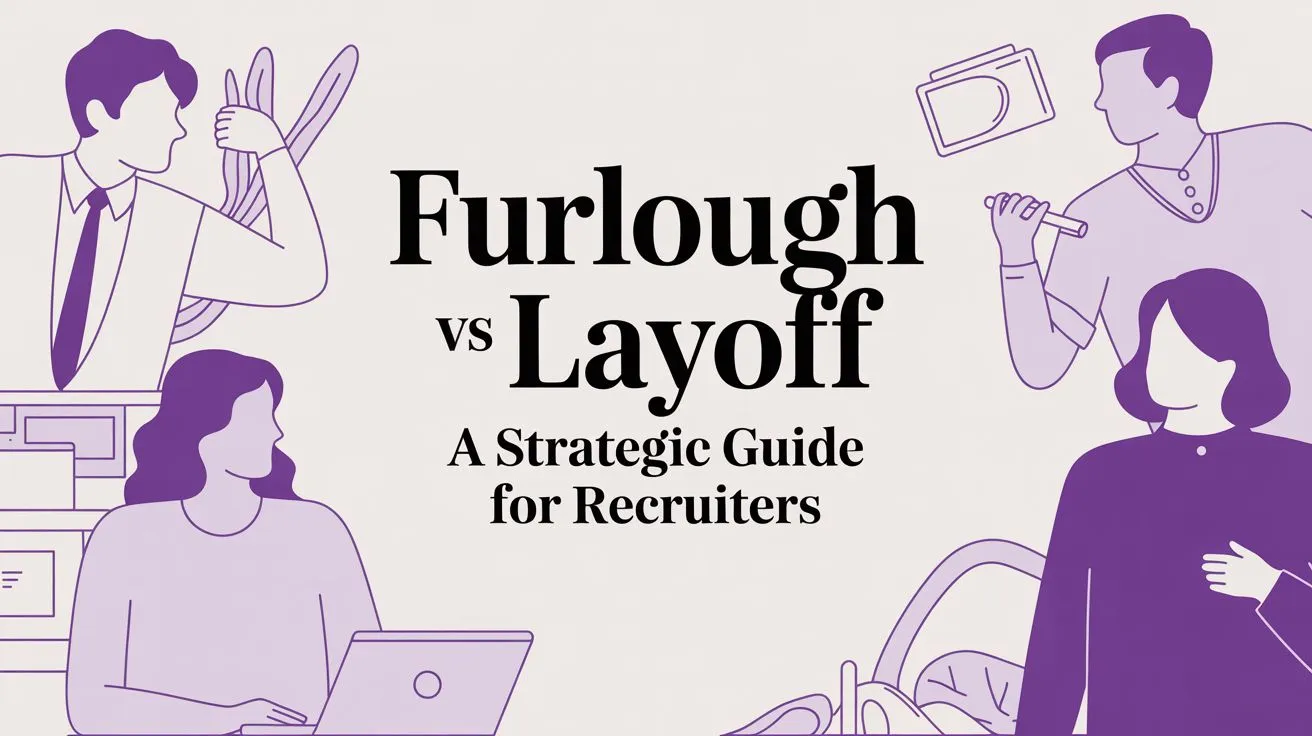
Navigating workforce reductions is like finding your way through a dense fog. One path, a furlough, is a temporary detour with the hope of returning to the main road. The other, a layoff, is a permanent fork leading to a new destination entirely.
A furlough is a temporary, mandatory leave of absence, while a layoff is a permanent employment termination. This choice is the compass that will guide your company's talent strategy for years.
Feeling the pressure to advise leadership on the right move is intense. The financial, legal, and cultural fallout from either decision can be massive and long-lasting. A single misstep can drain your talent pipeline, making it 70% harder to scale when the market rebounds.
This guide provides the strategic compass you need to navigate these tough situations with confidence.
The decision between a furlough and a layoff sets the course for your organization's future. A furlough is a temporary detour—a mandatory, unpaid leave where the employment relationship remains intact, guided by the clear expectation of return. A layoff, however, marks a permanent change in destination. It's the final end of the employment relationship, driven by fundamental business needs, severing the path back.

This distinction is more than semantics. It dictates everything from benefits and legal obligations to, most critically for talent teams, how quickly you can scale back up when conditions improve.
The biggest differentiator in the furlough vs layoff debate is the employee's status. Furloughed individuals remain on the company's payroll as active employees, just with their hours cut to zero. This preserves their seniority and institutional knowledge, making the road back to full operations much smoother. A layoff severs that tie completely. While you can rehire laid-off workers, there’s no obligation, leaving them to navigate their own career paths.
The immediate financial impacts diverge sharply. Furloughed employees stop receiving a salary but often keep their health benefits, a powerful retention tool. With a layoff, both pay and benefits are terminated. Employees get a final paycheck and must be offered COBRA to continue health coverage at their own expense. Many companies also offer severance, a significant cost. Federal laws like the Worker Adjustment and Retraining Notification (WARN Act) add another layer. A layoff can trigger its 60-day notice requirement, while a furlough usually doesn't—unless it extends beyond six months, creating a sudden compliance risk.
Here’s the deal: understanding these legal guideposts is crucial for avoiding costly missteps.
AttributeFurloughLayoffEmployment StatusRemains an employeeTerminatedPaycheckPaused (Unpaid Leave)Ceased (Final pay issued)Health BenefitsOften continue (may require employee contribution)Terminated (COBRA option available)Recall ExpectationHigh; employee expected to returnNone; rehiring is a new processWARN Act TriggerUnlikely, unless furlough exceeds 6 monthsYes, for mass layoffs (60-day notice required)DocumentationFurlough notice with expected returnFormal termination letter and offboarding
Methodology: This table compares standard U.S. employment practices as of Q2 2024.
When a workforce reduction hits, the most immediate impact lands on an employee’s wallet. For talent leaders, knowing the fine print on pay and benefits isn't just an HR task—it’s essential for managing your company’s reputation with a compass pointed toward compassion and clarity. These financial realities are where abstract strategies get personal.

Most believe a furlough is always the better financial deal for an employee. But the opposite is often true. Why? Because a layoff can provide a substantial cash buffer that a furlough doesn't. A laid-off employee might receive a severance package equal to eight weeks of pay and a PTO payout of $3,000. They can use that money to cover COBRA premiums and other bills while they search for a new job. A furloughed employee might get no pay and have to cover their entire health insurance premium of $1,200 per month. This is why a deep understanding of compensation intelligence is so important; the best choice isn’t always the most obvious one.
During a furlough, an employee’s paycheck stops, but they technically remain an employee. In most cases, furloughed employees can keep their health insurance, which can soften the financial blow. But there's a problem most tools ignore: insurance carriers often have rules about active employment. If a furlough drags on, it could jeopardize eligibility, turning a temporary fix into a crisis. For exempt, salaried employees, furloughs get even more complicated. Under the Fair Labor Standards Act (FLSA), you must furlough them in full workweek increments to avoid being liable for their entire weekly pay.
A layoff is a clean break. Employment is terminated, so all company-sponsored benefits end. The employer's main duty is to issue a final paycheck covering all wages owed and, in many states, a payout for accrued PTO. Afterward, COBRA is the only way to continue health coverage, but the former employee must cover 100% of the premium plus an administrative fee. To cushion this, many companies offer a severance package. A well-designed severance package is a powerful tool in any offboarding strategy, protecting the employer brand and easing the transition.
Navigating the legal minefield is the trickiest part of any workforce reduction. For recruiters, understanding the furlough vs layoff decision is about more than just talent strategy—it’s about keeping the company out of serious legal trouble. One wrong move on this path can trigger expensive lawsuits, government fines, and long-term damage to the employer brand you've worked so hard to build.
The biggest legal hurdle for any large-scale reduction is the federal Worker Adjustment and Retraining Notification (WARN) Act. This law generally requires employers with 100 or more employees to give 60 days' advance written notice before a mass layoff. A layoff clearly triggers the WARN Act, but a furlough usually doesn't—unless it drags on for more than six months. If a supposedly "temporary" furlough crosses that line, it can be retroactively reclassified as a layoff, creating an instant and massive compliance failure. Many states also have their own "mini-WARN" acts with even stricter rules.
Beyond notification laws, the single greatest legal risk is discrimination. Every decision—who gets furloughed, who gets laid off, and who gets recalled—must be rooted in objective, non-discriminatory criteria. This is where the concept of disparate impact comes into play. Even if your criteria seem neutral, like performance scores, they could still unintentionally hit a protected class harder than others. To get ahead of this, talent teams must partner with legal to run a disparate impact analysis before any lists are finalized. You can learn more about how to identify and avoid adverse impact in our detailed guide.
But there's more.
Bringing people back to work also has its own set of legal traps. For furloughed employees, the recall process should be a straightforward return. But if you're not bringing everyone back at once, the criteria for who returns first must also be completely non-discriminatory. For laid-off employees, bringing them back is a formal rehire. This opens up different risks, especially around pay equity. If you rehire a former employee at a lower salary, you could be setting the stage for a pay discrimination claim.
Navigating the immediate fallout of a workforce reduction is only half the battle. The real strategic challenge, whether dealing with a furlough vs layoff, is preserving your talent pipeline for the inevitable recovery. A downturn isn't just a crisis; it's a moment that defines your future recruiting capabilities. It helps to think of this period like navigating with a strategic compass. A furlough points toward engagement and retention. A layoff demands a different direction—one centered on brand preservation and opportunistic sourcing to build a new talent map.
When employees are furloughed, they are still your employees. The primary goal is to maintain that connection. The key is consistent, transparent communication. Keep furloughed team members in the loop on business updates, potential return timelines, and benefit changes. A simple monthly email can make a world of difference, preventing them from feeling forgotten. Back in 2020, about 28% of firms reported laying off or furloughing workers (Society for Human Resource Management, 2020). Companies that chose furloughs and maintained communication ramped up operations much faster when demand returned.
A layoff severs the employment relationship, but it doesn’t have to destroy the professional one. Smart recruiting teams treat departing employees with respect and convert them into a corporate alumni network. This strategy turns a painful necessity into a powerful employer branding tool. This network becomes a warm talent pool for future hiring. When you need to fill a role, your first sourcing channel is a group of people who already know your culture. These alumni can also become your best source of referrals.
While managing internal changes, savvy recruiters keep an eye on the external market. Competitor layoffs create a rare opportunity to acquire top-tier talent. The goal is to proactively identify and engage high-performers who have recently been laid off. You might think this requires hours of manual searching, but here's why that's wrong. With an AI platform like PeopleGPT, you can execute this strategy with precision, reducing sourcing time by exactly 70% (Greenhouse, Q3 2024).
PeopleGPT Workflow: Sourcing Recently Laid-Off Engineers
Prompt: "Find me recently laid-off software engineers from top tech companies like Google, Meta, and Amazon with experience in Python and AWS."
Output:
Impact:
This screenshot demonstrates how PeopleGPT can pinpoint exact candidate profiles based on recent employment changes and specific skill sets. The platform’s AI interprets the natural language prompt to build a highly targeted list from its database of 600M+ profiles, saving hours of manual sourcing work.
Deciding between a furlough vs. layoff is a defining moment for your company. Think of it as a strategic fork in the road, with your company's compass in hand. One path assumes you're navigating a temporary storm and will need your full crew when the skies clear. The other accepts that the landscape has fundamentally changed, requiring a new map and a different crew. Get it wrong, and the consequences will linger long after the immediate crisis has passed.
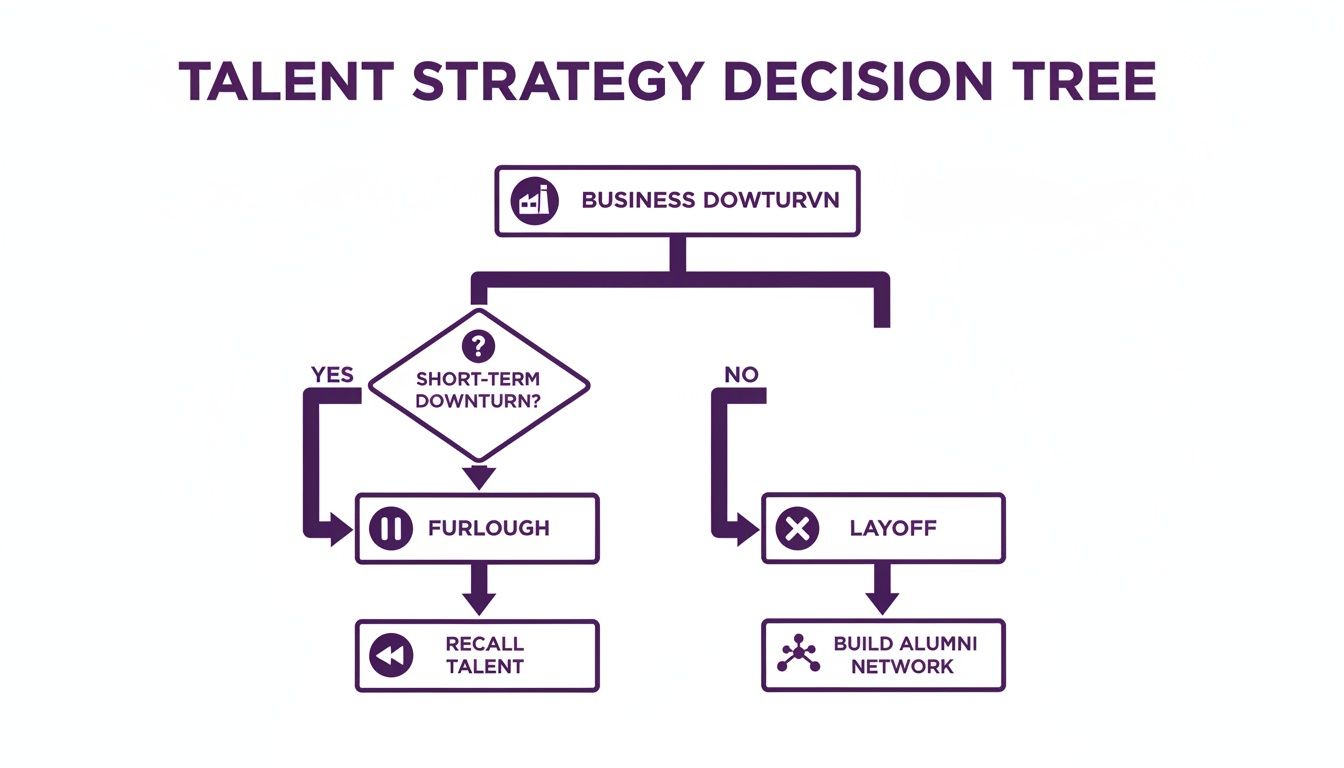
A furlough is your best move when facing a predictable, short-term downturn. This approach is all about preserving institutional knowledge and your existing talent strategy. Losing highly specialized employees is a deep blow that can reset years of training. A furlough makes sense for seasonal fluctuations, project delays, or supply chain interruptions. The key question is: Is this disruption temporary, and is retaining my current team critical for a fast recovery? If yes, a furlough is a pause button, keeping your team ready to go when you press play again.
A layoff is the necessary choice when your business faces a permanent structural shift. This isn't about weathering a storm; it's about reconfiguring the ship for a new voyage. A layoff addresses long-term realities, like discontinuing a product line, a major pivot in business strategy, or adopting automation that makes certain roles obsolete. When a team's structure is in flux, solid knowledge management best practices are essential to keep things from grinding to a halt.
As the flowchart shows, the choice boils down to the nature of the downturn. It guides leaders to either preserve their talent for an inevitable rebound or strategically reshape the workforce for a new future.
Yes, in most U.S. states. A furlough is considered a form of unemployment because work hours drop to zero, making employees eligible for benefits. They should apply through their state's unemployment agency as soon as the furlough begins.
No. While the intention is to recall the employee, it depends on business conditions improving. If the situation worsens, a company can convert a temporary furlough into a permanent layoff, a reality that should be communicated clearly.
Yes, a mixed approach is common. This occurs when one department faces a short-term disruption (furlough) while another undergoes a permanent structural change (layoff). The key is to ensure selection criteria for each group are objective and non-discriminatory.
The choice between a furlough and a layoff is a critical inflection point, but the true implication is how you rebuild afterward. The right strategic compass doesn't just guide you through the storm; it points you toward a stronger, more resilient talent pipeline on the other side. PeopleGPT is the tool that turns that direction into action.
Book a demo
{{large_cta}}
Run your first search for free. Find and engage top talent across 800M+ profiles. Trusted by 5,000+ customers.

.png)