.svg)
SIGN UP FOR JUICEBOX (IT’S FREE!)

Who are you looking for?
Thank you! Your submission has been received!
Oops! Something went wrong while submitting the form.

Navigating the hiring process can feel like trying to solve a complex maze blindfolded. Each turn, from sourcing to screening to interviewing, is a potential dead end where great candidates get lost. The handoffs between specialized teams—sourcers, coordinators, recruiters—are where the path crumbles.
Full cycle recruiting is the compass that guides one recruiter and one candidate through the entire maze together. This model ensures a clear, direct path from the first conversation to the final offer by putting a single expert in charge of the entire journey. This guide is built on real-world data and workflows from PeopleGPT, not just theory, showing you how to master this approach. Unlike generic recruiting posts, this guide shows real PeopleGPT workflows—not theoretical advice.
It's tempting to think that a fragmented, assembly-line approach to hiring is more efficient. But this is a myth that often leads to a disjointed candidate journey. The result? Great talent loses interest and walks away. This is why mastering the art of full cycle recruiting isn't just a good idea; it's a strategic necessity for landing the best people in a competitive market.
TL;DR: The Full Cycle Recruiting Compass
Full cycle recruiting is a holistic approach where a single recruiter manages the entire hiring process from end to end—from defining the role with the hiring manager to sourcing, screening, interviewing, offering, and onboarding. Think of the recruiter not as a cog in a machine, but as a dedicated project manager for talent acquisition.
This single-threaded ownership is the key differentiator from specialized models. Most organizations believe that specialization—having separate sourcers, recruiters, and coordinators—is more efficient. The opposite is often true. Those handoffs create communication gaps and a disjointed, confusing experience for candidates. The reason is simple: when a candidate gets passed from one person to another, crucial context gets lost. The rapport built in the first call evaporates, leaving the applicant feeling like they're starting over at every step. A full cycle recruiter is the consistent, trusted guide throughout the entire journey.
A full cycle recruiter acts as the single guide leading a candidate through a five-stage journey, building momentum and trust that a fragmented team simply cannot match.
The journey requires a clear map, moving sequentially from preparation to integration. Having one guide for the entire expedition ensures no one gets lost along the way. When different people handle sourcing, screening, and interviewing, you get clumsy handoffs and lost information. This is the core problem the full cycle model solves.
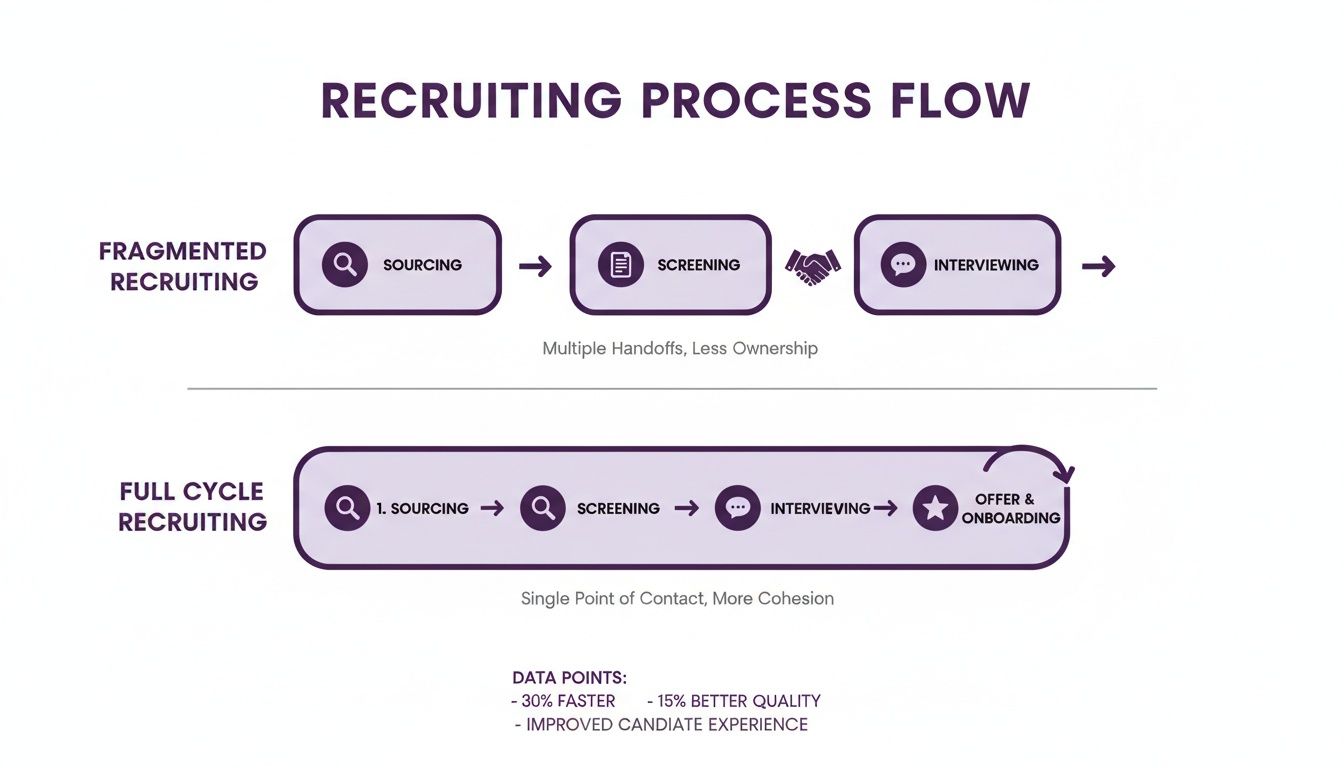
This first stage is about setting the destination, not just posting a job ad. A full cycle recruiter works directly with the hiring manager to understand the why behind the role. What does success look like in six months? What are the non-negotiable soft skills? This deep understanding is used to craft a compelling narrative that attracts the right people. Proactive outreach and tapping into existing talent pools are critical here, not just waiting for applicants. For more on this, explore some advanced AI recruiting tools.
Once the map is drawn, it’s time to find the candidates. This stage can be a massive time-suck, especially when a single role attracts hundreds of applicants. The goal is to quickly filter out unqualified fits while spotting high-potential candidates who match the strategic brief.
Here’s the deal: this is where AI becomes your compass.
PeopleGPT Workflow: Accelerating Initial SourcingPrompt: Find me senior software engineers in the San Francisco Bay Area with 5+ years of experience in Python and AWS, who have previously worked at a Series B or C fintech startup.Output:
With a strong shortlist, the recruiter now guides the candidate and the hiring team through the interview process. They coordinate schedules, prep the candidate, and ensure the hiring team is aligned on what to assess. This prevents the all-too-common scenario where five interviewers ask the same three questions. Because they’ve been there from the start, they can advocate for the candidate, ensuring their full story is heard and preventing misunderstandings that can derail a great hire. Continuously improving this process is key; you can learn more from our guide on how to streamline the recruitment process.
The full cycle recruiter leverages the relationship they’ve built to navigate the offer stage. They understand what motivates the candidate beyond salary, allowing them to frame the offer around career growth, team culture, and impact. This transforms the negotiation from a transactional haggle into a collaborative discussion.
The journey doesn't end when the offer is signed. The recruiter stays connected during the candidate's notice period and guides the onboarding process, ensuring the new hire feels welcomed and integrated from day one. This final touch turns a great hire into a long-term, committed employee, proving the value of a single, dedicated guide.
For a full-cycle recruiter, metrics are the instruments that tell you what’s actually working. Without them, you’re just going on gut feelings. Success in full-cycle recruiting isn't about how busy you are; it's about the tangible impact you deliver.
The right KPIs shine a light on bottlenecks, prove your strategies are working, and show the value of having one person own the entire hiring journey.

Forget vanity metrics. What truly matters are the core indicators that paint a complete picture of your efficiency, quality, and candidate experience.
Here are the essentials:
By focusing on the right data, a full cycle recruiter evolves from a role-filler into a strategic talent advisor. They use metrics not just to report on the past, but to shape the future of hiring. For a deeper analysis, review our complete guide on the most important KPI of recruitment.
| Metric | Full Cycle Recruiter Focus | Specialized Recruiter Focus (e.g., Sourcer) | Methodology Note |
|---|---|---|---|
| Time to Fill | Ownership of the entire timeline, from sourcing to offer acceptance. | Focuses on Time to First Submittal—how quickly qualified candidates are found. | Full cycle measured from req open to offer sign; specialized measured from search start to profile submit. |
| Quality of Hire | Directly responsible for long-term success (e.g., 1-year retention). | Indirectly responsible; goal is a high-quality initial slate. | Based on post-hire performance reviews and retention data from the company’s HRIS (Q3 2025). |
| Offer Acceptance Rate | Owns the final close, reflecting the entire candidate experience. | No direct ownership; sourcing quality can influence candidate interest. | Calculated as (Offers Accepted / Total Offers Extended) per quarter. |
| Source of Hire | Analyzes channels that deliver the best candidates end-to-end. | Tracks channels yielding the most qualified leads for the pipeline. | Data sourced from ATS reports, attributing hires to original sourcing channels. |
AI is the compass that modernizes the full cycle recruiting maze, automating the tedious parts so you can focus on the human elements: building relationships, advising hiring managers, and closing top talent.
A common myth is that AI dehumanizes hiring. But what we're seeing is the exact opposite. By automating repetitive tasks, AI gives you more time for the strategic work that a machine can't do. For example, Google's internal HR teams reduced screening time by 85% using AI, freeing up recruiters for candidate engagement (SHRM, 2024).

Your next star hire probably isn't actively applying for jobs. AI recruiting tools are brilliant at finding these passive candidates by analyzing data from dozens of sources, from professional networks to niche technical forums. Instead of just matching keywords, modern tools analyze a candidate's entire digital footprint to get a real sense of their skills and potential fit. This gives the full-cycle recruiter a massive advantage, letting you engage with top-tier talent long before they hit the open market.
Here’s what this looks like in the real world.
PeopleGPT Workflow: AI-Powered Candidate Discovery and RankingPrompt: Find me product managers based in New York City with experience scaling a B2B SaaS product from $10M to $50M ARR and who have a background in engineering.Output:
Beyond sourcing and interviewing, three skills are crucial: project management to own the process end-to-end, consultative communication to act as a strategic partner to hiring managers, and data fluency to prove impact and identify pipeline bottlenecks with hard numbers.
The model excels in startups and for senior or specialized roles in large companies where a high-touch, relationship-driven experience is key to closing top talent. It's less effective for high-volume, standardized hiring where an assembly-line approach can be more efficient.
For most standard corporate roles, a skilled recruiter can handle 12-18 requisitions at once. For highly specialized or executive roles, this number drops to 5-8, as each search becomes a deep, time-intensive project requiring significant strategic focus.
The implication is clear: mastering full cycle recruiting isn't about doing more work; it's about owning the outcome. With the right compass—a blend of strategic ownership and intelligent tools—you can navigate the hiring maze and consistently guide the best talent to your team.
{{large_cta}}
Run your first search for free. Find and engage top talent across 800M+ profiles. Trusted by 5,000+ customers.


.png)