.svg)
SIGN UP FOR JUICEBOX (IT’S FREE!)

Who are you looking for?
Thank you! Your submission has been received!
Oops! Something went wrong while submitting the form.


To find great employees today, you have to ditch the old "post and pray" method. Relying on job boards and waiting for the right person to stumble upon your ad is a slow, painful game of chance. The real benefit of modern recruiting isn't just filling roles faster; it's gaining a competitive edge by finding incredible talent before your competition does.
The real challenge isn't a shortage of people—it's cutting through the overwhelming noise to find the right people. This is the exact problem we built Juicebox to solve. While most tools focus on volume, we deliver precision by sourcing across 30+ platforms, not just LinkedIn. Modern recruiters need a new playbook, one that shifts from passive waiting to proactive, multi-source hunting.
TL;DR: The New Way to Find Employees
Let's be honest, the old way of hiring is officially broken. You post a job, cross your fingers, and then drown in a sea of irrelevant applications. But there’s a problem most tools ignore: they are designed to manage this flood of applications, not prevent it in the first place.
The data backs this up. A 2026 report from ManpowerGroup found that 75% of employers are struggling to find the skilled talent they need, the highest level in over a decade. This proves that while application volume might be high, the actual signal—qualified talent—is getting lost in the noise. It forces recruiters to waste hours sifting through resumes instead of talking to quality candidates.
Think about the last time you had to manually cross-reference a promising GitHub profile with someone’s LinkedIn page, only to hit a wall with a dead-end email address. That whole time-consuming, frustrating scavenger hunt can now be collapsed into a single, automated step. This isn't a small improvement; it’s a complete redefinition of a recruiter's daily workflow.
Most people believe that getting more applicants is a good thing. The opposite is true. Why? A flood of inbound applications is usually a sign of a poorly targeted job description or an over-reliance on saturated channels. All it does is force you to filter out unqualified people, slowing the entire process down. A better approach is outlined in our guide to streamline the recruitment process.
The real goal is to become a "signal operator."
That means proactively finding and engaging the right people—wherever they are online—before your competitors even know they exist. It’s about building a pipeline of vetted candidates in under an hour, not waiting weeks for applications to trickle in.

ALT: Find employees using an interface with dials for skills, experience, and culture.
Think of it like tuning a radio. Instead of wading through static, you're dialing directly into the right frequencies for skills, experience, and culture. AI-powered tools are what let you calibrate this with precision. You can explore AI recruiting tools to see how they automate this.
For a long time, mastering complex Boolean strings on LinkedIn was the mark of a great sourcer. But that approach is slow, easy to mess up, and fundamentally limited. Top talent isn’t just hanging out on one platform; they’re spread across dozens of them, from GitHub and academic sites to niche professional communities. Exploring Indeed alternatives is a great first step.
The modern way to find employees is to use natural language.
Instead of trying to build the perfect, complicated search query, you just describe your ideal candidate in plain English. For example: "Find a Senior Product Manager in New York with fintech experience who has seen a company through a Series C funding round."
This frees you up to do what actually matters: building relationships with people who are a perfect fit. That’s how you go from sourcing in months to sourcing in minutes.
To find employees who are a genuine fit, you have to dig deeper than a standard job description. It all starts with a smart sourcing strategy—one built on solid data, not just assumptions.
This means you need to move past a generic checklist of qualifications and build an Ideal Candidate Persona (ICP). Think of it less as a wish list and more as a data-backed blueprint of the person you need. It maps their skills, experience, and even their career path directly to what your company needs to succeed.
You might think you have a good handle on the talent market for a role, but the data often tells a completely different story. A common mistake is jumping into a search with a vague title and a few keywords. That approach casts a wide, sloppy net that brings in mostly irrelevant profiles, burning through your time and energy.
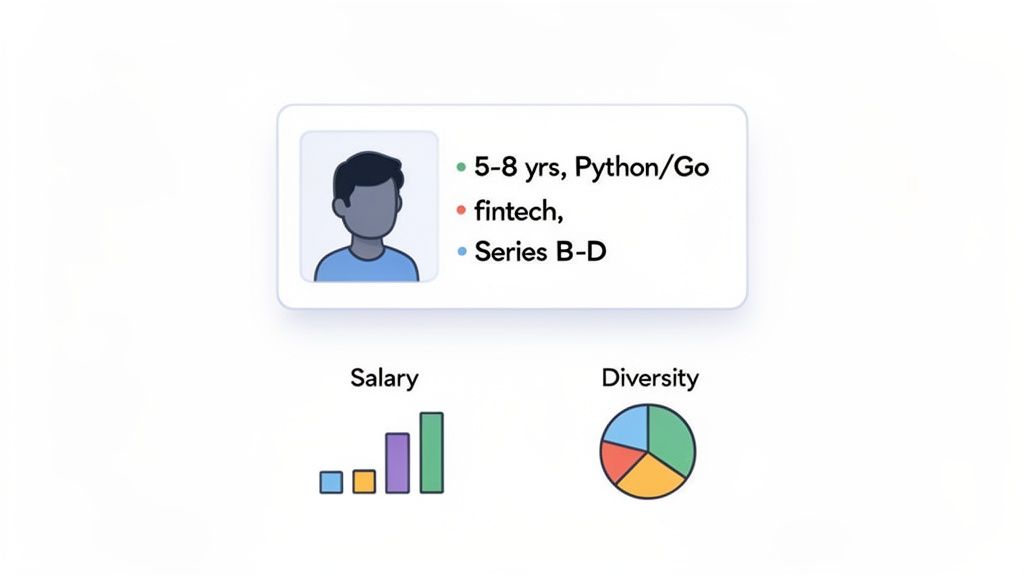
Here's the bottom line. The real magic of a strong ICP is its ability to translate high-level business goals into specific, searchable traits. Instead of just looking for a "Senior Software Engineer," a data-driven persona gets much more granular.
Let me show you what I mean:
This detailed profile gives you a crystal-clear set of criteria that AI sourcing tools can lock onto. It reframes the search from a simple title to a career story. Of course, a robust sourcing strategy also depends on knowing how to properly write and post job ads that will attract the right people from the very beginning.
But wait, there's more. Before you even think about starting your search, you need to analyze the market. This is where Talent Insights platforms are indispensable. Instead of guessing, you get concrete answers to the questions that matter most.
Key Data Points to Analyze:
This pre-search analysis stops you from chasing ghosts. If the data shows a severe talent shortage for "Go developers in Boise," you can pivot your strategy before you've wasted a single hour. For a deeper look at attracting candidates, you might be interested in our guide on what is recruitment marketing.
There's a myth that nearly every recruiter falls for: that LinkedIn is the only ocean with any fish. The truth is, the best talent isn’t endlessly scrolling their feed. They're busy building, creating, and sharing their work elsewhere.
Data from our own customers at Juicebox shows that over 80% of hires at fast-growing companies come from platforms like GitHub, academic sites, and niche professional communities. Sticking to a single platform means you’re blind to the majority of the market, which is why smart recruiters are branching out to find the best sourcing tools for recruiters to get real results.
You have to fish where the fish actually are.
The old way of sourcing across multiple platforms meant mastering ridiculously complex Boolean strings for each site. The modern approach is way simpler: use natural language.
Real-World PeopleGPT Prompt Example:
"Find software engineers in San Francisco who have contributed to open-source AI projects on GitHub and previously worked at a YC-backed startup."
A single prompt like that instantly scours dozens of sources. It understands the context behind "YC-backed" and even analyzes GitHub contributions—tasks that would take hours of manual cross-referencing. This is even more critical now that hiring is a global game. A 2026 report by Oyster found that 57% of companies plan to hire globally, with new talent hubs emerging in the Philippines, the US, and India.
You might think searching across dozens of platforms would be slower. It’s actually the opposite.
Company: RampMetric: Identified 50 qualified fintech engineersTimeframe: Under 30 minutesTactic: Used a multi-source, natural language search to find candidates with specific fintech project experience on platforms beyond LinkedIn.
This was a task that used to take their internal team two full days slogging through LinkedIn Recruiter. By looking beyond the obvious talent pool, they didn’t just cut their sourcing time by over 95%; they found incredible candidates their competitors were completely missing.
Uncovering hidden talent isn't just about where you look; it's about how you filter. Once you have an initial list, you can layer on qualifications that traditional platforms can't handle.
When you combine broad, multi-source searches with these kinds of deep, intelligent filters, you create a hyper-targeted list.
Finding a promising profile is just the starting line. The real challenge is converting that initial interest into a genuine, engaged candidate who actually wants to talk to you. You need a tactical, systematic approach.
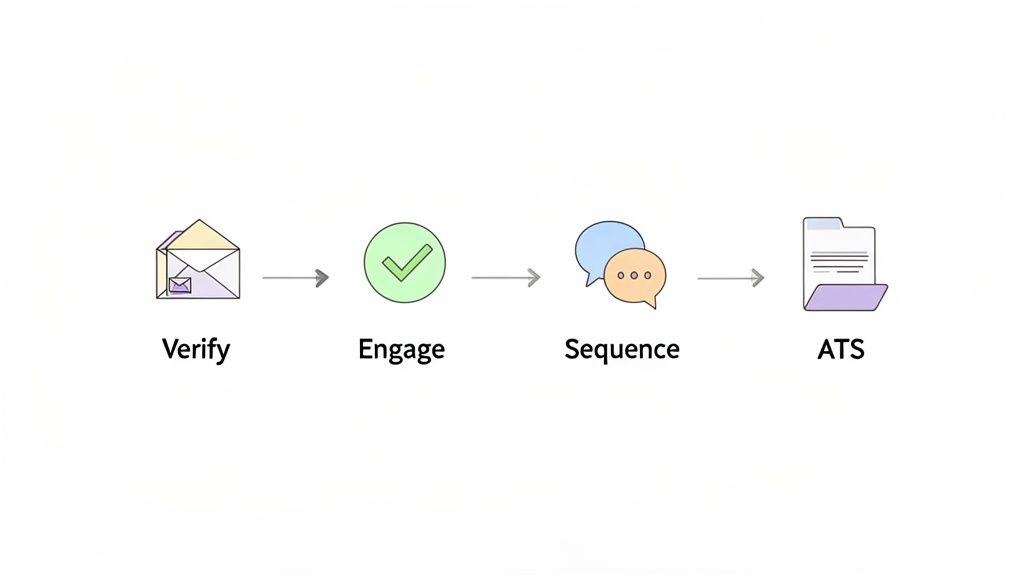
Before you even think about writing that first email, you have to verify the prospect's contact information. This isn't optional.
Sending messages to bad emails doesn't just kill your chances with that one person; it tanks your domain's sending reputation. Get this wrong, and all your future outreach could start landing in spam folders. Email verification and enrichment is a non-negotiable step. Think of it as your insurance policy for effective outreach, and an important part of good candidate relationship management.
Most recruiters treat outreach like a numbers game, blasting out generic templates and just hoping something sticks. But what if the problem isn't the template, but the entire disconnected workflow?
You find a profile in one tool, verify their email in another, and then load them into a third for sequencing. It's slow, clunky, and creates gaps where top talent can slip away. What if the search, verification, and outreach all happened in one seamless motion?
A single email almost never works. To break through the noise, you need a thoughtful, multi-step sequence.
Your first email has one job: get a reply. It needs to be short, personalized, and focused on them, not you.
If you don't hear back, your follow-up needs to offer something of value. Share a relevant industry report, a link to a tech talk, or an article you think they'd genuinely find interesting. This builds goodwill and keeps you top-of-mind.
The "breakup" email is a surprisingly effective final touch. A simple message like, "Assuming the timing isn't right, so I'll close this out for now," can often trigger a reply. At Juicebox, we've seen this tactic triple reply rates on its own.
Here’s the thing most outreach tools ignore: they are completely disconnected from the sourcing workflow. An integrated platform connects your search, verification, sequencing, and Applicant Tracking System (ATS) into one fluid motion.
The goal is to eliminate manual data entry. When a candidate replies, you should be able to sync them directly into your ATS—like Greenhouse or Lever—with one click.
This integrated approach is becoming more critical as hiring picks up speed. An NPAworldwide report for Q1 2026 shows a strong Net Employment Outlook of +24%, with 40% of employers planning to hire. You can discover more hiring trends and insights to see why a fast, efficient pipeline is no longer optional.
How can I find employees if I'm not technical?
Modern AI tools use natural language. Just describe your ideal hire in plain English; the AI does the complex searching for you.
Is an all-in-one platform better than multiple tools?
Yes. An integrated platform for sourcing, verification, and outreach saves time, cuts costs, and stops top talent from falling through the cracks.
Is sourcing beyond LinkedIn really worth the effort?
Absolutely. It gives you access to a larger, more diverse talent pool that your competitors are completely ignoring, giving you a huge edge.
What's the single biggest mistake in recruiting today?
Waiting for candidates to come to you. The best talent is almost always passive, so proactive sourcing isn't just a good idea—it's essential.
Ultimately, the core benefit of a modern hiring strategy is breaking free from a single, crowded channel like LinkedIn. When you leverage AI to source talent from a wide array of platforms, you find employees your competitors can't.
What this unlocks is a powerful competitive advantage: the ability to discover and engage world-class talent before anyone else even knows they exist. This is how you build a stronger team, faster.
Explore PeopleGPT inside Juicebox
{{large_cta}}
Run your first search for free. Find and engage top talent across 800M+ profiles. Trusted by 5,000+ customers.