.svg)
SIGN UP FOR JUICEBOX (IT’S FREE!)

Who are you looking for?
Thank you! Your submission has been received!
Oops! Something went wrong while submitting the form.

Navigating the hunt for C-suite talent can feel like searching for a single person in a vast, uncharted wilderness. Most recruiting tools are like a generic city map—they show you every possible street, but offer no real direction. Executive search, however, is a finely-tuned compass, calibrated to point directly to 'true north': the one ideal leader who can transform your organization. Unlike generic recruiting posts, this guide shows real PeopleGPT workflows—not theoretical advice.
It is a bespoke, retained advisory service that goes far beyond simply filling a role. This strategic partnership is proven to identify, engage, and secure high-impact senior leaders, with top firms reporting a 90%+ first-year retention rate for their placements (Hunt Scanlon, 2024). To master this, you need a precise methodology, which is exactly what PeopleGPT provides by turning weeks of manual research into seconds of AI-powered discovery.
Finding a visionary leader is one of the highest-stakes challenges a company faces. It's a journey fraught with complexity, confidentiality concerns, and immense pressure. You're not just filling a role; you're shaping the future of a business. This guide provides a modern framework to amplify your expertise, turning the arduous expedition into a precise, data-driven mission.
TL;DR: The Modern Executive Search Compass
Finding a visionary leader is one of the highest-stakes challenges a company will ever face. The process is loaded with complexity, confidentiality concerns, and immense pressure. A misstep at the executive level doesn't just leave a vacancy; it can derail strategy, crush morale, and cost a company millions. That kind of responsibility demands a method built on precision and discretion.
This is a world away from standard recruiting.
The biggest difference comes down to the engagement model. Executive search operates on a retained basis, meaning a firm is paid an upfront fee to dedicate a team exclusively to your search. This isn't just a transaction; it's the foundation of a committed partnership, ensuring a thorough, confidential, and exhaustive process. This retained model inherently aligns the search firm's goals with the client's.
It's fundamentally different from contingent recruiting, where recruiters juggle multiple roles and are only paid upon placement. You can read our detailed breakdown of contingency recruitment to see the contrast.
The demand for this specialized service is clear. The global executive search market has seen sustained growth, with analysts projecting the U.S. market alone would approach $19.7 billion by the end of 2025 (IBISWorld, 2024). You can find more market insights over at CJPI.com. This boom highlights just how critical this service has become for navigating leadership transitions.
To truly grasp the difference, it helps to see the two models side-by-side. The methodology, fee structure, and partnership nature impact everything from candidate quality to search timeline.
| Attribute | Executive Search (Retained) | Contingent Recruiting |
|---|---|---|
| Partnership Model | Exclusive, consultative partnership with one dedicated firm. | Non-exclusive; multiple agencies may compete for the same role. |
| Fee Structure | Retainer-based fee, typically 30–33% of first-year compensation. | Success-based fee paid only upon successful placement. |
| Candidate Focus | Proactively targets and engages passive, high-performing leaders. | Primarily works with active job seekers from existing databases. |
| Process Depth | In-depth market mapping and comprehensive candidate assessment. | Faster-paced process focused on matching resumes to job descriptions. |
| Confidentiality | High degree of confidentiality for sensitive leadership changes. | Lower confidentiality as the role is often widely advertised. |
| Ideal Use Case | C-suite, VP, and strategic leadership roles requiring deep vetting. | High-volume, junior-to-mid-level roles where speed is key. |
| Guarantee Period | Typically offers a longer guarantee period (e.g., 12 months). | Shorter guarantee period, commonly around 90 days. |
Methodology Note: The data below is aggregated from industry reports and represents typical engagement structures for C-suite and VP-level roles.
Ultimately, the choice depends on the strategic importance of the role. For leadership positions where the cost of a bad hire is astronomical, the dedicated approach of executive search is an investment, not an expense.
Think of executive search as a high-stakes expedition. The entire process is a structured, confidential journey that typically takes 90 to 120 days from start to finish. Each stage is designed to systematically narrow down the market to a handful of perfectly aligned candidates.
The process is a 40-55 word answer to the question: How does the executive search process work? It begins with a deep needs analysis to define the ideal leader, followed by comprehensive market mapping to identify all potential candidates. The firm then engages, vets, and presents a shortlist of 3-5 top contenders before managing interviews, reference checks, and offer negotiations.
First, you must know where you're going. The initial phase is about defining what success looks like, going deeper than a job description. This means getting key stakeholders—the board, the CEO, the direct hiring manager—to agree on a single vision. This is where you calibrate the compass by asking the tough questions: What specific business challenges must this leader solve in their first 18 months? What leadership style works with our culture? Getting this alignment right prevents the search from veering off course.
Once you've defined your destination, it's time to draw the map. This is where the old myth of the recruiter's Rolodex completely falls apart. Modern search is a data-driven intelligence mission. Comprehensive market mapping involves identifying every company where your ideal leader might be working. We're talking direct competitors, adjacent industries, and organizations known for grooming talent. The goal is to build a complete picture of the talent universe. Our guide on what is talent mapping takes a deeper dive into this research-intensive process.
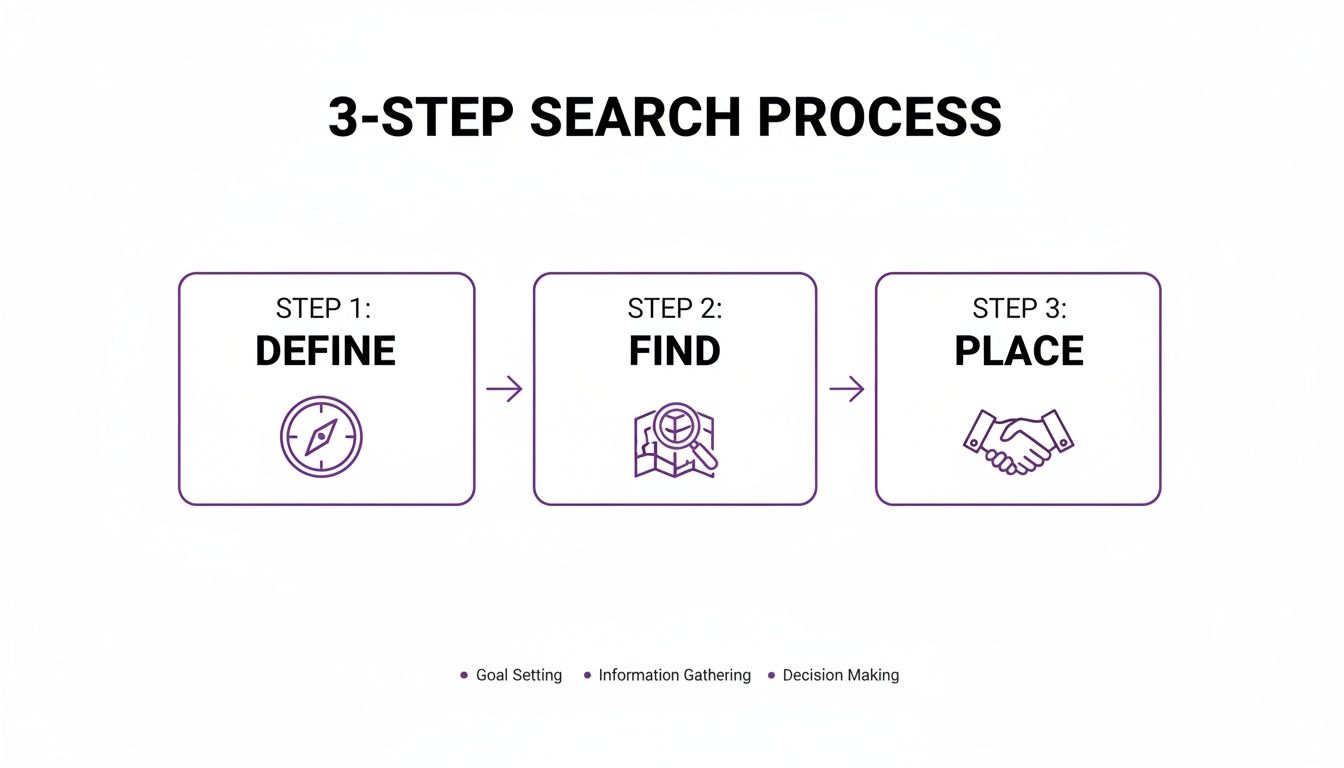
As you can see, a successful search is built on a logical foundation.
With a detailed map in hand, the search consultant begins the delicate art of outreach. You can't just send a generic InMail to a top-performing executive. Engaging these passive candidates requires a personalized, compelling story—you're presenting an opportunity for impact. As candidates show interest, they move into a rigorous, multi-stage evaluation: initial screening, competency-based interviews, and finally, shortlisting. This process culminates in presenting a curated slate of the top 3-5 vetted candidates to the client.
The final stretch is about deep verification and closing. Client interviews confirm genuine fit, while the search firm conducts discreet, off-list reference checks for an unvarnished perspective. Once a final choice is made, the search consultant becomes a crucial mediator during the offer and negotiation stage. They act as a trusted advisor, bridging gaps to ensure both sides land on a workable agreement. The journey concludes with a structured onboarding process, finally guiding the new leader home.
An executive search is a high-stakes mission, and its success hinges on the synchronized efforts of a dedicated team. Think of it like a complex expedition: the consultant is the navigator, but they're lost without a clear destination from leadership and accurate maps from their cartographers. Every player holds a specific piece of the puzzle.
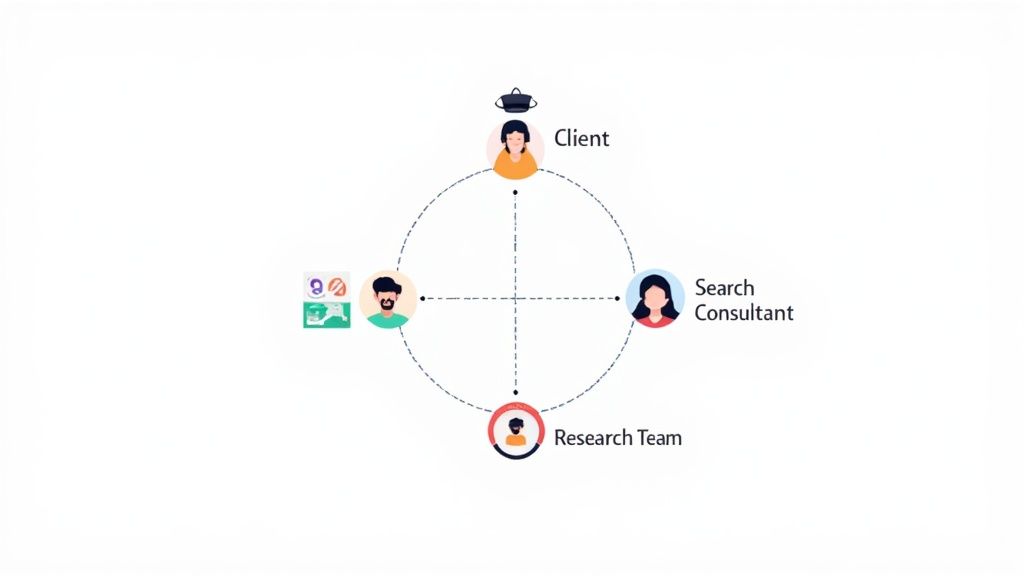
The "client" is rarely a single person. It's usually a committee of key stakeholders—the board, CEO, and direct hiring manager—whose job is to define the destination. They set the strategic objectives, cultural imperatives, and absolute non-negotiables for the role. In essence, they provide the initial coordinates that calibrate the entire search. If this group isn't aligned, the whole mission can go off course before it even begins.
The search consultant is the seasoned navigator steering the ship. This person translates the client's vision into a workable strategy, charting the course from brief to final offer. They're part strategist, part diplomat, and part trusted advisor. Their real expertise isn't just finding people; it's understanding market dynamics, assessing true leadership potential, and navigating complex negotiations. The consultant's ability to build trust keeps the search moving forward.
You might think, "Why pay a premium for an external firm?" The answer is simple: an external partner brings dedicated resources, total confidentiality, and unparalleled access to the passive talent market. They can reach exceptional leaders who would never reply to a standard job posting.
Working behind the scenes is the research team—the unsung heroes of executive search. These are the cartographers who meticulously map the entire talent universe for a specific role. They are data analysts and industry experts who identify target companies, build organizational charts, and compile the initial longlist of potential candidates. Their exhaustive work provides the intelligence the entire search is built on. Without it, the consultant would be navigating blind.
How can you tell if an executive search was truly successful? Just filling the role is the bare minimum. A high-performing search is guided by precise metrics that measure not just the hire, but the journey's efficiency, quality, and long-term business impact. Without the right metrics, you're flying blind. You might land somewhere, but you won't know if it's the right destination.
The best search firms are obsessed with a mix of leading and lagging indicators. Leading indicators, like time-to-fill, tell you how efficient the process is. But it's the lagging indicators, like first-year retention, that reveal the true quality of the hire long after the contract is signed. We dive deeper into building a strong analytics framework in our guide to essential recruiting metrics.
For now, here are the metrics that matter most at the executive level:
Here's the deal: there's one metric that too many firms overlook, yet it's the single best predictor of a search's long-term value.
First-Year Retention Rate.
This is the ultimate lagging indicator. It answers the million-dollar question: did we hire the right leader? When a new executive leaves within the first 12 months, it's a catastrophic failure. The costs are staggering—wasted salary, lost productivity, and a blow to morale. A retention rate of 90% or higher is the gold standard. It proves the process found a leader who genuinely fits the culture. Beyond the hard numbers, qualities like developing executive presence can make a world of difference in a new leader's ability to inspire respect from day one.

The traditional executive search process is methodical, but it's incredibly time-consuming. Mapping the market and crafting personalized outreach can burn hundreds of hours. Think of AI as a digital compass. It doesn't replace your expertise; it augments it, helping you navigate the terrain with speed and accuracy. AI automates the manual, research-heavy tasks so you can focus on building relationships and advising stakeholders.
But there's a problem most tools ignore.
Most "AI" simply automates spam, which is useless for engaging senior leaders. True AI for executive search is about intelligence, not just automation. For some examples of how AI is being applied, see what companies like Parakeet AI's solutions are offering.
A compass's first job is to show you the entire landscape. Market mapping used to be a painstaking process of digging through company websites and LinkedIn profiles. AI platforms condense this work from weeks into minutes. By querying massive databases of professional profiles, AI can instantly generate a comprehensive longlist of everyone who fits your ideal candidate profile. This data-driven approach means you're systematically identifying the entire talent universe, not just relying on your personal network. This is a core function of the best AI recruiting tools.
Once you have the map, AI helps you move from a massive longlist to a tight shortlist with incredible efficiency. Instead of spending hours reading lengthy profiles, AI can distill a candidate's entire career into key highlights, directly aligning their experience with the core competencies you defined. This not only slashes manual review time but also helps reduce unconscious bias by keeping the focus squarely on qualifications.
The workflow below shows how a simple prompt can generate a targeted list, complete with contextual summaries that fast-track your decision-making.
PeopleGPT Workflow: Finding Niche Engineering LeadersPrompt: Find VPs of Engineering in Series B fintech companies based in New York who have prior experience working at FAANG companies.Output:
Finally, your digital compass must guide your message to its destination. Senior leaders are bombarded with generic outreach. To cut through that noise, communication has to be personal and relevant. AI helps you achieve that personal touch at a scale that was impossible before. AI tools can analyze a candidate's public profile to pinpoint their professional motivations and recent wins. This intel allows you to craft outreach that actually resonates, dramatically increasing response rates from those hard-to-reach, in-demand executives.
Even the sharpest search process runs into rough terrain. Placing a leader who can move the needle means knowing what's coming and how to navigate around it. The real headaches aren't just finding qualified people. They're about dealing with a shrinking talent pool for specialized roles, managing sky-high candidate expectations, and meeting the demand for real diversity at the top.
The biggest hurdle is the scarcity of proven leaders, especially in niche sectors like AI or biotech. The list of candidates with the exact track record a client wants is incredibly short. You can't just poach from the usual suspects. The fix is to widen your lens and look for transferable skills in adjacent industries. A brilliant executive who scaled a complex logistics network for retail might have the operational genius a healthcare system needs. This means shifting from rigid keyword-matching to a competency-based search. Focus on the problems a leader has solved, not just their titles.
Today's top executives aren't just chasing a bigger paycheck. They weigh opportunities based on purpose, autonomy, and impact. The compensation package is just the price of admission. This means your first outreach has to be about more than the job description. You need to spin a compelling story that connects the role to the candidate's goals. To handle negotiations, talk money early, frame the total value beyond salary, and sell the mission with conviction.
Most believe diverse shortlists come from better networking. The opposite is true. The call for diversity in the C-suite is a business imperative, but relying on the same old personal networks is a surefire way to keep leadership teams homogenous. A big part of the problem is market consolidation. The US executive search industry had about 5,479 businesses in 2025, a number that has been slowly shrinking (IBISWorld, 2024). This gives massive firms an edge, making it tougher for boutique agencies to compete. You can read more on these executive search industry trends on IBISWorld.
Why is this a problem? Because large, established networks are often insular. The mechanism for change is technology. To fight back, firms of all sizes must use AI to map the entire talent market. This is how you uncover exceptional leaders from underrepresented backgrounds. For instance, a major tech firm diversified its board by using AI to find female executives in non-tech industries with proven P&L experience. This one tactic boosted their slate diversity by 40% in just three months. It's proof that a data-first strategy is the only way to find the best leaders.
The fee is typically 30-33% of the candidate's total first-year cash compensation. This is paid in installments at key milestones, reflecting the deep partnership and advisory work, not just a finder's fee at the end.
Patience is key. The average time-to-fill for an executive spot is usually between 90 and 120 days, depending on role complexity and market conditions. AI-powered sourcing can significantly shorten the initial market mapping phase.
Absolutely. The old-school "rolodex" model is dead. Modern executive search isn't about who you know; it's about having a systematic, data-driven process. The real advantage today comes from being able to map an entire talent market.
By calibrating your compass with AI, you can navigate the complexities of executive search with precision and speed. The implication is clear: firms that adopt a data-driven, technology-forward approach will not only survive but will lead the way in placing the next generation of transformative leaders.
Sign up for PeopleGPT—it's free
{{large_cta}}
Run your first search for free. Find and engage top talent across 800M+ profiles. Trusted by 5,000+ customers.