
.svg)
SIGN UP FOR JUICEBOX (IT’S FREE!)

Who are you looking for?
Thank you! Your submission has been received!
Oops! Something went wrong while submitting the form.

Most companies treat their Employee Value Proposition (EVP) as a fluffy marketing slogan. They believe a vague promise of "great culture" or "impactful work" is enough to attract top-tier talent.
This is a common myth. The opposite is true. Top candidates, especially in competitive fields like tech, have become numb to these generic claims. They see them as interchangeable, forcing them to guess what working at your company is really like. This ambiguity isn't just ineffective; it's actively sabotaging your hiring funnel by attracting mismatched applicants and failing to resonate with the high-performers you actually want.
A weak EVP is a silent killer of recruiting efficiency. It creates noise, slows down sourcing, and leads to offer rejections from candidates who were never a good fit in the first place. You end up competing on salary alone because you haven't given candidates a better reason to join. But what if your EVP could do the heavy lifting for you? The most successful talent teams understand this, which is why they build their hiring process around a powerful, specific, and compelling EVP.
This guide provides a deep dive into eight battle-tested employee value proposition examples that are more than just slogans; they are complete talent attraction systems. We'll break down the specific frameworks used by hyper-growth companies to attract candidates who are a perfect fit, not just a keyword match.
High-growth tech startups operate at a blistering pace, and their recruiting teams are often the first to feel the pressure. When you need to 5-10x your engineering headcount in a year, traditional recruiting methods break down. This employee value proposition example is designed specifically for the overworked startup recruiter, centering on two core promises: speed and autonomy.
Instead of offering more headcount or bigger budgets, this EVP provides the tools to multiply a recruiter's output. The focus is on eliminating time-consuming, manual tasks like building complex Boolean search strings and manually sourcing candidates. By leveraging AI-powered tools, recruiters can reclaim their day to focus on high-value activities: building relationships with top talent, perfecting their pitch, and closing candidates. It transforms the role from a reactive, process-driven function into a strategic, results-oriented one.
This EVP is highly effective because it directly addresses the primary pain point of its target audience: a chronic lack of time. For recruiters at companies like Ramp or Perplexity during their hyper-growth phases, the daily reality is an impossible volume of open roles.
You can implement this EVP by focusing your messaging on workflow automation and strategic impact.
For enterprise talent acquisition (TA) teams, the challenge isn't just finding candidates; it's managing a sprawling, fragmented tech stack while adhering to strict compliance standards. This employee value proposition example is for the TA Director or operations leader drowning in vendor management, data silos, and compliance risks. It promises two things: consolidation and governance.
The core of this EVP is moving from a chaotic, multi-tool environment to a single, unified platform. But there’s a problem most tools ignore: they don’t truly integrate. Instead of juggling separate tools for sourcing, outreach, and analytics, this approach centralizes everything. It emphasizes seamless, bi-directional data flow with the core Applicant Tracking System (ATS), ensuring a single source of truth. This shift reduces licensing costs and eliminates data integrity issues, transforming the TA function from a complex, high-risk operation into a streamlined, compliant, and data-driven powerhouse.
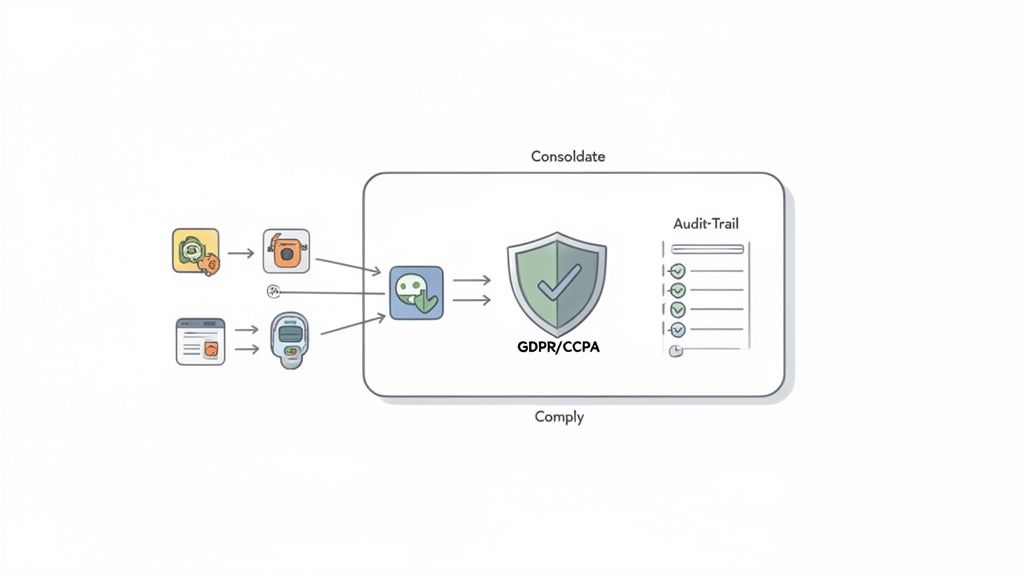
This EVP resonates deeply with enterprise and mid-market leaders because it speaks their language: ROI, risk reduction, and operational efficiency. For a global hiring team trying to standardize processes or a company like Greenhouse or Lever looking to eliminate redundant tools like Gem or SeekOut, the appeal is immediate and tangible.
Implementing this EVP involves a strategic shift toward a unified platform and workflow.
Boutique recruiting agencies and executive search firms operate on a razor-thin margin. Their core challenge is scaling output and profitability without ballooning headcount or sacrificing placement quality. This employee value proposition example is built for agency recruiters and sourcers, promising to directly impact their earning potential by boosting placement velocity and delivery margins.
Ready for a change?
The proposition shifts the focus from traditional, labor-intensive sourcing to a technology-first workflow. It eliminates the need for deep Boolean expertise, allowing junior sourcers to become productive faster and enabling senior recruiters to handle more requisitions simultaneously. By leveraging autonomous sourcing and multi-source data aggregation, agencies can place candidates twice as fast, improving per-recruiter revenue and making the firm more competitive. This transforms the job into a high-leverage, high-margin role focused on client management and closing.
This EVP resonates deeply because it ties directly to the financial incentives of both the agency and its employees. For boutique firms where commissions are a significant part of compensation, improving efficiency is not an abstract goal; it's a direct path to higher earnings. It's a powerful retention tool in a high-turnover industry.
To build this EVP, focus on tooling and workflows that create measurable efficiency gains and directly impact the bottom line.
For solo founders and early-stage teams, hiring the first 10-50 employees is a make-or-break challenge. They don't have dedicated recruiting teams, extensive budgets, or the time to learn complex hiring software. This employee value proposition example is built for them, promising a hiring process that is founder-friendly and low-friction.
The core idea is to democratize recruiting, shifting it from a specialized function to an accessible, intuitive task. Instead of requiring founders to become expert sourcers, this EVP offers tools that work like a consumer app: simple, direct, and affordable. It removes the barriers of high costs and steep learning curves, allowing a founder hiring their first engineer to operate with the same data-driven precision as a seasoned recruiter. It’s about making world-class talent acquisition a plug-and-play capability from day one.
This EVP resonates deeply with its target audience because it solves the fundamental constraints of an early-stage startup: limited time, money, and specialized expertise. Founders at Y Combinator or indie startups aren't just CEOs; they're also the first salesperson, marketer, and, crucially, the first recruiter.
You can build this low-friction EVP by focusing on accessibility and immediate utility in your hiring tools and messaging.
For talent acquisition teams with explicit DEI mandates, moving from aspirational goals to tangible results is a constant challenge. This employee value proposition example is built for recruiters tasked with building a more diverse workforce, offering them a clear path to impact. The core promise is simple: transform DEI from a performative checkbox into a data-driven, strategic function.
Here’s the deal.
This EVP shifts the focus from vague commitments to measurable action. Instead of just hoping for a diverse applicant pool, it equips recruiters with the tools to proactively source from underrepresented talent communities, benchmark their current team against real market supply, and generate transparent reports for leadership. It empowers them to become strategic advisors who can confidently say, "Here's our current diversity baseline, here's the available talent pool, and here's our specific plan to bridge that gap." This turns the recruiting role into an engine for meaningful organizational change.

This EVP resonates deeply because it provides a concrete solution to an often ambiguous and high-pressure corporate goal. A 2022 McKinsey report showed companies in the top quartile for gender diversity on executive teams were 25 percent more likely to have above-average profitability. For teams at Fortune 500 companies or venture-backed startups with founder diversity metrics, the pressure to deliver on DEI is immense. This approach offers a clear methodology, not just a mission statement.
You can operationalize this employee value proposition example by integrating DEI data directly into your sourcing workflow.
For talent acquisition teams at rapidly scaling companies like Ramp or Perplexity, the primary challenge is maintaining hiring velocity without seeing a proportional increase in recruiting headcount and costs. When you need to fill 50-200+ roles annually, often for recurring positions like sales or customer success, manual processes become an anchor on growth. This employee value proposition example is built for TA teams facing this exact scenario, promising scale through intelligent automation.
This EVP redefines the recruiter's role from a high-volume processor to a strategic operator. Instead of being buried in repetitive sourcing and outreach for the same role profile month after month, recruiters are given the tools to build autonomous hiring engines. The core promise is simple: automate the top-of-funnel work so you can focus on candidate engagement, closing, and strategic partnership with hiring managers. It's about preserving quality and speed as hiring demands multiply.
This EVP directly targets the operational nightmare of high-volume recruiting: the trade-off between speed, quality, and cost. For any Series B/C startup doubling its headcount, this is not a theoretical problem but a daily operational hurdle.
You can bring this EVP to life by building an automated, scalable recruiting infrastructure.
For mid-market companies and finance-conscious TA leaders, recruiting isn't just about finding talent; it's about doing so efficiently and predictably. When every dollar of the budget is scrutinized by the CFO, the appeal of expensive, all-in-one legacy platforms diminishes rapidly. This employee value proposition example is built for recruiting teams under pressure to demonstrate clear ROI, promising drastic cost savings and budget predictability.
This EVP shifts the conversation from features to financial impact. It directly confronts the bloated costs of tools like LinkedIn Recruiter by offering an alternative that delivers enterprise-grade sourcing power at a fraction of the price. The core message is simple: you can consolidate your tool stack, eliminate surprise fees, and achieve an ~80% cost reduction without sacrificing candidate quality or pipeline speed. It transforms the recruiting function from a cost center into a strategic, high-ROI business partner.
This EVP resonates powerfully because it speaks the language of the C-suite: numbers, efficiency, and return on investment. It's perfectly suited for organizations where the CFO has significant influence over departmental spending, such as a mid-market company looking to trim its $50k+ annual software spend.
You can build a cost-conscious EVP by focusing on quantifiable savings and transparent financial reporting.
For many talent acquisition teams, LinkedIn Recruiter has become an expensive, all-consuming default. This employee value proposition example targets recruiters experiencing platform fatigue, frustrated by vendor lock-in, diminishing returns, and a lack of candidate diversity. It reframes the recruiting role by promising freedom from a single source, emphasizing strategic independence and superior access to talent.
The core of this EVP is a shift from dependency to diversification. Instead of sinking ever-larger budgets into one platform, it empowers recruiters to source from the entire open web, tapping into candidate pools that competitors on LinkedIn will never see. This proposition transforms the recruiter's toolkit, replacing complex Boolean strings and escalating costs with natural language search and access to over 80% of talent undiscoverable on LinkedIn. It’s a move from being a platform operator to a true talent hunter.
This EVP resonates deeply with experienced TA teams who feel their hands are tied by a single, increasingly costly vendor. It directly confronts the pain points of stale talent pools and budget constraints, offering a powerful combination of financial and strategic advantages.
You can implement this EVP by demonstrating the superiority of a multi-source approach and tying it to business outcomes.
What are the 5 main components of an EVP?An EVP typically includes compensation, benefits, career development, work environment, and company culture.
How do you write a compelling employee value proposition?Start by surveying current high-performers, analyze competitor EVPs, and tailor your message to different candidate personas.
Why is a strong EVP important for recruiting?A strong EVP attracts better-fit candidates, reduces time-to-hire, and improves employee retention by setting clear expectations.
We've explored a diverse landscape of employee value proposition examples, from the autonomy-driven messaging of a fast-growing tech startup to the efficiency-focused promises of a boutique agency. The common thread is clear: a powerful EVP is not a generic slogan. It's a strategic system that attracts the right talent and repels the wrong fit.
You might think creating such a specific EVP will shrink your talent pool. But that fails to account for the noise in a broad-net approach. A vague message attracts lukewarm candidates, bloating your pipeline. A sharp, authentic EVP creates a concentrated pool of highly motivated individuals who are already bought into your mission.
The core benefit is turning your company into a talent magnet. This unlocks the ability to build a team of high-performers who are not just skilled, but deeply aligned with your mission, culture, and pace. It’s the engine that accelerates growth and solidifies your place in the market.
{{large_cta}}
Run your first search for free. Find and engage top talent across 800M+ profiles. Trusted by 5,000+ customers.
.png)


.png)